

SMS Automation
This guide explains how to create and configure SMS automation workflows in Sender so that SMS messages are sent automatically when subscribers meet specific trigger conditions.
Where to Find This Feature
In the Sender dashboard, go to: Automations (left sidebar)
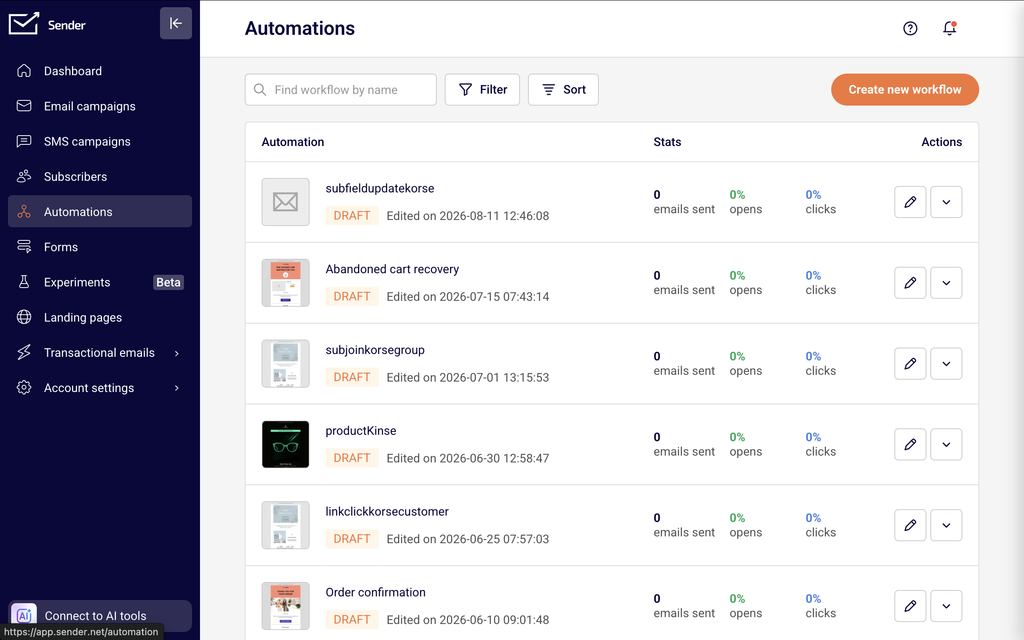
You will see the Automations list page displaying all existing workflows. Each workflow shows its name, status badge (Draft or Active), last edited date, and stats columns for emails sent, opens, and clicks. At the top of the page, use the Find workflow by name search bar to locate a specific workflow, or click Filter to show only Active or Draft workflows. Click Create new workflow in the top-right corner to start building a new automation.
Steps to Create an SMS Automation Workflow
Step 1 — Choose a Trigger
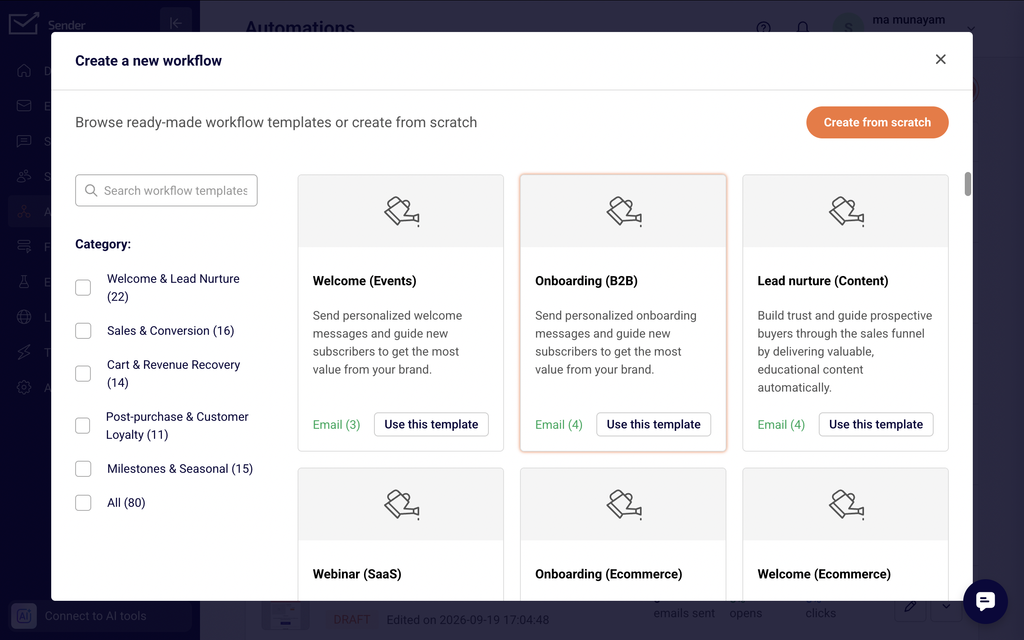
Click Create new workflow. You can select a prebuilt template by browsing the template gallery, or click Create from scratch to choose a trigger manually. Select the event that starts the workflow, such as Subscriber joins a group, A cart is abandoned, A date, or A product is purchased. Enter a name in the Name your workflow dialog and click Create.
The workflow builder opens with your selected trigger displayed on the canvas and the Trigger Setup panel on the right. Configure the trigger settings, such as selecting a subscriber group from the Select group dropdown, and optionally enable the Repeat workflow toggle to allow the automation to run again when the same subscriber reactivates the trigger. Click Save.
Step 2 — Add and Configure an SMS Step
Click the + icon below the trigger on the canvas to open the Add a new step menu. Select SMS. The SMS Setup panel opens on the right side.
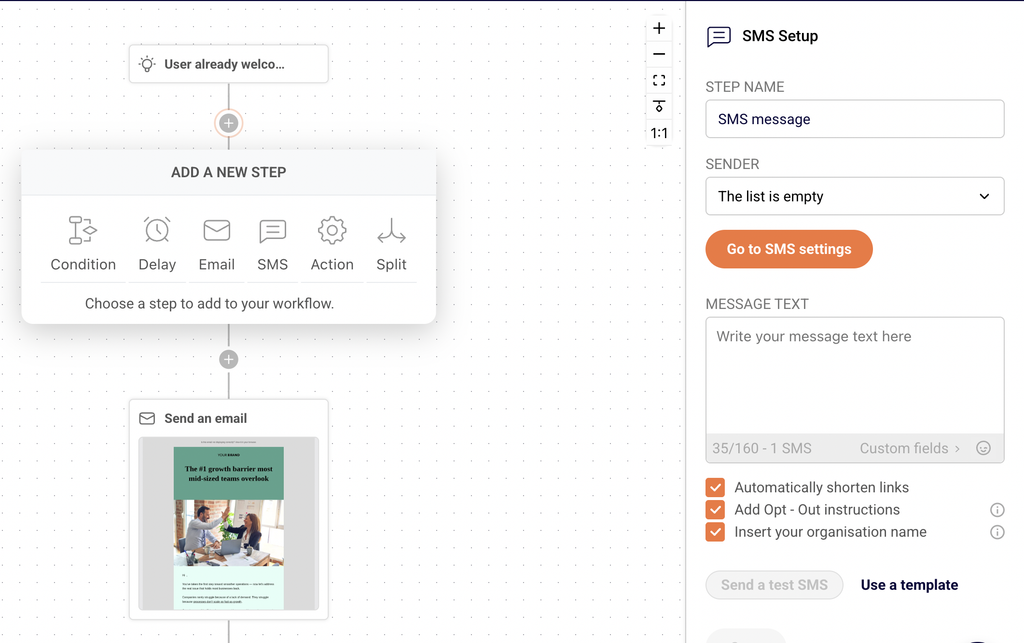
Enter a descriptive label in the Step name field, then choose a registered sender from the Sender dropdown. Type your message in the Message text field — the character counter below displays your usage in the format 35/160 - 1 SMS. Click Custom fields to insert personalization variables such as First name, Last name, Email, Phone number, or Birthday. The checkboxes below the message field let you enable Automatically shorten links, Add Opt – Out instructions, and Insert your organisation name. Click Send a test SMS to verify your message before activating, or click Use a template to load a prewritten message from the template library. Click Save to confirm the step.
Step 3 — Add Delays, Conditions, or Additional Steps
Click the + icon between or after any step on the canvas to insert additional steps. Select Delay to pause the workflow before the next action — in the Delay Setup panel, choose Time delay, Specific date & time, or Custom date field and set the duration using the Of field and the Select time period unit dropdown (options include Minutes, Hours, Days, Weeks, and Months).
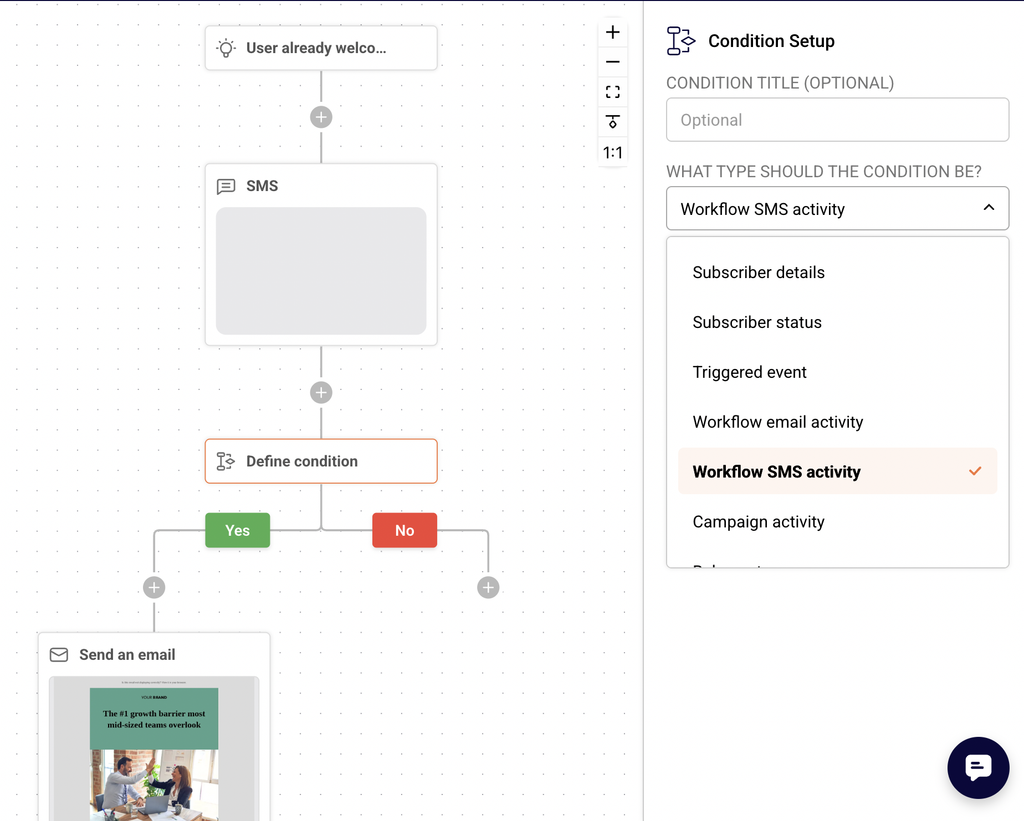
Select Condition to create a branching path with Yes and No outcomes based on criteria like Subscriber details, Workflow SMS activity, Group membership, or Segments. Select Action to perform subscriber management tasks such as Move subscriber to another group, Mark subscriber as unsubscribed, or Send webhook. You can also add a Split step to divide traffic between different paths. Add as many steps as your workflow requires.
Step 4 — Review and Activate the Workflow
Check the Completion indicator in the top-right corner of the builder, which shows how many steps are fully configured (for example, 4/4). Ensure every step displays a completed configuration — unconfigured steps show labels like Define delay or Define action and must be set up before activating. The Status badge next to the workflow name shows Draft until you activate. When all steps are configured, return to the Automations list, open the actions menu (dropdown arrow) next to your workflow, and click Activate. The workflow begins running automatically when subscribers meet the trigger condition.
Message Writing Guide
Character limits — A single SMS segment supports 160 characters using standard GSM-7 encoding. The character counter below the Message text field displays your current usage and segment count in real time (for example, 35/160 - 1 SMS). Keep messages concise to minimize credit usage.
Message segmentation — If your message exceeds 160 characters, it splits into multiple segments of 153 characters each because 7 characters per segment are reserved for concatenation headers. Each segment counts as one SMS credit, so longer messages cost more.
Personalization variables — Click Custom fields below the Message text field to insert subscriber data such as First name, Last name, Email, Phone number, or Birthday. Sender replaces these variables with the subscriber’s actual data when the SMS sends.
Opt-out text — Enable the Add Opt – Out instructions checkbox to automatically append opt-out language (such as “Reply STOP to optout”) to your message. This text counts toward your character limit, so factor it into your message length.
Unicode and special characters — Using emojis or non-GSM characters switches encoding to Unicode, which reduces the segment limit to 70 characters per segment (67 for concatenated messages). Avoid special characters when possible to keep credit costs low.
Organisation name — Enable the Insert your organisation name checkbox to prepend your business name to the message. This helps recipients identify the sender immediately.
Campaign Management Actions
Editing a draft workflow — From the Automations list, click the edit icon (pencil) next to a Draft workflow to open the builder. Modify any trigger, SMS step, delay, condition, or action, then click Save on each updated step.
Duplicating a workflow — Click the dropdown arrow next to any workflow and select Duplicate. A copy is created in Draft status with the same steps and configuration, ready to modify and activate independently.
Renaming a workflow — Click the dropdown arrow next to the workflow and select Rename. Enter the new name in the dialog and confirm. You can also click the pencil icon next to the workflow name inside the builder.
Activating a workflow — Click the dropdown arrow and select Activate to start the automation. The status changes from Draft to Active and the workflow begins processing subscribers who meet the trigger condition.
Deleting a workflow — Click the dropdown arrow and select Delete. This action removes the workflow permanently. Only delete workflows you no longer need.
Filtering workflows — Click Filter on the Automations list page and select All, Active, or Draft to narrow the list by workflow status.
Campaign Tips
Test before activating — Always click Send a test SMS in the SMS Setup panel to preview your message on a real device before activating the workflow. This confirms personalization variables resolve correctly and character counts are accurate.
Use delays strategically — Insert Delay steps between trigger events and SMS sends to control timing. For example, set a 5-minute delay after a subscriber joins a group before sending a welcome SMS.
Keep messages within one segment — Aim to keep SMS messages under 160 characters (including opt-out text and organisation name) to use a single credit per recipient and reduce costs.
Use conditions to target the right subscribers — Add a Condition step with criteria such as Group membership or Subscriber details before an SMS step to ensure only qualifying subscribers receive the message.
Name your steps clearly — Enter descriptive labels in the Step name field for every SMS, delay, and action step. This makes complex workflows easier to manage and troubleshoot later.
Common Issues
SMS step shows “The list is empty” for Sender → Your account has no registered sender IDs configured for SMS. Go to your SMS settings to add and verify a sender ID before configuring SMS automation steps.
Character counter shows more segments than expected → Special characters or emojis in your message triggered Unicode encoding, which reduces the per-segment limit to 70 characters. Remove non-GSM characters to return to the standard 160-character limit.
Completion indicator does not reach full count → One or more steps in the workflow are not fully configured. Look for steps labeled Define delay, Define action, or Define condition on the canvas, click them, complete their setup in the right panel, and click Save.
Workflow is not sending messages after activation → Verify the trigger condition is met by subscribers, confirm the Select group field is set in the Trigger Setup, and check that the SMS step has a valid sender and message text saved.
Custom fields insert blank values → The subscriber record is missing data for the selected field. Ensure subscribers have the relevant field populated (for example, First name) before they enter the workflow.
FAQs
What triggers can start an SMS automation workflow?
Sender offers multiple trigger types including A date, An anniversary of a date, Subscriber joins a group, Subscriber is removed from a group, A link is clicked, A cart is abandoned, A product is purchased, An order is fulfilled, Subscriber unsubscribed, Subscriber field updated, Subscriber status changed, and Custom event is triggered. Select the trigger that matches the event you want to automate.
What step types can I add to an SMS automation workflow?
The workflow builder supports six step types: Condition (branching logic with Yes/No paths), Delay (timed pause), Email (send an email), SMS (send a text message), Action (subscriber management such as moving groups or updating fields), and Split (divide traffic between paths).
How do I personalize an SMS message in a workflow?
In the SMS Setup panel, click Custom fields below the Message text field. A dialog appears with available fields such as First name, Last name, Email, Phone number, and Birthday. Click a field to insert it into your message. Sender replaces the variable with the subscriber’s actual data at send time.
Can I use SMS templates in automation workflows?
Yes. In the SMS Setup panel, click Use a template to open the SMS templates library. Browse categories such as Promotional, Holiday, Feedback, or Saved templates, and select a template to load it into the Message text field for further editing.
How are SMS credits charged in automations?
Each SMS segment sent by the automation counts as one credit. A message under 160 characters (GSM-7 encoding) uses one credit per recipient. Longer messages split into multiple segments, and each segment uses one credit. Unicode messages (with emojis or special characters) have a lower per-segment limit of 70 characters, which may result in more segments and higher credit usage.
Can I add conditions to send SMS only to certain subscribers?
Yes. Add a Condition step before the SMS step and select a condition type such as Subscriber details, Group membership, Workflow SMS activity, or Segments. The condition creates Yes and No branching paths, and you can place the SMS step on the appropriate path so only qualifying subscribers receive the message.
What is the Repeat workflow option?
The Repeat workflow toggle in the Trigger Setup panel allows the same subscriber to enter the workflow again if they reactivate the trigger condition. For example, if the trigger is A cart is abandoned, enabling repeat allows the workflow to run each time that subscriber abandons a cart.