


Email marketing delivers an average return of $36 for every $1 spent—a 3,600% ROI that outperforms most other marketing channels. Yet many businesses leave money on the table by sending emails at the wrong time.
Timing directly impacts revenue: 52%* of consumers have made a purchase from an email, and automated emails drive 37%* of all email-generated sales despite accounting for only 2% of volume. This guide breaks down the best send time by email type, day, industry, and audience—backed by 2024–2025 data. The answer to when to send emails depends on your specific audience and goals.
This article is part of our Email marketing guide.
Best Time to Send Marketing Emails
Let’s admit—everyone’s email inbox is packed with stuff they don’t read. On average, two-thirds of people have unread emails in their inbox—1602* of them.
How do you plan your campaigns in a world where emails are ignored? A logical assumption is that emails at the top of your subscribers’ inboxes will likely be viewed and opened. So, you need to time them well and develop a solid email scheduling strategy. Here are a few insights:
- Your send time by industry should depend on the specific sector you’re operating in.
- Tuesday through Thursday* tend to be the strongest days to send emails for both B2C and B2B companies, with Wednesday and Thursday often performing particularly well—making them the best day to send emails for most businesses.
- Weekend performance varies*—don’t automatically rule out Saturdays or Sundays, especially for newsletters and promotional content.
- Test different send times and let your data decide when your audience is most active through email automation tools.
Important note on open rates: Due to privacy changes (like Apple’s Mail Privacy Protection) and automated ‘machine opens,’ email open rate as a metric has become less reliable on its own. Track click-through rate and conversion rate alongside opens for a more accurate picture of performance — see our breakdown of email marketing metrics and KPIs for the full picture.
Launch email campaigns with ease with Sender. Use features like drag-and-drop builder, automation, segmentation and more—completely free.
Best Time to Send Email Blast by Day of the Week
When is the best time of day for emails based on the day of the week?
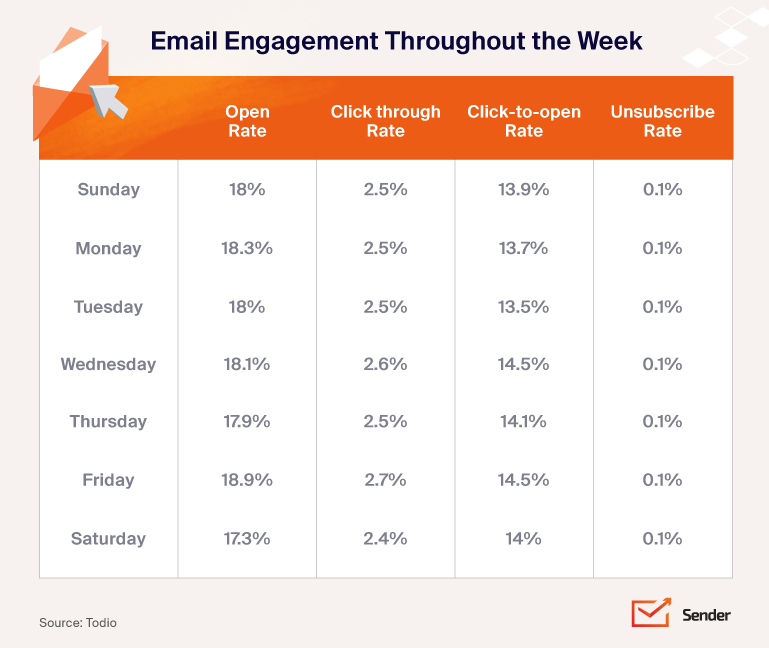
Research* consistently shows that weekdays outperform weekends for most email types, though weekend sends can work well for certain audiences and content types. Here is a breakdown of the best time to send email marketing campaigns based on recent data:
According to aggregated 2024–2025 data, the strongest days tend to be:
- Friday*: Friday often registers strong open, click-to-open, and click-through rates.
- Wednesday and Thursday*: These mid-week days consistently perform well across industries.
- Tuesday*: A reliable choice, particularly for B2B audiences.
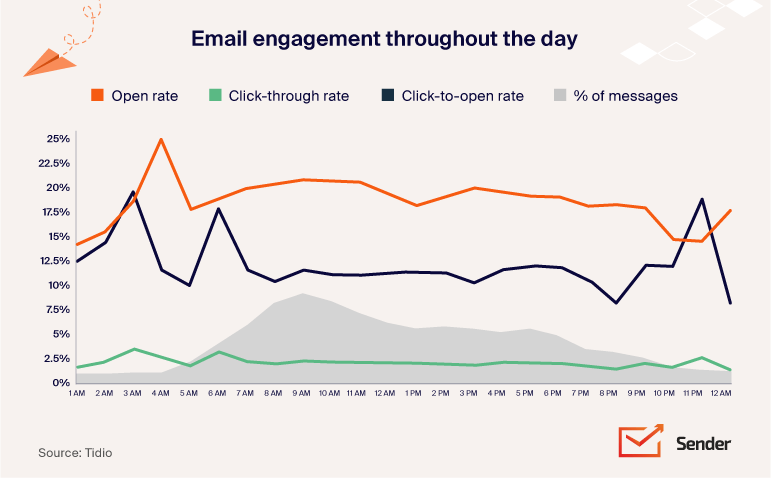
Let’s look at when you should send an email each day of the week. Generally, the optimal email send time falls between 9 a.m. and 3 p.m. local time, with mid-afternoon (3–7 p.m.)* also showing strong performance in recent studies.
- On Friday: Friday sees strong engagement rates, making it one of the best days for email marketers. The optimal window is typically mid-morning to early afternoon (9 a.m.–2 p.m.), though performance varies by audience.
- On Thursday: Thursday is a strong opportunity for marketers with engagement rates close to Friday’s. The best time to send is during business hours, particularly between 10 a.m. and 2 p.m. for most audiences.
- On Wednesday: Wednesday registers strong click-to-open rates. The optimal window is mid-morning through early afternoon (9 a.m.–3 p.m.) for most subscriber bases.
- On Tuesday: Tuesday is good for achieving solid open rates. The best time to send emails on Tuesday is between 9 a.m. and 11 a.m., or early afternoon around 1–3 p.m.
- On Monday: Monday comes close to Friday regarding open rates, though click-to-open rates can be lower as subscribers catch up from the weekend. Schedule emails for mid-morning (around 10–11 a.m.) when people have settled into their workday.
- On Saturday: Saturday can score well on click-to-open rates but typically has lower open rates than weekdays. Consider it for specific campaigns targeting audiences who engage on weekends—test before committing.
- On Sunday: Sunday can perform better than Saturday for certain audiences, particularly for newsletters and leisure content. Late morning or early afternoon tends to work best.
Why Does Email Timing Matter?
Sending an email at the right timing can potentially improve your email campaign success rates. Timing the messaging well helps you stay relevant, be seen more often, and achieve better email engagement with your subscribers. Here are some of the reasons why email send time optimization matters:
- Improved open rates. Knowing when your subscribers are most active and timing your campaigns around that peak email engagement time helps improve the odds of your email being opened during peak engagement windows.
- Maximized click-through rates. When your audience’s engagement rate peaks, they’re most likely to click on links within your email. So, timing based on user activity matters a lot to increase engagement and click-through rates.
- Heightened competitive standing. Your audience will appreciate your thoughtfulness when they receive the right email at the right time. This will give you a competitive edge and increase your value in their life, which will help defeat competing for their attention with other brands.
- Increased target audience reach. Your target audience will appreciate you for sending an email when they want to read more about you. Plus, it increases the chances of referrals, increasing your reach and improving your email open rate.
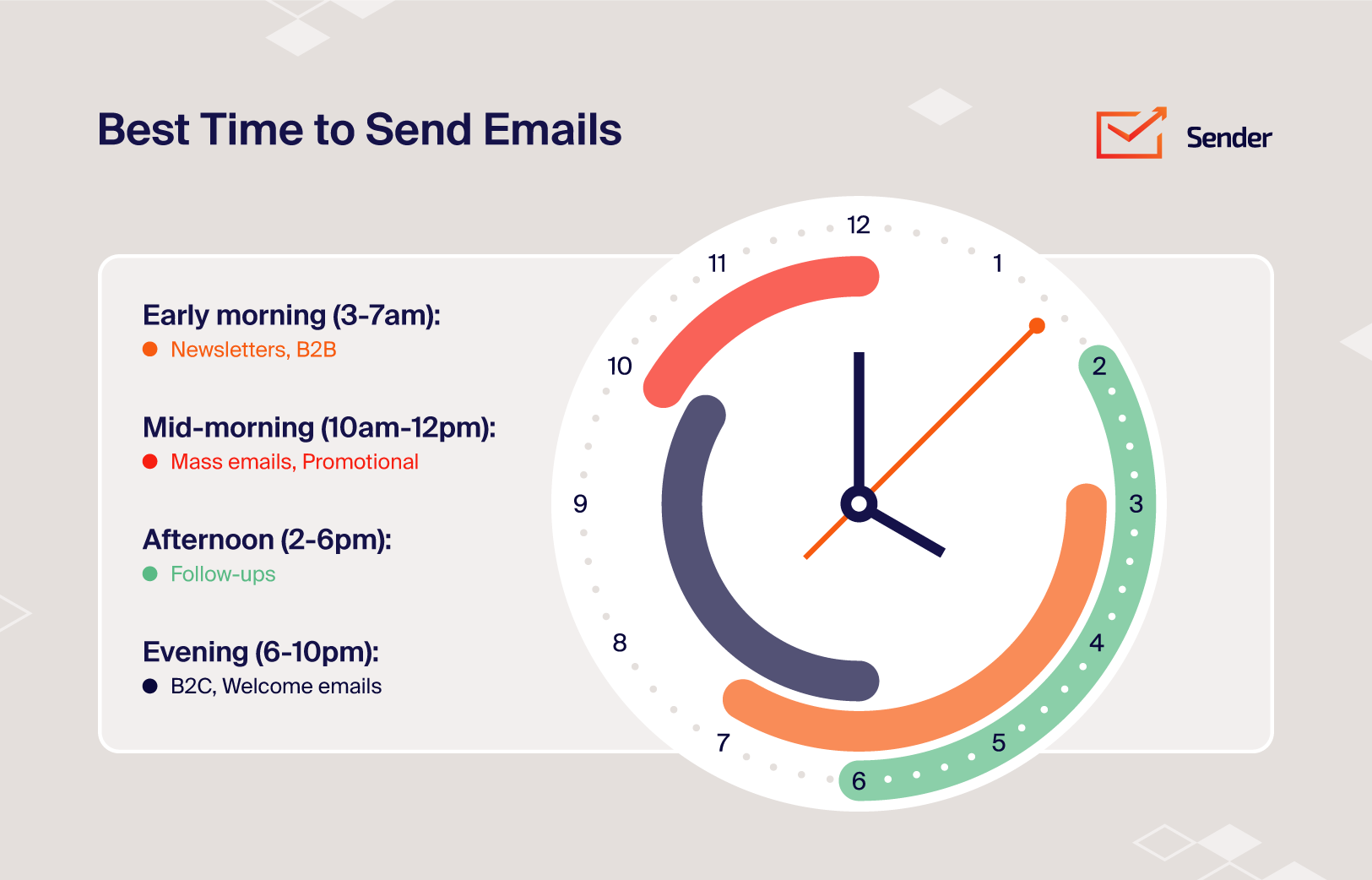
Best Time to Send Email Newsletter by Type
Each type of email comes with characteristics that dictate the right time you can send it. For example, you’ll want to send an invitation email a few weeks before the event, a survey email when you want feedback, and an abandoned cart email a few hours after.
The type of email commands the optimal time decision in email marketing. Here is a breakdown of the best time to send sales emails and newsletters according to the type:
Newsletters Emails
For most subscribers, the best time to send newsletter content is during mid-morning to early afternoon (9–11 a.m. or 1–3 p.m. local time)* when people have time to read longer content. Avoid sending during very early morning hours unless your data specifically supports it.
Tuesday, Wednesday, and Friday* tend to perform well for newsletters. However, you might not see immediate opens until days later—many subscribers save newsletters to read when convenient.
The sweet spot for newsletters is typically between 9–11 a.m. or early afternoon. For maximum impact, test your specific audience and track engagement over time.
Key Takeaways:
- Best days: Tuesday, Wednesday, Friday;
- Best time: 9–11 a.m. or 1–3 p.m. local time.
Mass Emails
Unlike carefully crafted newsletters, mass email blasts are more sporadic. Track your audience’s online behavior and segment lists based on activity patterns to determine the best send time for your specific audience.
For general guidance, the ideal time to send mass email campaigns falls between 10 a.m. and 4 p.m.* during business hours when people take breaks and check inboxes. Friday is also a viable option, particularly for promotional and ecommerce content. When scheduling emails in bulk, consistency matters.
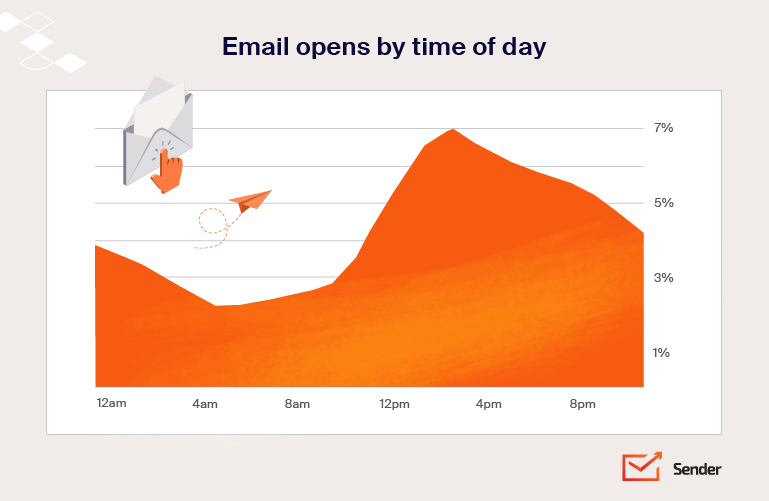
You can still send promotional content or event announcements outside these hours if you know your audience’s habits. Use A/B testing and consider implementing auto resend features to better understand customer behavior patterns across all email types.
Key Takeaways:
- Best days: Tuesday through Friday;
- Best time: 10 a.m.–4 p.m., including early afternoon (1–4 p.m.).
Promotional Emails
Brands generally send promotional emails as and when they please. But there are better strategies than that, especially when you want to improve your email marketing KPIs. Scheduling emails for promotional content at the right time helps increase CTR (click-through rates) like any other email campaign.
Since promotional emails are unsolicited, you should make them instinctive (and spontaneous) for the recipients to open and read. So, scheduling them when subscribers are on their devices is best, or you risk getting lost in a crowded inbox. Proper timing combined with email subject line best practices maximizes your chances of engagement — a good subject line can boost engagement significantly.
The best time to send promotional emails is typically mid-morning to early afternoon, around 10 a.m.–2 p.m. local time*. This also applies to holiday promotions, though you may want to test earlier sends during peak shopping seasons. Remember, always research your audience and use the following tips to get the best results:
- Test multiple time slots to find the best hour to send emails for your audience.
- Analyze click-through rate and conversion data (not just opens) to find the best times using analytics tools.
- Adjust sending times for holidays and relevant events.
- Personalize content, offers, and subject lines for higher engagement and consider implementing smart sending features.
Key Takeaways:
- Best time: 10 a.m.–2 p.m. local time;
- Best days: Tuesday through Friday.
Transactional Emails
Transactional emails include order confirmations and other post-interaction messages. While the instinct is to deliver emails immediately after a transaction, timing strategy can improve engagement and avoid overwhelming customers.
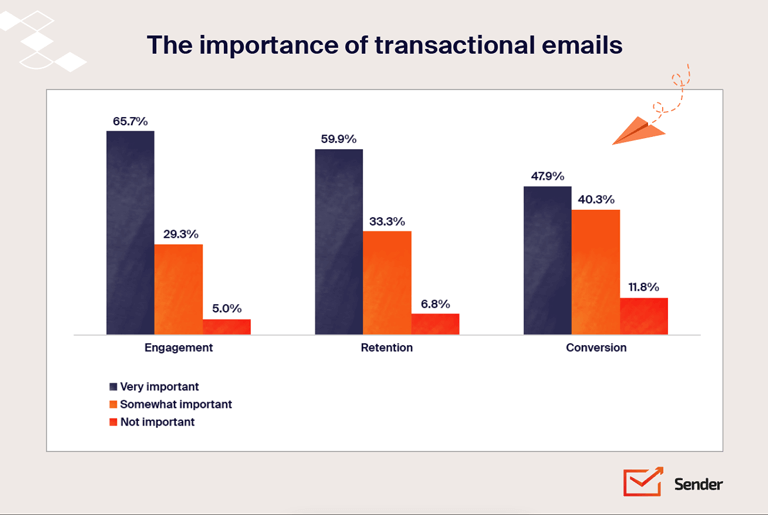
Send confirmation and password reset emails immediately after the transaction occurs. However, abandoned cart emails can be optimized based on these guidelines:
- Send the first reminder within a few hours as a gentle nudge;
- Send the second email 24 hours later, giving customers time to reconsider;
- Send the final email one week later with a discount incentive.
This approach addresses trust issues, high shipping costs, or technical problems that may have prevented the initial purchase without appearing pushy. Many marketing services now offer automated sequences for this type of timing strategy.
Key Takeaways:
- Best day: Same day as the transaction;
- Best time: Immediately for confirmations; within a few hours for abandoned cart reminders.
Welcome Emails
Welcome emails achieve some of the highest open rates, jumping from the typical 15-25% to around 50%*. Follow this 3-step welcome sequence:
- Send the first welcome email immediately after signup while your brand is fresh in their mind.
- Send a second email based on whether they’ve made a purchase—continue the welcome series or switch to transactional emails.
- Send the final welcome email two days after the original, ensuring they receive your intended message and convert.
For complex offerings like tech startups or payment processors, you may need more than three emails to convey your message effectively. Adjust the sequence length based on your business complexity.
Key Takeaways:
- Best day: Same day as subscription;
- Best time: Immediately after subscribing, then follow the sequence.
Email Follow-ups
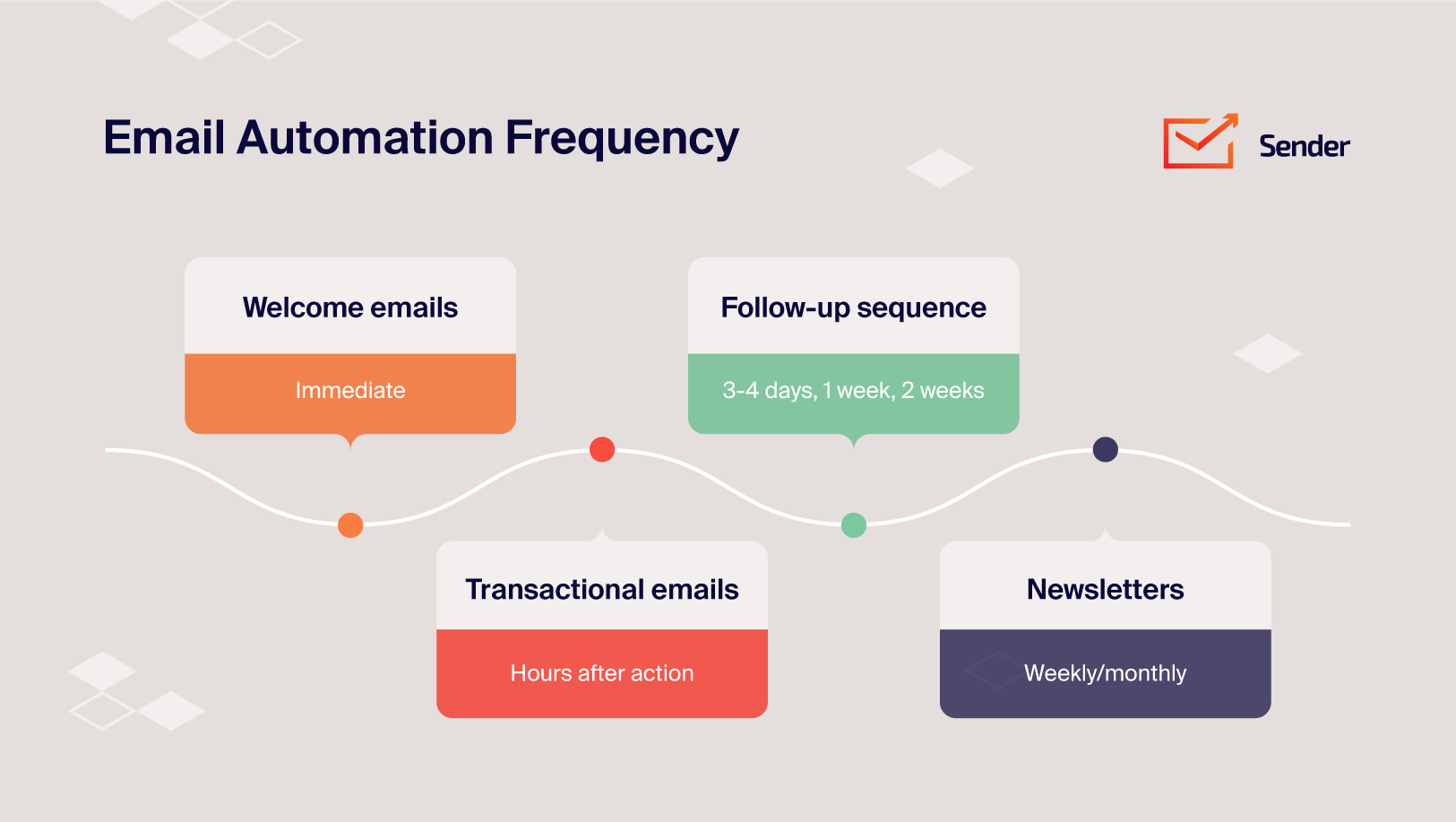
Follow-up emails are highly time-sensitive and can yield excellent results when executed properly, especially for new businesses. Understanding email habits by different groups shows that surprisingly, not many companies follow up with potential customers, representing a massive missed opportunity.
Key timing strategies for the best time to send email for response rate:
- If customers contact you first, respond promptly.
- If you’re initiating contact and haven’t received a response, wait 3-4 days before following up.
- Tuesday, Wednesday, and Thursday around 10 a.m. tend to work best when people are most productive.
- Saturdays at 10 a.m. and Sundays at 8 p.m. can work for entrepreneur clients who plan ahead.
According to industry statistics, most emails are forgotten after the first 24 hours. So, you should have a follow-up sequence. There is a 21%* chance of receiving a response to follow-up emails when the initial email goes unnoticed. Good email deliverability is essential here—if your follow-ups land in spam, you’ll never get that response.
Pro Tip: Automation that handles scheduling for you can determine when to send follow-ups and other emails when unsure about your customers’ behavior.
Key Takeaways:
- Best days: 3-4 days after user action;
- Best time: Around 10 a.m..
Cold Emails
Recipients are likelier to click cold emails when they appear on top of their inboxes. So, the best time to send cold emails is early in the morning, between 6 a.m. and 9 a.m.*, so they’re seen at the start of business hours.
As recipients settle down to open their work emails, they’re more likely to open and respond to your messages.
Key Takeaways:
- Best days: Business days (Tuesday–Thursday preferred);
- Best time: 6–9 a.m. local time.
B2B Email
B2B emails contain sales enablement or marketing material for business professionals, enterprises, and companies from other businesses.
Tuesday, Wednesday, or Thursday are typically the strongest days to send B2B emails. The optimal window is between 9 a.m. and 4 p.m.*, when professionals are actively working. Consider the recipient’s role and typical device usage when scheduling—executives may check email early, while operational staff engage more mid-morning. This timing makes sense given typical business hours.
Keep in mind that recipients are often located in multiple time zones. Use time-zone-based sending when possible, or stick to general optimal times for the most effective campaigns. Maintaining a strong sender reputation is critical for B2B emails to reach decision-makers’ inboxes.
Revenue per recipient: Revenue per email for B2C marketing generates $25–$45 per subscriber annually on average.
Key Takeaways:
- Best days: Tuesday, Wednesday, Thursday;
- Best time: 9 a.m.–4 p.m. local time;
- Annual revenue per subscriber: $45–$65.
B2C Email
B2C emails are targeted directly at the end consumers to create awareness, increase sales revenue, or promote your products. While such emails are an essential part of an ecommerce email strategy, there’s a common misconception that you can send a marketing email anytime. This approach often fails for offline retail businesses transitioning to digital marketing.
In reality, the best time to send B2C emails should align with when your audience is most active. According to recent research*, the B2C target audience often engages well during late afternoon and early evening hours (post-work, around 5–8 p.m.), as well as mid-morning windows. Many consumers check email during their leisure time after work.
A good way to find the optimal send time for your B2C campaigns is to test at different times. Analyze when you get the best engagement and clicks, and plan campaigns accordingly. Additionally, here are some tips for timing your B2C campaigns:
- Test different days of the week for variations in engagement rates.
- Segment your audience based on time zones for optimal delivery.
- Use marketing automation tools for scheduling and personalizing emails.
- Consider the nature of your business and subscriber interests when deciding send times.
Revenue per recipient: B2C email marketing generates $25–$45 per subscriber annually on average.
Key Takeaways:
- Best days: Tuesday through Friday (test weekends for promotions);
- Best time: Mid-morning (9–11 a.m.) or late afternoon/early evening (5–8 p.m.);
- Annual revenue per subscriber: $25–$45 (standard); automated flows generate 30x more per recipient.
Strategic Timing by Email Purpose
Different email purposes call for different timing strategies. Understanding the psychology behind when your audience is most receptive to specific content types can significantly improve engagement.
Educational Content Emails
Educational emails—such as tutorials, how-to guides, industry insights, and thought leadership content—require more cognitive effort from recipients. These emails perform best* when sent during times when readers can focus and absorb information.
Optimal timing:
- Mid-morning (9–11 a.m.): Recipients have cleared their initial inbox rush and are in a focused work mindset.
- Early afternoon (1–2 p.m.): Post-lunch, when people often allocate time for learning and professional development.
- Best days: Tuesday through Thursday, when professional engagement peaks.
Avoid sending educational content late in the day or on Fridays, when mental energy is lower and readers are less likely to engage deeply.
Actionable Request Emails
Emails that require action—such as surveys, feedback requests, registration forms, or calls for sign-ups—need recipients who are ready to complete tasks. Timing these emails correctly* can dramatically improve response rates.
Optimal timing:
- Mid-morning (10–11 a.m.): People are settled into work and have momentum for completing tasks.
- Early afternoon (2–3 p.m.): A secondary peak when people tackle to-do lists before end of day.
- Best days: Tuesday, Wednesday, and Thursday offer the highest completion rates.
Keep subject lines clear about the action required and the time commitment (“2-minute survey” performs better than vague asks).
Leisure and Entertainment Content
Content designed for entertainment—such as lifestyle newsletters, humor, creative content, or hobby-related emails—can follow different rules* since recipients engage with these during downtime.
Optimal timing:
- Early evening (6–8 p.m.): After work hours when people unwind and check personal email.
- Weekend mornings (9–11 a.m.): Relaxed browsing time, particularly for lifestyle content.
- Late evening (8–10 p.m.): For mobile-heavy audiences who scroll before bed.
B2C and lifestyle brands often see stronger weekend performance for this content type compared to traditional B2B timing.
The Psychology Behind Email Timing
Understanding why certain times work helps you make smarter decisions for your specific audience:
- Morning mindset (6–9 a.m.): People in “planning mode” are receptive to information that helps organize their day. Newsletters and informational content can work here, but complex asks may get deferred.
- Mid-morning focus (9 a.m.–12 p.m.): Peak productivity hours. Recipients are more likely to engage deeply, click through, and complete actions. This is ideal for most business and educational content.
- Post-lunch lull (12–2 p.m.): Engagement dips as people decompress. Light content or easily digestible emails work better than heavy asks.
- Afternoon push (2–5 p.m.): A secondary productivity window. Good for action-oriented emails and time-sensitive promotions.
- Evening unwind (6–9 p.m.): Personal time dominates. B2C, entertainment, and lifestyle content thrive here. Avoid heavy B2B content.Late night (9 p.m.+): Mobile browsing peaks for some demographics, but engagement depth (clicks, conversions) often drops. Test carefully.
Breakdown of Email Benchmarks by Different Industries
Email performance varies significantly across industries, with factors like audience expectations, purchasing cycles, and engagement patterns affecting open rates and click-through rates. Understanding these industry-specific benchmarks helps set realistic expectations and optimize your email strategy accordingly.
For example, nonprofit organizations typically see higher open rates (25-30%) due to subscriber commitment, while retail and e-commerce average around 18-22%. B2B industries like software and technology often experience lower open rates (15-20%) but higher click-through rates due to targeted, relevant content.
Healthcare, education, and government sectors tend to have higher engagement rates, while highly competitive industries like travel and hospitality face more inbox competition, resulting in lower benchmarks. Consider creating a custom report to track your industry-specific performance metrics.
Industry-Specific Timing Recommendations
Ecommerce and Retail:
- Best days: Thursday and Friday (pre-weekend shopping mindset);
- Best times: 10 a.m.–12 p.m. and 7–9 p.m.;
- Key insight: Promotional emails perform well on weekends for impulse purchases.
B2B / SaaS:
- Best days: Tuesday, Wednesday, Thursday;
- Best times: 9–11 a.m. and 2–4 p.m.;
- Key insight: Decision-makers often check email early; operational staff mid-morning.
Media and Publishing:
- Best days: Tuesday through Friday;
- Best times: 9–10 a.m. (with morning news consumption) or 6–8 p.m. (evening reading);
- Key insight: Newsletters benefit from consistent scheduling so readers anticipate them.
Healthcare and Wellness:
- Best days: Monday through Wednesday;
- Best times: Early morning (7–8 a.m.) or lunch hour (12–1 p.m.);
- Key insight: Higher engagement rates overall; focus on trust-building content.
Nonprofit:
- Best days: Tuesday and Thursday;
- Best times: 10 a.m.–12 p.m.;
- Key insight: Donation asks perform better mid-week; storytelling content works on weekends.
Here’s a breakdown of average email benchmarks by different industries:
| Industry | Average Open Rate | Average Click Rate | Revenue per recipient |
| Food | 18.68% | 1.05% | $0.16 |
| DIY & Construction | 15.74% | 2.51% | – |
| Computers & Electronics | 13.79% | 1.42% | – |
| Media & Publishing | 12.04% | 1.42% | – |
| Groceries | 10.52% | 1.05% | $0.16 |
| Fashion | 8.23% | 1.05% | $0.09 |
| Pharmacies | 6.13% | 0.54% | $0.10 |
Note: Open rates should be interpreted cautiously due to privacy changes affecting tracking accuracy. Click rates and conversions provide more reliable engagement signals.
Age and Gender of Your Audience
Different email habits by age group can significantly affect optimal send times.
- Younger audiences (18-34): Prefer evening hours between 6-10 p.m. and show higher weekend engagement rates. They primarily use mobile devices for email consumption and often check email throughout the day in short bursts.
- Older audiences (45+): Prefer traditional business hours with peak activity between 10 a.m. and 2 p.m. on weekdays. They favor desktop devices and detailed content over quick promotional messages.
- Gender differences also matter: Women tend to engage more during lunch hours (12-1 p.m.) and late evening (8-10 p.m.), while men show higher engagement in early morning (6-9 a.m.) and mid-afternoon (2-4 p.m.). Segment your email lists by demographic data to optimize send times for each group’s preferences.
What Device Your Subscribers Use
Device usage patterns dramatically affect email engagement and optimal send times. Mobile users represent over 60%* of email opens and behave differently than desktop users in terms of interaction timing.
- Mobile users: Check emails throughout the day, showing higher engagement during commutes and evening downtime. They prefer emails sent between 6-9 a.m. (morning commute) and 6-10 p.m. (evening relaxation). Mobile-first audiences may engage late at night as well, but conversion rates often drop.
- Desktop users: Typically engage during business hours (9 a.m.-5 p.m.) and are more likely to complete longer actions like purchases or form fills. They prefer detailed content and rarely engage outside business hours.
- Tablet users: Fall between mobile and desktop behaviors, with peak engagement during evening hours (7-10 p.m.) and weekend mornings. For best results, optimize for mobile-first experiences and consider device-specific timing strategies.
Time Zones of Your Email Subscribers
Managing time zones* is crucial for global email campaigns, as wrong local timing can significantly impact engagement rates. A well-timed email for East Coast subscribers might arrive at 3 a.m. for West Coast recipients.
Key strategies include:
- Segment by region: Create email segments based on subscriber time zones and schedule sends for optimal local times.
- Use time-zone sending features: Most modern email platforms offer automatic delivery based on recipient time zones—use this feature whenever possible.
- Apply send-time optimization (STO): Many ESPs can automatically deliver emails based on individual engagement patterns.
For unsegmented lists, choose compromise times that work across main time zones. For US audiences, late morning around 10-11 a.m. EST often provides decent engagement nationwide.
Internationally, Tuesday through Thursday typically perform well universally, while weekends show cultural variations. Test different approaches and analyze engagement data by geographic region to refine your time optimization strategy and maximize performance across all time zones.
How to Find YOUR Best Sending Time
While industry benchmarks provide useful starting points, your specific audience may behave differently. Here’s how to discover the optimal send times for your unique subscriber base.
Start With Your Baseline
Before running tests, establish your current performance:
- Review historical data: Analyze 3–6 months of campaigns to identify patterns in opens, clicks, and conversions by day and time.
- Segment your analysis: Break down performance by audience segment and email type—promotional emails and newsletters often have different optimal times.
- Document current send times: Record when you’ve been sending so you can measure improvements against a clear baseline. For Sender users, our walkthrough on scheduling campaigns in Sender covers timezone settings and recurring schedule logic.
- Identify outliers: Note campaigns that performed unusually well or poorly and what time they were sent.
Run Simple A/B Tests
A/B testing in email marketing is the most reliable way to discover your best send times. The deeper guide covers how to design tests that actually produce conclusions:
- Test one variable: Change only the send time while keeping subject line, content, and audience identical.
- Start broad: Test morning vs. afternoon before fine-tuning to specific hours.
- Use sufficient sample sizes: Each test group needs at least 1,000 recipients for statistically significant results.
- Confirm patterns: Run the same comparison across 3–5 campaigns before drawing conclusions.
Use Send Time Optimization (STO)
Send-time optimization automatically determines the best send time for each individual subscriber:
- How it works: The platform analyzes each subscriber’s historical engagement patterns and delivers emails at their predicted optimal time.
- Performance boost: STO often improves open and click rates by 10–25% compared to batch sending.
- Popular platforms: Klaviyo, Mailchimp, HubSpot, and Brevo all offer STO features.
- When to use it: Use STO for broad campaigns; use manual timing for time-sensitive announcements where everyone needs the email simultaneously.
Monitor and Adjust
Optimization is ongoing, not a one-time task:
- Review regularly: Check email metrics weekly or monthly and look for shifts in engagement patterns.
- Seasonal adjustments: Audience habits change with seasons, holidays, or industry cycles—re-test during major transitions.
- Refine segments: As you learn more about your audience, create finer segments with tailored send times.
- Avoid over-optimizing: Small timing differences (9:00 vs. 9:15 a.m.) rarely produce meaningful results—focus on broader patterns first.
Best Time to Send Emails FAQs
When should you send a cold email?
Recipients are likelier to click cold emails when they appear on top of their inboxes. So, send them out early in the morning, between 6 a.m. and 9 a.m. local time, so they’ll be seen during business hours. As recipients settle down to open their work emails, they’re more likely to open and respond. Tuesday through Thursday tend to be the strongest days.
What is the best time to send email to get a response?
You should send an email when engagement rates are highest if you’ve planned a campaign to get a response from your customers. According to recent data, mid-morning on Tuesday, Wednesday, or Thursday (around 10 a.m. local time) tends to produce strong response rates. However, always test with your specific audience, as behavior varies.
When is the optimal time to send an abandoned cart email?
There is no specific day or time to contact your customers when sending abandoned cart emails. Regardless of the day, send your first abandoned cart email within 60 minutes of the customer abandoning the cart. That ensures the recipient can respond before moving on to other tasks. Look for the section about transactional emails above to learn a proven abandoned cart email sequence.
Should I use send-time optimization (STO)?
Yes, for most campaigns. STO features in modern email platforms analyze individual subscriber behavior and deliver emails at predicted optimal times for each recipient. This typically improves engagement by 10-25% compared to sending to everyone simultaneously. Use manual timing only for time-sensitive announcements where everyone needs to receive the message within a specific window.
How do I handle subscribers in different time zones?
Segment your email list by geographic region and schedule sends based on local optimal times. Most email platforms offer automatic time-zone-based delivery. For unsegmented lists, late morning EST (10-11 a.m.) often works as a reasonable compromise for US audiences. For global lists, consider using STO or creating region-specific campaigns.
Timing is one lever — and it’s downstream of the rest of the program. For email marketing fundamentals beyond timing (list health, content strategy, segmentation, deliverability), see our master guide.
Sources:
- https://optinmonster.com/email-marketing-statistics/
- https://www.inboxally.com/blog/the-most-important-email-marketing-statistics
- https://wixx.com/2021/09/24/the-average-person-has-1602-unread-emails-story/
- https://www.brevo.com/blog/best-time-to-send-email/
- https://www.omnisend.com/blog/best-time-to-send-email/
- https://www.mailerlite.com/blog/compare-your-email-performance-metrics-industry-benchmarks
- https://mailchimp.com/resources/insights-from-mailchimps-send-time-optimization-system/
- https://blog.hubspot.com/marketing/best-time-to-send-email
- https://www.mailerlite.com/blog/best-time-to-send-email
- https://www.twilio.com/en-us/blog/insights/the-best-time-to-send-your-email-campaign
- https://www.inboxally.com/blog/the-most-important-email-marketing-statistics
- https://www.yesware.com/blog/sales-email-frequency-guide-pays-follow
- https://www.salesforce.com/marketing/email/best-time-to-send-emails/
- https://mailshake.com/masterclass/follow-up-email/
- https://www.echelonmedia.co.uk/best-day-and-time-to-send-marketing-emails/
- https://altcraft.com/blog/how-to-choose-the-best-time-for-sending-emails
- https://www.uplead.com/follow-up-email/
- https://www.emailmonday.com/mobile-email-usage-statistics/
- https://mailchimp.com/resources/insights-from-mailchimps-send-time-optimization-system/