


Choosing the right tool for creating email templates can make a significant difference in both efficiency and design quality. This page highlights the best email template builders in 2026, including free options, to help you find the most suitable platform for your needs.
Whether you’re a marketer, business owner, or designer, these tools offer a variety of features to streamline your email creation process, making it easier to craft professional-looking emails without coding knowledge.
Capterra, G2, Trustpilot, and Reddit to create an objective evaluation. Learn more about our review methodology
Why You Should Use an Email Template Builder
An email template builder is a powerful tool that simplifies email design and streamlines the creation process. By using a template editing software, you can create professional-looking emails quickly, even without a background in design or coding.
Key Benefits:
- Easy to use: Email template editing software designed with simplicity in mind. With drag-and-drop functionality, you can easily add text, images, buttons, and more to your emails. No coding is required, making it accessible for anyone, even those with little design experience;
- Time-saving: Instead of starting from scratch each time, you can create reusable templates tailored to your brand. This allows you to speed up the email creation process, reducing the time spent on each campaign;
- Mobile-friendly: Many email template builders ensure that your emails are automatically optimized for mobile devices. Given that a significant portion of users read emails on their phones, this ensures your message looks great on all screen sizes and improves overall engagement;
- Customizable: You have the flexibility to tailor templates to your brand’s style. Adjust fonts, colors, and layouts to create consistent, on-brand email designs without relying on a graphic designer;
- Increased productivity: With a template builder, you spend less time designing and more time focusing on the content and strategy of your emails. Pre-made templates and simple customization options allow you to work more efficiently while maintaining quality.
An email template builder streamlines your process, boosts productivity, and ensures visually appealing emails. It’s a valuable tool for anyone looking to enhance their email marketing efforts, whether you’re a beginner or a seasoned pro.
How We Evaluated These Email Template Builders
- Ease of Use. We assessed the user interface and design capabilities of various email template builders, comparing drag-and-drop functionality to HTML-based options. The goal was to evaluate how intuitive and accessible each platform is for users with varying technical expertise;
- Template Library Size and Variety. We compared the size and diversity of template libraries across platforms, considering both pre-designed and customizable options. The evaluation focused on how well each platform caters to different industries and use cases, from basic newsletters to advanced, highly personalized email campaigns;
- Export Options & Integration Compatibility. We reviewed the export capabilities of each builder, examining whether templates can be easily exported to various email marketing platforms or CRM systems. Integration with popular third-party tools and services, such as marketing automation software, was also assessed to ensure seamless workflows and easy deployment across different environments;
- Pricing Transparency. We analyzed pricing models across different email template builders, focusing on clarity and fairness in the cost structure. This included evaluating tiered pricing plans, any additional charges for premium templates or advanced features, and how well the email template software pricing aligns with the value provided;
- Personalization and Dynamic Content Options. We evaluated each email campaign builder’s ability to support personalization features, such as dynamic content blocks, advanced targeting, and variable data insertion. The analysis focused on how well these tools allow users to create personalized emails that engage recipients based on their behavior, preferences, and profile data.
This comprehensive evaluation helps users determine which email template builder aligns best with their operational needs, design flexibility, and budget, ensuring they can create effective, on-brand email campaigns with ease and efficiency.
Email Template Builders: Comparison Table
Before I dive deep into each email template builder, let’s compare them quickly first:
| Platform | Best For | Pricing | Key Feature | Free Plan Available |
| Sender | Beginners, SMEs | From $7/mo | Advanced blocks + analytics | ✅ Yes |
| Stripo | HTML designers | From $20/mo | 1,500+ templates, AMP support | ✅ Yes |
| Postcards | Teams needing modular design | From $16/mo | Modular, drag-and-drop email sections | ✅ Yes |
| Unlayer | Marketers & developers | From $250/mo | WYSIWYG editor, embeddable builder | ✅ Yes |
| Flodesk | Brand-first small businesses | From $25/mo | Intuitive drag-and-drop block editor | ✅ Yes |
| Chamaileon | Designers & teams | From $400/mo | Advanced customizations, team collaboration tools | ❌ No |
| Tabular | Designers focused on mobile-ready layouts | From $29/mo | Highly responsive, table-based editor | ✅ Yes |
| Beefree | Agencies & designers | From $25/mo | Polished UI, team collaboration tools | ✅ Yes |
| Topol.io | Beginners | From $10/mo | Simple, intuitive drag-and-drop interface | ✅ Yes |
| MJML | Developers and technical email designers | $0/mo | CLI & Integrations | ✅ Yes |
Quick Picks: Find the Perfect Email Template Builders Fast
Use this list to quickly match your business needs with the right email template builder.
- Best Free Plan: Sender (Free plan includes up to 2,500 subscribers and 15,000 emails per month, with a large template library.)
- Best for Ecommerce: Stripo (Large template library with ecommerce-friendly designs; integrations with Shopify, Magento, and WooCommerce.)
- Best for Startups/SMBs: Sender (Low entry price, intuitive builder, and automation features make it a practical fit for smaller teams.)
- Best Budget Option: Unlayer (Simple but solid free drag-and-drop editor, works well as a standalone template maker.)
- Best for Enterprise/Agencies: Beefree (Built for agencies and designers, with team-friendly collaboration, reusable assets, and strong testing support.)
- Best for Advanced Testing: MJML (The only fully free tool among the listed platforms for HTML emails.)
10 Best Email Template Builder Software Compared
You will find several options while searching for an HTML email template builder. It’s good to try different solutions and see how they fit your plans and simplify your template-building process.
Let’s look at each of the top email template builders in detail.
- Sender — Feature Rich Drag-and-Drop Email Builder;
- Stripo — Free HTML Email Builder;
- Postcards — Email Builder for Customizable Content;
- Unlayer — WYSIWYG Email Editor and Page Builder;
- Flodesk — Email Template Builder for Brand-First Small Businesses.
- Chamaileon — Collaborative Email Builder for Teams
- Tabular — Email Builder for Responsive Emails;
- Beefree — Most Refined HTML Email Builder;
- Topol.io — User-Friendly & Simple Newsletter Creator;
- MJML — Developer-Centric Email Builder with Full HTML Control;
Sender — Feature-Rich Drag-and-Drop Email Builder
Sender is a powerful yet beginner-friendly email template builder that combines ease of use with professional-grade features.
That said, one of those features is an intuitive drag-and-drop interface that makes email creation a breeze, even for beginners. You can choose from a library of pre-designed email templates or start from scratch and customize to your heart’s content using content elements and brand assets.

Beyond basic design, this email marketing solution offers advanced features like sign-up forms for list building and direct integrations with popular marketing tools. Sender lets you be a crafty email campaign creator no matter the skill level.
Email Builder Features
Sender has a long list of user-friendly features that make creating stunning email campaigns easy. Here are some of them:
- Editor Type. Sender offers a user-friendly drag-and-drop email editor that enables easy, fast design creation. It also supports WYSIWYG editing, allowing users to see exactly how the email will appear in real-time;
- HTML & Code Control. While the editor is primarily focused on visual design, users can import existing HTML templates and even tweak the code within the same interface for more advanced customization;
- Responsive Controls. This marketing email builder automatically ensures mobile responsiveness, with mobile/desktop previews available to ensure your emails look great across devices. Manual adjustments are also possible for fine-tuning design elements;
- Content Blocks. Sender’s editor provides a wide range of pre-built content blocks including buttons, images, countdown timers, and product blocks. These are reusable, allowing for easy creation of consistent, engaging emails;
- Personalization. You can easily add merge tags and dynamic content to personalize emails based on subscriber data, enhancing engagement and relevance for your audience;
- Preview & Testing. The editor offers real-time previewing of your email designs, and you can send test emails to check functionality. It also supports dark mode preview, ensuring your emails are optimized for all viewing preferences.
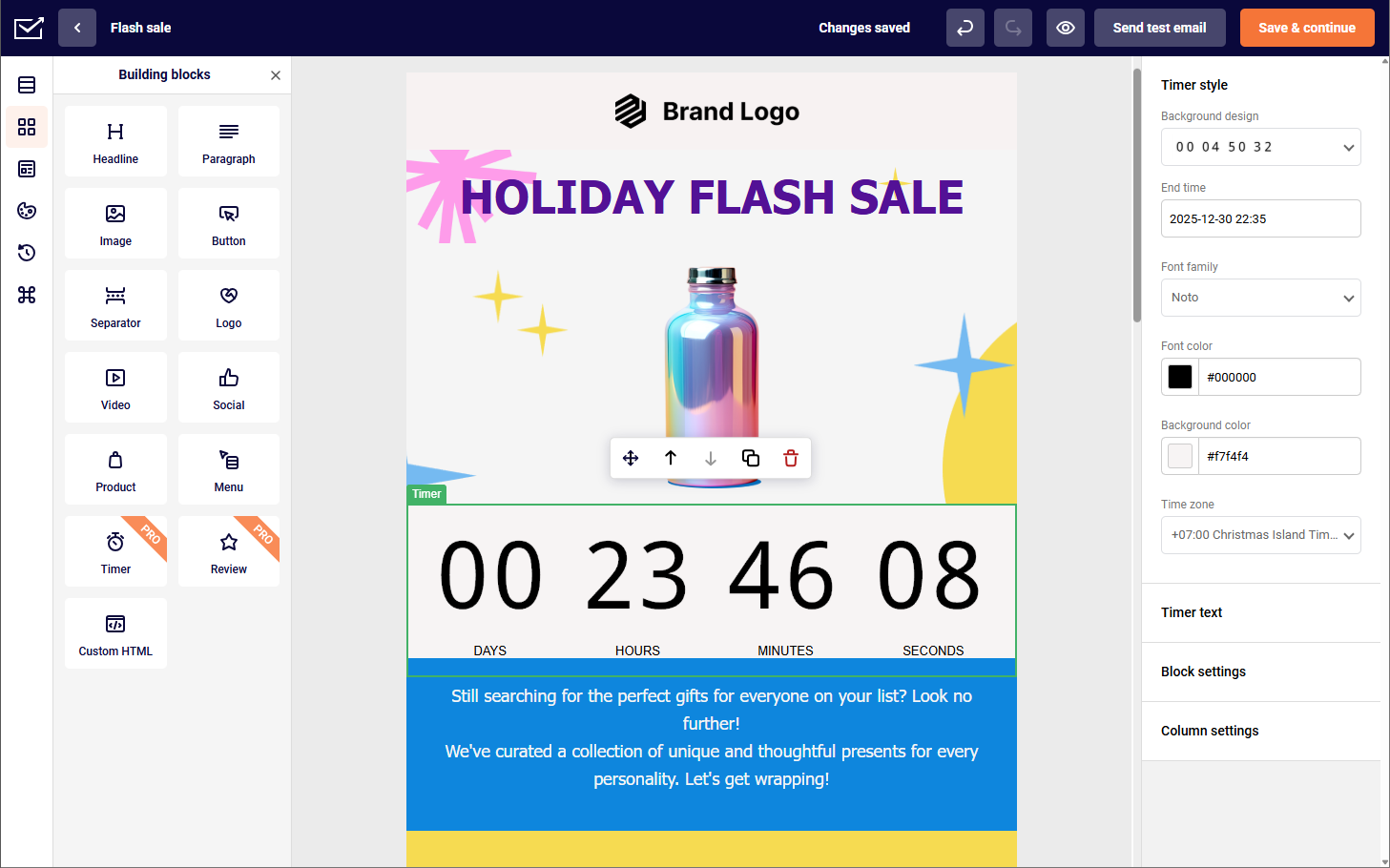
Template Library
When it comes to email templates, Sender doesn’t mess around. With over 1,100 fully-customizable templates ready at your disposal no matter what’s the occasion, you will never run out of ways to surprise your subscribers.
- Mobile-responsive design. Templates automatically adapt to any device, ensuring emails look professional on desktops, tablets, and smartphones;
- Extensive template library. Access over 1,100 ready-made designs covering various industries and campaign types;
- Fully customizable layouts. Easily adjust colors, fonts, and images to match your brand;
- Automation-ready templates. Use prebuilt designs in automated emails like welcome emails or cart reminders.
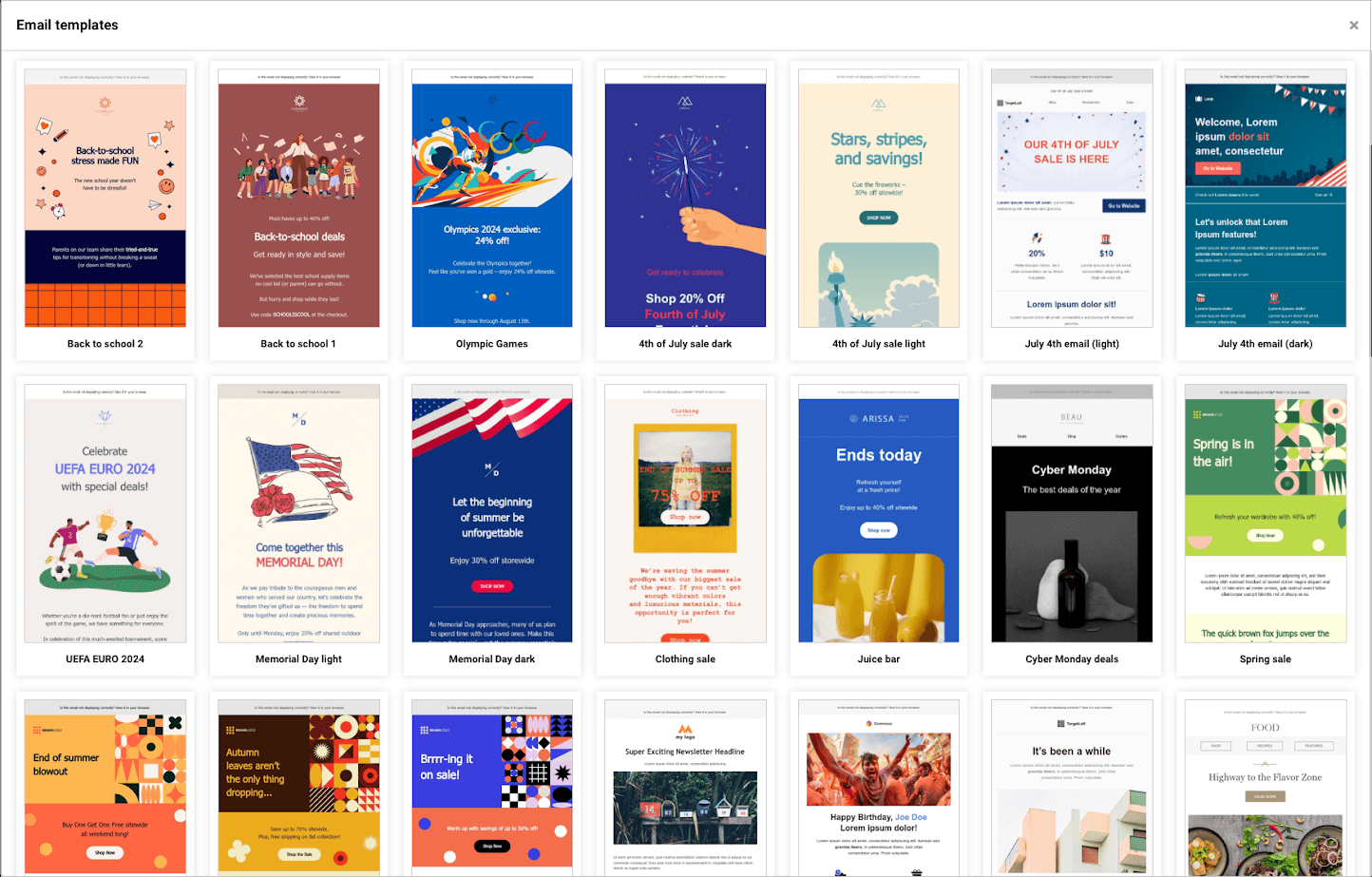
Pros & Cons
- Over 1,100 professional templates included even in the free plan
- Fully customizable layouts
- Mobile-responsive and works well across devices
- Easy drag-and-drop editor with no coding required
- Templates categorized by purpose and industry
- Some templates may need customization to match specific brand styles
Pricing
Pricing starts at $7/month, with a free plan available for SMBs looking for a reliable email marketing software without committing.
- Free plan available (up to 2,500 subscribers and 15,000 emails/month);
- Paid plans start at $7/mo nth for up to 12,000 emails/month and 1,000 contacts;
- Pricing scales by number of contacts;
- Automation features included in paid tiers;
- Annual billing discounts available;
- Last verified: February 2026.
See why businesses choose Sender:
Stripo — Free HTML Email Builder with Customization Power
Stripo stands out for its robust free plan, offering a surprising number of features for those on a budget. But this is far from why this unsung template builder ended up on this list.

During my time with Stripo, I was able to create visually stunning emails with its intuitive drag-and-drop editor and extensive library of 1,600+ pre-designed templates (even if not all of them are great by today’s standards).
Stripo primarily focuses on email template building, but it integrates seamlessly with popular email marketing services, like Mailchimp, HubSpot, and Sender. That seamless workflow means you can design in Stripo and deploy in your preferred platform without a hitch— a small touch, sure, but one that will win many marketers over.
Email Builder Features
Stripo has several useful features, like AMP support, that can help you improve your email marketing effectiveness. Here’s a brief glimpse of the features:
- Editor Type. Stripo offers a hybrid editing mode, combining the ease of a drag-and-drop interface with the flexibility of an HTML email editor. This allows users to visually design emails while maintaining full control over the code for advanced customization;
- HTML & Code Control. With Stripo, you can easily import and edit HTML templates or build your emails from scratch using the built-in HTML editor. The hybrid approach ensures both ease of use and precise code control for those with coding experience;
- Responsive Controls. Stripo ensures that your emails are fully responsive, with the ability to preview them across both mobile and desktop views. Users can also make manual adjustments to elements for mobile optimization, ensuring emails look great on all devices;
- Content Blocks. The editor includes a variety of pre-built content blocks, such as buttons, images, and AMP-powered interactive elements. These reusable blocks streamline email creation, making it easy to design consistent, engaging emails;
- Personalization. Stripo supports dynamic content and merge tags, allowing you to personalize emails based on subscriber data, creating more relevant and engaging messages for your audience;
- Preview & Testing. Stripo offers real-time previewing, letting you instantly see your email designs. You can also send test emails to check how they render across different devices and email clients.
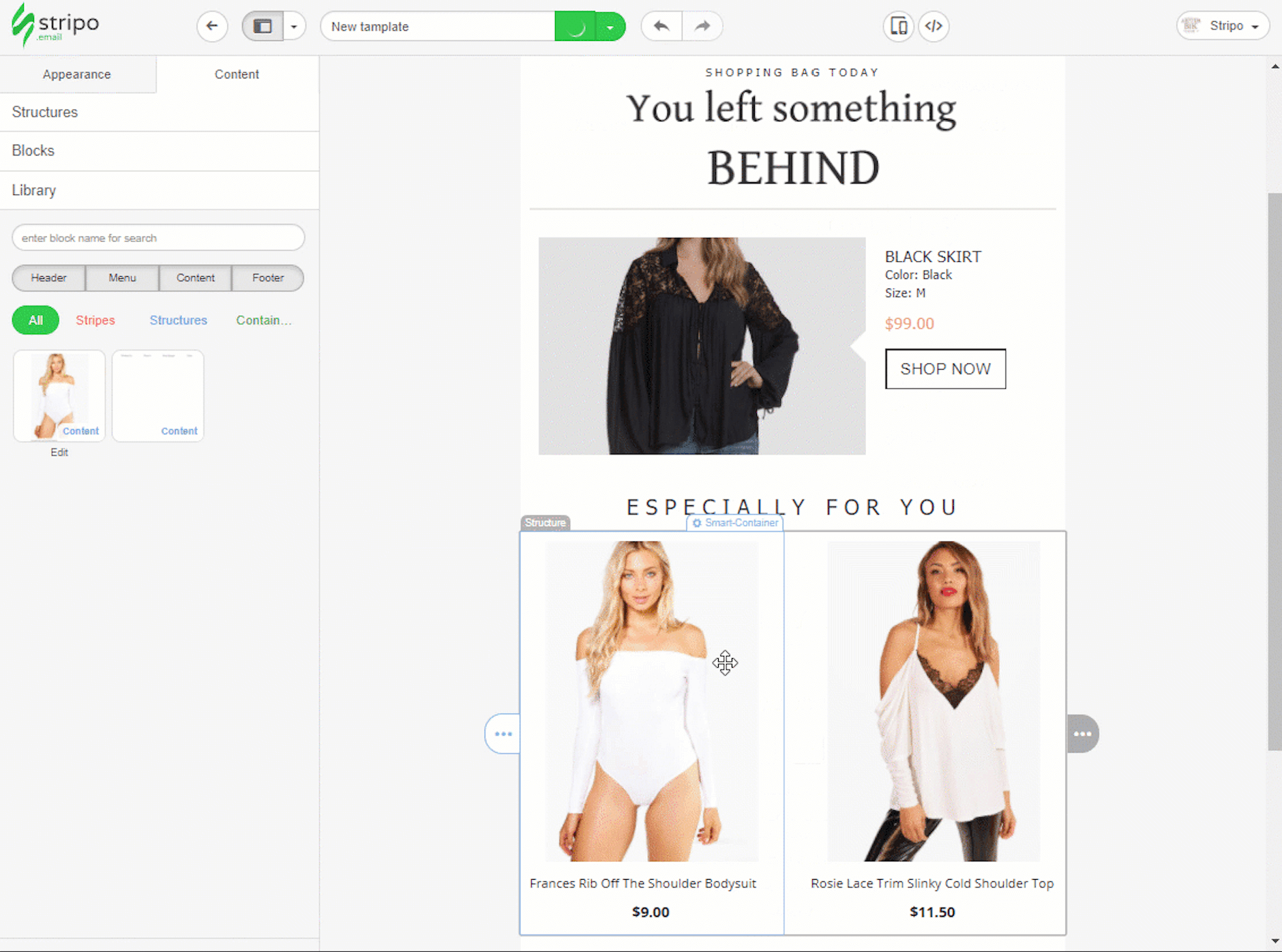
Template Library
Stripo gives you access to over 1,600 email templates for just about any occasion or industry. You can tweak colors, layouts, and content blocks to fit your brand, or mix things up from scratch. Every template is mobile-friendly, so your emails always look good wherever they’re opened.
- Extensive template library. Browse a wide range of ready-made, professionally designed templates to jumpstart your next campaign;
- Reusable module blocks. Save and reuse custom sections like headers, footers, or product showcases to keep your emails consistent and speed up creation;
- Seamless export options. Download clean HTML or export your finished designs directly to your favorite email marketing platform.
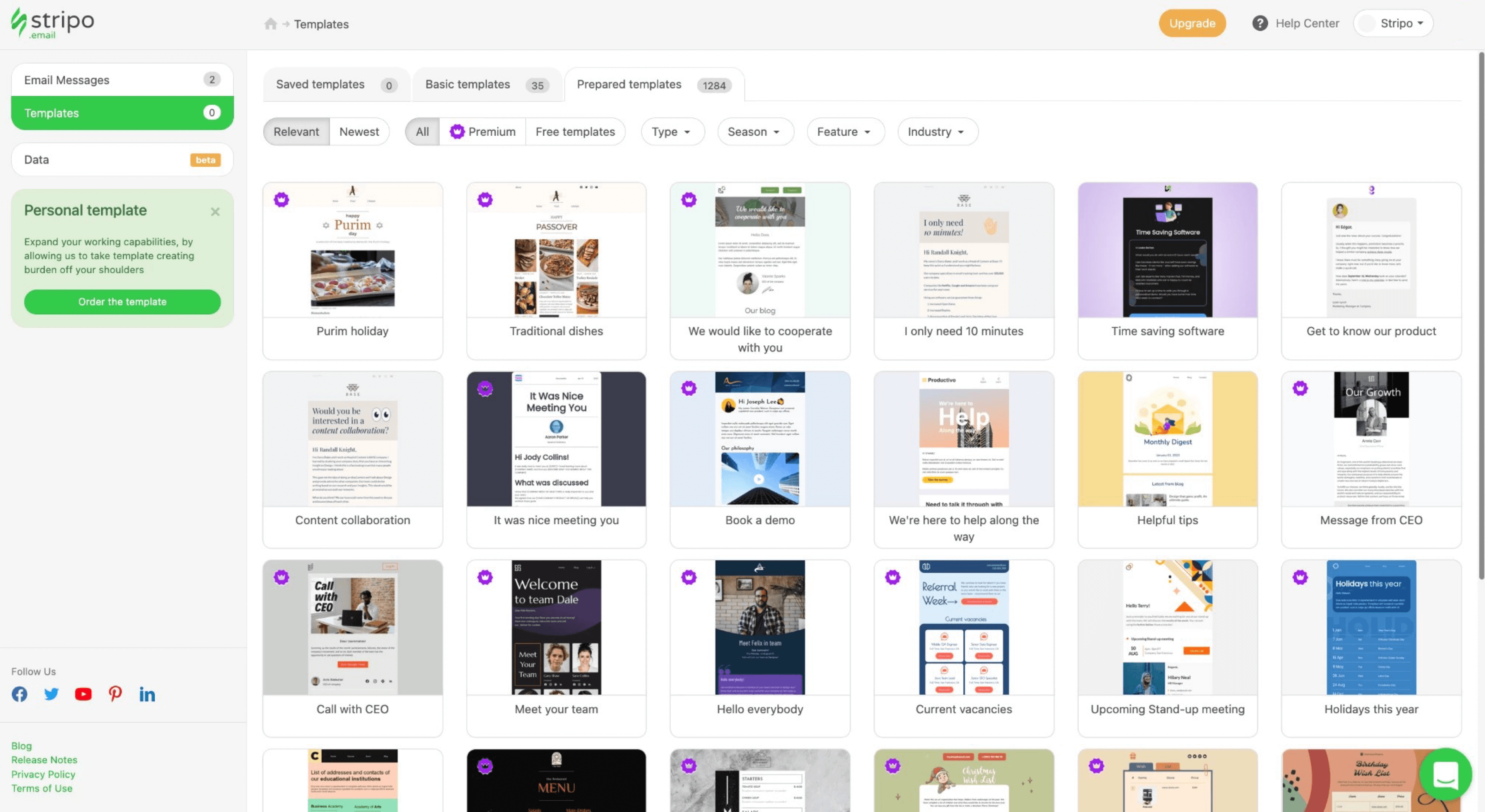
Pros & Cons
- Intuitive drag-and-drop editor with optional HTML/CSS mode
- Supports interactive and AMP elements
- Integrates with 70+ ESPs and CRMs
- Collaboration options with shared modules
- Large library of customizable templates
- Fully responsive design preview
- Some advanced tools require a paid plan
- Occasional rendering inconsistencies
- Interface can lag when working with complex templates
- Limited exports and features on free tier
- Some learning curve for advanced customization
Pricing
Pricing starts at $20/month, with a free plan available for basic use.
- Free plan available (4 email exports and 5 test emails per day);
- Paid plans start at $20/month for up to 50 email exports/month;
- Premium features include sharing email previews and advanced email design tools
- Pricing scales based on the number of exports and features;
- Annual billing discounts available.
- Last verified: February 2026.
Postcards — Customizable Email Builder for Flexible Designs
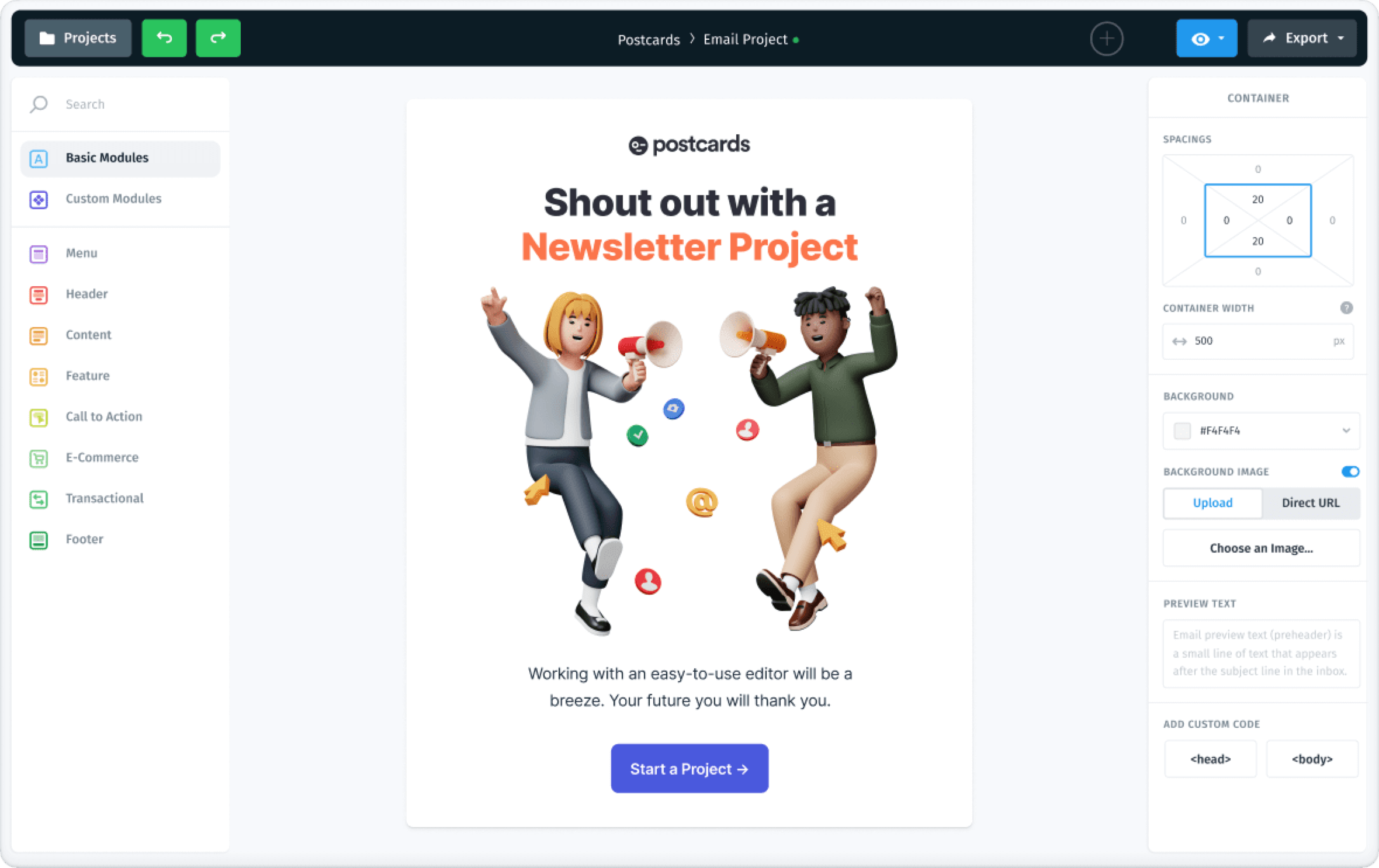
Postcards email builder, powered by Designmodo, makes it simple to create unique and visually consistent branded emails. It takes a modular approach to email design, allowing you to build emails piece by piece using pre-built modules.

What sets Postcards apart is its exceptional customization options. You have granular control over every element’s design, from fonts and colors to spacing and padding. While it focuses primarily on email design, Postcards offers helpful features like real-time collaboration for teams and export options for various ESPs, such as Sender or Klaviyo.
Email Builder Features
The drag-and-drop builder in Designmodo’s Postcards’ editor puts visual email design front and centre. You don’t pick a full template and hope it fits—instead you stack and arrange modular blocks (headers, content sections, CTAs) and drag them into place. Besides all that, it’s packed with some nifty features worth taking a look at.
- Editor Type. Designmodo’s Postcards offers a no-code drag-and-drop builder, making it easy to create and adjust email layouts visually without needing to know HTML, perfect for users looking for an intuitive, user-friendly design experience.
- HTML & Code Control. While primarily a visual builder, Postcards allows you to export clean HTML code for use with other email marketing platforms, giving you flexibility to further customize your emails or integrate them into other services.
- Responsive Controls. Responsive design previews are built into the editor, so you can instantly see how your email will display on mobile, tablet, and desktop, ensuring your emails are optimized for all screen sizes.
- Content Blocks. Postcards provides modular design blocks like headers, footers, and content areas, which you can mix and match to quickly build custom email layouts tailored to your needs.
- Personalization. While Postcards focuses on design, it integrates with email platforms that allow you to add dynamic content and personalization via merge tags, enabling you to send targeted, customized emails to your audience.
- Preview & Testing. With real-time previews and the ability to share projects via a shareable link, Postcards makes collaboration and testing easier before sending emails to your list.
- Cloud Image Hosting. Postcards provides cloud image hosting, allowing you to store and manage your images securely in the cloud for faster email loading times and a smoother design process.
Template Library
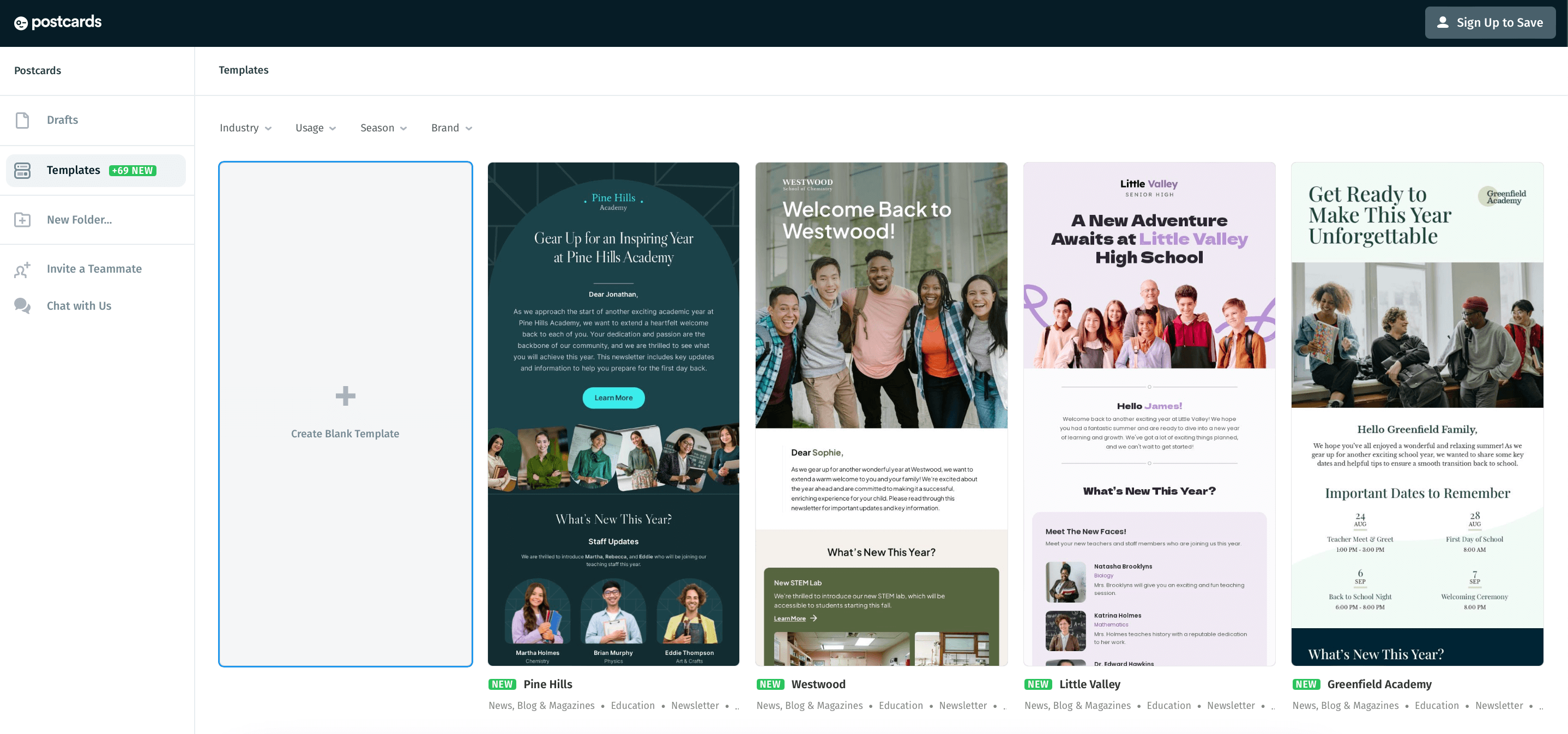
Designmodo’s Postcards takes a slightly different route: instead of simply providing a large library of ready-made templates, it offers a modular system of blocks that you assemble into custom templates. Because of this, you get more design flexibility (colour, spacing, brand fonts) than many “pick a template and tweak it” tools without writing a line of HTML.
- Reusable custom modules. Save a block you’ve built and reuse it in future projects;
- Brand-level customisation. You can set brand presets (fonts, buttons, colours), upload custom fonts, edit spacing and layout, and adjust how things appear on mobile—all helping your emails stay “on brand”;
- Export & integrations. Once done designing, you can export the email as HTML or integrate directly with major ESPs (e.g., Mailchimp, HubSpot, Klaviyo) in a single click. The exported code is clean, and mobile-responsive designs are built in.
Pros & Cons
- Intuitive, no-code interface that’s easy for beginners
- Professional, modern-looking templates and modules
- Clean HTML exports compatible with major ESPs
- Responsive designs that look good across devices
- Helpful and responsive customer support
- Pricing can feel high for smaller teams
- Limited control for highly customized layouts
- Fewer advanced design options than some competitors
- Organizational tools (folders, template management) could be improved
Pricing
Pricing starts at $16/month, with a free plan available for limited use.
- Free plan available (up to 10 template projects and 10 daily email tests);
- Paid plans start at $16/month for full access to modules + 20 monthly and 5 weekly exports;
- Collaboration features included in paid plans;
- Pricing scales based on the number of templates and collaboration tools;
- Annual billing discounts available;
- Last verified: February 2026.
Unlayer — WYSIWYG Email Editor and Page Builder
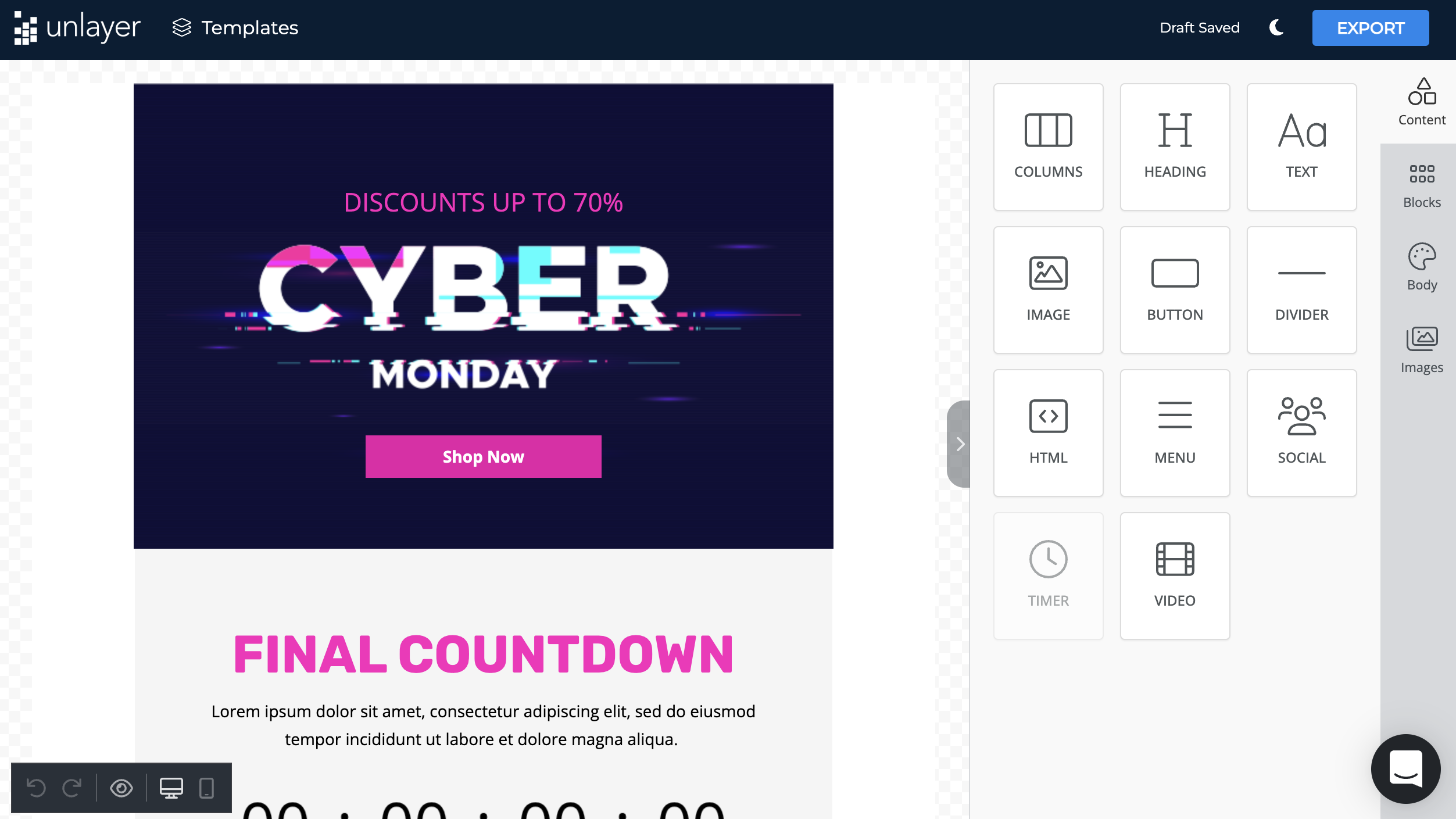
Unlayer is a versatile WYSIWYG email editor that also doubles as a landing page builder. Its intuitive drag-and-drop interface makes it simple to create both emails and landing pages with consistent branding.

I like that Unlayer lets you start with a blank canvas or pick from a library of pre-designed templates and pre-built blocks. The image editing tools were a standout too, since I can make quick edits without leaving the platform.
That said, the paid plans starting at $250 per month unlock more advanced features. But with that hefty price tag, the free plan, even without an image editor or stock image library, seems like a better starting point.
Email Builder Features
Unlayer is amazing when it comes to drag-and-drop functionality. But there’s more. Here’s a list of the most useful features of Unlayer:
- Editor Type. Unlayer offers advanced editor controls with a drag-and-drop builder, allowing you to design emails intuitively. It includes features like custom file storage, unique design blocks, and full undo-redo functionality to refine your layouts seamlessly;
- HTML & Code Control. While primarily visual, Unlayer provides flexibility with HTML support, allowing you to import and edit HTMLtemplates directly within the editor, giving more control to users who need advanced customization;
- Responsive Controls. The editor ensures responsive design with mobile and desktop previews. You can also adjust email elements manually to ensure your emails look great across different devices and screen sizes;
- Content Blocks. Unlayer’s modular design blocks allow you to mix and match various sections, such as buttons, images, and product blocks, making it easy to build custom, engaging emails quickly;
- Personalization. With dynamic merge tags, Unlayer allows you to personalize emails by integrating subscriber data and other dynamic content into your email templates, enhancing user engagement and relevance;
- Ecommerce Product Integration. Unlayer integrates with ecommerce platforms, enabling you to embed products directly into your email templates. This feature helps drive clicks and increase sales by showcasing your products within the email itself.
Template Library
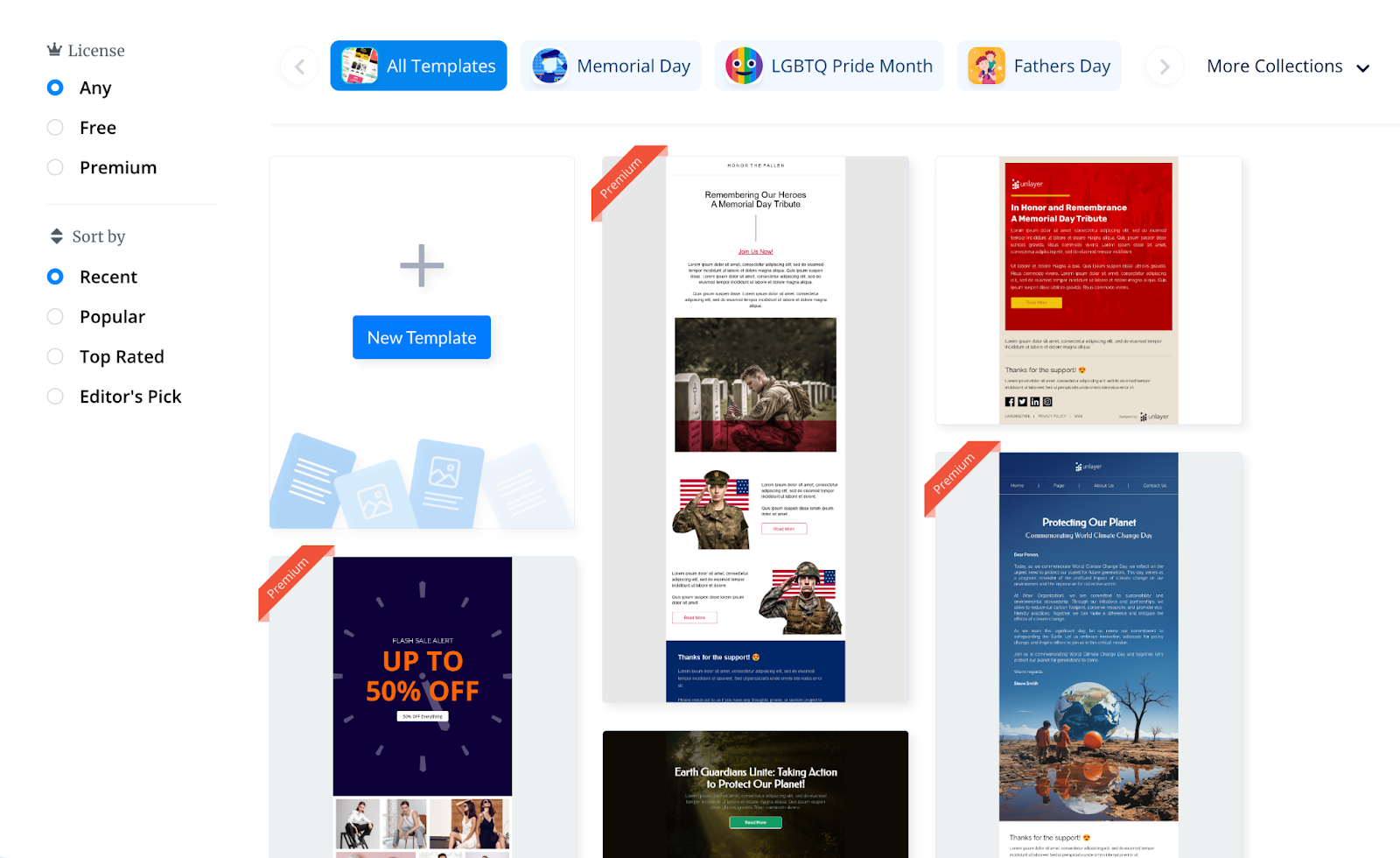
Unlayer offers a powerful template builder with features designed to make email creation faster, more flexible, and fully on-brand. Here are some of its standout features:
- White-label editor experience. Customize the Unlayer editor itself to match your brand’s look and feel, so your team or multiple users see a fully branded interface;
- Pre-designed content blocks library. Access a wide variety of ready-to-use sections—like testimonials, product showcases, and announcements—to speed up email creation;
- Multi-language support. Build templates that can be easily localized for different languages and regions, perfect for international campaigns;
- Advanced image editing inside the builder. Crop, resize, add filters, and tweak images directly in Unlayer without needing an external editor.
Pros & Cons
- Intuitive drag-and-drop editor
- Wide range of integrations
- Robust built-in image editing tools
- Strong branding consistency
- Steep entry plan pricing
- Limited features on the free plan
- Customer support only during business hours
- Performance can be slower with large templates
Pricing
Pricing starts at $250/month, with a 14-day free trial available.
- Free plan available with limited functionality and feature restrictions;
- Paid plans start at $250/month for unlimited email template generations;
- Paid plans include full access to features and templates;
- Pricing scales based on usage and required features;
- Last verified: February 2026.
Flodesk — Email Template Builder for Brand-First Small Businesses
Flodesk is a design-first email marketing platform built for small businesses, solopreneurs, creators, and coaches who want their emails to look as polished as the brands they’re building. Founded in 2019, it’s trusted by over 100,000 businesses globally — and it’s easy to see why once you open the builder.

Where most email platforms bolt brand customization on as a settings panel, Flodesk builds from the other direction: your custom fonts, color palette, and visual identity are the foundation every template is built on. The result is that every email you send feels yours — no design background required, no compromise on aesthetics.
With a platform-wide delivery rate of ~98.4%, Flodesk pairs beautiful design with real marketing performance.
Email Builder Features
Flodesk’s editor is built around a single principle: your brand should come first. Here’s what that looks like in practice:
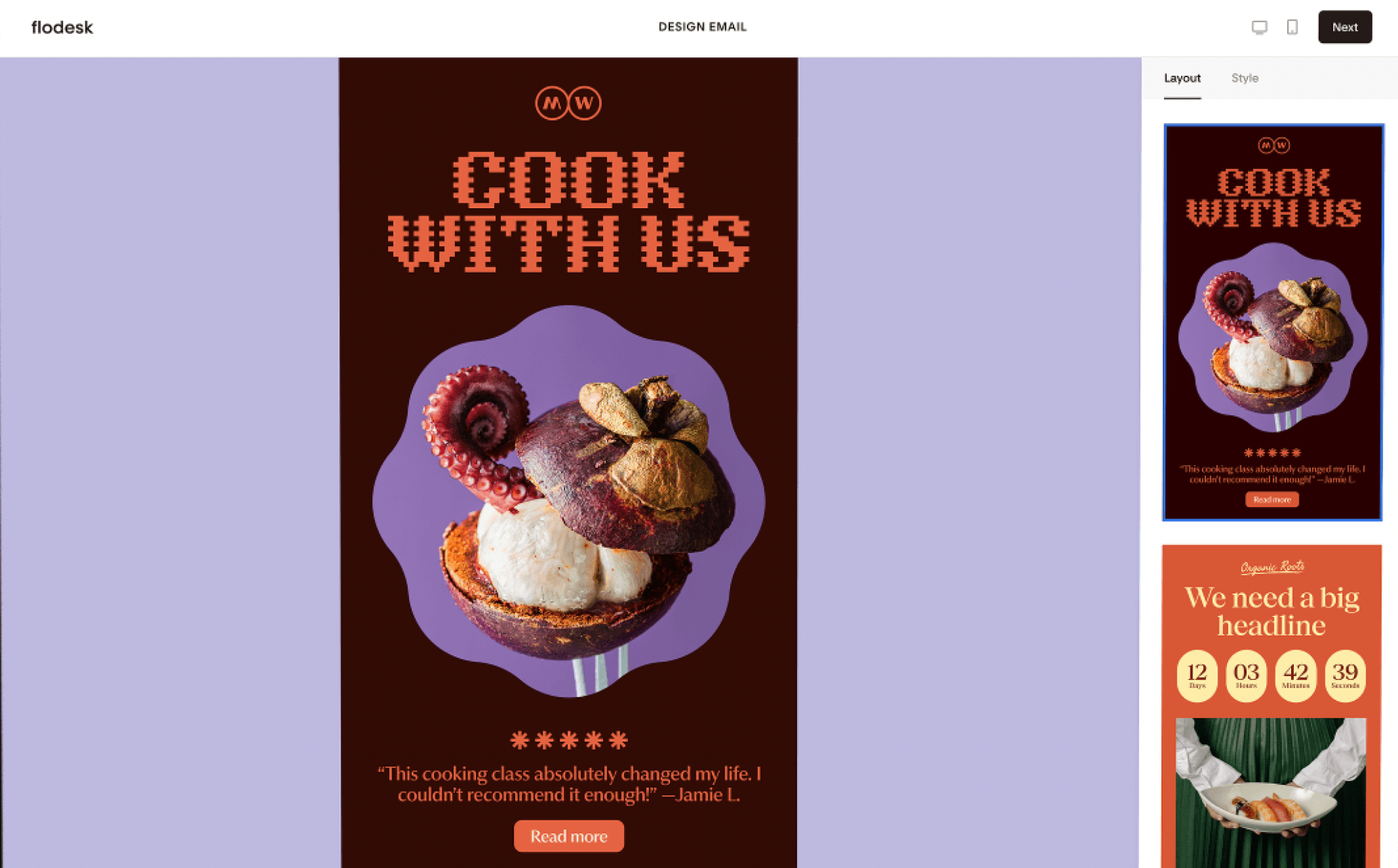
- Editor Type. Flodesk uses an intuitive drag-and-drop block editor designed for non-technical users. The interface is clean and minimal — there’s no clutter, no feature overwhelm, just a straightforward canvas where your brand does the talking.
- Brand Customization. Flodesk is the only email builder with patented layout technology built around your visual identity. Set your custom fonts, brand colors, and logo once, and they carry through every email, form, and checkout automatically.
- HTML & Code Control. Flodesk is primarily a visual, no-code builder designed for ease of use. It is not intended for developers who need granular HTML/CSS access, but rather for business owners who want great-looking results without touching code.
- Responsive Controls. All Flodesk templates are automatically mobile-responsive. Emails render cleanly across devices without requiring manual adjustments, so your design always looks intentional whether opened on a phone or desktop.
- Content Blocks. The editor includes a variety of reusable content blocks — text, images, buttons, video embeds, countdown timers, and more — that can be mixed and matched to build layouts that feel unique to your brand.
- Personalization. Flodesk supports merge tags and advanced audience segmentation, allowing you to personalize emails based on subscriber data for more targeted, relevant sends.
- Preview & Testing. Flodesk provides real-time email previews and the ability to send test emails before deploying. AI-powered subject line recommendations based on email marketing best practices are also included to help optimize performance before you hit send.
Template Library
Flodesk’s template library leans into aesthetics — these are among the most visually striking templates available in any SMB email platform. Every template is built to look custom, not generic.
- Visually distinctive designs. Templates are crafted with a design-forward sensibility, making it easy to send emails that stand out in a crowded inbox without hiring a designer.
- Brand-synced customization. Because your brand fonts and colors are applied platform-wide, any template you choose is instantly on-brand from the moment you open it — no manual re-skinning required.
- Fully customizable layouts. Adjust any element of a template — copy, imagery, structure, color — to fit the specific campaign you’re building.
- Automation-ready templates. Templates plug directly into Flodesk’s workflow automations, making it easy to build welcome sequences, abandoned cart flows, post-purchase emails, and more with consistent, branded designs throughout.

Pros & Cons
- Custom fonts, brand colors, and patented layout technology included
- Brand identity applies platform-wide across emails, forms, and checkout
- Intuitive enough to use without onboarding or technical expertise
- Unlimited email sends on all paid plans
- Unique form types like spin-the-wheel, video forms, and countdown timers
- Built-in checkout, automations, and landing pages
- No native HTML/CSS editor
- Template library is smaller than competitors
- No standalone export to third-party ESPs
- No SMS or multi-channel capabilities
Pricing
Flodesk paid plans start at $25/month (Lite) for up to 1,000 subscribers with unlimited email sends. Free plan is available.
- Free plan available (unlimited forms and landing pages; no email sending);
- Paid plans start at $25/month for up to 1,000 subscribers with unlimited email sends;
- Pricing scales by subscriber count, not send volume;
- Annual billing includes one month free;
- Last verified: February 2026. Verify current pricing at flodesk.com/pricing.
Chamaileon — Collaborative Email Builder for Teams
Chamaileon is a highly collaborative email builder designed specifically for teams. It offers advanced features that help streamline the email design process, ensuring that teams can work together efficiently on email projects.

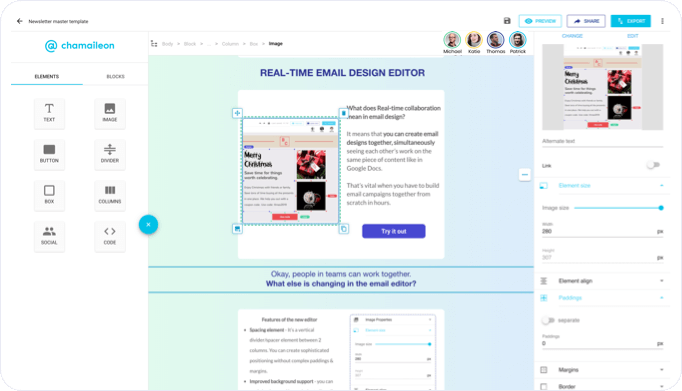
With Chamaileon, you can create customizable, professional email templates with ease, while providing your team with the tools to collaborate seamlessly. The platform provides an intuitive drag-and-drop editor, making it easy for both novice and experienced designers to build compelling emails without writing a single line of code.
But Chamaileon doesn’t stop at just design—it’s built for collaboration. Teams can work together seamlessly, with real-time updates, shared content libraries, and the ability to review and edit email drafts simultaneously.
Template Library
Chamaileon offers a flexible approach to email templates, allowing you to create customized designs using reusable content blocks. This makes it easier for teams to maintain consistency across multiple email campaigns.
- Customizable Templates: Chamaileon offers a library of pre-designed templates that you can tailor to your brand’s style. Adjust fonts, colors, and content to create professional emails without the need for coding.
- Mobile-Responsive: All templates are fully responsive, ensuring they automatically adjust for optimal viewing on mobile, tablet, and desktop devices.
- Collaboration-Friendly: Templates can be shared with team members for collaboration. You can easily invite others to work on email designs, ensuring seamless teamwork.
Email Builder Features
- Editor Type. Chamaileon features an advanced drag-and-drop editor with custom file storage capabilities, offering intuitive design controls. It includes powerful features like unique design blocks and full undo-redo functionality, ensuring flexibility and precision when building emails;
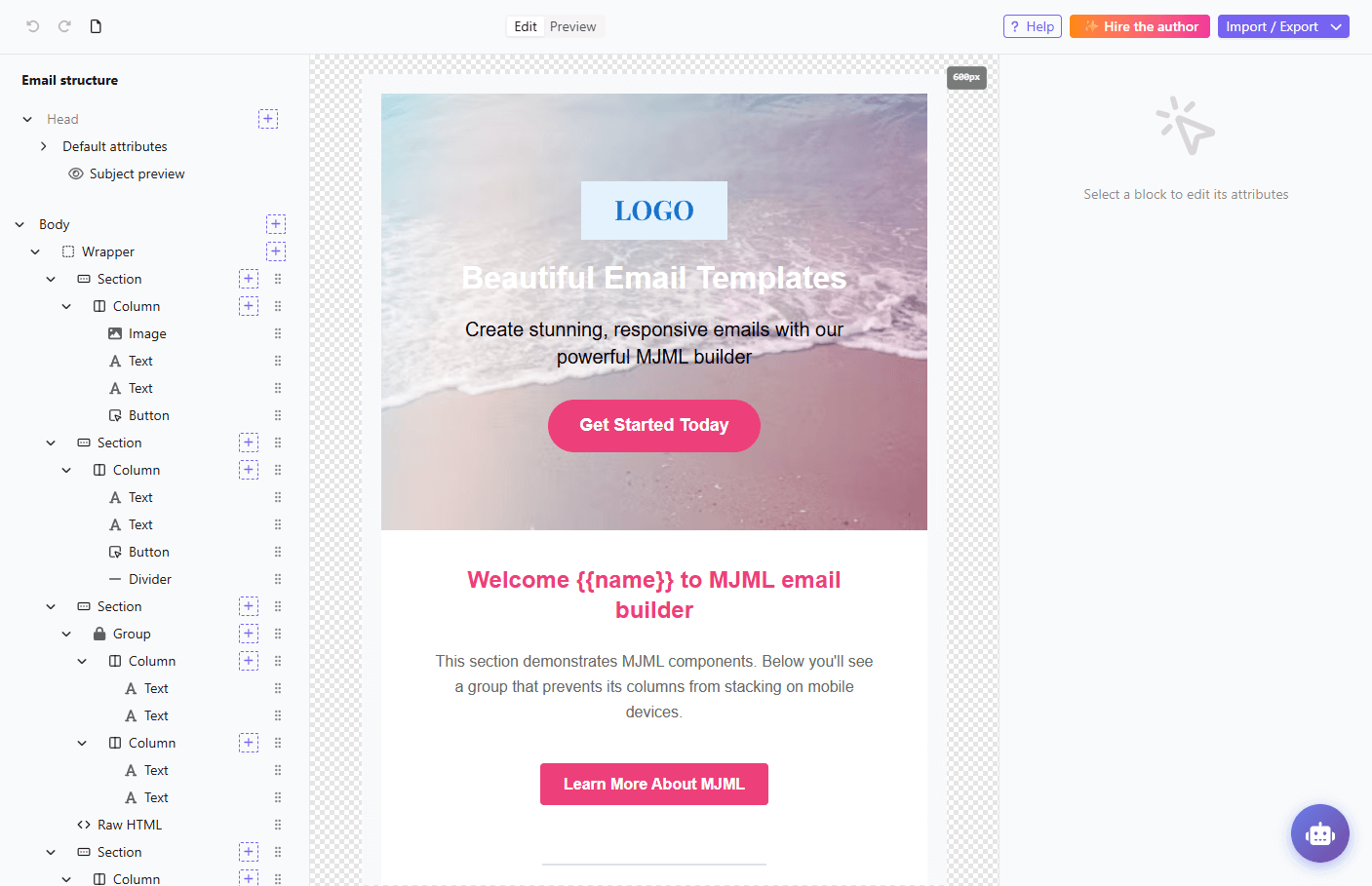
- HTML & Code Control. While primarily no-code, Chamaileon allows users to import HTML and offers full code editing options, enabling those with coding experience to customize email templates while maintaining an easy-to-use interface;
- Responsive Controls. Chamaileon provides responsive design previews across both mobile and desktop views. You can make manual adjustments to ensure your emails look flawless on any device or screen size;
- Content Blocks. The platform offers a variety of pre-built modular design blocks, such as headers, footers, buttons, and product sections, which can be easily mixed and matched to create custom email designs efficiently;
- Personalization. Chamaileon supports dynamic merge tags, allowing you to personalize emails by pulling data such as subscriber names, locations, and preferences directly into the templates for more tailored content;
- Ecommerce Product Integration. With ecommerce integration, Chamaileon allows you to embed products from your online store directly into emails, helping boost engagement and drive sales directly from your email campaigns.
Pros & Cons
- Advanced collaboration tools for team-based email design
- No-code builder with full HTML editing options
- Real-time device previews to ensure mobile responsiveness
- Wide range of customizable modular content blocks
- Integration options with popular email service providers (ESPs)
- High starting price for smaller teams
- Some features, such as advanced customizations, are only available in higher-tier plans
- Requires a learning curve for teams unfamiliar with advanced email design features
Pricing
Pricing starts at $400/month for the basic plan tailored for teams of all sizes;
- No free plan available;
- Paid plans start at $400/month with full access to collaboration features, advanced template customizations, and team tools;
- Free trial available for paid plans to explore the platform’s premium features;
- Pricing scales based on the number of users, team features, and integrations;
- Last Verified: February 2026.
Tabular — Responsive Email Builder for Mobile Optimization
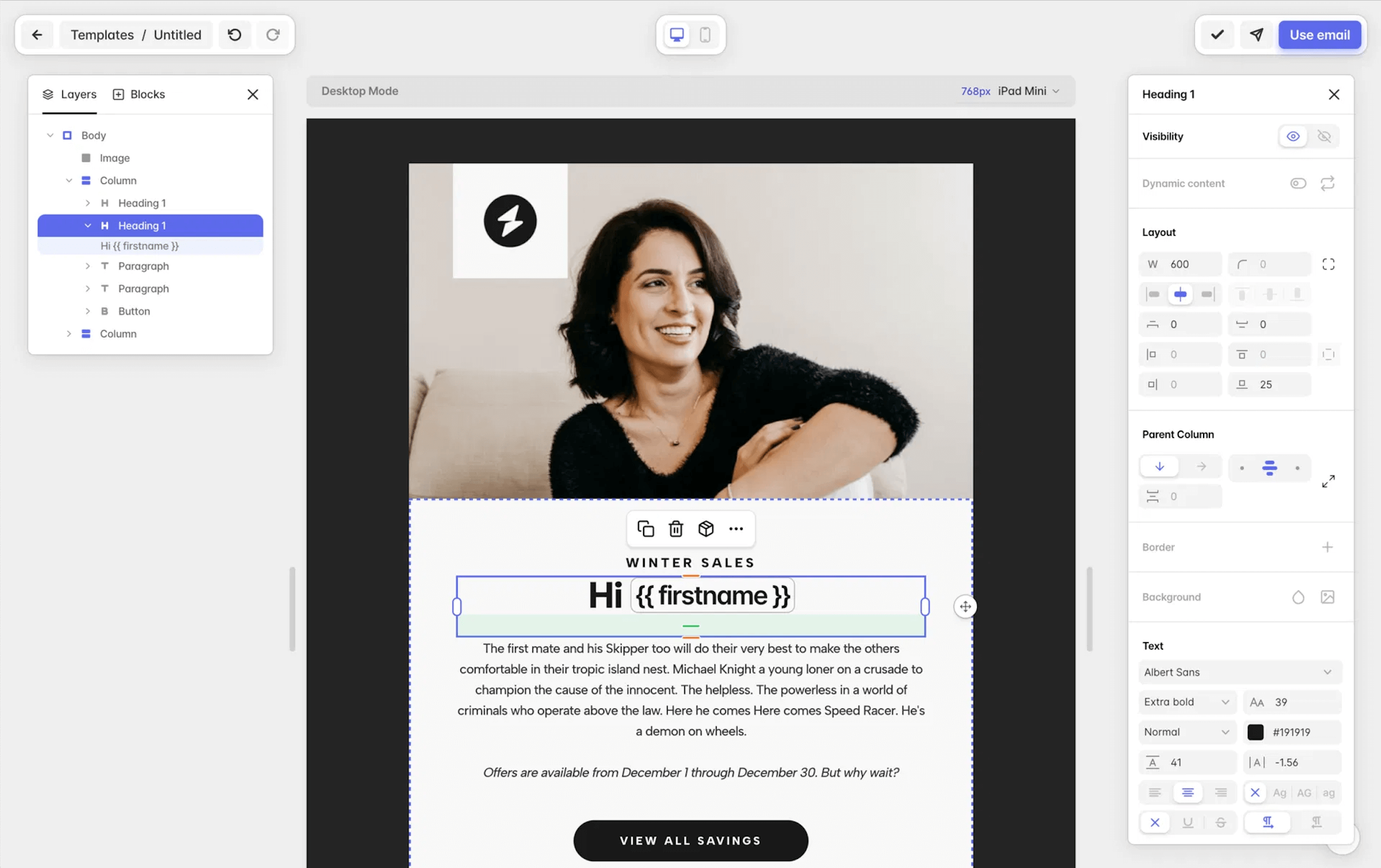
Tabular‘s email template builder is renowned for its focus on creating perfectly responsive emails across all devices. Besides being mobile-responsive, it knocks it out of the park with its email testing functionality.
I’ve been trying many different online builders while coming up with this guide, and Tabular immediately stood out thanks to its “block” system. It makes designing emails surprisingly straightforward while ensuring everything looks perfect across any screen size.
I also appreciate how clean and efficient the code is—my emails load quickly and render correctly, which is a huge plus for deliverability. That said, Tabular leans heavily on the technical side of email creation—for more advanced customization, some HTML coding knowledge definitely helps.
Overall, Tabular feels like a tool designed for anyone serious about creating high-quality, responsive emails without cutting corners.
Email Builder Features
Tabular comes with several features you can use to design stunning email campaigns quickly. Here are the most useful ones:
- Editor Type. Tabular offers an intuitive drag-and-drop email builder with a wide range of ready-to-use design blocks. This allows for quick creation of professional, polished emails without needing any coding skills, ideal for users looking to streamline their email design process;
- HTML & Code Control. For more advanced users, Tabular includes a built-in HTML editor that provides full control over the design and responsiveness of emails, making it easy to customize email templates to fit specific needs;
- Responsive Controls. Tabular ensures that your emails are mobile-optimized with responsive design features. You can manually adjust the layout to ensure your emails look great across all devices, with easy previews available to view how emails render on different screen sizes;
- Content Blocks. With modular design blocks, Tabular offers flexible components like images, text, and buttons, which can be mixed and matched to build customized email layouts quickly;
- Personalization. Tabular supports dynamic content personalization, allowing you to tailor emails based on subscriber data, behavior, or other custom fields, enhancing engagement and making messages more relevant to each recipient;
- Ecommerce Product Integration. Tabular integrates smoothly with ecommerce platforms, enabling you to embed products directly into your emails. This feature helps to drive clicks and sales by showcasing items from your store right within the email content.
Template Library
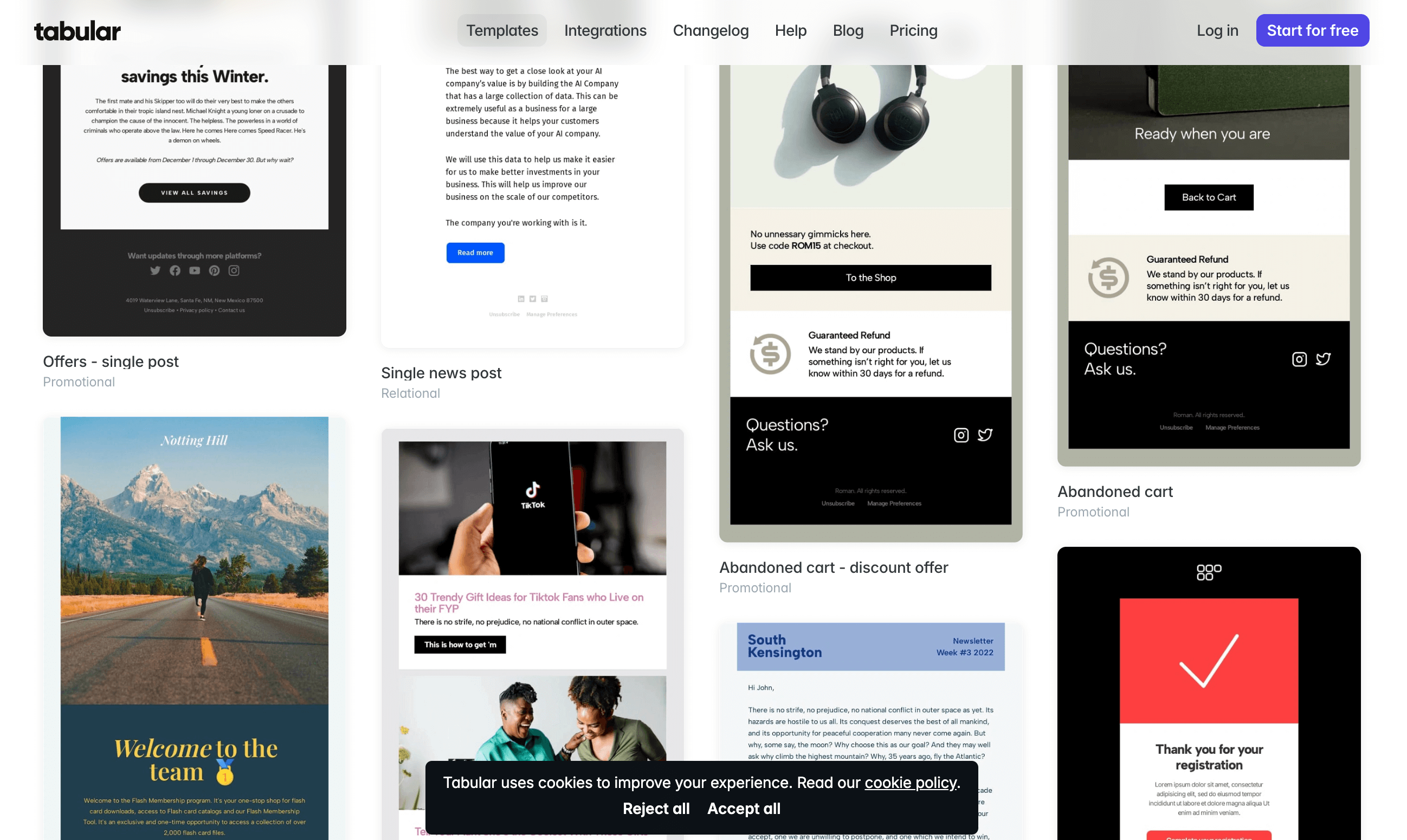
Tabular’s email template builder packs a range of smart, user-friendly features designed to make creating responsive, personalized, and professional emails fast and efficient.
- Modular design system. Create reusable email blocks (e.g., headers, footers, product sections) and save them for future use, promoting brand consistency and efficiency;
- Dynamic content personalization. Incorporate variables and dynamic content to tailor emails to boost engagement;
- AI-Powered email testing. Automatically preview and test your emails in various inboxes to ensure consistent rendering without manual coding;
- Clean HTML output. Tabular’s smart algorithm generates HTML that ensures compatibility across 50+ email clients, including older versions of Outlook.
Pros & Cons
- User-friendly interface
- Seamless cloud integrations
- Efficient data processing
- Comprehensive security management
- Limited analytical functions
- Template customizations are limited
- Learning curve for advanced features
- Integration setup complexity
Pricing
Pricing starts at $24/month, with a free plan available for basic use.
- Forever free plan available (up to 3 stored emails and 3 exports/month);
- Paid plans start at $24/month for unlimited stored emails and up to 100 exports/month;
- Pricing scales based on the number of exports and features;
- Annual billing discounts available;
- Last verified: February 2026.
Beefree — Powerful HTML Email Builder for Professionals
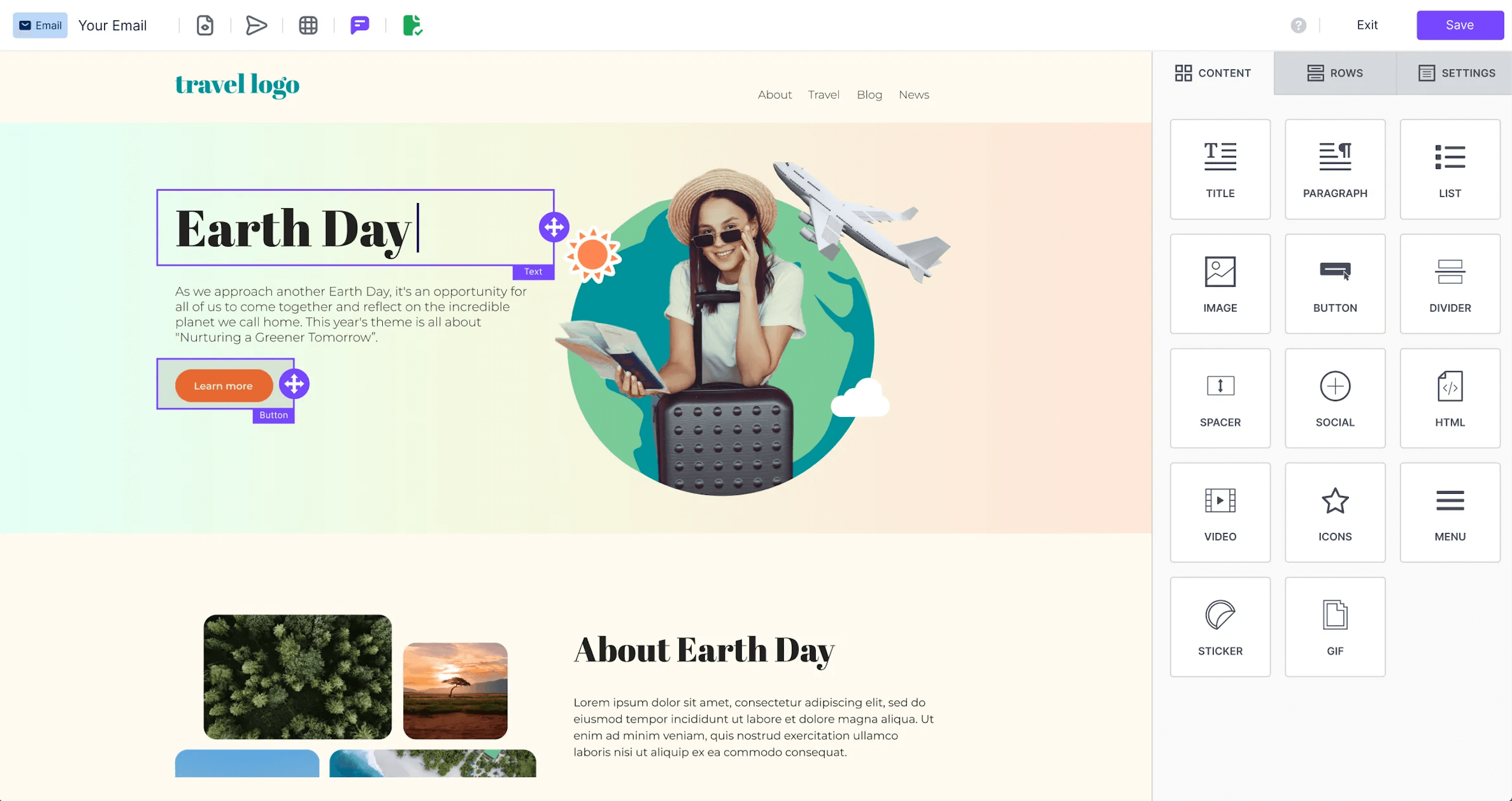
Beefree’s intuitive drag-and-drop email builder empowers users of all skill levels, from beginners to experienced designers, to create stunning HTML emails.
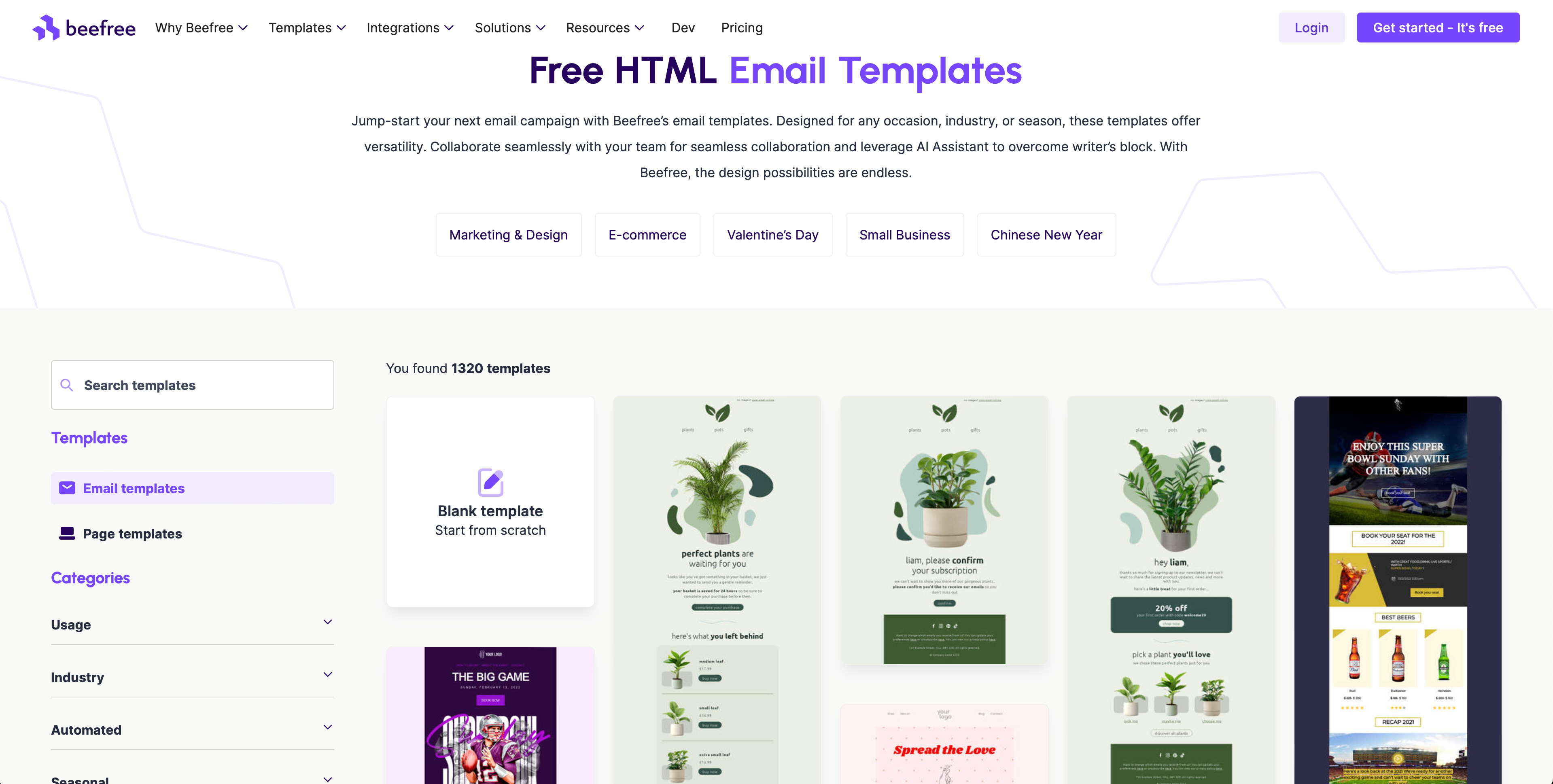
During my hands-on with Beefree, it quickly became my go-to tool for crafting responsive HTML emails. Whether I start with one of their over 2,000 professionally designed templates or build from scratch, the customization options are extensive. For those comfortable with code, Beefree allows to store and reuse custom code modules across campaigns.
Overall, Beefree has proven to be an invaluable tool for creating high-quality, responsive emails efficiently—especially when there’s a free plan with 1,700+ templates to jump-start your creativity.
Email Builder Features
Here are the top Beefree builder’s features that will help you speed up the email design process:
- Editor Type. BeeFree offers a smart, drag-and-drop editor that allows users to create professional emails quickly without needing any coding skills. The editor includes responsive templates that adjust automatically to different screen sizes, ensuring that emails look great on mobile devices as well as desktops;
- HTML & Code Control. While BeeFree primarily focuses on a no-code email design builder, it also offers HTML export capabilities, giving users the option to tweak the HTML code for more advanced customization if needed, while keeping the process simple for beginners;
- Responsive Controls. BeeFree ensures mobile optimization with responsive email templates that automatically adjust based on the device used to open them. You can also preview and make manual adjustments to ensure a perfect display across all devices;
- Content Blocks. BeeFree provides modular design blocks like headers, footers, and content areas that are reusable, enabling you to create consistent email designs quickly and efficiently across multiple campaigns;
- Personalization. BeeFree integrates with email platforms that allow for dynamic content personalization, enabling you to tailor emails based on user data, preferences, and behaviors to increase relevance and engagement;
- Ecommerce Product Integration. BeeFree integrates with major ecommerce platforms, allowing you to embed product blocks directly into emails. This helps drive customer engagement by showcasing items from your online store within your email campaigns.
Template Library
Even if you’re not savvy with HTML, you will still squeeze a lot of mileage out of Beefree’s pre-made templates, of which there are dozens.
- Extensive template library. Access a professionally designed collection of 1,200+ responsive email templates across industries and use cases;
- Reusable template kits. Build cohesive campaigns using multi-template kits that maintain consistent design and branding across newsletters, promotions, and transactional emails;
- Responsive & mobile-optimized. Every template is automatically formatted for mobile, tablet, and desktop views, with instant previews and layout control;
- One-click HTML export. Download clean, production-ready HTML or export directly to supported email platforms for seamless deployment.
Pros & Cons
- Extensive template library
- Mobile-responsive designs
- Customizable layouts
- High deliverability
- Limited advanced customization
- Learning curve for beginners
Pricing
Pricing starts at $25/month, with a free plan available for limited use.
- Free plan available with limits on the number of email templates and feature restrictions;
- Paid plans start at $25/month for unlimited email designs;
- 14-day free trial available for paid plans;
- Pricing scales based on feature access and number of templates;
- Last verified: February 2026.
Topol.io — Simple and Intuitive Newsletter Creation Tool
Topol.io is yet another free newsletter creator tool designed to help you save time. Besides its intuitive drag-and-drop editor, it offers a variety of responsive templates no matter what type of newsletter you’re going for.

I tested Topol.io to see how it stacks up as a newsletter builder tool against go-to newsletter platforms like Substack and Ghost.io. And let me tell you—it’s surprisingly capable for such a lightweight tool.
You can use its drag-and-drop editor as a standalone builder or integrate it directly into your own SaaS platform, which is a nice touch. While the template library feels limited compared to other online builders, the interface feels clean and intuitive, with all the standard design blocks you’d expect to find.
Email Builder Features
Topol is a full-fledged email builder with many useful features that can make your life easier as a marketer or business owner. Some features include:
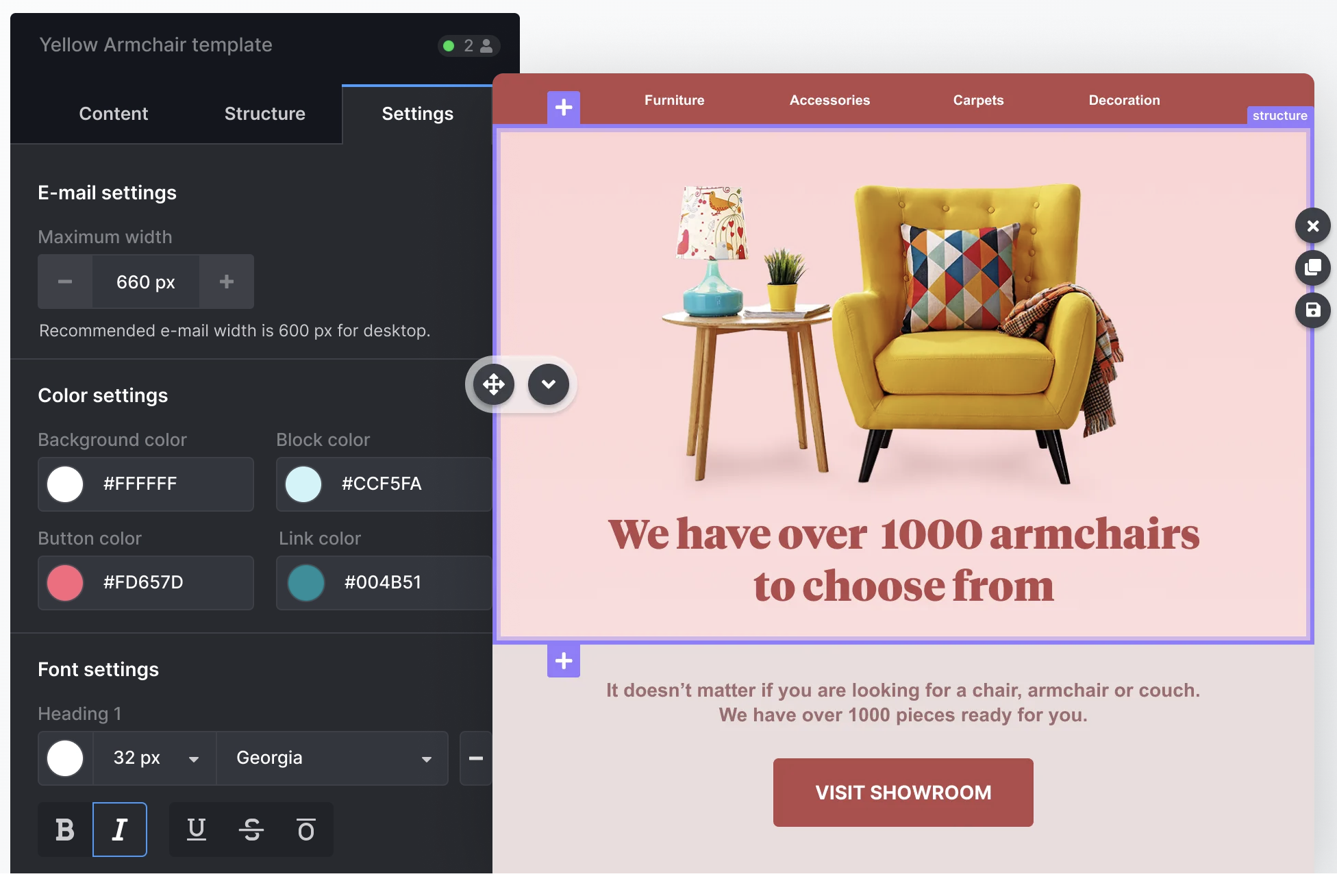
- Editor Type. Topol.io offers an intuitive drag-and-drop email builder, allowing users to design visually with pre-made content blocks and a rich template library. This no-code editor is ideal for users who want to create professional emails quickly without touching any code;
- HTML & Code Control. For those requiring more control, Topol.io provides a custom HTML editor where you can edit or inject HTML code directly into templates. This feature offers full design flexibility for users comfortable with code, enabling advanced customization;
- Responsive Controls. Topol.io ensures mobile optimization with its responsive email templates. Users can preview emails in both mobile and desktop views, making adjustments as needed to ensure emails display perfectly on any device;
- Content Blocks. Topol.io includes a wide range of modular design blocks like images, buttons, and text sections that are fully reusable. This feature allows for efficient design creation and consistency across different email campaigns;
- Personalization. Topol.io supports merge tag personalization, enabling you to dynamically customize text, images, and design blocks based on subscriber data, providing a more tailored experience for each recipient;
- Ecommerce Product Integration. Topol.io integrates with XML product feeds, enabling you to import or export product information and automatically populate your emails with up-to-date items and details, making it easy to create product-focused campaigns.
Template Library
Topol.io’s email templates make it super easy to whip up great-looking newsletters fast. Here’s what I liked the most about its templates:
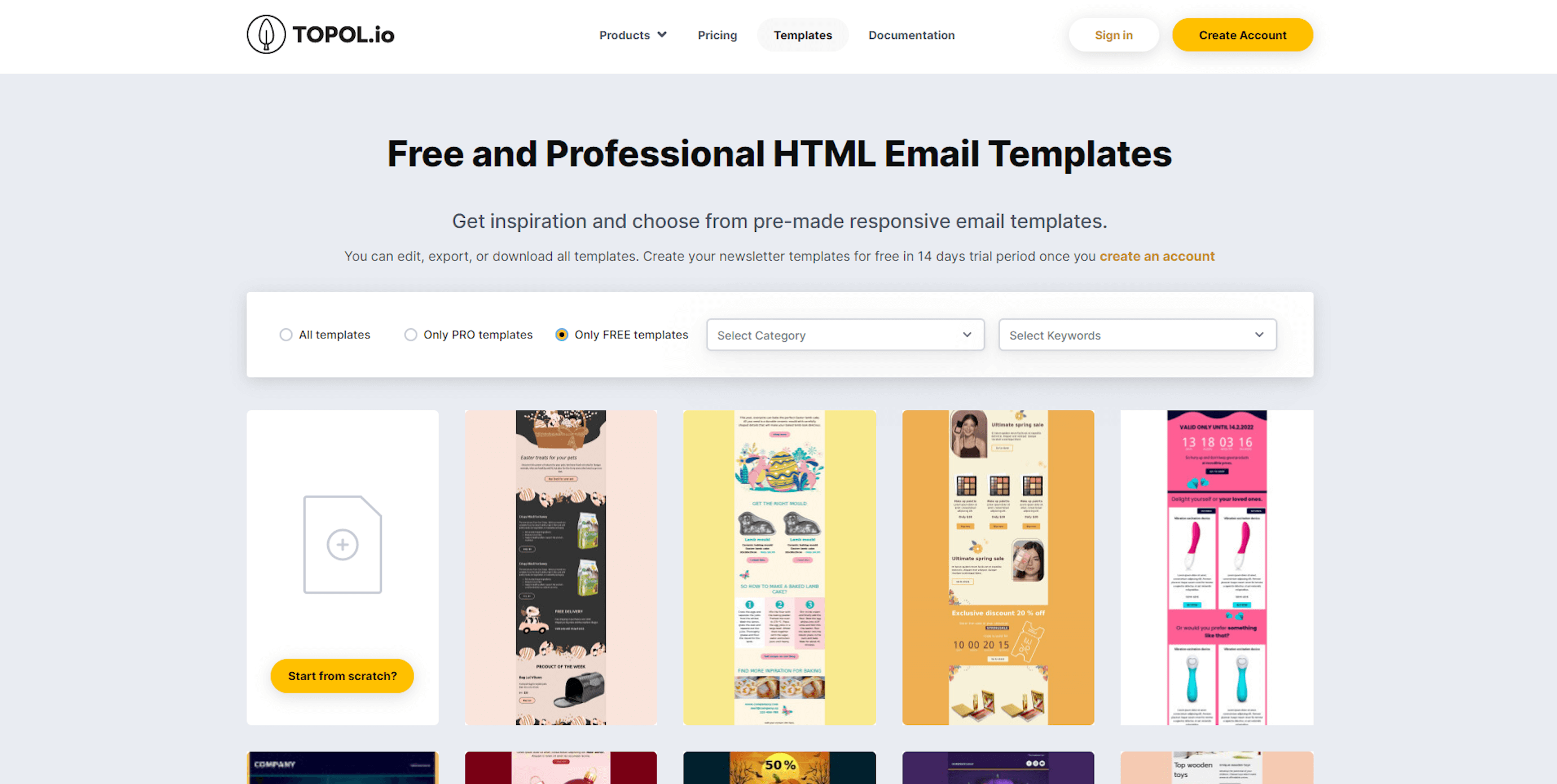
- Newsletter-focused templates. Choose from a curated selection of modern, ready-to-edit newsletter templates designed for fast customization and clean visual appeal;
- Reusable content blocks. Save frequently used sections—like headers, footers, or product showcases—to speed up future email creation;
- Mobile-responsive design. All templates automatically adjust to display perfectly across devices, from desktop to smartphone.
Pros & Cons
- Intuitive drag-and-drop editor
- Responsive, mobile-friendly email templates
- Reusable content blocks and HTML export
- Affordable for small teams and freelancers
- Limited advanced customization
- Some UI quirks and minor bugs
- Fewer templates than top competitors
- Lacks dynamic content and integrations
Pricing
Topol.io starts at $10/month, with a free plan available for limited use.
- Free plan available with basic features and limited exports/designs;
- Paid plans start at $10/month for expanded exports and full design capabilities (Pro plan);
- Pricing scales based on the number of exports, stored templates, or advanced features;
- Annual billing discounts available;
- Last verified: February 2026.
MJML — Developer-Centric Email Builder with Full HTML Control
MJML is a developer-centric email builder that provides full control over HTML code while simplifying the creation of responsive email templates.
Unlike drag-and-drop builders, MJML uses a custom markup language that developers can write in to generate clean, semantic HTML. It automatically converts this code into responsive emails, ensuring they display well on all devices.
While it lacks a visual interface and is not suitable for beginners, MJML offers unmatched flexibility for developers needing precise control over their email designs. Its mobile-responsive templates make it an excellent choice for creating professional, custom emails with advanced coding capabilities.
Email Builder Features
- Editor Type. MJML uses a command-line interface (CLI) or integration with various development environments, allowing developers to write email templates in an easy-to-understand markup language that converts into responsive HTML code. This offers precise control over every element of the email;
- HTML & Code Control. With MJML, developers can write clean, semantic code in a user-friendly markup language. The platform ensures that emails are rendered consistently across all devices by converting MJML code into responsive HTML automatically;
- Responsive Controls. The platform’s focus on responsive email design ensures that emails automatically adjust to different screen sizes, offering a seamless experience across mobile, tablet, and desktop devices;
- Content Blocks. MJML provides a set of pre-built components, such as headers, footers, and buttons, that are fully customizable through code. These reusable blocks can be tailored to fit any email design, saving developers time while ensuring consistency;
- Preview & Testing. While MJML does not offer a visual builder, it allows for real-time testing in the form of live previews and email rendering across multiple devices. Developers can quickly spot rendering issues and correct them with precise code adjustments.
Template Library
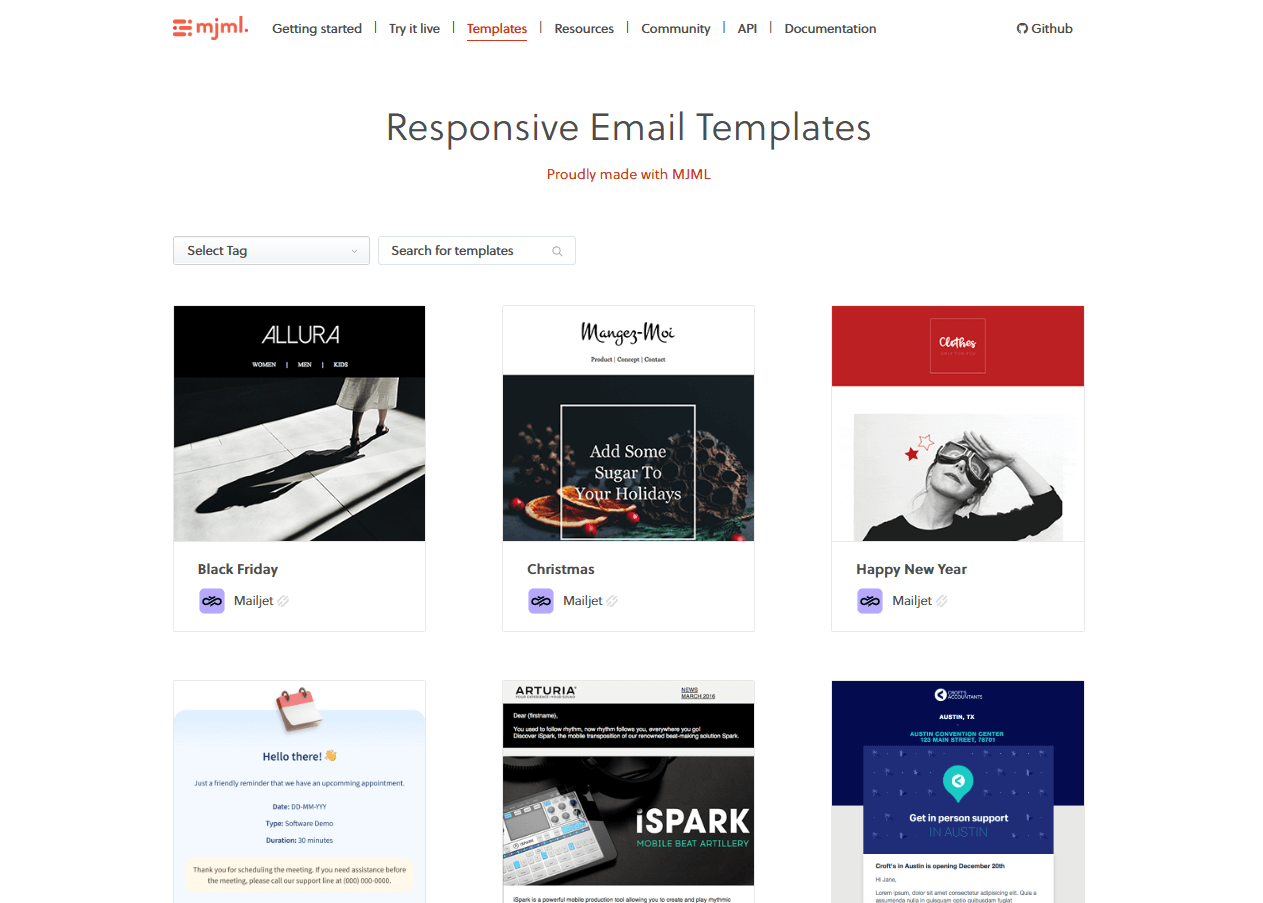
MJML doesn’t provide a traditional template library, as it is built primarily for developers who prefer to create custom designs from scratch. However, it does provide some basic components and code snippets to help get started.
- Customizable Templates. MJML users can create templates that are flexible and fully responsive by customizing code components to match the brand’s style.
- Responsive by Default. Every MJML template is built with mobile responsiveness in mind, ensuring emails look great on any device without additional adjustments.
Pros & Cons
- Full HTML control for developers
- Responsive email design out of the box
- Easy-to-understand markup language for efficient coding
- Extensive community support for troubleshooting and resources
- Not suitable for non-developers or those without coding experience
- Lack of a drag-and-drop editor or visual design features
- Limited out-of-the-box template options
Pricing
MJML is open-source which means it is free to use with no strings attached.
What Defines a Good Email Template Builder?
First and foremost, a good email service provider should help you design a beautiful email template without coding. If you’re asked to dust off your HTML skills to build an email template—that’s a no go in my books. Also, modern email builder software offers a range of templates to get started quickly without looking at a blank page.
Then, you can customize an email design quickly using the drag-and-drop email editor that supports predesigned templates and blocks (image, text, timer, review block, etc.).
Here are some characteristics that define a good email template maker:
- Ease of use. Your template builder should have an intuitive user interface. You should be able to quickly drag and drop blocks to create an engaging email template;
- Customization options. The email template generator should enable you to easily add your branding. Usually, it involves adding your brand logo, color palette, and text written in your brand voice;
- Responsive design. Email design software makes creating responsive designs that look great on any device a breeze. Plus, your design is easily visualized through the in-built preview for desktops, smartphones, and tablets;
- Advanced features. Go beyond the basics with features like dynamic content personalization, interactive elements, and conditional logic for tailored journeys;
- Template library. The email builder should have an email template library with easily accessible email templates that fits your goals;
- Integration capabilities. You should be able to connect your email template builder to your CRM, email platform, stock photo libraries, and analytics tools for a seamless workflow and data-driven decisions.
FAQs
What are the main benefits of using an email template builder?
Email template builders offer time-saving, drag-and-drop design tools that simplify the creation of responsive, mobile-friendly emails. They allow users to focus on content while ensuring professional, visually appealing results. These tools often feature pre-built templates, making it easier to create branded emails without requiring coding skills, ensuring consistency and efficiency in campaigns.
How do I choose the right email template builder for my business?
When selecting an email template builder, consider the platform’s ease of use, customization options, and integration capabilities with your existing email marketing software. You should also assess whether the tool offers mobile optimization, responsive templates, and real-time collaboration features. Evaluate how well it meets your business’s design and functionality needs while supporting your workflow.
Can I use an email template builder without coding experience?
Yes, you can use email template builders without coding experience, since most email template builders are designed for non-developers. These builders allow users to customize templates easily, even without coding knowledge. However, some tools may offer HTML customization for advanced users who want more control over their designs, providing flexibility for all skill levels.
What’s the difference between drag-and-drop and HTML-based email template builders?
Drag-and-drop builders focus on ease of use, allowing users to design emails by simply moving elements around, ideal for non-technical users. In contrast, HTML-based email builders offer full control over the code, making them suitable for developers or those requiring highly customized templates. The choice depends on your technical skills and design needs.
Are free email template builders sufficient for professional use?
No, free email template builders aren’t great for professional use. They may lack advanced features like integrations, analytics, and customization options necessary for professional, high-volume campaigns. That’s why you should start with an affordable tool that offers strong features at a low cost, like Sender.