


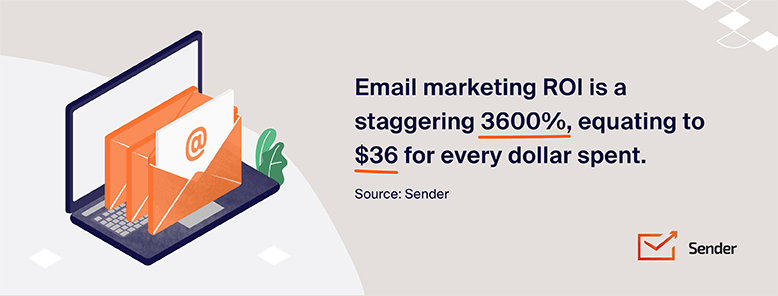
Did you know email marketing generates an average return of $36 for every $1 spent? That’s why it remains one of the most profitable marketing channels in 2025, and understanding email marketing pricing is crucial for planning your budget.
So what is email marketing? At its core, it’s a digital strategy that involves sending customized messages to groups of people via email, whether for promotional, informational, or relationship-building purposes.
Its effectiveness comes from direct communication with your target audience, making it uniquely email marketing cost-effective compared to other marketing approaches. When you create compelling emails, you can drive significant customer engagement and website traffic.
No matter the size of your business, if you’re trying to figure out how much does email marketing cost, you’ve come to the right place. This guide breaks down everything you need to know about email marketing expenses without the fluff. Whether you’re researching email marketing cost for startups or established enterprises, we’ve got you covered.
This article is part of our Email marketing guide.
How Much Does Email Marketing Cost in 2026?
Email marketing costs typically range from $0 to $500+ per month for most small to mid-sized businesses, depending on your subscriber count, sending volume, and chosen platform. Understanding email marketing platform pricing helps you make informed decisions about your marketing strategy.
| Platform | Free Plan | Paid Starting Price | 2,500 Subscribers | 10,000 Subscribers | Pricing Model | Best For |
| Sender | 2,500 subs / 15,000 emails | $7/month | $13/month | $40/month | Subscribers | Budget-conscious businesses |
| Mailchimp | 500 subs / 1,000 emails | $13/month | $45/month | $97/month | Contacts | Brand recognition & integrations |
| Brevo | 300 emails/day | $8/month | $26/month | $26/month | Email volume | Large lists, low send frequency |
| MailerLite | 500 subs / 12,000 emails | $7.50/month | $25/month | $73/month | Subscribers | Beginners & creators |
| Klaviyo | 250 contacts / 500 emails | $20/month | $60/month | $150/month | Active profiles | Ecommerce & Shopify stores |
| Constant Contact | None (60-day trial) | $12/month | $50/month | $120/month | Contacts | Event management & nonprofits |
Understanding Email Marketing Costs
Email marketing costs vary based on several factors: your list size, how often you send emails, what features you need, and whether you handle campaigns yourself or hire someone else. Smart businesses plan their email marketing budgets strategically, thinking about both immediate costs and long-term benefits.
Many organizations choose email marketing specifically because it costs less than other digital marketing strategies like direct mail. Unlike paid ads that require constant funding to maintain visibility, email marketing services help you build owned media channels through which you can communicate with your audience at a relatively stable cost over time.
When you invest in email marketing—through subscription fees, training your in-house team, or creating valuable content—you’re building lasting customer relationships, not just making a one-time purchase. This is why email marketing service cost often delivers better returns than other digital marketing services.
What’s Included in Email Marketing Costs
Understanding where your money goes helps you budget effectively and avoid surprises. Email marketing expenses break down into several key categories, some bundled into platform subscriptions and others charged separately.
Most email marketing providers include core features in their base pricing, but advanced capabilities often require upgrades or add-ons. When evaluating how your email marketing cost calculated, consider all these factors:
Platform & Software
- Monthly or annual subscription fees;
- Costs based on subscriber count or email volume;
- Tiered pricing for advanced features.
Design & Content
- Email template creation or customization;
- Copywriting for campaigns and sequences;
- Stock images or custom graphics.
Technical & Deliverability
- List verification and cleaning tools;
- Dedicated IP addresses ($20–$250/year);
- Domain authentication setup.
Add-Ons & Extras
- SMS marketing credits;
- Landing page builders;
- CRM integrations;
- A/B testing tools;
- Advanced analytics and reporting.
Optional Services
- Agency management ($500–$5,000+/month);
- Freelance specialists ($15–$200/hour);
- Strategy consulting.
Email Marketing ROI and Profitability
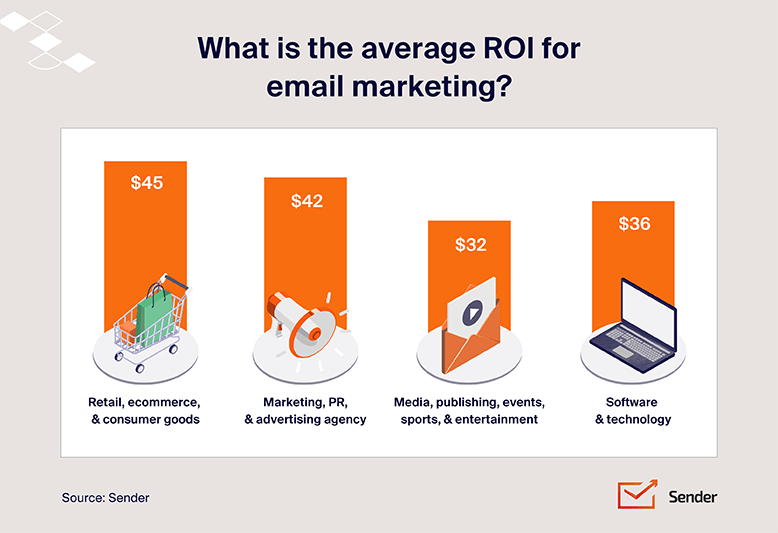
Email marketing consistently outperforms other marketing channels when it comes to return on investment (ROI). Recent email marketing statistics reveal impressive returns across different industries, making your email marketing efforts highly worthwhile:
- Retail and ecommerce: $45 return per $1 spent;
- Financial services: $36 return per $1 spent;
- Healthcare: $27 return per $1 spent;
- Travel and hospitality: $40 return per $1 spent.
These numbers explain why companies spend significant portions of their marketing budgets on email campaigns despite having so many other marketing options. For how to actually calculate email marketing ROI for your own program, see our standalone breakdown.
Take NightOwl Electronics as an example. This mid-sized retailer started using segmented email marketing in late 2024. They spent about $1,200 per month on an email marketing campaign and generated over $43,000 in revenue within just three months—that’s a 35:1 return that completely changed how they communicate with customers.
Running a successful email marketing campaign requires understanding your audience and providing value consistently.
Why does email marketing work so well from a cost perspective? It’s targeted. Unlike broad advertising that wastes money reaching people who aren’t interested, your email marketing tool lets you communicate only with people who have shown interest in what you offer.
This dramatically improves conversion rates and lowers acquisition costs. You can also add lead capture forms to your website to continuously grow your subscriber base.
Factors Influencing Email Marketing Costs
Why does one platform’s Basic Plan cost $8/month while others ask for $25? There are a few reasons to consider when evaluating email marketing pricing plans:
Email List Size
The number of email contacts in your database typically determines the base cost for most email platforms. As your subscriber base grows, businesses pay more, though many providers offer volume discounts at higher tiers.
For example, a business with 2,000 subscribers might pay about 1.5 cents per subscriber, while one with 50,000 subscribers might get rates closer to 0.8 cents per subscriber. This bulk email pricing structure helps businesses grow their email programs without costs spiraling out of control. Understanding small business email marketing cost structures helps you plan for growth.
Subscription Plans
Email marketing pricing packages typically fall into two main categories: subscription-based and pay-as-you-go email marketing models. Your email marketing subscription choice depends on your sending patterns.
Pay-as-you-go vs. subscription-based pricing for email marketing boils down to paying for each email sent versus a recurring fee for a set of features or email/subscriber allowance. Cost per subscriber and/or email volume are key factors in both models, with subscriptions often tiered by subscriber count and PAYG directly tied to email volume. When comparing email marketing software cost, consider your sending frequency carefully.
Subscription plans also typically come in tiers:
Basic plans ($15-$50/month):
- Essential features including standard email templates;
- Basic segmentation capabilities;
- Fundamental analytics;
- Limited features;
- Email support only.
Pro plans ($50-$200/month):
- Advanced automation workflows;
- Deeper analytics and reporting;
- A/B testing capabilities;
- Integration with other platforms;
- Priority support with faster response times.
Enterprise plans ($300+/month):
- Custom solutions tailored to specific needs;
- Dedicated support representatives;
- Advanced security features;
- Comprehensive API access;
- Service level agreements (SLAs);
- White labeling options.
Pay-as-you-go models charge based on how many emails you actually send rather than subscriber count. This typically costs between $0.0005 and $0.01 per email depending on volume and provider. These plans work well for businesses with irregular sending patterns or those with large databases who email subscribers infrequently. The email service provider cost varies significantly between models.
Which approach costs less? It depends on your email strategy and sending habits:
- If you send emails frequently (weekly or more), unlimited-send subscription models usually provide better value.
- If you send occasional campaigns (monthly or quarterly), volume-based pricing might save money.
- If your sending is seasonal or campaign-based, pay-as-you-go offers more flexibility.
Email Volume
The number of emails you send each month significantly impacts costs, especially if you use volume-based pricing models. Transactional messaging, automated emails, and regular newsletters all contribute to your total send volume.
Businesses implementing sophisticated drip campaigns or customer journey automation may send 10-20 emails per subscriber monthly, substantially increasing costs on volume-based plans. Conversely, companies using more restrained approaches might send only 2-4 emails monthly, keeping volume-related expenses lower. The email campaign pricing will reflect these differences.
When considering email blast cost per thousand recipients, typical rates range from $0.50 to $10 depending on your provider and plan structure. This affects your total email blast cost, which can range from a few dollars for small businesses to thousands for enterprises sending millions of messages.
Plan your sending frequency and targeting strategically to optimize this cost factor without sacrificing engagement or conversion opportunities. Consider:
- Sending to smaller, more targeted segments rather than your entire list;
- Prioritizing transactional and triggered emails over mass broadcasts;
- Implementing frequency caps based on engagement levels;
- Using preference centers to let subscribers control email frequency.
Email List Quality and Verification
Maintaining a clean email list directly impacts both your costs and campaign performance. Most platforms charge based on subscriber count, so paying for invalid, inactive, or duplicate contacts wastes money. Using an email verification service can save significant costs over time.
List verification services typically cost $3–$10 per 1,000 emails and help you:
- Remove invalid or misspelled addresses;
- Identify spam traps and disposable emails;
- Reduce bounce rates and protect sender reputation;
- Lower monthly platform fees by trimming inactive subscribers.
Regular list hygiene—removing unengaged contacts every 3–6 months—can cut platform costs by 10–30% while improving deliverability rates. Many businesses find that a smaller, verified list outperforms a larger, unverified one in both engagement and ROI. This also helps optimize future campaigns.
| Service | Cost per Email | Volume Discounts |
| ZeroBounce | From ~$0.003–$0.006 per email | Yes—lower rates at higher verification volumes |
| NeverBounce | From ~$0.003–$0.008 per email | Yes—tiered pricing with bulk discounts |
| BriteVerify | From ~$0.004–$0.010 per email | Yes—custom pricing for high-volume users |
Campaign Complexity
The sophistication of your email campaigns directly affects both platform requirements and labor costs. Basic newsletters require minimal investment in tools and expertise, while complex personalized journeys demand robust technology and specialized skills. A professional marketing agency can help manage these complex campaigns effectively.
Basic email blasts with standardized content typically need only entry-level platform capabilities costing $20-$100 monthly. But implementing multi-step automations with conditional logic, personalized content, and behavioral triggers requires advanced platforms costing $100-$500+ monthly, plus the expertise to configure these systems. Many businesses turn to a marketing agency for this specialized work.
Does advanced complexity justify the additional cost? It depends entirely on your business goals and audience. Evidence from Epsilon’s 2024 Email Marketing Research* shows sophisticated personalization can increase conversion rates by 30-50% compared to basic campaigns, potentially justifying higher investment for businesses with substantial average order values or lifetime customer values.
Consider this comparison – a retail business sending basic promotional emails might spend money on a basic email platform costing $200 monthly. A SaaS company implementing complex onboarding, retention, and upsell sequences might invest $600 monthly for advanced capabilities with marketing automation integration. So, the SaaS company might see dramatically different engagement and conversion metrics that make the higher expense worthwhile.
Common complexity factors that impact costs include:
- Dynamic content that changes based on customer information;
- Behavioral triggers based on website or app interactions;
- Predictive send-time optimization;
- A/B testing at scale across multiple variables;
- Coding only design elements for interactive experiences;
- Advanced segmentation using multiple data points.
Email Platform Choice
Your choice of platform significantly affects your overall budget — see the 14 best email marketing platforms compared head-to-head for a deeper feature breakdown alongside the pricing comparison below. Major providers like Mailchimp, Klaviyo, AWeber, and Campaign Monitor offer different pricing models and feature sets designed for different business types. A marketing agency can help you navigate these options based on your specific needs.
Entry-level platforms like Sender provide essential functionality at lower price points, with plans starting around $10-$25 monthly for small lists. Mid-market solutions like Mailchimp and AWeber cost $20-$500 monthly depending on subscriber count and features. Premium specialized platforms like Klaviyo, with advanced ecommerce capabilities, typically start around $30-$50 monthly but quickly scale to $150-$700+ for growing businesses.
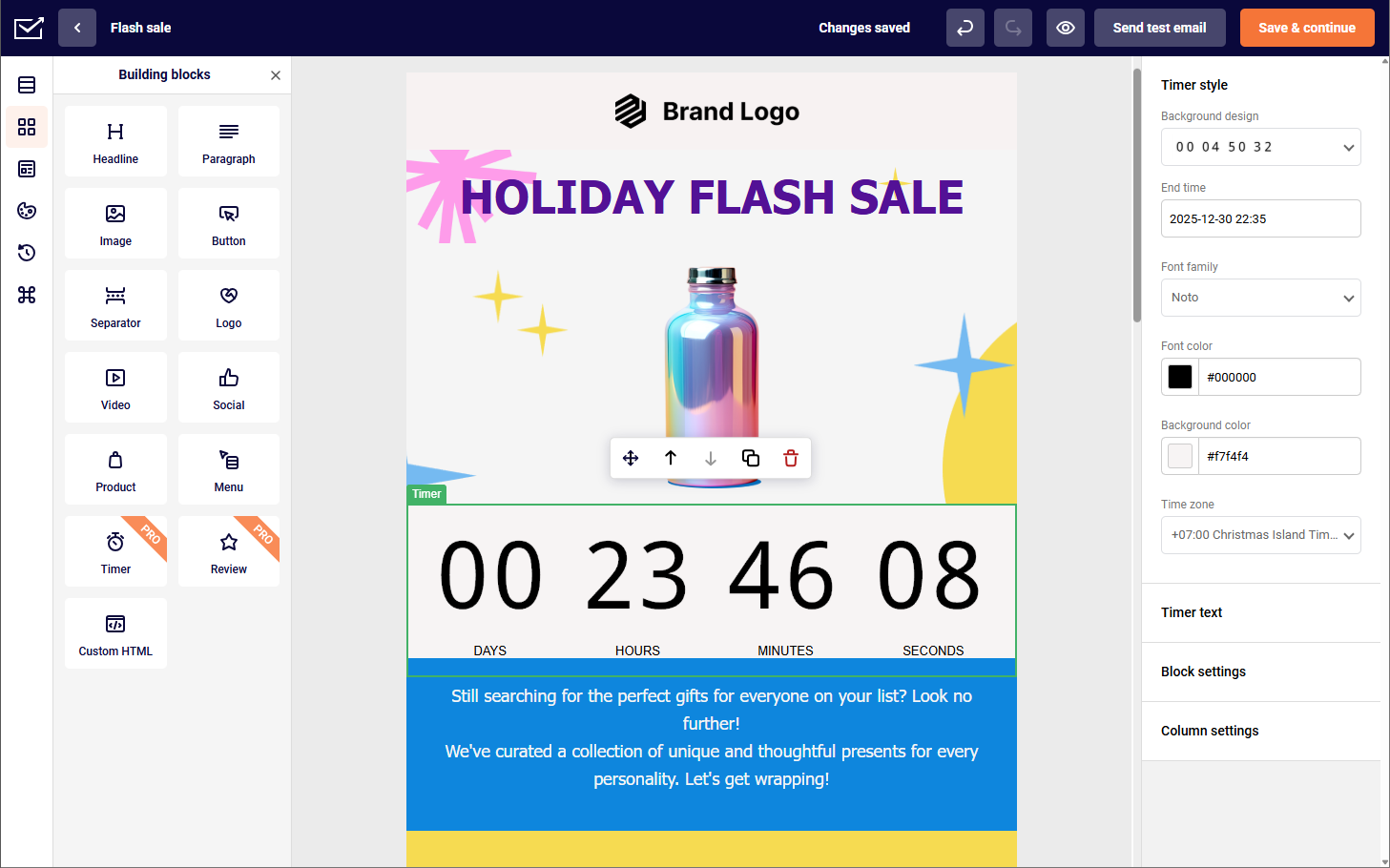
For low cost email marketing options, you might explore newer platforms with competitive introductory rates, but always ensure they have the core features you need. Take advantage of advanced tools like automation, segmentation, and a drag-and-drop builder with Sender. The best part? It’s free!
Take advantage of advanced tools like automation, segmentation, and a drag-and-drop builder with Sender. The best part? It’s free!
Migration Costs and Setup Costs
Switching email platforms or starting fresh involves upfront expenses that many businesses overlook when budgeting — though switching to a more affordable platform without losing data or workflows is increasingly handled by guided migration services.
Migration costs vary based on complexity:
- Simple migrations (under 10,000 contacts): $0–$500;
- Mid-size migrations with automations: $500–$2,500;
- Enterprise migrations with custom integrations: $2,500–$10,000+.
Common setup expenses include:
- Data cleaning before import
- Template redesign to match new platform requirements;
- Rebuilding automation workflows and sequences;
- Re-integrating with CRM, ecommerce, or analytics tools;
- Staff training on new software.
Some platforms offer free migration assistance, while others charge premium onboarding fees ($100–$500+). Factor in 2–4 weeks of potential performance dips during transition as you rebuild sender reputation. Always export your data and document existing workflows before switching to minimize downtime and lost functionality. Some migrations may require custom API development for complex integrations.
In-House vs. Outsourcing
Handling email marketing in-house or hiring external help can dramatically affect your cost structure. A marketing agency can provide expertise that might be difficult to build in-house.
In-house email marketing typically requires:
- Platform subscription costs ($30-$500+ monthly);
- Staff time for campaign development (10-30 hours monthly);
- Design resources for template creation and maintenance;
- Content creation time for email copywriting and crafting subject lines;
- Technical expertise for integration management.
By contrast, outsourcing to an email marketing agency might cost $500-$5,000 monthly but eliminates the need for internal expertise and tool investments. Freelance specialists charging $15-$200 hourly provide targeted expertise without the overhead of full-time staff. The email marketing agency cost varies based on the scope of services.
For businesses with consistent, high-volume email needs, building internal capabilities often costs less long-term. However, companies with irregular campaigns or specialized needs frequently find better value in external marketing resources that provide on-demand expertise.
When comparing in-house vs. outsourcing costs, consider these factors:
- Your current team’s technical capabilities and available time;
- The complexity of your planned email campaigns;
- The frequency of your email sending;
- Your need for specialized design or copywriting;
- Integration requirements with your other systems;
- Your budget’s preference for fixed costs vs. variable expenses.
How Email Marketing Costs Scale with Business Size
As organizations grow, their email marketing requirements—and associated costs—evolve in predictable patterns. Understanding these scaling factors helps businesses forecast expenses and make appropriate infrastructure decisions. Partnering with a marketing agency can help manage this growth effectively.
Small businesses (under 10,000 subscribers)
Small businesses typically operate with straightforward email marketing budgets ranging from $100–$500 monthly. At this scale, costs primarily cover platform subscriptions, occasional template customization, and limited time from general marketing staff. Understanding email marketing cost for startups helps new businesses plan their budgets effectively.
Small businesses focus on finding platforms offering good functionality at entry-level prices, often utilizing limited free versions to establish initial processes before upgrading to a paid platform. A marketing agency can help small businesses maximize their limited budgets.
Strategy characteristics:
- Simple newsletters (weekly or bi-weekly);
- Basic welcome sequences;
- Promotional campaigns for sales;
- Limited segmentation;
- Focus on building list foundation.
Medium businesses (10,000–50,000 subscribers)
Medium businesses see costs expand to $500–$2,000 monthly as they implement more sophisticated strategies. At this stage, dedicated email marketing personnel become common, adding $40,000–$70,000 in annual staffing costs. Integration with CRM systems and ecommerce platforms becomes essential, and development expenses during implementation may add one-time costs. Many medium businesses work with a marketing agency for specialized projects.
Additional requirements include advanced segmentation and automation requiring more robust platforms, A/B testing and optimization becoming regular practices, and specialized design resources needed for template creation.
Strategy differences:
- Multi-touch nurture campaigns;
- Behavioral trigger sequences (cart abandonment, browse abandonment);
- Customer lifecycle segmentation;
- Re-engagement campaigns;
- Product recommendation engines;
- Regular optimization and testing cadence.
Large enterprises (50,000+ subscribers)
Large enterprises typically invest $2,000–$10,000+ monthly in advanced email systems. Enterprise implementations involve:
- Advanced platform subscriptions with custom pricing agreements;
- Custom development work and specialized consulting from a marketing agency;
- Enterprise-grade security requirements and compliance monitoring;
- Complex approval workflows spanning multiple departments;
- International compliance considerations and legal oversight;
- Dedicated email teams handling everything from content calendars to deliverability;
- Deep integration with other marketing technologies in the enterprise stack.
Strategic sophistication:
- Omnichannel campaign orchestration;
- Predictive analytics and AI-powered optimization;
- Advanced personalization engines;
- Account-based marketing integration;
- Complex customer journey mapping;
- Dedicated deliverability monitoring;
- Multi-brand management capabilities.
Average Email Marketing Costs by Type
Different email types serve distinct purposes and carry varying cost structures. Understanding these differences helps you allocate budget effectively across your email program and improve customer engagement.
| Email Type | Setup Cost | Ongoing Cost | Best For | ROI Timeline |
| Newsletter | $50–$500 | $100–$1,000/month | Brand awareness, content distribution | 3–6 months |
| Transactional | $200–$2,000 | $0.001–$0.01/email | Order confirmations, receipts | Immediate |
| Behavioral/Triggered | $500–$5,000 | $200–$2,000/month | Cart recovery, re-engagement | 1–3 months |
| Promotional | $100–$800 | $200–$1,500/month | Sales, product launches | Immediate–2 weeks |
Newsletter Emails
Newsletters are regularly scheduled emails that deliver valuable content, company updates, or curated information to subscribers. They build long-term relationships and keep your brand top-of-mind between purchases. Tracking performance through Google Analytics helps optimize newsletter effectiveness.
Cost breakdown:
- Template design: $50–$300 (one-time);
- Copywriting: $50–$500 per issue;
- Platform costs: $20–$500/month (based on list size);
- Images/graphics: $0–$100 per issue;
- Total per send: $0.01–$0.05 per subscriber.
Best for:
- Content publishers and media companies;
- B2B businesses nurturing long sales cycles;
- Brands building community and loyalty.
Transactional Emails
Transactional emails are automated messages triggered by specific user actions, such as purchases, password resets, or account updates. Recipients expect them and enjoy open rates of 40–50%—far higher than marketing emails. These automated emails are essential for customer communication, and unlike phone calls, they provide instant, documented responses.
Cost breakdown:
- Initial setup and integration: $200–$2,000;
- Per-email sending costs: $0.001–$0.01;
- Dedicated transactional ESP (optional): $15–$100/month;
- Template development: $100–$500 per template;
- Monthly cost for 10,000 emails: $10–$100.
Best for:
- Ecommerce order confirmations and shipping updates;
- SaaS account notifications and receipts;
- Financial services statements and alerts.
Behavioral/Triggered Emails
Behavioral emails are automated messages sent based on subscriber actions or inactions, such as browsing products, abandoning carts, or going inactive. They deliver highly relevant content at precisely the right moment, and a marketing agency can help set up sophisticated behavioral triggers.
Cost breakdown:
- Automation setup: $500–$5,000 (one-time);
- Platform with automation features: $50–$500/month;
- Copywriting for sequences: $200–$1,000 per workflow;
- Ongoing optimization: $100–$500/month;
- Integration with tracking tools: $0–$300/month.
Best for:
- Ecommerce cart and browse abandonment recovery;
- SaaS onboarding and activation sequences;
- Re-engagement campaigns for dormant subscribers.
Promotional Emails
Promotional emails are sales-focused messages designed to drive immediate action, such as purchases, sign-ups, or event registrations. They include flash sales, product launches, seasonal campaigns, and limited-time offers. Understanding email marketing agency pricing helps when outsourcing promotional campaign creation.
Cost breakdown:
- Campaign strategy and planning: $100–$500;
- Email design and copywriting: $100–$800 per campaign;
- A/B testing setup: $0–$200;
- List segmentation: Included or $50–$200;
- Platform sending costs: $0.001–$0.02 per email;
- Total per campaign (10,000 subscribers): $150–$1,200.
Best for:
- Retail and ecommerce seasonal sales;
- Product launches and new feature announcements;
- Event promotions and webinar registrations.
Email Marketing Price Comparison
Let’s see how much you can expect to pay and receive in return:
Email Marketing Platforms
Selecting the right email service provider requires evaluating pricing structures against your specific feature needs and growth projections. Below, we examine email marketing rates among leading providers based on current market offerings according to G2’s 2025 Email Marketing Software Grid*.
| Feature/Plan | Sender | Mailchimp | Klaviyo | AWeber | HubSpot |
| Starting Price | $7/month (2.5K) | $13/month (0.5K) | $20/month (0.25K) | $12.50/month (0.5K) | $9/user/month (1K) |
| 10K Subscribers | $40/month | $96/month | $150/month | $84/month | $302/month |
| 25K Subscribers | $82/month | $235/month | $400/month | $175/month | $703/month |
| Free Plan | Up to 2,500 subs | Up to 500 subs | Up to 250 subs | No | Yes |
| Automation | Advanced on all plans | Limited on basic, full on premium | Full on all paid plans | Full on all paid plans | Advanced on high tiers |
| Ecommerce | Essential integration | Advanced with higher tiers | Advanced with all plans | Basic integration | Limited on basic, advanced on high tiers |
These comparisons reveal significant variations in how providers structure their pricing for similar subscriber counts.
- Klaviyo pricing positions it as a premium solution with specialized ecommerce capabilities justifying higher rates;
- Sender offers more benevolent pricing and a generous feature package to gain market share;
- Mailchimp pricing reflects their established market position and brand recognition;
- AWeber pricing targets small businesses with moderate scaling costs;
- HubSpot pricing targets small businesses, while scaling costs are quite high.
Beyond the baseline subscription costs, each platform offers distinct advantages for specific business types:
- Klaviyo works best for ecommerce operations requiring sophisticated product recommendation engines;
- Sender provides excellent value for content-focused businesses prioritizing deliverability;
- Mailchimp offers strong design capabilities and user-friendly interfaces;
- AWeber provides reliable deliverability and strong customer support;
- HubSpot includes numerous marketing automation tools beyond emails via the Marketing Hub.
When comparing social media marketing to email marketing from a cost perspective, email typically delivers acquisition costs 40-60% lower* according to recent comparative studies. While social media excels at awareness building and top-of-funnel engagement, email marketing demonstrates superior conversion rates and customer retention metrics at lower implementation costs.
Many businesses achieve optimal results by using social media for audience building and email for nurturing and conversion.
Email Marketing Agency
Partnering with a specialized marketing agency for email marketing execution represents a significant investment but eliminates the need for internal expertise development and platform management.
Current market rates for agency services typically fall between $2,500-$10,000 monthly depending on campaign volume, complexity, and required services. Finding a good email marketing agency requires evaluating their track record and service offerings. However, note that most agencies prefer to work with clients who have clear goals and established brand guidelines.
Entry-level marketing agency engagements starting around $1,000-$2,500 monthly typically include:
- Campaign calendar management;
- Basic template design and maintenance;
- Standard content development;
- Regular performance reporting.
Mid-tier partnerships ($2,500-$5,000 monthly) expand these services to include:
- Advanced segmentation strategy;
- Customer journey development;
- A/B testing programs;
- Deeper analytics and optimization.
Premium marketing agency relationships ($5,000-$10,000+ monthly) provide comprehensive services and management including:
- Full-service strategy development;
- Custom coding for interactive elements;
- Integration with broader marketing initiatives;
- Deliverability monitoring and management.
When evaluating agencies, consider the cost of constant contact with a dedicated team versus managing campaigns in-house. According to the 2024 Analysis of Agency Costs Survey Report*, businesses with 20,000+ subscribers working with specialized agencies report average annual returns 22% higher than those managing email marketing in-house, despite the higher initial investment.
This improved performance stems from several marketing agency advantages:
- Specialized expertise in deliverability optimization;
- Advanced segmentation techniques not available in-house;
- Continuous testing methodologies that internal teams often lack resources to develop;
- Access to specialists across design, copywriting, and technical implementation;
- Experience across multiple clients and platforms 10,000 monthly depending on campaign volume, complexity, and required services.
Partnering with a specialized agency eliminates the need for internal expertise but requires significant investment. Agencies bring dedicated teams, proven processes, and cross-client insights that in-house teams often lack. Most agencies offer tiered service packages, though hourly work remains common for specific projects or consulting engagements.
Agency Pricing Models Explained
Understanding how agencies charge helps you negotiate better contracts and choose the right partnership model for your needs.
| Pricing Model | % of Agencies | How It Works | Best For |
| Fixed Project | 25 % | Set price for defined deliverables (e.g., $3,000 for automation setup). Scope changes trigger additional fees. | One-time projects with clear requirements—template redesigns, platform migrations, automation builds |
| Time & Materials | 20 % | Billed hourly or daily based on actual work performed. Requires detailed time tracking and regular reporting. | Exploratory projects, ongoing optimization, or undefined scopes where flexibility is essential |
| Retainer | 35 % | Fixed monthly fee for agreed-upon services and hours. Unused hours may or may not roll over. | Ongoing partnerships requiring consistent support—campaign management, strategy, monthly reporting |
| Agile/Phased | 8 % | Project broken into phases with separate pricing. Each phase approved before next begins. | Complex implementations, large-scale migrations, or businesses testing agency fit before full commitment |
| Value-Based | 7 % | Pricing tied to projected business impact rather than hours worked. Higher upfront cost, aligned incentives. | Established businesses with clear revenue goals and sufficient historical data to project outcomes |
| Performance-Based | 5 % | Fees tied to results (revenue generated, leads captured, conversion improvements). Often includes base fee plus bonus. | Ecommerce and lead-gen businesses confident in their product-market fit and tracking capabilities |
Choosing the right model:
- Predictable budgets: Retainer or Fixed Project;
- Maximum flexibility: Time & Materials or Agile/Phased;
- Aligned incentives: Performance-Based or Value-Based;
- Testing an agency: Fixed Project or Agile/Phased.
Hourly Rate Structures
Hourly billing remains common for consulting, audits, and project-based work where scope is difficult to define upfront. Rates vary significantly based on experience level, geographic location, and specialization.
What influences hourly rates:
- Experience and track record: Specialists with proven results and case studies command 50–100% premiums;
- Geographic location: US/UK agencies charge 2–3x more than Eastern European or Asian counterparts;
- Specialization depth: Niche experts (deliverability, ecommerce, B2B) price higher than generalists;
- Agency overhead: Boutique consultants often charge less than large agencies with higher operational costs.
When hourly pricing makes sense:
- Strategic audits and one-time assessments;
- Consulting on specific challenges (deliverability issues, automation architecture);
- Training internal teams on platform usage or best practices;
- Short-term projects with undefined or evolving scope.
Common hourly engagements and typical costs:
- Email program audit: 5–15 hours ($500–$2,500);
- Automation strategy session: 3–8 hours ($300–$1,500);
- Deliverability troubleshooting: 5–20 hours ($750–$6,000);
- Template design and coding: 4–12 hours ($300–$1,800);
- Team training workshop: 4–8 hours ($400–$2,000).
What you can expect to pay for different levels of specialization depth:
| Rate Structure | Role/Level | Hourly Rate | Typical Responsibilities |
| Entry-Level | Junior Specialist | $15–$50/hour | Basic campaign execution, list management, template updates, performance reporting, scheduling sends |
| Mid-Tier | Mid-Level Expert | $50–$100/hour | Automation setup, A/B testing, segmentation strategy, copywriting, analytics interpretation, platform migrations |
| Senior-Tier | Senior Strategist | $100–$200/hour | Program audits, strategic planning, deliverability consulting, complex automation architecture, team training |
| Specialist | Deliverability Expert | $150–$250/hour | Inbox placement optimization, IP warming, sender reputation repair, blacklist remediation, authentication setup |
| Specialist | Email Developer | $75–$150/hour | Custom HTML/CSS coding, interactive email elements, template systems, cross-client rendering fixes |
| Specialist | Copywriting Expert | $50–$150/hour | Subject line optimization, email copy, sequence writing, brand voice development, conversion copywriting |
| Executive | Fractional Email Director | $200–$350/hour | C-suite consulting, department building, vendor selection, annual strategy, budget planning, team hiring |
Service-Specific Agency Costs
Marketing agency pricing varies significantly based on service type. Some services lend themselves to project-based pricing, while others require ongoing support. Understanding typical costs by category helps you budget accurately and identify where agencies add the most value.
| Service Category | Common Services | Cost Range | Pricing Model |
| Content Creation | Email copywriting, subject line development, content calendars | $50–$500/email or $500–$3,000/month | Per piece or retainer |
| Template design (custom HTML/CSS) | $200–$2,000/template | Per project | |
| Creative asset production (graphics, GIFs, interactive elements) | $100–$800/asset or $1,000–$5,000/month | Per piece or retainer | |
| Analytics | Performance reporting and dashboards | $300–$1,500/month | Retainer |
| A/B testing program management | $500–$2,000/month | Retainer | |
| Attribution modeling and ROI analysis | $1,000–$5,000/project | Per project | |
| Customer journey analytics | $2,000–$10,000/project | Per project | |
| Strategic | Email program audit | $1,000–$5,000 | Per project |
| Annual strategy development | $2,500–$15,000 | Per project | |
| Customer segmentation strategy | $1,500–$7,500 | Per project | |
| Lifecycle marketing planning | $2,000–$10,000 | Per project | |
| Technical | Platform migration | $1,000–$10,000+ | Per project |
| Automation workflow setup | $500–$3,000/workflow | Per project | |
| Deliverability remediation | $1,500–$8,000 | Per project or hourly | |
| Custom integrations (API, CRM, ecommerce) | $2,000–$15,000 | Per project | |
| Dedicated IP warming | $500–$2,500 | Per project |
Agency vs. In-House Cost Comparison
Deciding between building internal capabilities or outsourcing depends on your email volume, budget, and strategic importance of the channel. This comparison breaks down true costs for a business with 20,000+ subscribers running a moderately sophisticated email program.
| Cost Component | In-House Team (20K+ subs) | Full-Service Agency (20K+ subs) |
| Manager salary | $55,000–$85,000/year | Included in retainer |
| Design resources | $15,000–$30,000/year (partial FTE or freelance) | Included in retainer |
| ESP/Platform | $1,200–$4,800/year | $1,200–$4,800/year (client pays) or included |
| Additional tools(testing, analytics, verification) | $1,200–$3,600/year | Included or client pays |
| Training & development | $1,000–$3,000/year | Not required |
| Overhead(benefits, equipment, management) | $15,000–$25,000/year | None |
| Agency retainer | N/A | $36,000–$96,000/year ($3,000–$8,000/month) |
| Total Annual Cost | $88,400–$151,400 | $37,200–$100,800 |
| Typical Performance | Baseline (varies with experience) | +20–30% above baseline |
Freelance Email Marketing Services
For businesses seeking specialized expertise without marketing agency overhead, freelance email marketing professionals offer flexible engagement models typically structured around hourly rates or project-based fees.
Freelance email marketing specialists command varying rates based on expertise level:
- Junior specialists: $15-$50/hour;
- Mid-level experts: $50-$100/hour;
- Senior strategists: $100-$200/hour.
Many businesses adopt hybrid models, maintaining platform subscriptions and basic operations in-house while engaging freelancers for specialized projects.
This approach provides access to expert guidance without the commitment of full-service marketing agency relationships.
The freelance model works particularly well for businesses with irregular campaign schedules or those requiring specialized expertise for specific initiatives while handling routine execution internally.
Hidden Costs of Email Marketing
Beyond obvious subscription and service fees, comprehensive email marketing budget planning must account for several less apparent cost factors that significantly impact total investment:
Integration expenses often surprise businesses implementing new email platforms. While most providers advertise seamless connections with popular CRMs and ecommerce systems, complex integrations frequently require:
- Development resources costing $500-$5,000;
- Ongoing maintenance as systems are updated;
- Custom API work for non-standard connections;
- Staff time for testing and troubleshooting.
Custom template development represents another significant hidden expense:
- Standard templates often don’t match brand guidelines;
- Professional design services cost $500-$2,500;
- Ongoing maintenance as brand guidelines evolve;
- Additional costs for responsive/mobile optimization.
Email advertising cost often extends beyond just the platform fees when you factor in all these additional considerations.
Legal Compliance Costs
Email marketing operates under strict regulations worldwide, and non-compliance carries severe penalties. GDPR fines can reach €20 million or 4% of global revenue, while CAN-SPAM violations cost up to $50,120 per email. Beyond avoiding penalties, compliance builds subscriber trust and improves deliverability.
Key regulations affecting email marketers:
- CAN-SPAM (US): Requires unsubscribe options, physical address, honest subject lines;
- GDPR (EU/UK): Mandates explicit consent, data access rights, breach notification;
- CCPA/CPRA (California): Grants opt-out rights and data deletion requests;
- CASL (Canada): Requires express consent with strict documentation;
- LGPD (Brazil): Similar to GDPR with local enforcement.
Typical compliance costs:
| Compliance Area | Cost Range | Frequency |
| Legal consultation (initial setup) | $1,000–$10,000 | One-time |
| Privacy policy drafting/updates | $500–$3,000 | Annual |
| Consent management platform | $0–$500/month | Ongoing |
| Compliance audit | $2,000–$15,000 | Annual |
| Staff training | $500–$2,000 | Annual |
| Data processing agreements | $500–$2,500 | As needed |
| Cookie consent tools | $0–$100/month | Ongoing |
| Record-keeping systems | $0–$200/month | Ongoing |
Template Design, Copywriting, Tools, Add-ons
Beyond platform subscriptions and marketing agency fees, several ancillary costs can significantly impact your email marketing budget. These expenses are often overlooked during planning but add up quickly—especially as programs mature and require greater sophistication.
Template Design
Professional email templates ensure brand consistency, mobile responsiveness, and optimal rendering across 90+ email clients. Costs vary based on complexity and customization level.
Cost-saving tip: Invest in 3–5 modular templates upfront rather than designing one-off emails. A $2,000 template system pays for itself within months compared to $300 per custom design.
Copywriting
Compelling copy drives opens, clicks, and conversions. Whether you hire freelancers, agencies, or build in-house capabilities, quality writing requires investment.
What influences copywriting costs:
- Industry complexity (B2B, technical, regulated sectors cost more);
- Research requirements and brand voice development;
- Revision rounds included;
- Copywriter experience and proven conversion results.
Essential Tools
Most email programs require supplementary tools beyond the core ESP platform. Budget $50–$500 monthly depending on program sophistication.
Common Add-Ons
Platform add-ons extend functionality but increase monthly costs. Evaluate ROI carefully before enabling.
Email Marketing Cost Calculator
Want to know how much you can expect to pay when choosing a specific platform? Here’s a handy cost calculator for comparing costs:
Free or Low-Cost Email Marketing Solutions
For businesses with limited marketing budgets or those just beginning their email marketing journey, cheap email marketing tools that don’t compromise on basics offer free or low-cost options with varying capabilities and limitations:
| Platform | Free Plan Limit | Key Limitations | Upgrade Path |
| Sender | 2,500 subscribers + 15,000 emails/month | Sender branding, no SMS marketing | $7/month for branding removal and extra features |
| Mailchimp | 250 subscribers + 500 emails/month | Limited templates, no automation | $18/month for automation |
| Klaviyo | 250 subscribers + 500 emails/month | Limited sends, reduced support | $20/month for full access |
| AWeber | No free plan | 14-day trial only | $13/month minimum |
| Constant Contact | No free plan | 60-day trial only | $12/month minimum |
| HubSpot | 1,000 subscribers + 2,000 emails/month | Limited email automation | $9/user/month for extra features |
These entry-level solutions provide viable starting points for small businesses or solopreneurs testing email marketing strategies before committing to paid solutions.
When evaluating free plans, carefully assess limitations that might constrain marketing: effectiveness:
- Sending volume restrictions;
- Template variety and customization options;
- Automation capabilities;
- Analytics and reporting depth;
- Segmentation possibilities;
- Deliverability monitoring;
- A/B testing availability.
Businesses leveraging free plans should develop migration strategies before reaching subscriber limits to ensure seamless transitions when upgrades become necessary.
For organizations with highly limited budgets but growing needs, several bulk email services offer nonprofit discounts (typically 15-25%) or educational pricing that can make premium features accessible at reduced rates for qualifying organizations.
Tips for Email Marketing Cost Reduction
If there’s a set price, it doesn’t mean that you can’t get more out of what you pay for. Here’s how:
Pick a Platform for Your Needs and Budget
Begin by thoroughly documenting your specific requirements, distinguishing between essential features and “nice-to-have” capabilities. For instance, a content publisher might prioritize newsletter templates and scheduling flexibility, while an ecommerce business requires robust product integration and abandoned cart functionality.
Evaluate platforms offering month-to-month contracts initially, allowing you to test capabilities before committing to annual agreements that typically provide 10-20% savings but reduce flexibility. As your strategy matures, annual commitments can reduce your email marketing budget while providing cost certainty.
Consider your growth trajectory when selecting platforms. Migration between systems typically costs $1,000-$5,000 in technical resources and temporary performance disruption, making it economical to select platforms that accommodate 12-24 months of projected growth rather than focusing exclusively on current requirements.
The pricing structure you choose should align with your business model and sending behavior for optimal cost-efficiency.
Leverage Free and Trial Versions
Most major email marketing platforms offer generous free trials (14-60 days) or forever free versions with subscriber limitations. These options provide valuable opportunities to thoroughly evaluate platform fit before financial commitment.
During trial periods, test all critical workflows rather than basic functionality. Configure sample automation sequences, experiment with segmentation capabilities, and evaluate analytics depth to ensure the platform meets your comprehensive needs rather than just surface-level requirements.
Many providers also offer free version options for businesses with limited subscriber bases. These free trials enable new businesses to establish email marketing programs without initial investment, then transition to paid plans as subscriber numbers grow and feature requirements expand.
Regularly Clean and Segment Your Email List
List maintenance represents one of the most effective cost-control measures for subscription-based email marketing platforms. Regular removal of inactive subscribers can significantly reduce monthly expenses while simultaneously improving engagement metrics and deliverability rates.
Implement quarterly reengagement campaigns targeting subscribers showing no activity for 90+ days. Those who remain unengaged after specific reactivation attempts should be removed from active sending lists.
Advanced segmentation strategies allow targeted communication rather than broad-based sending to entire databases. By delivering specific messages only to relevant subscriber segments, businesses reduce unnecessary send volume while improving engagement rates—a dual benefit affecting both cost and performance.
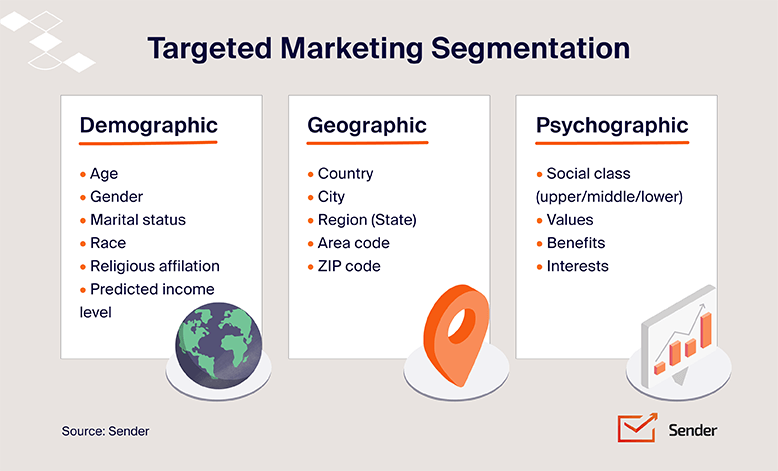
For businesses using volume-based pricing models, implementing preference centers enabling subscribers to select content categories and frequency preferences can substantially reduce send volume while improving relevance and engagement—directly impacting both costs and effectiveness.
Utilize Automation To Reduce Manual Efforts
Strategic automation implementation can dramatically reduce the labor costs associated with email marketing while improving campaign performance and consistency. Automated workflows eliminate repetitive tasks that typically consume 5-15 hours weekly for marketing teams managing manual campaigns.
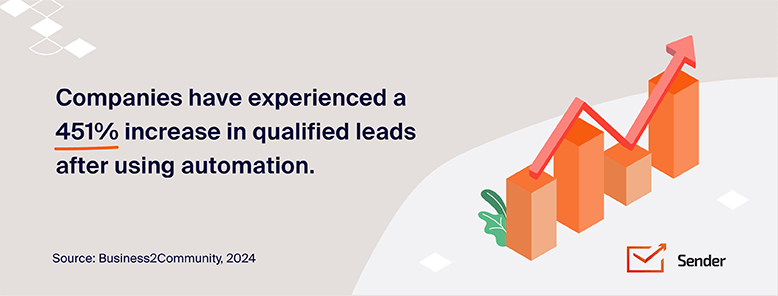
Begin with fundamental automation sequences delivering reliable returns:
- Welcome series for new subscribers;
- Abandoned cart recovery (for ecommerce);
- Post-purchase follow-up sequences;
- Renewal or replenishment reminders.
These baseline automations typically generate 30-40%* of email-attributed revenue while requiring only initial setup and periodic optimization rather than ongoing campaign development.
Advanced behavioral triggers based on website interactions, purchase history, or engagement patterns further expand automation capabilities. These sophisticated sequences may require more substantial initial investment but operate with minimal ongoing maintenance while delivering highly relevant communications.
For businesses with limited technical resources, template-based automation systems offering pre-configured sequences require minimal customization while providing much of automation’s efficiency benefit without specialized expertise requirements.
How to Plan Your Email Marketing Budget
Effective email marketing budgeting requires more than picking a platform and hoping for the best. A strategic approach aligns your investment with business goals, accounts for hidden costs, and builds in flexibility for optimization. Whether you’re starting fresh or restructuring an existing program, systematic planning prevents overspending and ensures every dollar drives measurable results.
Strategic Planning Questions
Before allocating a budget, answer these foundational questions to clarify your needs and avoid misaligned investments.
Business Goals & Revenue Expectations
- What specific outcomes do you expect from email marketing? (Revenue, leads, retention, engagement)
- What percentage of total revenue should email generate? (Industry average: 15–30% for ecommerce)
- What’s your customer lifetime value, and how does email impact it?
- Are you prioritizing acquisition, retention, or reactivation?
Audience & List Considerations
- What’s your current list size, and what’s your 12-month growth projection?
- How did you acquire your subscribers? (Quality impacts deliverability and engagement)
- What’s your current engagement rate? (Active subscribers vs. total list)
- Do you need to segment by geography, behavior, or lifecycle stage?
Resource Assessment
- Who will execute campaigns—in-house team, freelancers, or agency?
- What’s your team’s current skill level with email marketing?
- How much time can realistically be dedicated to email weekly?
- Do you have design resources, or will you rely on templates?
Technical Requirements
- What integrations do you need? (CRM, ecommerce, analytics)
- Do you require advanced automation or simple broadcast capabilities?
- What’s your sending frequency and volume?
- Do compliance requirements (GDPR, HIPAA) affect platform choice?
Competitive Context
- How sophisticated are competitors’ email programs?
- What subscriber expectations exist in your industry?
- Are there seasonal peaks requiring budget flexibility?
Calculate and Allocate Your Budget
Use this framework to build a realistic email marketing budget based on your business size and goals.
Step 1: Determine Total Budget Range
Start with industry benchmarks, then adjust based on your strategic priorities.
Step 2: Allocate Across Categories
Distribute your budget based on program maturity and in-house capabilities.
Step 3: Build Your Monthly Budget
Example allocation for a growing ecommerce business (15,000 subscribers, $1,500/month budget):
Step 4: Plan for Variables
Build 10–15% buffer for unexpected costs:
- Platform tier upgrades as list grows;
- Peak season sending increases;
- Emergency deliverability remediation;
- New automation or integration projects.
Measuring Email Marketing ROI
Tracking the right metrics ensures your budget delivers results. Focus on metrics that connect email activity to business outcomes—not just vanity numbers.
Core ROI Formula:
Email Marketing ROI = ((Revenue from Email – Email Marketing Costs) / Email Marketing Costs) × 100
Example: $50,000 revenue from email campaigns with $5,000 total costs ROI = (($50,000 – $5,000) / $5,000) × 100 = 900% ROI
Essential Metrics Table
| Metric | Formula | What It Measures | Healthy Benchmark | Action If Low |
| Open Rate | (Opens ÷ Delivered) × 100 | Subject line effectiveness, sender reputation | 20–25% | Test subject lines, verify sender name, check deliverability |
| Click-Through Rate (CTR) | (Clicks ÷ Delivered) × 100 | Content relevance, CTA effectiveness | 2.5–4% | Improve copy, redesign CTAs, segment audiences better |
| Click-to-Open Rate (CTOR) | (Clicks ÷ Opens) × 100 | Email content quality for engaged readers | 10–15% | Enhance content value, strengthen offer, improve design |
| Conversion Rate | (Conversions ÷ Clicks) × 100 | Landing page and offer alignment | 2–5% | Optimize landing pages, improve offer relevance, reduce friction |
| Revenue Per Email (RPE) | Total Revenue ÷ Emails Sent | Direct monetary value per send | $0.05–$0.25 | Segment for relevance, personalize offers, test pricing |
| Revenue Per Subscriber (RPS) | Total Revenue ÷ Total Subscribers | List monetization efficiency | $1–$5/month | Improve engagement, re-engage dormant subscribers, prune list |
| List Growth Rate | ((New Subs – Unsubscribes) ÷ Total List) × 100 | Audience building momentum | 2–5%/month | Increase lead magnets, optimize signup forms, promote list |
| Unsubscribe Rate | (Unsubscribes ÷ Delivered) × 100 | Content-audience fit, send frequency | Under 0.5% | Reduce frequency, improve relevance, set expectations |
| Bounce Rate | (Bounces ÷ Sent) × 100 | List hygiene, data quality | Under 2% | Clean list regularly, verify new signups, remove invalid emails |
| Spam Complaint Rate | (Complaints ÷ Delivered) × 100 | Permission quality, content expectations | Under 0.1% | Review acquisition sources, honor preferences, improve content |
| Customer Lifetime Value (Email) | Avg. Purchase × Purchase Frequency × Retention Period | Long-term email subscriber value | Varies by industry | Nurture relationships, cross-sell/upsell, loyalty programs |
| Cost Per Acquisition (CPA) | Email Costs ÷ New Customers from Email | Acquisition efficiency | Varies by industry | Improve targeting, optimize welcome series, test offers |
Summary
Email marketing continues to represent one of the most cost-effective channels available to modern businesses, with implementation costs ranging from under $100 monthly for small operations to several thousand dollars for enterprise-scale programs. The key to maximizing return on this investment lies in strategic platform selection, efficient resource allocation, and continuous optimization of both technical and content elements.
As we progress through 2026, businesses face an increasingly sophisticated email marketing landscape requiring thoughtful budget allocation. The fundamental value equation remains compelling—no other digital channel consistently delivers comparable returns across industries and business models. With average returns of $36 per dollar invested and even higher performance in select sectors, email marketing ROI justifies continued investment even as costs for advanced capabilities increase.
The larger email marketing picture — strategy, creative, list health, deliverability — determines whether that input pays back. For businesses looking to optimize email marketing costs without sacrificing performance, Sender offers a powerful mix of affordability, robust features, and scalability—typically 30-40% cheaper than comparable solutions.
Sources:
- https://www.litmus.com/resources/state-of-email/
- https://www.epsilon.com/resources/email-marketing-research
- https://www.g2.com/categories/email-marketing
- https://www.winsavvy.com/email-marketing-vs-social-media-marketing-key-statistics/
- https://www.aaaa.org/resource/2024-analysis-of-agency-costs-survey-report/
- https://www.structured.agency/post/simple-guide-on-email-automation