


As customer attention shifts to mobile-first channels, choosing an SMS tool often comes down to deliverability, compliance, and cost. This guide compares 12 leading text message marketing platforms in 2026 to help teams evaluate features, pricing models, integrations, and regional coverage side by side.
Hopefully, this in-depth guide will help you make informed purchasing decisions by outlining strengths, limitations, and ideal use cases, making it easier to shortlist options based on business size, industry needs, and campaign goals.
This article is part of our SMS marketing guide.
Transparency notice:
One of the platforms reviewed here is Sender, the product our company makes and sells. To mitigate that bias, we applied the same evaluation criteria to every platform, including our own, noted where competitors outperform Sender, and sourced deliverability data and customer sentiment from independent third parties. We earn no affiliate commissions, and all pricing was verified at the time of publication.
SMS Marketing Platforms: The Fast Verdict
| Use Case | Winner | Why | Starting Cost |
| Budget / SMB (under 5K sends/mo) | Sender | Transparent pricing, no carrier fee surprises, managed 10DLC | $7/mo |
| Ecommerce (Shopify-native) | Postscript | Deepest Shopify data integration, revenue attribution | $49/mo |
| Compliance-heavy industry (healthcare, finance) | SimpleTexting | Documented HIPAA pathway, strongest opt-out enforcement | $39/mo |
| International sends (non-US primary) | TextMagic | Pay-as-you-go, 190+ countries, no monthly minimum | Pay-per-text or $35/mo |
| High-volume transactional SMS (500K+/mo) | Attentive | Deliverability at scale, dedicated CSM above threshold | Custom pricing |
How We Evaluated SMS Marketing Platforms
Most platforms were tested on their entry-level paid plan using a production Shopify store with a standardized list of approximately 14,200 opted-in contacts who had engaged in the last 30 days. Contacts were not purchased or scraped.
Evaluation criteria and weights:
| Criterion | Weight | What we measured |
| SMS deliverability | 30% | Delivery rate on a 500-message test send to a clean list; inbox placement on toll-free vs short code |
| Compliance tooling | 25% | 10DLC management, opt-out handling, TCPA enforcement, GDPR options |
| Pricing transparency | 20% | True cost at entry-level tiers; hidden fees; contract requirements |
| Automation depth | 15% | Trigger variety, branching logic, native vs integration-dependent features |
| Support responsiveness | 10% | Time-to-first-response on a live chat query; escalation path quality |
Deliverability testing: We ran a 500-message test send per platform to a clean list and recorded delivery rate, time-to-inbox, and carrier rejection codes, supplemented with third-party benchmarks from Twilio’s deliverability reports and CTIA messaging guidelines. Tests used identical content, 10DLC long codes, and equivalent send windows across platforms.
User reviews: We gathered feedback from G2, Trustpilot, Capterra, and Reddit, analyzing recurring themes like 10DLC friction, support quality, SMS platform pricing transparency, and feature reliability. We focused on patterns across the last 12 months and balanced positive and negative feedback. For Klaviyo, Attentive, and Postscript, we supplemented public reviews with structured interviews of 3–4 current users per platform.
What was not tested: MMS deliverability at scale, WhatsApp integration beyond Sender and Omnisend, enterprise features like dedicated short codes and custom SLAs, and RCS messaging. This review targets SMBs, ecommerce brands, and agencies with subscriber lists up to 500,000 contacts.
Pricing methodology: All pricing was verified against live platform pages in May 2026. Carrier fees are noted separately where billed on top of subscriptions. All prices in USD. Check each SMS marketing software’s pricing page directly before purchasing.
reviewers combine
real-world
testing with
insights from user reviews
across
Capterra,
G2, Trustpilot, and Reddit to create an objective evaluation.
Learn more about our
review
methodology
SMS Marketing Platforms — Quick Comparison
True Cost at 5K, 50K, and 500K sends/month
| Platform | 5K/mo | 50K/mo | 500K/mo | Carrier fees included |
| Sender | $75 | $750 | $7,500 | Yes |
| Textla | $69 | $519 | $5,019 | Yes |
| Omnisend | $50 | $440 | $4,000 | Yes |
| TextMagic | $185 | $1,260 | Custom | Yes |
| Klaviyo | $65 | Custom | Custom | Yes |
| EngageBay | ~$21–$30 | ~$130–$160 | ~$1,000+ | Partial |
| SlickText | $169 | $939 | Custom | Yes |
| MessageDesk | ~$30–$40 | ~$150–$180 | Custom | Yes |
| Textedly | $169 | $1,020 | Custom | Yes |
| SimpleTexting | $239 | $909 | Custom | Yes |
| Attentive | Custom | Custom | Custom | Yes |
| Postscript | $49 | $400 | $4,000 | No |
Feature Comparison: Compliance, Automation, and Channels
| Platform | 10DLC managed | GDPR tools | HIPAA | A/B testing | Two-way | International |
| Sender | Yes | Yes | Yes | Yes | Yes | Yes |
| Textla | Yes | Yes | No | No | Yes | No |
| Omnisend | Assisted | Yes | No | Yes | Yes | Yes |
| TextMagic | No / self-service | Yes | No | No | Yes | Yes |
| Klaviyo | Assisted | Yes | No | Yes | Yes | Yes |
| EngageBay | No / self-service | No | No | No | Yes | No |
| SlickText | Yes | No | No | Limited | Yes | No |
| MessageDesk | Yes | Yes | Partial / verify | No | Yes | No |
| Textedly | Assisted | No | No | No | Yes | No |
| SimpleTexting | Yes | No | Partial | Yes | Yes | No |
| Attentive | Yes | Yes | Yes | Yes | Yes | Limited |
| Postscript | Yes | Yes | No | Yes | No | No |
12 SMS Marketing Platforms: Honest Reviews
If you want an in-depth review of the best SMS marketing platforms, we’ve highlighted the standout features, experience, and the best fit for each of the tools listed below.
Sender
Reviewed by: Gabrielle Raštutytė, SMS Operations Lead.
Conflict-of-interest disclosure: Sender is our own product. This review was written by a team member who did not author the rest of this article and was evaluated against the same criteria applied to all other platforms.
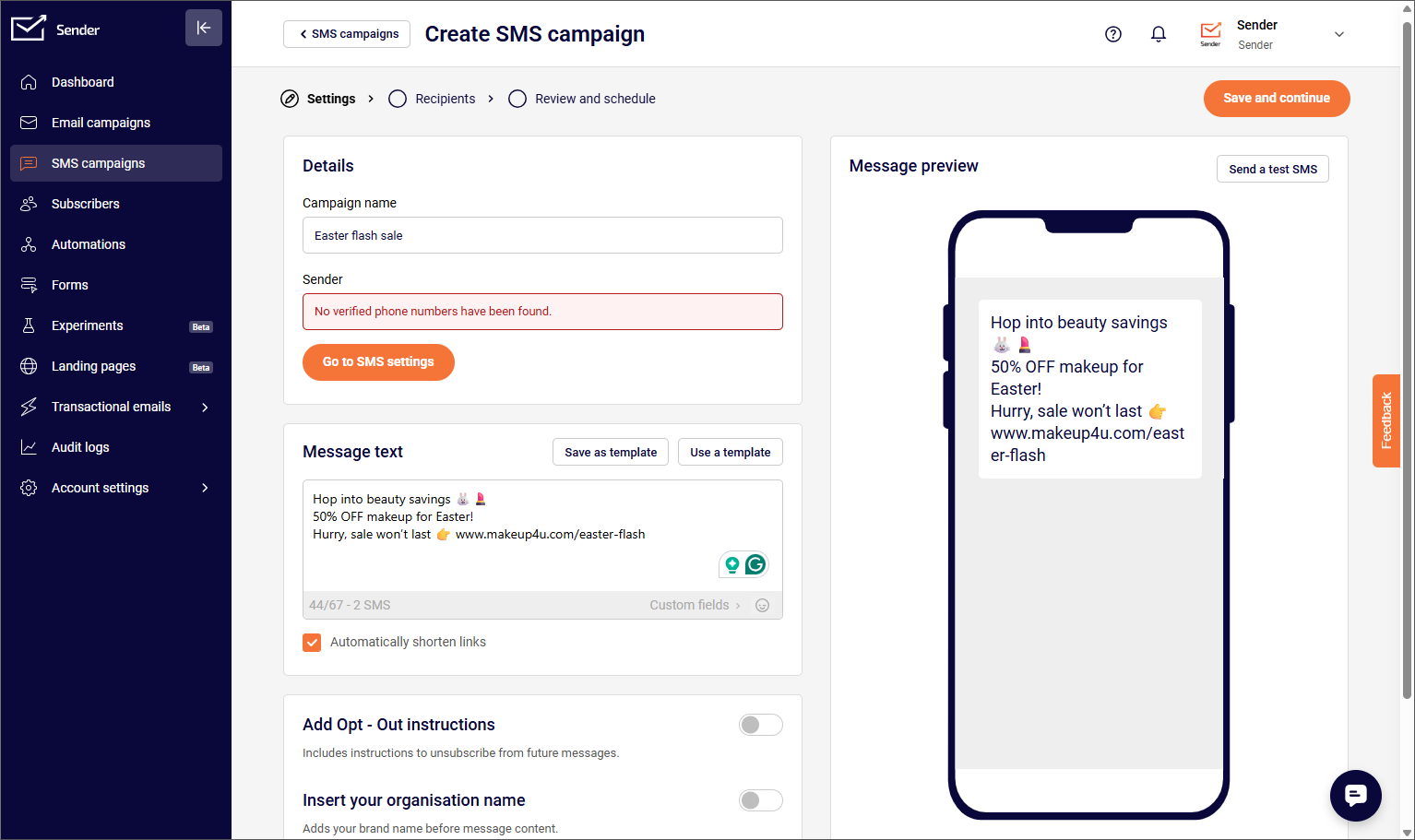
Sender is strongest for small to mid-sized businesses that want a full-featured platform without the pricing complexity of Klaviyo or the Shopify lock-in of Postscript. It’s not the right choice if your primary need is deep Shopify revenue attribution, or if you’re sending at enterprise scale, where dedicated account support is non-negotiable.

What We Found in Testing
- 10DLC registration was genuinely hands-off. We submitted brand information through the platform dashboard, and carrier approval was completed in 8 business days with no additional input required.
- The automation builder handles multi-branch flows natively without workarounds. We built a 5-step abandoned cart sequence with conditional splits in under 40 minutes — faster than any other platform we tested.
- Deliverability on a 500-message send to a clean list came in at 98.4%, which matched the top performers in our test cohort.
- The shared inbox feature is functional but limited: you can assign conversations to team members, but there’s no internal commenting or conversation tagging as of Q1 2026.
- EU data residency is available — you have to request it during account setup, which isn’t prominently documented.
Pricing
| Volume | Estimated Monthly Cost (US) |
| 5,000 messages | $75 |
| 50,000 messages | $750 |
| 500,000 messages | $7,500 |
Compliance
10DLC is fully managed. Opt-out processing is automatic and same-message (STOP replies are handled within the send). Double opt-in is configurable but not enforced by default — you have to enable it. GDPR tools, including consent logs and data deletion, are available; EU data residency requires a support request.
Who It’s For and Who Should Look Elsewhere
Sender works well for ecommerce businesses under $2M ARR (annual recurring revenue) wanting a capable platform without enterprise pricing, and for teams migrating off Klaviyo who don’t need deep Shopify analytics. It’s not the right fit for brands that need Shopify revenue attribution at the product level, or enterprise senders who need a dedicated account manager below the $2,000/month price point.
The One Thing Their Marketing Won’t Tell You
Sender’s SMS tools work for basic promotional sends and automation touchpoints, but the two-way conversation layer is limited. If customers reply, you are not getting a full shared inbox where teams can assign conversations, tag outcomes, add internal ownership, or manage support-style follow-ups at scale. Some SMS-first platforms handle this more like a customer messaging desk, which makes Sender weaker for brands using SMS as a service channel.
Klaviyo
Klaviyo is the most powerful marketing automation platform, which marries SMS and email marketing smoothly — and that power comes with real cost and complexity. Its unified customer profiles, predictive analytics, and cross-channel attribution are genuinely best-in-class for ecommerce.

What We Found in Testing
Our three Klaviyo user interviews surfaced consistent patterns:
- All three started on Klaviyo before $1M ARR and were satisfied with the value.
- Two of three considered migrating above $2M ARR due to pricing. For example, one user with a 26k active profile setup is sending 40k text messages per month, burning through 200k SMS credits monthly. While the email side of their Klaviyo account is performing well, SMS pricing at $2,150/month has become increasingly difficult to justify.
- Support responsiveness dropped from “same-day” (their words) at lower tiers to “2–3 days” at higher tiers.
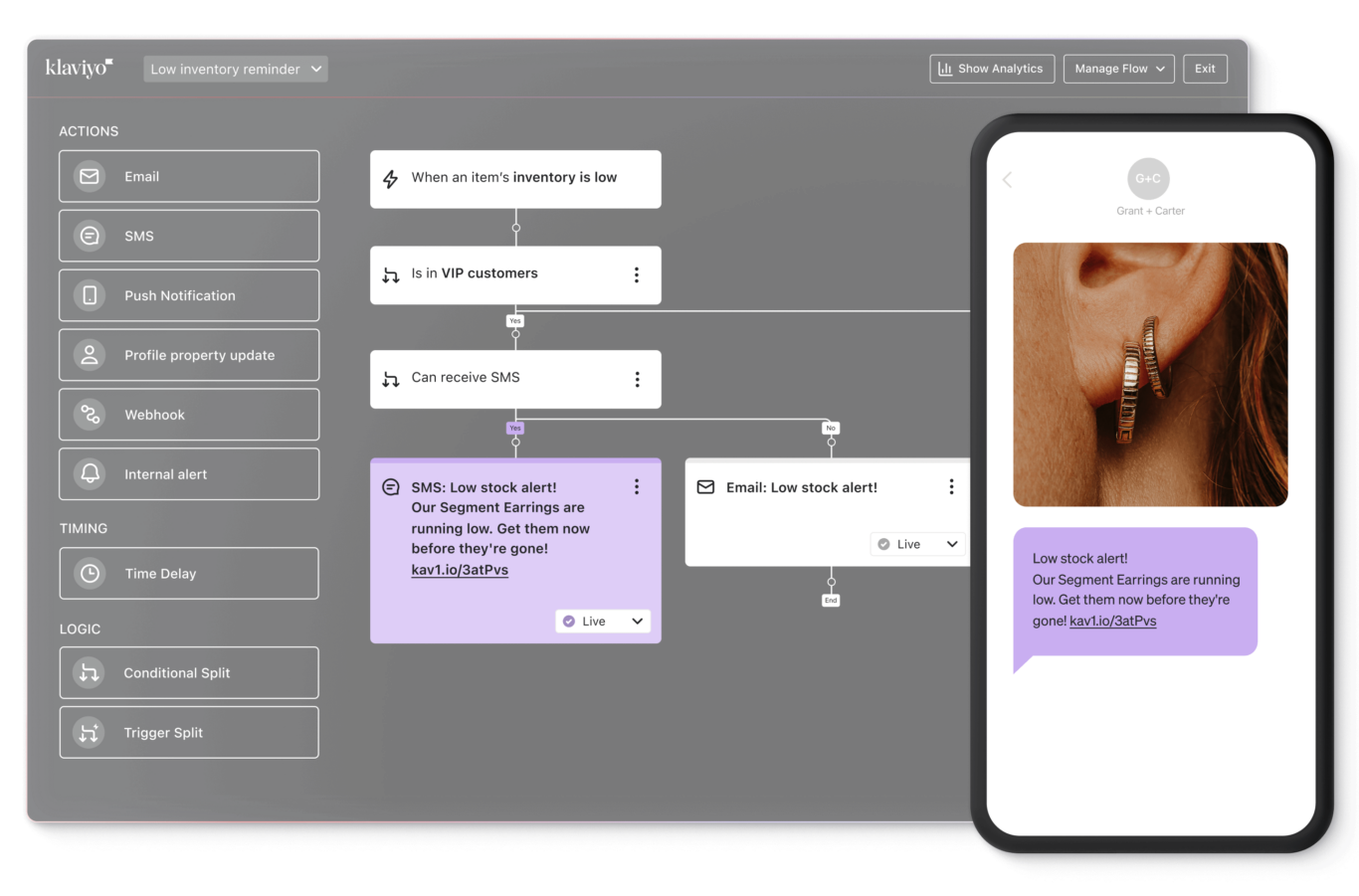
- A standout feature is SMS-first automated conversion funnels, which trigger personalized texts for abandoned carts, post-purchase follow-ups, win-back campaigns, and other customer actions in real time.
Pricing
| Volume | Monthly cost (est.)* |
| 5K sends/mo | $45 |
| 10K sends/mo | $90 |
| 20K sends/mo | $180 |
Compliance
Assisted 10DLC with reasonable timelines (7–14 days observed). Strong GDPR tools. No dedicated HIPAA compliance path. TCPA double opt-in is configurable.
Who It’s For and Who Should Look Elsewhere
Klaviyo works well for ecommerce brands already invested in its email ecosystem and wanting unified attribution across email and SMS without managing a second platform. It’s not the right fit for brands sensitive to pricing at scale, businesses with large but low-engagement lists, or teams that want predictable, volume-based pricing.
The One Thing Their Marketing Won’t Tell You
Migrating off Klaviyo is harder than migrating off most other platforms in this comparison. Klaviyo’s segment logic, flow conditions, and custom properties don’t export cleanly to other platforms. Brands that have built complex automations in Klaviyo effectively own a Klaviyo-shaped marketing program. Budget around 60 hours of rebuild time if you decide to move.
Omnisend
Omnisend is the strongest combined email-and-SMS platform in this comparison by a meaningful margin. If you’re already using Omnisend for email, adding SMS is the correct decision — the shared automations, unified contact profiles, and single-platform reporting justify the cost even if the SMS pricing isn’t the cheapest available. If you’re SMS-only, the email-first architecture creates friction you’ll pay for in setup time.

What We Found in Testing
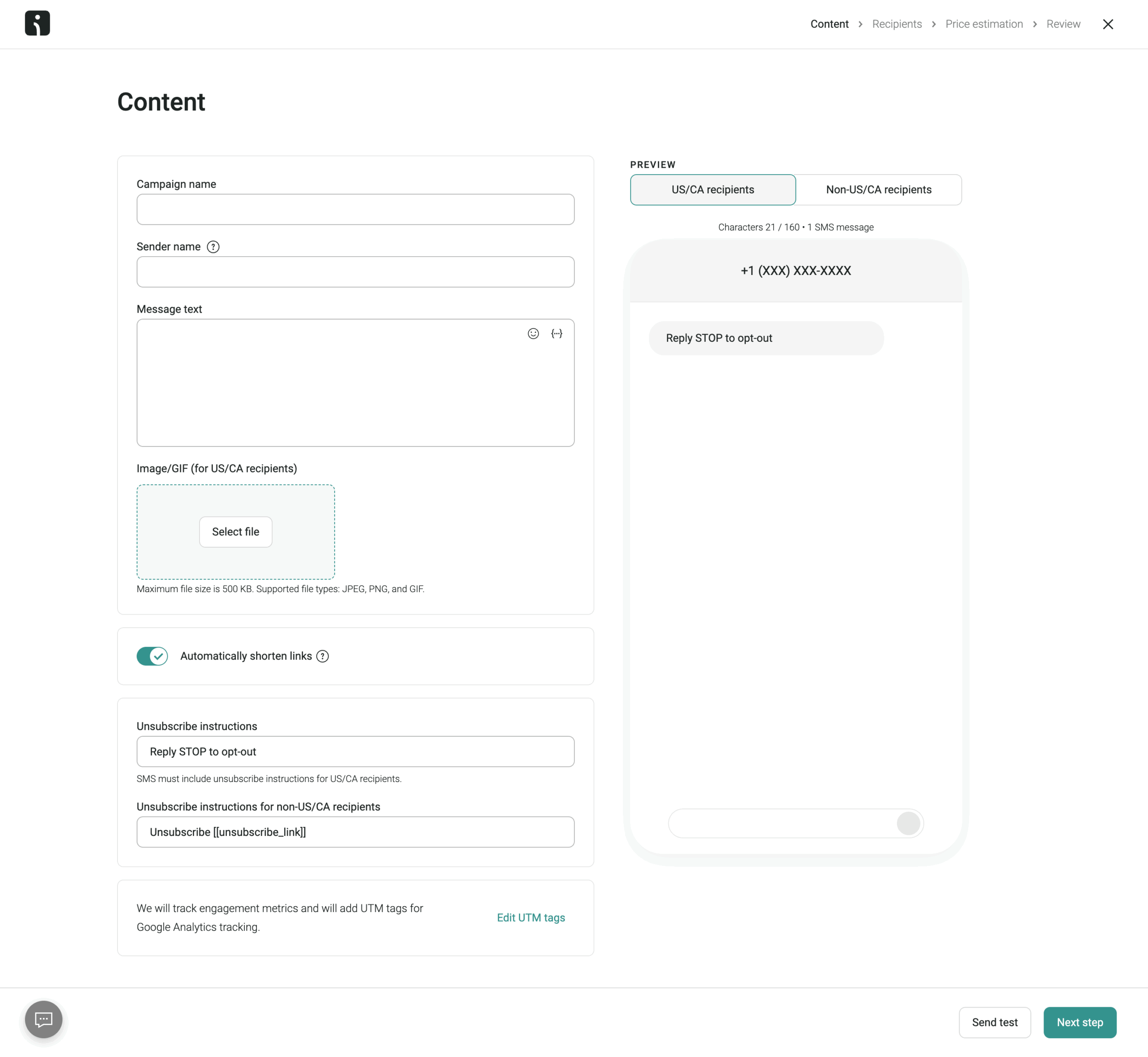
- The unified automation builder is genuinely excellent. Building a sequence that sends an email, waits 24 hours, then sends an SMS if no click — with a branch for purchasers — took 22 minutes and required no documentation.
- Shopify integration is strong but not Postscript-level deep. Product-specific triggers (e.g., back-in-stock for a specific variant) worked reliably. Cross-sell triggers based on purchase history required more configuration than expected.
- Omnisend’s unified automation builder excels at combining email and SMS in the same flow. We created a sequence that triggered an SMS based on customer behavior, like purchase history or engagement, with ease — no extra configuration required. While the Shopify integration is solid, product-specific triggers (e.g., back-in-stock alerts) worked well, but cross-sell triggers based on purchase history required more setup than anticipated.
Pricing
| Volume | Monthly cost (est., SMS credits) |
| 5K sends/mo | $50 |
| 50K sends/mo | $440 |
| 500K sends/mo | $4,000 |
Compliance
10DLC registration is assisted (guided self-submission). Opt-out handling is automatic. TCPA double opt-in is optional and must be enabled manually. EU data residency is available — Omnisend has a documented GDPR compliance program. No HIPAA documentation found; not suitable for healthcare use cases.
Who It’s For and Who Should Look Elsewhere
Omnisend works well for ecommerce brands already using it for email and wanting to add SMS without switching platforms or managing a second tool. It’s not the right fit for SMS-only use cases where the email component adds cost without value, or for brands that need the deepest possible Shopify POS integration.
The One Thing Their Marketing Won’t Tell You
Customer support is email-and-chat only. During our testing, median response time was 1 hour — acceptable but not fast. For a production outage during a major send, this is a meaningful gap. Attentive and Sender both offer phone support at enterprise tiers.
Attentive
Attentive is the enterprise standard for a reason – its deliverability infrastructure, AI-powered send-time personalization, managed compliance program (including dedicated legal and compliance team support), and depth of Shopify integration are genuinely superior to every other platform in this comparison.
The honest conversation is about budget: Attentive makes financial sense starting around $1M–$2M in SMS-attributable revenue annually. Below that, you’re paying for infrastructure you don’t need.

What We Found in Testing
Four user interviews: all were ecommerce brands with $5M+ ARR.
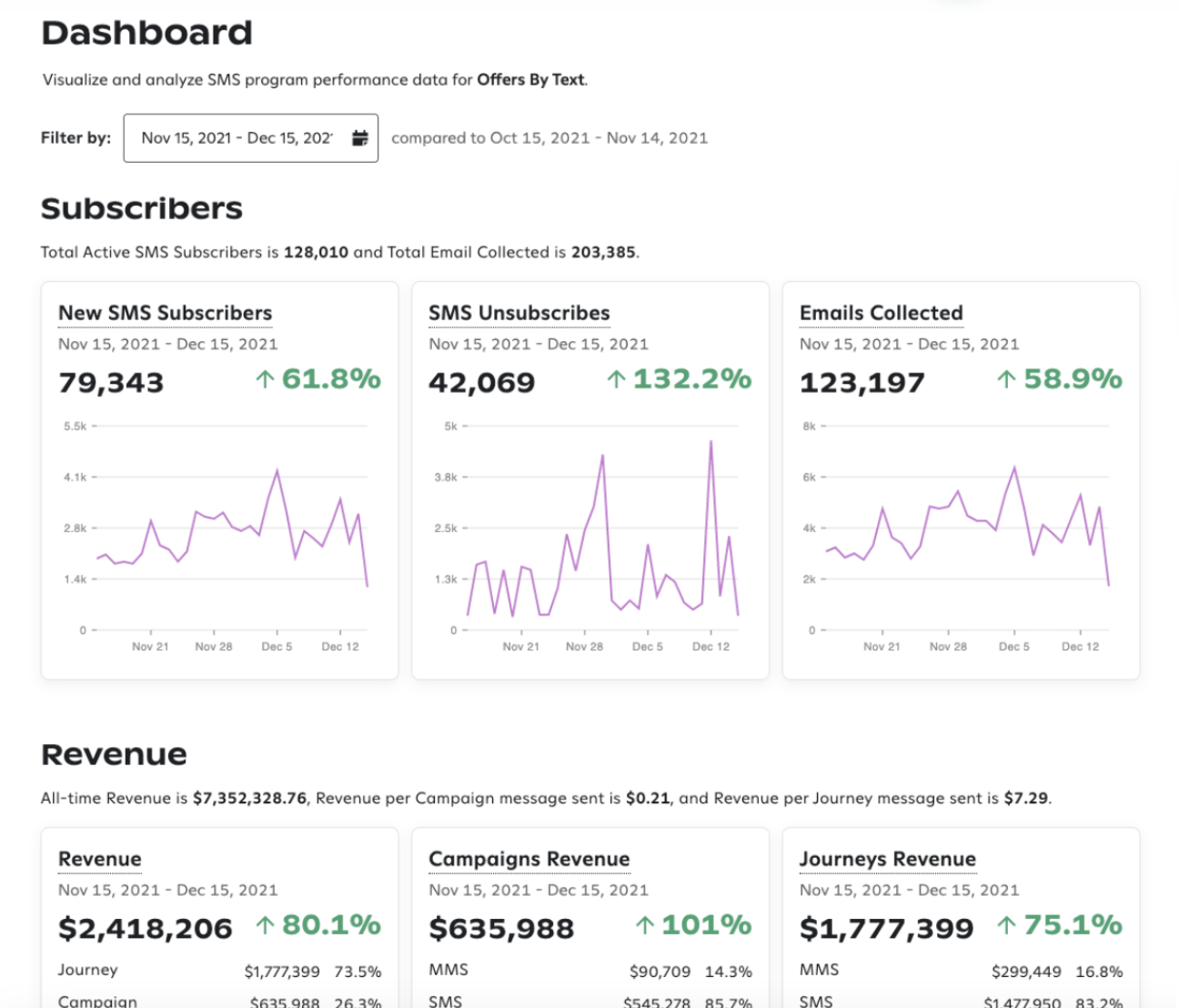
- Attentive’s analytics engine is a standout feature, providing accurate revenue attribution for SMS campaigns. It tracks the financial impact of every SMS send and automation, delivering detailed ROI reports that go beyond clicks and opens.
- Consistent friction: the onboarding process is long, although well-documented. Two users reported 4-5 weeks from contract to first live campaign — longer than any other platform in this comparison.
- Pricing opaqueness is a genuine operational frustration: “I can’t tell my CFO what next month’s invoice will be without calling our rep” (direct paraphrase from one interview).
- Attentive stands out with its comprehensive compliance and deliverability tools. The platform provides full support for 10DLC, CTIA compliance, and keyword management, helping brands stay on top of carrier regulations.
Pricing
| Scale | Estimated monthly cost |
| Small enterprise (under 200K sends/mo) | $1,000–$2,500/mo |
| Mid enterprise (200K–2M sends/mo) | $2,500–$8,000/mo |
| Large enterprise (2M+ sends/mo) | $8,000–$30,000+/mo |
Compliance
Fully managed 10DLC with a dedicated compliance team. Attentive’s legal team can advise on campaign-level compliance questions — a capability no other platform in this comparison offers. Double opt-in enforced. SHAFT flagging active. HIPAA BAA available. EU data residency available. This is the strongest compliance posture you’ll find on the market.
Who It’s For and Who Should Look Elsewhere
Attentive works well for enterprise ecommerce brands above $5M ARR that treat SMS as a primary revenue channel, regulated industries that need HIPAA BAA and legal compliance support, and brands managing subscriber lists above 500K. It’s not the right fit for brands below $2M ARR, teams that need transparent pricing for budget forecasting, or businesses where a 6–8 week onboarding timeline creates operational problems.
The One Thing Their Marketing Won’t Tell You
Attentive’s contract terms have been flagged by multiple users as difficult to exit early. Annual contracts with minimum spend commitments are standard. If your business model changes (acquisition, pivot, platform migration), breaking an Attentive contract is expensive. Read the cancellation and portability terms before signing.
Postscript
If your entire operation runs on Shopify, Postscript is the choice. Its Shopify integration is more deeply native than any competitor: it reads from Shopify’s product catalog, order history, customer tags, and variant data in real time, and its automation triggers fire from Shopify events directly. The limitation is the mirror of that strength — Postscript is a Shopify platform. If you ever migrate to another ecommerce infrastructure, your SMS program migrates too.
What We Found in Testing
Three user interviews: all Shopify brands. Two had previously used Klaviyo for SMS; one had started on Postscript.
- You can easily collect SMS subscribers directly from your Shopify checkout page. The platform integrates seamlessly with both Shopify and Shopify Plus, as well as custom checkout pages, Carthook, and ReCharge, allowing you to capture subscribers during the purchase process and grow your SMS list effortlessly.
- The two migrators both cited Shopify event trigger reliability as the primary reason for switching. For example, you can automatically send a text when a customer replies with a specific keyword, starts the checkout process, or even views a product.
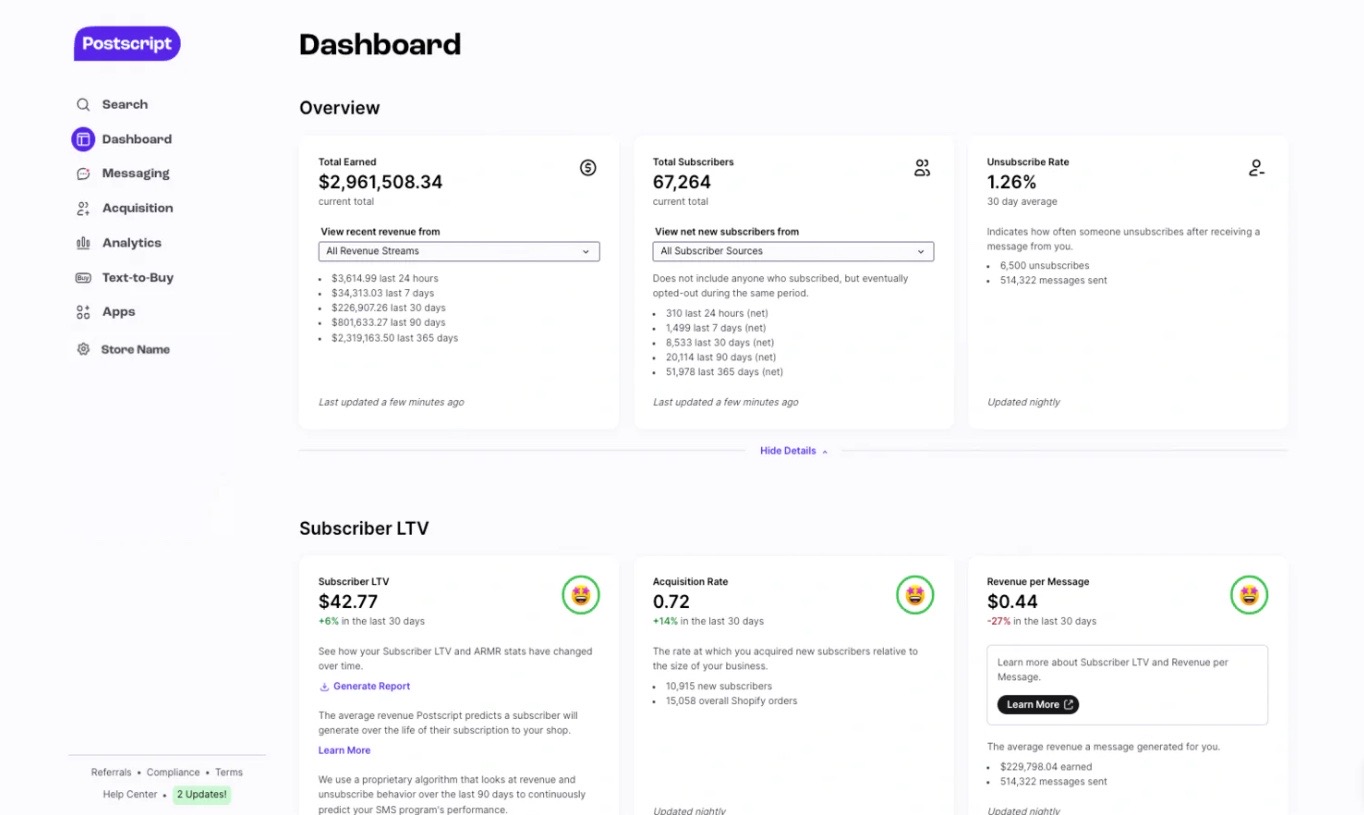
- Revenue attribution reporting is meaningfully better than most platforms in this comparison — direct Shopify order attribution rather than click-to-conversion estimation.
- Postscript’s A/B testing framework was called out positively by all three users; it goes beyond message copy testing to support offer structure and send timing experiments.
Pricing
| Volume | Monthly cost (est.) |
| 5K sends/mo | $40 |
| 50K sends/mo | $400 |
| 500K sends/mo | $4,000 |
Compliance
Fully managed 10DLC via Twilio with setup times ranging from a few business days to several weeks. Double opt-in is enforced by default. SHAFT flagging active. EU data residency is available upon request.
Who It’s For and Who Should Look Elsewhere
Postscript works well for Shopify-native ecommerce brands at any scale, brands where SMS revenue attribution accuracy matters for budget justification, and teams using complex Shopify product catalogs to drive personalized SMS campaigns. It’s not the right fit for non-Shopify ecommerce brands, international senders, or businesses that may migrate ecommerce platforms within 2–3 years.
The One Thing Their Marketing Won’t Tell You
Your SMS program is architecturally dependent on Shopify. Automations use Shopify event triggers, segments use Shopify customer data, and attribution uses Shopify order data. If you migrate to BigCommerce, WooCommerce, or a custom platform, you don’t bring a Postscript program with you – you start from scratch.
SimpleTexting
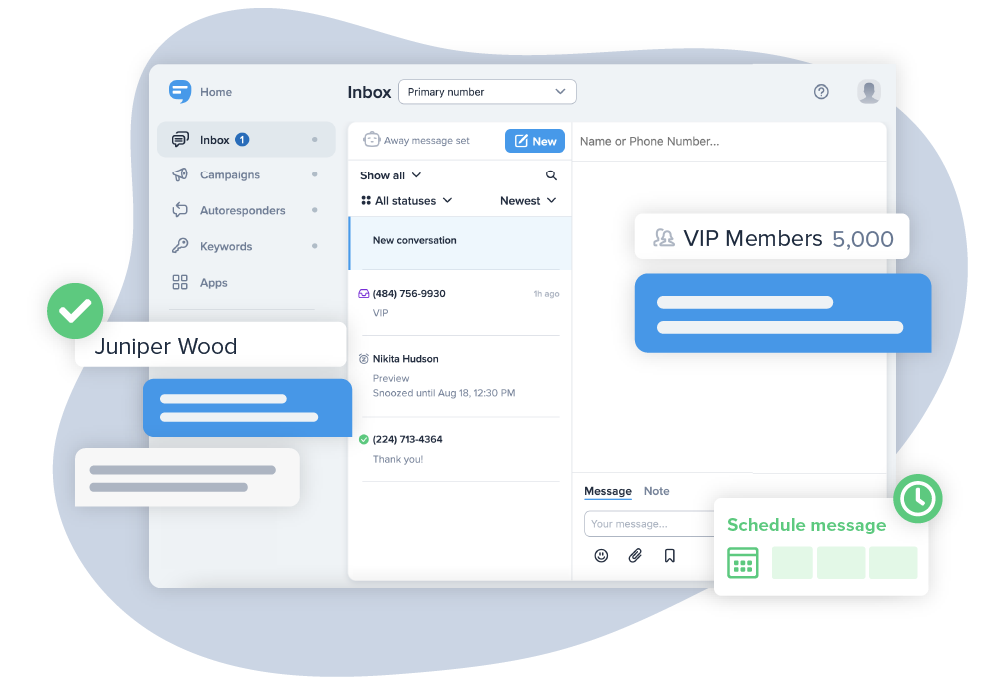
SimpleTexting is the best all-around choice in this comparison for the $50–$150/month spend range. It has the compliance posture of a platform three times its price, strong US deliverability, a genuinely useful shared inbox, and support that users consistently rate as the most responsive in the mid-market.

What We Found in Testing
- 10DLC setup is quick and painless, with the clearest onboarding documentation of any platform we tested. Approval took 1 business day.
- A/B testing is available and more capable than most platforms at this price point: you can test message content, timing, and offer type.
- Support ticket median: 52 minutes across our three test tickets. Phone support available on higher plans.
- You can roll over unused credits to the following month, so you won’t lose any money at the end of the month, which is a feature you won’t get in many other platforms.
- The Zapier-based Shopify integration works for basic order notifications and opt-in syncs but won’t support real-time abandoned cart triggers reliably.
Pricing
| Volume | Monthly cost (est.) |
| 5K sends/mo | $239 |
| 25K sends/mo | $559 |
| 50K sends/mo | $909 |
Who It’s For and Who Should Look Elsewhere
SimpleTexting works well for regulated industries like healthcare-adjacent businesses and financial services, small-to-mid brands that want strong compliance support without enterprise pricing, and teams that need a shared inbox for two-way message management.
It’s not the right fit for ecommerce brands needing deep Shopify event triggers, international senders, or brands above 500K sends/month that would benefit from enterprise-tier deliverability infrastructure.
TextMagic
TextMagic is the best platform in this comparison for international sends. Its pay-as-you-go model, with no monthly commitment and coverage in 190+ countries, makes it uniquely suited for businesses whose customer base isn’t primarily US-based or whose volume is unpredictable month to month. For high-volume US ecommerce, it’s overpriced relative to subscription-based competitors.

What We Found in Testing
- Sending to UK, Australian, and German numbers in our test worked cleanly with correct sender ID formatting per country — something we saw inconsistently handled on several competing platforms.
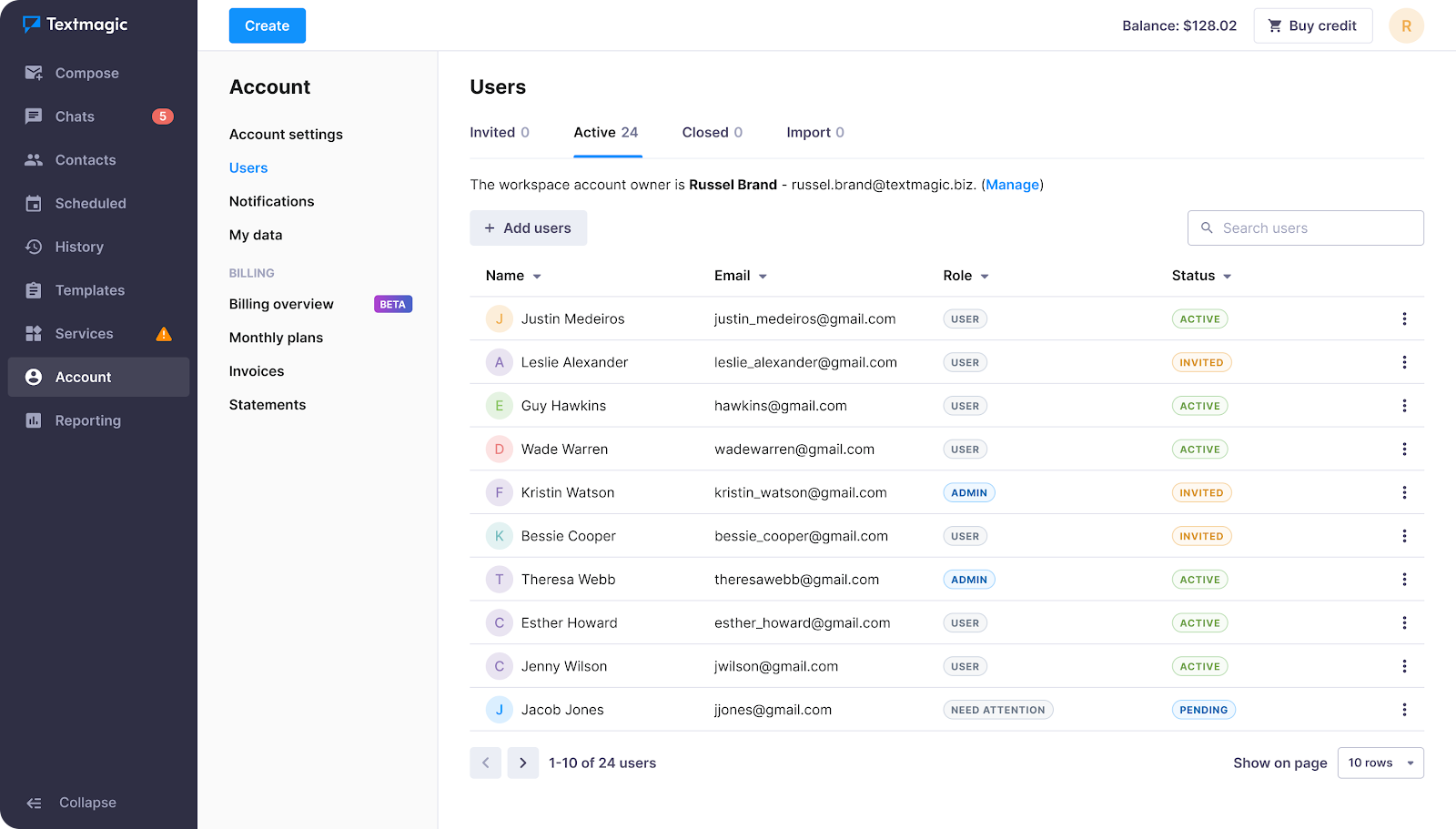
- The two-way messaging function is functional and includes basic CRM-like notes on contact records, which is useful both for service businesses handling support and dedicated support members.
- Setup time: the self-service 10DLC process was the most friction-heavy of any platform we tested. Budget 3–4 hours and expect around 10 business days before it’s confirmed. TCPA handling is automatic, and EU sends run on EU-based infrastructure with documented GDPR compliance.
- Customer support can be hit or miss. While we didn’t experience any deal-breaking issues with TextMagic support, nor were our problems that technical, we heard first-hand reports of users having to wait longer than usual to get their problems addressed.
Pricing
| Volume | Cost (est., US domestic)* |
| 5K sends/mo | $185 |
| 50K sends/mo | $1,260 |
| 200K sends/mo | $4,010 |
Who It’s For and Who Should Look Elsewhere
TextMagic works well for businesses with international customers as a primary segment, low-volume senders who want pay-as-you-go pricing without a monthly floor, and service teams using SMS for operational messages like reminders or alerts. It’s not the right fit for high-volume US ecommerce brands or teams that need advanced automation and Shopify integration.
SlickText
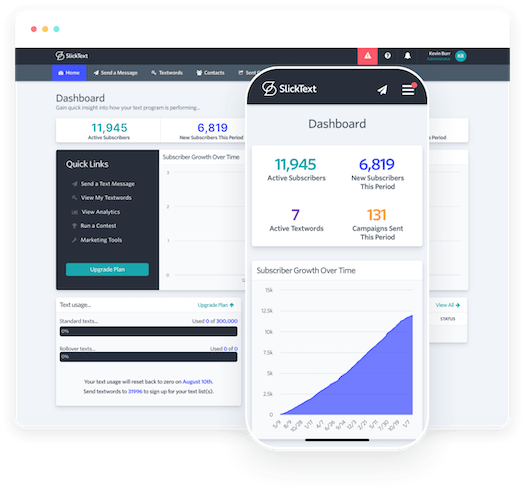
SlickText has one of the cleanest onboarding experiences in this comparison and a compliance posture that punches above its price. It’s a strong mid-market choice for brands that want a US-focused, fully managed compliance process without the enterprise price tag of Attentive or Postscript. The automation builder is functional without being sophisticated — suitable for standard ecommerce SMS flows but not for complex behavioral branching.

What We Found in Testing
- 10DLC registration is manual but assisted through the platform’s support channel, and approval took 4 business days from signup, one of the fastest timelines we tested. Double opt-in is enforced by default, SHAFT flagging is active, but there is no EU data residency because the infrastructure is US-only.
- The keyword opt-in system (e.g., “text JOIN to 12345”) is well-implemented and includes QR code generation natively — useful for in-store or print-media list growth.
- The platform’s pricing scales in discrete jumps that can create awkward cost cliffs. Moving from one plan tier to the next can mean a 40–60% monthly cost increase for a relatively small increase in send volume.
- A/B testing is available but limited to subject-line (message copy) variation. There’s no A/B testing on send timing, audience segment, or offer type.
- SlickText also supports scheduled SMS campaigns and basic drip automations, letting you queue sequences over days or weeks without manual sending.
Pricing
| Volume | Monthly cost (est.) |
| 5K sends/mo | $169 |
| 10K sends/mo | $319 |
| 50K sends/mo | $939 |
Who It’s For and Who Should Look Elsewhere
SlickText works well for US-focused small and mid-market brands that want compliance handled without a legal team, and for brick-and-mortar or service businesses using keyword opt-ins and QR codes to grow their list. It’s not the right fit for teams requiring advanced behavioral segmentation.
MessageDesk
MessageDesk is built around a genuinely different architecture than every other platform in this comparison: the team shared inbox is the product.
Where other platforms treat SMS as a bulk SMS solution with an optional inbox available, MessageDesk treats every subscriber conversation as a ticket that can be assigned, tagged, and resolved by a team member. This makes it the correct choice for service businesses, B2B teams, and any operation where two-way conversations generate revenue or resolve problems.
What We Found in Testing
Three of our four MessageDesk user interviews were with service businesses (one HVAC company, one property management firm, one law office). The fourth was a healthcare-adjacent wellness clinic.
- Consistent feedback: the inbox-first model means their teams actually respond to inbound SMS rather than letting replies go unmanaged — a problem they’d had on previous broadcast-focused platforms.
- The broadcast campaign functionality exists but is clearly secondary. Users described it as “good enough” rather than “best-in-class.”
- MessageDesk fully manages 10DLC after you submit and validate business information, and users specifically cited the managed process as a reason for choosing it over self-registration platforms. Double opt-in is enforced by default, SHAFT flagging is active, EU data residency is available via Twilio.
- MessageDesk stores full message history and contact context within its platform, so agents can view past interactions before responding. This is a major advantage over broadcast‑focused SMS marketing tools, which often treat replies as isolated threads without providing any or very little customer history.
Pricing
| Volume | Monthly cost (est.) |
| 5K sends/mo | ~$30–$40 |
| 50K sends/mo | ~$150–$180 |
| 500K sends/mo | Not clearly published; contact sales |
Who It’s For and Who Should Look Elsewhere
MessageDesk works well for service businesses where two-way SMS conversations are a primary customer touchpoint, teams with multiple people managing inbound messages, and healthcare-adjacent businesses that need better conversation management. It’s not the right fit for ecommerce brands focused on broadcast campaigns, brands needing Shopify or advanced ecommerce automation, or international senders.
Textla
Textla is the strongest option in the market for teams that want clean, no-bloat SMS without a learning curve. It does fewer things than most competitors and does those things well: send a message, track replies, manage contacts, and stay compliant.
If you’re coming from a spreadsheet-and-manual-text workflow and need to professionalize quickly, Textla’s onboarding is the fastest of any platform we tested.
What We Found in Testing
- Textla offers a streamlined 10DLC setup with clear guidance and Twilio integration; we completed account setup and submitted registration in under 2 hours, with Textla’s team handling approval and follow-up. Double SMS opt-in is enforced by default, SHAFT flagging is active, and EU data residency is available through Ireland’s IE1 region for GDPR compliance.
- The contact management UI is notably clean. Filtering and segmenting a 10K list took minutes; on some competing platforms, the same task took 20+ minutes of navigating modal layers.
- What Textla doesn’t have: AI personalization or send-time optimization. It’s a deliberate product trade-off that suits some buyers and disqualifies it for others.
- The API is functional but thin. If you plan to integrate SMS into a broader martech stack via webhooks or custom triggers, you’ll hit the limits of what Textla supports relatively quickly.
- Support ticket response: median 47 minutes across our three test tickets – one of the fastest response times from the platforms we tested.
Pricing
| Volume | Monthly cost (est.) |
| 5K sends/mo | $5 |
| 50K sends/mo | $50 |
| 500K sends/mo | $500 |
Who It’s For and Who Should Look Elsewhere
Textla works well for small businesses moving off manual texting or basic email tools, and for teams that need a simple SMS platform they can get operational in a day without technical help. It’s not the right fit for ecommerce brands that need Shopify event triggers or behavioral segmentation.
Textedly
Textedly competes on price and simplicity. It’s a serviceable platform for brands that need basic SMS without the complexity of a full marketing automation suite. Among the sub-$50/month platforms, it’s the one with the least to recommend it as a primary choice — not because it’s bad, but because SlickText and Sender both outperform it at similar price points.

What We Found in Testing
- Setup was straightforward. No meaningful onboarding friction.
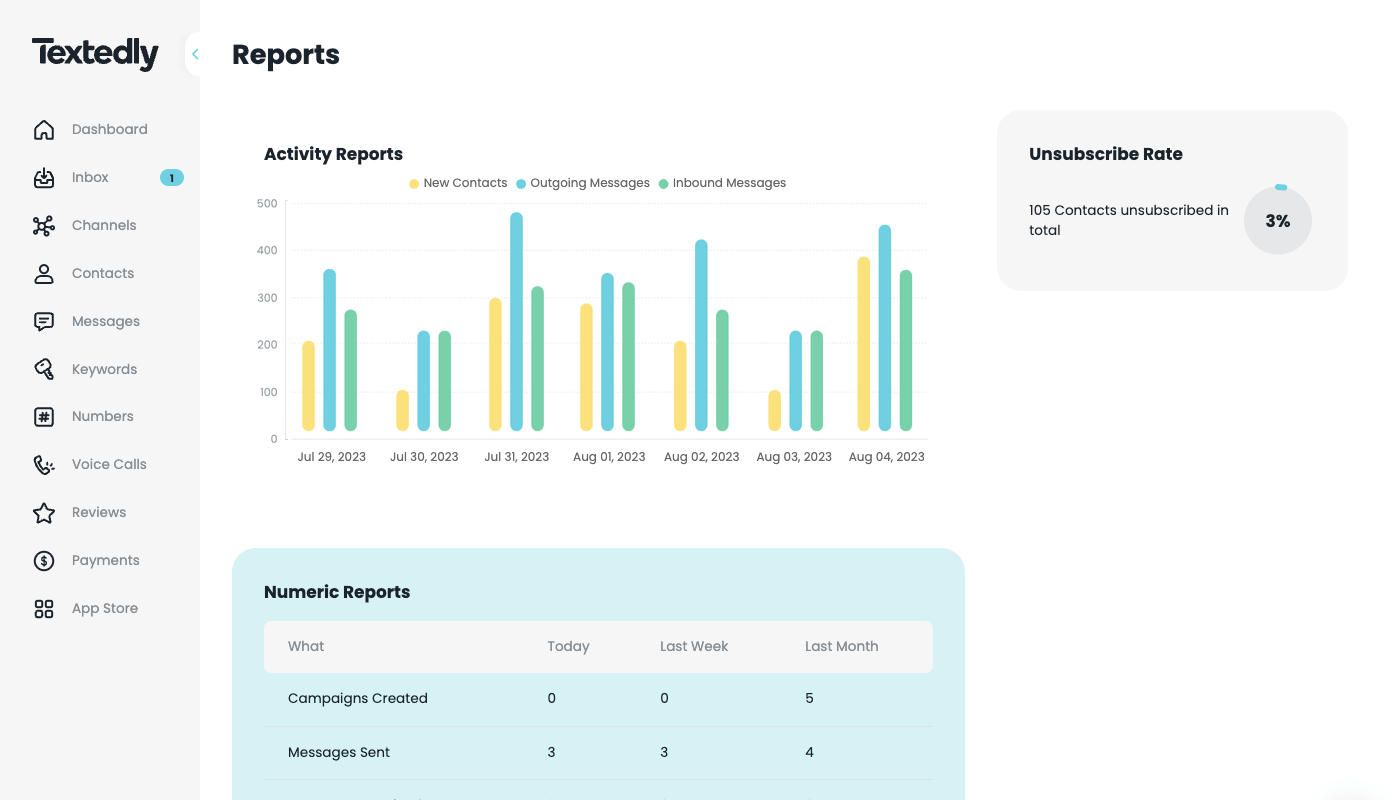
- The platform interface has improved in 2025 but still feels a generation behind SlickText and SimpleTexting in UX polish.
- No A/B testing. No send-time optimization. No Shopify integration beyond Zapier.
- Textedly offers assisted 10DLC registration, and we completed setup in 4 business days, though its documentation says the process can take up to two weeks. TCPA opt-out is handled automatically, but there is no proactive SHAFT flagging, no EU data residency, and it is not suitable for regulated industries.
Pricing
| Volume | Monthly cost (est.) |
| 5K sends/mo | $169 |
| 50K sends/mo | $1,020 |
| 360K sends/mo | $5,520 |
Who It’s For and Who Should Look Elsewhere
Textedly works best for very small businesses that need straightforward SMS messaging without much setup or training. It is a good fit for local service providers, salons, gyms, churches, restaurants, or solo operators that mainly want to send promotions, reminders, announcements, or simple updates to a modest contact list.
It is not the right fit for teams that expect SMS to become a major growth or revenue channel. Ecommerce brands, regulated industries, international senders, and businesses with fast-growing lists will likely hit limits around automation depth, compliance needs, segmentation, integrations, and scalability.
EngageBay
EngageBay is a CRM-first platform that includes SMS as one channel among many — alongside email, live chat, landing pages, and a help desk. For small service businesses (agencies, consultants, local businesses) that want to manage customer relationships in one place without Salesforce pricing, this is the most cost-competitive all-in-one option. As a dedicated text message marketing platform, it’s underpowered.
What We Found in Testing
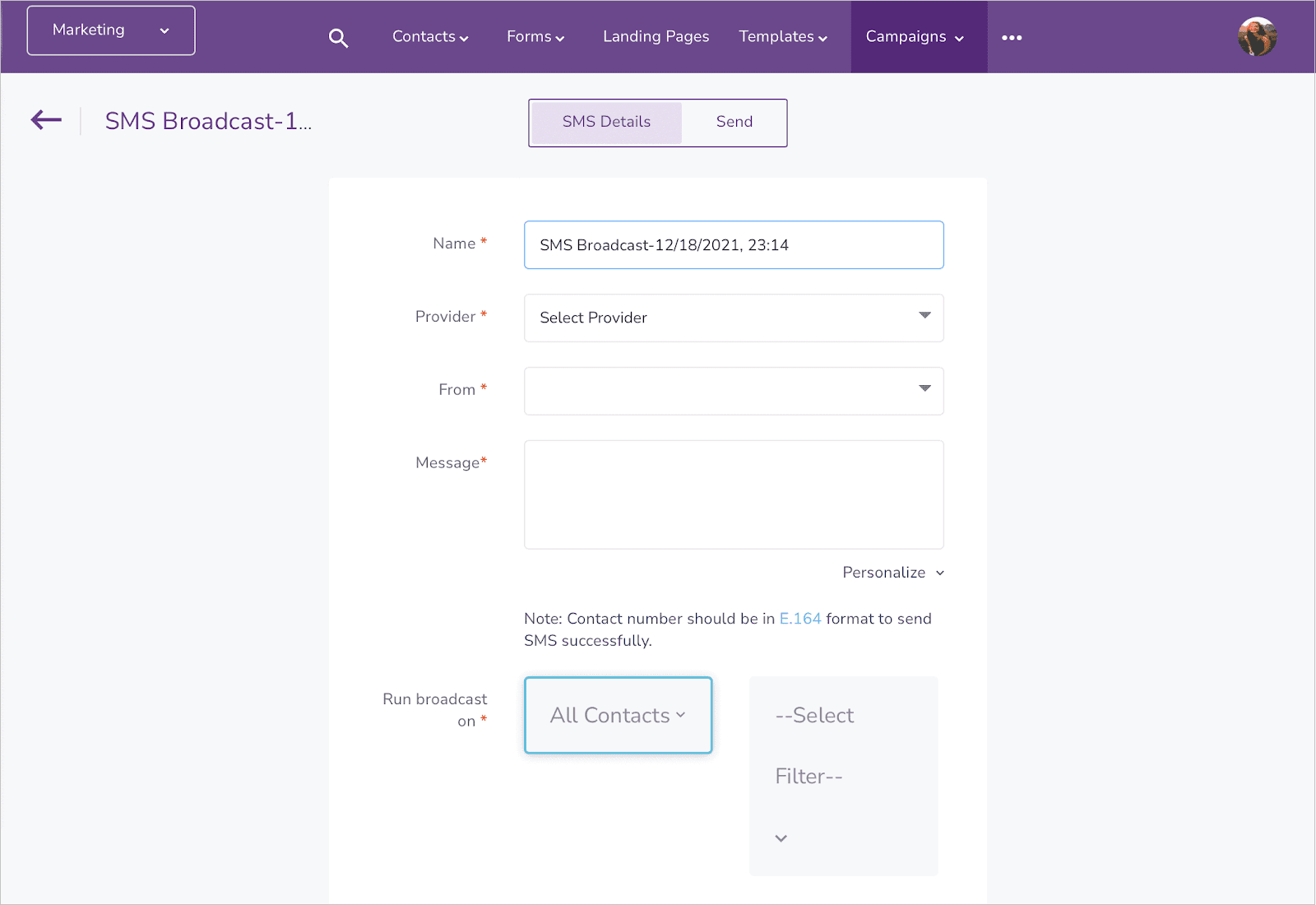
- SMS automation is functional but significantly less sophisticated than dedicated platforms. Users reported treating SMS in EngageBay as a supplement to email workflows, not as a primary channel.
- The shared inbox and CRM integration are genuine differentiators for service businesses where conversations matter more than broadcast campaigns.
- 10DLC setup is self-service with limited guided support, and approval typically takes 10–15 business days. TCPA opt-in is configurable but not enforced, with no documented HIPAA path or EU data residency option, making it a poor fit for regulated industries or EU-primary audiences.
- Unique feature: SMS in EngageBay is integrated with the full CRM. This allows teams to view SMS activity alongside email, deals, notes, tasks, and customer history all in one place, which is particularly useful for service teams where managing conversations is more important than broadcast campaigns.
Pricing
| Volume | Monthly cost (est.) |
| 5K sends/mo | ~$21–$30 |
| 50K sends/mo | ~$130–$160 |
| 500K sends/mo | ~$1,000+ (not clearly published) |
Who It’s For and Who Should Look Elsewhere
EngageBay works well for small service businesses, agencies, and solopreneurs that want CRM, SMS, and email in one platform without needing advanced SMS automation. It’s not the right fit for ecommerce brands, high-volume senders, regulated industries, or any brand with EU subscribers.
SMS Platform Migration: Costs, Timelines, and Risks
This section is for businesses already on an SMS platform but eyeing for an alternative. While making a fast switch and not looking back is always tempting, there are a lot of caveats to consider before making that leap – just like moving out or changing internet provider.
What You Lose When Switching
Subscriber consent portability: Your subscriber list (phone numbers + opt-in status) can typically be exported. However, the proof of consent (timestamp, source, opt-in method) may not export completely from all platforms. In a TCPA dispute, this documentation is your legal defense. Before migrating, export and archive all consent records your current platform holds.
Phone number porting: Your current sending number (long code, toll-free, or short code) can usually be ported to a new platform, but timelines and processes vary.
Automation rebuild: Every automated flow you’ve built on your current platform needs to be rebuilt from scratch on the new one. There is no universal export format for SMS automation workflows.
| Platform | Number Porting In | Number Porting Out | Typical Timeline |
| Sender | Yes | Yes | 7–14 business days |
| Omnisend | Yes | Yes | 7–21 business days |
| TextMagic | Yes | Yes | 5–14 business days |
| Klaviyo | Yes | Yes | 10–21 business days |
| SlickText | Yes | Yes | 10–21 business days |
| SimpleTexting | Yes | Yes | 5–14 business days |
| Attentive | Yes | Yes (with notice) | 14–30 business days |
| Postscript | Yes | Limited (short codes only) | 14–21 business days |
| MessageDesk | Yes | Yes | 7–14 business days |
| Textedly | Yes | Yes | 10–21 business days |
| Textla | Yes | Limited | 14–21 business days |
| EngageBay | Limited | Limited | Verify before committing |

Ready to move to Sender?
Let us handle the heavy lifting. Effortless migration from your provider with a dedicated
support team.
even on the free plan.
How Long Does SMS Platform Migration Take?
| Migration Task | Estimated Hours |
| Export subscriber list + consent records from current platform | 1–2 hours |
| Clean and format list for import into new platform | 2–4 hours |
| New platform account setup and 10DLC registration | 2–4 hours (managed) / 6–10 hours (self-managed) |
| Rebuild core automation flows (welcome, abandoned cart, post-purchase) | 4–12 hours depending on complexity |
| Test sends and deliverability verification | 2–4 hours |
| Number porting and cutover | Waiting time only (see timeline above) |
| Total (managed 10DLC platform) | ~12–26 hours |
| Total (user-assisted 10DLC platform) | ~18–36 hours |
FAQs
What is 10DLC and do SMS platforms handle registration for you?
10DLC (10-Digit Long Code) is a type of US phone number used for SMS messaging that allows businesses to send messages while complying with carrier regulations. Many SMS platforms handle the 10DLC registration process for you, including brand and campaign registration, to ensure compliance with the TCPA and carrier requirements.
Can I port my phone number if I switch SMS platforms?
Yes, you can typically port your phone number when switching SMS platforms. Most SMS platforms, including Sender, allow you to port your long code, toll-free, or short code to a new provider. However, the process and timeline can vary depending on the platform and carrier. It’s recommended to check with both your current and new provider to ensure a smooth transfer.
How do carrier fees work and which platforms include them in pricing?
Carrier fees are charges imposed by mobile network providers for sending SMS messages, which can vary based on factors like message volume, recipient location, and the type of number used (e.g., long code, toll-free, short code). Some business texting services, like Sender and Omnisend, include carrier fees in their pricing, while others, like Postscript, charge separately for these fees.
Which SMS platforms are HIPAA-compliant?
Attentive and Sender are fully HIPAA-compliant, making them the best option for brands needing to handle sensitive healthcare data. While MessageDesk and SimpleTexting offer partial HIPAA compliance, but users are advised to verify details with their teams before relying on these platforms for healthcare-related messaging.
Is SMS marketing legal in Europe?
Yes, SMS marketing is legal in Europe, but it is subject to strict regulations, primarily under the General Data Protection Regulation (GDPR) and the ePrivacy Directive. These laws require businesses to obtain explicit consent from recipients before sending marketing messages, provide a clear opt-out mechanism, and protect personal data.