



Repeat customers are the backbone of many businesses.
Part of our Email Segmentation Guide.
Most businesses prefer keeping existing customers at all costs over gaining new ones, as the returning customer revenue impact is well-documented—long-standing business research has shown that acquiring a new customer can be five times as expensive!
Therefore, it’s no surprise that many businesses have been looking into strategies that help them create repeat customers that keep buying.
However, we should first describe repeating customers and their benefits to implement these strategies correctly.
Repeat Customer at a Glance
- A repeat customer is someone who has purchased from your business multiple times, distinct from one-time return customers or brand-loyal customers who actively choose you over competitors.
- Customers who have made multiple purchases are 9x more likely to convert again than first-time buyers.
- Repeat customers directly drive business growth — 65% of a company’s revenue comes from existing customers, and increasing retention by just 5% can lift revenue by 25–95%.
- Key metrics for tracking repeat customers include Customer Retention Rate, Churn Rate, Repeat Purchase Ratio, and Net Promoter Score (NPS).
- The most effective ways to increase repeat purchases include loyalty programs, personalized experiences, triggered email campaigns, and a strong focus on customer service.
Repeat Customer Definition
Repeat customers (or recurring customers) have purchased from your business numerous times. They are differentiated from return customers and loyal customers. The former are those who returned to make another purchase at a later date but do not tend to do so repeatedly.
Loyal customers will choose your brand time and time again over competitors, even if they haven’t even tried other products on offer.
What makes a buyer become a loyal repeat customer is an incredibly wide topic. Studying customer repeat purchase behavior shows that, depending on the business model, excellent customer service teams and overall experience, great prices, and customer loyalty programs are the key drivers.
Of course, more repeat customer spending is better for retail and ecommerce businesses. Shopify recommends that profitable, well-established ecommerce companies focus on retention over acquisition.
However, focusing on acquiring more repeat customers results in relevance in all industries and business models; therefore, even if you are not in ecommerce, there’s a lot you can learn by studying repeat buyer trends.
Existing Customers vs. Loyal Customers
Loyal and existing customers are similar in that they both have a history of purchasing products or services from a particular company. However, there is a key difference between the two loyalty.
Existing customers are simply customers who have purchased from a company at some point. They may continue to do business with the company, but they are not necessarily loyal to the brand. They may be open to considering other options and could switch to a different company if they find a better deal or more appealing products or services.
On the other hand, loyal customers are more committed to a particular company and are less likely to switch to a different brand. They may have a strong emotional connection to the company and its products or services and may be willing to pay a premium for the quality and value it provides.
Shortly, loyal customers are a subset of existing customers with a stronger commitment and dedication to a particular company and its products or services. Returning customer statistics consistently show that this subset generates disproportionately higher revenue for businesses.
Repeat Customer & Customer Retention Statistics 2026
Before moving ahead, look at some existing customer revenue statistics and repeat buying statistics. Because the thing is—it’s good to measure, quantify, and analyze a problem before starting to find a solution. So, let’s go:
Customer Retention and Loyalty Programs
- 83% of loyalty program owners who measure ROI report a positive return, and they say their programs generate 5.2x more revenue than cost.
- Loyalty and CRM now take up 31.4% of total marketing budgets among loyalty program owners.
- 69.8% of consumers join loyalty programs to earn rewards, discounts, or cashback.
- 72% of consumers say loyalty programs make them more likely to spend with their preferred brand.
- 56% of consumers say they spend more because of the loyalty program, and 80% say the program helps them get more from the brand.
Customer Retention and Revenue Growth
- 65% of a company’s revenue comes from existing customers’ repeat business.
- Customers who have made multiple purchases are 9x more likely to convert again than first-time buyers.
- 49% of customers have made impulse purchases after receiving personalized recommendations.
- 40% of consumers say they’re likely to spend more during highly personalized experiences.
- 91% of consumers are more likely to engage with brands that personalize content and offers to their preferences.
Customer Churn Statistics
- The average customer churn rate in the U.S. is 21%.
- Customer churn costs U.S. businesses $168 billion per year.
- 71% of businesses say price increases are the top reason customers leave.
- A 5% decrease in churn can lift company revenue by 25% to 95%.
- U.S. companies could save more than $35 billion annually by reducing churn through better customer happiness and retention.
Customer Service Experience & Retention
- 63% of consumers would switch to a competitor after just one bad experience, up 9% year over year.
- 73% of consumers will switch after multiple bad experiences.
- 56% of consumers rarely complain after a bad experience and instead quietly switch.
- 75% of customers will spend more on brands that offer good customer experience.
- 43% of customers say poor customer service discouraged them from buying from a brand again.
Customer Retention Statistics by Industry
- In 2025 retention benchmarks, Media and Professional Services were both at 84%, while Ecommerce was much lower at 38%.
- In another 2026 industry benchmark set, Commercial Insurance led at 86%, followed by Business Consulting (85%) and IT & Managed Services (83%).
- In that same 2026 benchmark, Hotels & Hospitality had 55% retention, while ecommerce sat around 62%–63%.
- For churn, Financial Services reached 26%, Telecom 25%, Retail 24%, and ecommerce 22% in the 2026 industry comparison.
- Qualtrics’ 2026 churn roundup says hospitality, travel, and restaurants average 45% churn in the U.S., while financial, credit, and cable companies can hit 25%.
Customer Acquisition and Retention Statistics
- It costs 5 to 25 times more to acquire a new customer than to retain one.
- Companies that focus more on retention than acquisition are 60% more profitable on average.
- The average CAC climbed to $802 in 2025, showing how expensive acquisition has become.
- Google Ads cost per lead rose 5.13% to $70.11 in 2025.
- In email, companies that dedicate more than 15% of their marketing budget to email are 2x more likely to reach 40%+ open rates, which supports email’s role as a retention channel.
The statistics show that customer lifetime value rises exponentially if customers become repeat or loyal customers, and repeat buyer conversion rate data further reinforces this point. So, building customer retention strategies to nurture long-lasting customer relationships is the best way to grow a business.
Repeat Customer – Goals & KPIs
Every good strategy starts with measuring the progress and efficiency of processes. If you’re wondering how to make customers return to your website or ecommerce business, then you will have to implement the tracking of specific metrics.
Customer Retention Rate
Straightforward and simple. You will always measure customer retention rate as it’s the foundational metric. Of course, there are other metrics you will be tracking.
Comparing your results against repeat purchase benchmarks helps contextualize your performance; however, the rest of the metrics mostly support customer retention rates and allow you to understand them better.
To calculate the repeat customer rate, there’s a handy formula you should use:
Customer Retention Rates = ((NCE – NEW) / NCS)) X 100
- NCE – Number of customers (over a time period).
- NEW – Number of new customers over the same time period.
- NCS – Number of customers at the start of the same time period.
Customer Churn Rate
If you run an ecommerce or retail business, you’re likely already calculating some form of churn rate. If not, a short version of churn rate is essentially the number of customers you lose over time.
A rule of thumb when aiming for a good churn rate is to keep it below 5%. All businesses have some churn; however, if you’re consistently above 5 or 7%, you should be delving deeper into why it’s so high.
However, there are numerous ways to calculate the churn rate. Depending on who you ask, they might provide you with a more or less complicated formula. The easiest way, however, is:
Churn Rate = Number of Churned Customers / Number of Total Customers
Considering more granular metrics, consider time periods, quarters, sample sizes, and many more factors. Even customer segments might churn at different rates.
If you are looking for more granular metrics, consider periods, quarters, sample sizes, and many more factors. Even customer segments might churn at different rates.
Repeat Purchase Ratio
Repeat purchases ratio is a good way to gauge the number of loyal customers over one-time customers. Of course, you will never know exactly when is the last time someone decided to buy from you, making the ratio slightly skewed. However, the metric is still great in and of itself.
Calculating the repeat purchase ratio is actually quite simple:
Repeat Purchase Ratio = NRC / NTC
- NRC – Number of returning customers (over some time).
- NTC – Number of total customers (over the same time).
It’s generally considered a strong indicator of customer loyalty. You want to get it as high as possible as long as it doesn’t harm NTC.
Repeat Customer Rate
The repeat customer rate is useful for companies to track because it can provide insight into customer loyalty and satisfaction.
A high repeat customer rate can indicate that customers who’ve purchased and are happy with the products or services they are receiving are likely to continue doing business with the company. On the other hand, a low repeat customer rate may indicate that customers are not satisfied with their experiences and are less likely to return in the future.
To increase the repeat customer rate, companies may focus on improving the quality of their products or services, providing excellent customer service, and offering ongoing support and value to their customers. By cultivating loyal customers, companies can potentially increase their profitability and reduce their marketing and acquisition costs.
Customer Lifetime Value (CLV)
Customer Lifetime Value is the total revenue a business can expect from a single customer throughout their entire relationship. It’s one of the most telling metrics when evaluating the long-term impact of your retention efforts — because it shifts the focus from individual transactions to the overall value a customer brings over time.
Customer lifetime value statistics show that CLV is particularly useful when paired with your Customer Acquisition Cost (CAC). If it costs more to acquire a customer than they’ll ever spend, your business model has a problem. A healthy CLV-to-CAC ratio is generally considered to be 3:1 or higher.
To calculate CLV, use the following formula:
Customer Lifetime Value = Average Purchase Value × Purchase Frequency × Average Customer Lifespan
- Average Purchase Value — Total revenue divided by number of purchases over a set period.
- Purchase Frequency — Total number of purchases divided by total number of unique customers.
- Average Customer Lifespan — The average number of years a customer continues buying from you.
Improving CLV doesn’t always require drastic changes. Small improvements in retention, order value, or repeat purchase frequency can compound significantly over time. This is why strategies like loyalty programs, personalized offers, and strong customer service don’t just feel good — they directly move the needle on one of your most important business metrics.
Net Promoter Score – NPS
Most of us have run into NPS, even if we don’t know what it stands for. Suppose you’ve received a request to rate how likely you are to recommend the business to someone else from 1 to 10 after a purchase or a customer service event. Such a request is for the company to collect data to measure the net promoter score.
NPS is another strong indicator, although auxiliary, of customer loyalty. A high number of promoters means that people are likely to recommend your business to others. Of course, that also generally means that they will repeat customers.
To calculate NPS, you must collect data by implementing a survey or questionnaire after relevant customer interactions. However, the NPS data has to be normalized on a scale of 1 to 10.
After collecting the data, all you need to do is plug in a couple of numbers:
Net Promoter Score = % of Promoters – % of Detractors
- Promoter – Gave a score of 9 or 10.
- Detractor – Gave a score of 6 or less.
How to Make Customers Keep Coming Back
As repeat customers are such an integral part of retail and ecommerce, these industries have developed many best practices for every repeat customer marketing strategy. Luckily, even if you aren’t in these industries, you can easily use most of the best practices and have customers keep coming back.
Luckily, even if you aren’t in these industries, you can easily use most of the best practices and have customers keep coming back.
1. Start Customer Retention Programs
A classic lesson we can learn from ecommerce and retail is to implement loyalty programs that reward customers for repeat purchases. While these are not the sole reason your customers will keep returning, they’re a great starting point.
For example, if you sell a similar service for a similar price as your competitors, small benefits from loyalty programs might tilt the scales just enough. Additionally, it may give them a better reason to continue buying from you, even if your products aren’t essential.
Finally, another way to implement a loyalty program is to create a VIP discount club. Of course, you must segment customer audiences carefully, but those people will appreciate being in an exclusive club.
2. Focus on Customer Service
If you’ve ever dealt with Amazon customer support, you might have noticed one particular message that appears after you finish the conversation – “the Earth’s most customer-centric company.” Amazon puts great emphasis on providing great customer service.
As they are an extremely established ecommerce company, we can deduce they heavily focus on retention and that customer service is part of their strategy. Brands with superior customer experience generate up to 5.7x* more revenue than competitors that lag in that aspect. So invite changes if needed.
3. Collect In-Depth Feedback
There’s no better source of information on how your business is doing than the customer. However, many businesses only collect customer feedback from reviews and comments, which causes data to skew.
Gathering returning buyer insights through an in-depth feedback collection strategy is the way to ensure that customers keep coming back. Usually, this will involve using emails to send surveys and, sometimes, rewarding those who have finished them. Of course, you must act upon the customer feedback, but simply implementing a collection strategy is a great start.
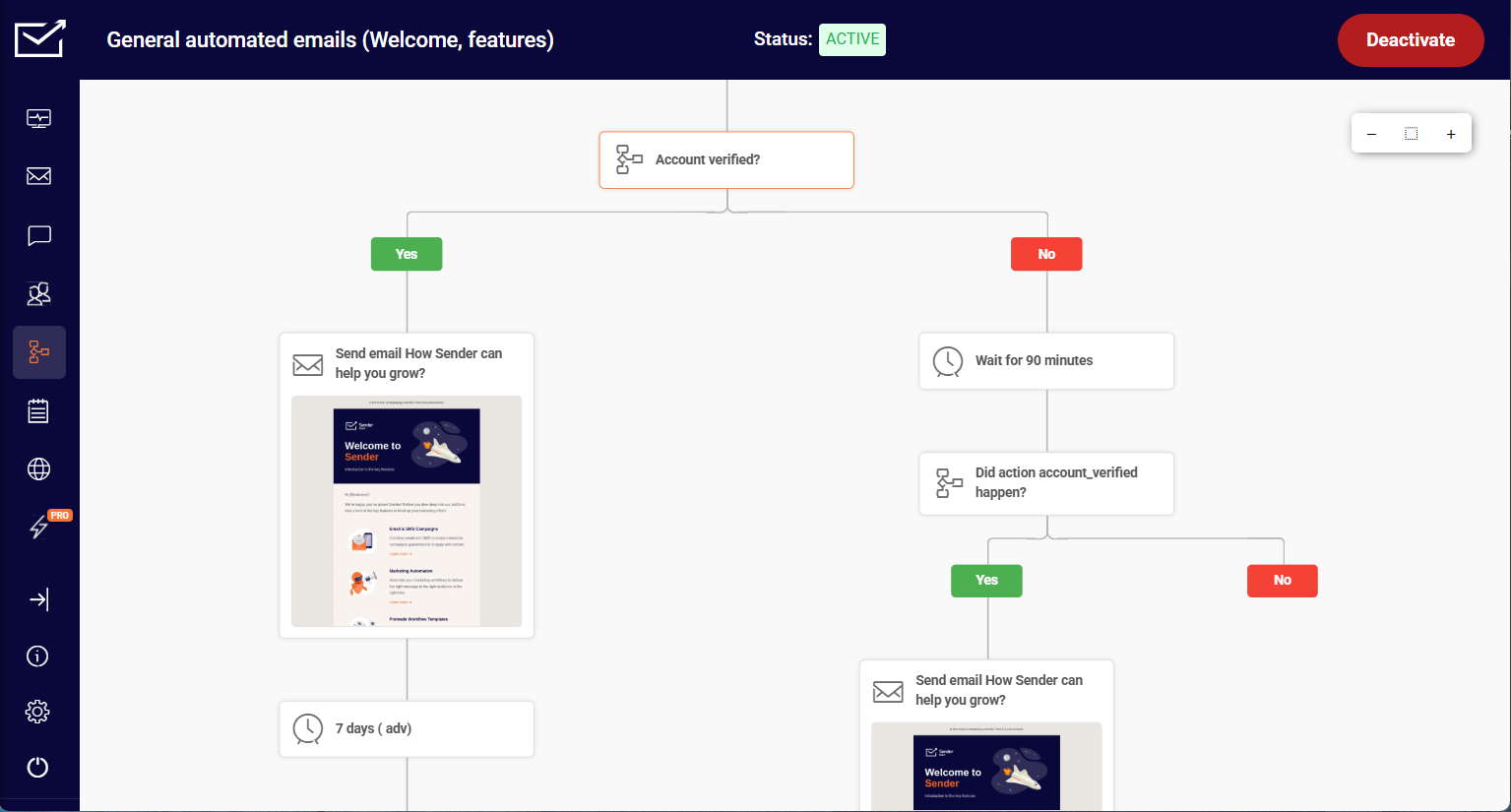
With Sender’s automation feature, create automated feedback emails based on a particular event, e.g., after a purchase. With a user-friendly interface, the setup process is simple.
Here’s a sneak peek of the automated workflow:
4. Send Triggered Emails
An old marketing strategy was to always stay on the customer’s mind. Some salesmen even gave branded calendars as gifts to make the logo and company visible.
Triggered emails can serve the same purpose, except in a significantly better manner. They have the added benefit of being partly personalized. Therefore, customers will pay more attention to triggered emails.
There are numerous ways to approach triggered emails, each depending on the industry. However, the most popular triggered emails are:
- Abandoned cart emails (for ecommerce and retail);
- Reactivation emails (after a period of inactivity);
- Personal event emails (on holidays or birthdays);
- Promotional emails.
Of course, you can include many more triggered emails and customize them according to your industry standards.
5. Use Personalization
Personalization means delivering the right message to the right customer at the right time — whether that’s recommending products based on repeat purchase behavior and past purchases or simply addressing customers by name in emails.
Here are some practical ways to use personalization to drive repeat purchases:
- Product recommendations — Suggest items based on browsing history or previous orders.
- Personalized email campaigns — Segment your audience and tailor content based on purchase history or lifecycle stage.
- Birthday and anniversary offers — A well-timed discount creates a positive emotional touchpoint that encourages return visits.
- Post-purchase follow-ups — Send tailored messages after a purchase, such as usage tips or complementary product suggestions.
The more you understand your customers’ behavior and preferences, the more relevant your outreach becomes — and relevance is what turns a one-time buyer into a repeat customer.
Recurring Customers as a Recurring Revenue Model
Recurring clients mean recurring revenue, which can be the foundation for a profitable business. The most successful businesses make it easy for customers to buy from them repeatedly. Recurring revenue can be as simple as one-off payments, including subscriptions and memberships.
If someone purchases something from you and continues buying from you after that initial purchase, they’re part of your recurring revenue stream. A regular revenue model is much more predictable than a one-time revenue business. You know what to expect from your customers and how much it costs to serve them. You can also plan for the future by investing in infrastructure and hiring employees.
Why Recurring Revenue Matters
Online businesses can be less customer-centric because they don’t have physical stores and inventory costs like brick-and-mortar businesses. However, this can lower the quality of customer service and lead to less customer loyalty.
Recurring revenue models are a great way to increase the value of your business by creating ongoing relationships with your repeat buyers. These relationships make it easier for you to retain their business and increase their lifetime value — which means more money in your pocket!
The most important thing about recurring clients is that they’re predictable. You know exactly how much money will come in every month (or week or day) because it’s set up as a subscription service or membership site where people pay for access to something (like an online course).
The other advantage of recurring customers is that they provide consistent income. You can plan and know how much cash flow will come every month (week or day). It also allows you to scale up your business if things go well. It’s the idea that you can repeatedly have the same clients spend money with you.
Examples of Recurring Revenue Models
Recurring revenue models are built on the principle that repeat customers generate more predictable — and more profitable — income than one-time buyers. Here are some of the most common examples across industries:
- Subscription services (Netflix, streaming platforms). Streaming platforms charge a fixed monthly or annual fee, turning one-time sign-ups into a reliable, recurring revenue stream. Because customers are billed automatically, the business can forecast revenue with a high degree of accuracy and plan resources accordingly.
- Membership programs (Amazon Prime, Costco). Membership models charge customers upfront for access to exclusive benefits, discounts, or services. This creates a powerful retention loop — once a customer has paid for membership, they are far more likely to return repeatedly to get their money’s worth.
- Ecommerce “subscribe & save” deliveries. Retailers like Amazon offer discounted pricing in exchange for scheduled repeat deliveries of everyday products. This converts what would otherwise be irregular, one-off purchases into predictable monthly orders — reducing churn and increasing customer lifetime value simultaneously.
- SaaS & software subscriptions (CRM, email marketing tools). Software tools like CRMs and email marketing platforms typically operate on monthly or annual subscription plans. Because customers integrate these tools into their daily workflows, switching costs are high — making renewals predictable and churn rates relatively low compared to other industries.
How to Increase Repeat Purchases
Increasing repeat purchases comes down to a handful of proven strategies: building loyalty and retention programs that reward continued buying, delivering consistently excellent customer service, collecting meaningful feedback to improve the experience, and staying top of mind through triggered email campaigns tailored to customer behavior.
Tools like Sender make it easy to put the email side of this on autopilot — allowing you to set up automated triggered campaigns for abandoned carts, post-purchase follow-ups, reactivation emails, and more, all without manual effort for every send.
Sources:
- https://antavo.com/reports/global-customer-loyalty-report-2025/
- https://antavo.com/blog/global-customer-loyalty-report-2025/
- https://www.deloitte.com/us/en/insights/industry/retail-distribution/reshaping-customer-loyalty-programs.html
- https://www.sellerscommerce.com/blog/customer-loyalty-statistics/
- https://www.qualtrics.com/articles/customer/30-statistics-about-customer-churn/
- https://www.qualtrics.com/research/global-satisfaction-loyalty-2025/
- https://www.zendesk.com/newsroom/articles/2025-cx-trends-report/
- https://www.zendesk.com/blog/customer-service-statistics/
- https://blog.hubspot.com/service/customer-service-stats
- https://www.hubspot.com/marketing-statistics
- https://firstpagesage.com/seo-blog/customer-retention-rates-by-industry/
- https://focus-digital.co/average-customer-retention-rate-by-industry/
- https://www.phoenixstrategy.group/blog/cac-benchmarks-by-channel-2025
- https://www.prnewswire.com/news-releases/validity-releases-state-of-email-2025-report-revealing-email-marketing-trends-302472906.html
- https://www.usepylon.com/blog/50-customer-support-statistics-trends-for-2025
- https://helploom.com/blog/customer-service-statistics
- https://blog.ourgreenfish.com/the-business-mind/customer-service-trends-2025-hubspot-data-that-matters
- https://www.renascence.io/journal/key-customer-experience-cx-statistics-you-need-to-know-in-2025