


If you’re an ecommerce store owner wondering why 3 out of every 4 people who add something to their cart leave without paying you, read on.
In this blog, we address the elephant in the room (aka abandoned carts) and offer insights and some best practices to deal with abandoned shopping carts in your ecommerce store. So, let’s get started.
Top Cart Abandonment Rate Statistics at a Glance
- 70.2% of shopping carts are abandoned on average;
- Ecommerce stores have around $260 billion in recoverable revenue each year due to cart abandonment;
- Mobile cart abandonment reaches 85.65%, compared with 73.76% on desktop;
- 39% of shoppers abandon checkout due to extra costs like shipping and taxes;
- Abandoned cart recovery rates typically range between 10% and 30%;
- Abandoned cart emails recover an average of 10.2% of lost sales;
- 40%–50% of users who click an abandoned cart email complete their purchase;
What is Cart Abandonment?
Cart abandonment is when a user adds one or more products to their shopping cart but fails to check out. By adding items to their cart, customers have expressed a clear interest in their products, but something has stopped them along the way.
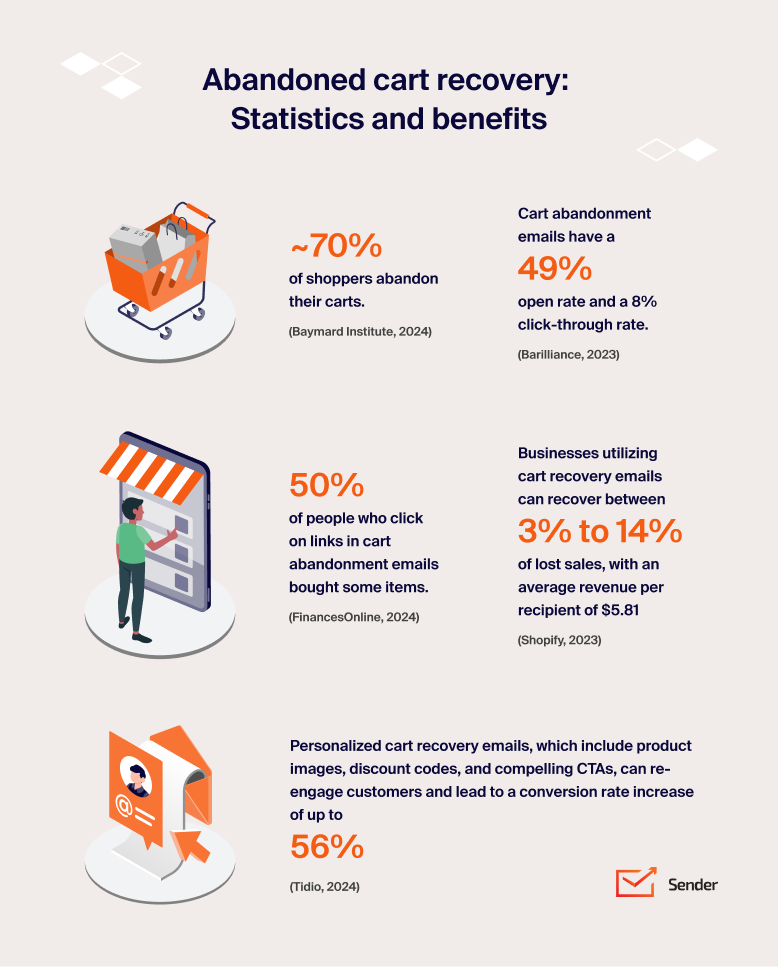
Abandoned carts happen way more often than you can imagine (think 7 out of every 10 visitors*). This trend isn’t just a minor hiccup; it’s a widespread problem that affects most online retailers.
Shopping Cart Abandonment Statistics
Abandoned carts happen way more often than you can imagine (think 7 out of every 10 visitors*). This trend isn’t just a minor hiccup; it’s a widespread problem that affects most online retailers.
Here are some abandoned cart statistics to further prove that cart abandonment is a significant problem for anyone running an ecommerce store:
Average Cart Abandonment Rate
According to recent shopping cart abandonment rate benchmarks, the average shopping cart abandonment rate across all industries is 70.2%* as of 2026, reflecting broader ecommerce funnel conversion statistics across the purchase journey.
It continues a steady upward trend from 68.8% in 2015 to 69.5% in 2020, highlighting a persistent and growing revenue recovery opportunity for ecommerce brands.
Mobile shoppers abandon carts more often than desktop users, with cart abandonment rates reaching 85.65% on mobile compared with 73.76% on desktop.
That shows the importance of a mobile-friendly and easy-to-navigate website to reduce shopping cart abandonment.
Industry Cart Abandonment Rate Statistics
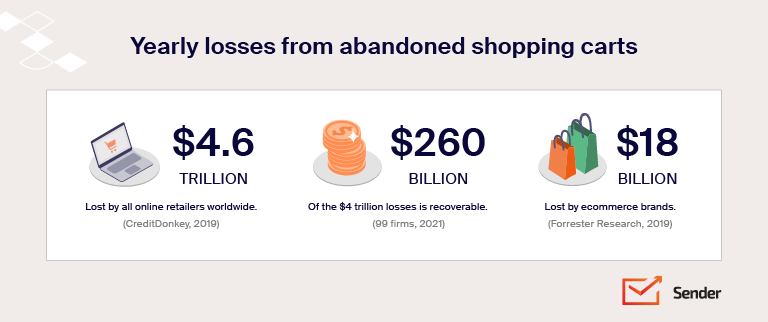
Baymard estimates that ecommerce stores in the US and EU have around $260 billion in recoverable sales revenue each year due to cart abandonment.
Here’s a breakdown of cart abandonment rate by industry*:
| Industry | Cart abandonment rate |
| Luxury & jewelry | 82.84% |
| Beauty & personal care | 72.04% |
| Home & furniture | 78.65% |
| Fashion, accessories, and apparel | 78.53% |
| Multi-brand retail | 76.90% |
| Food & beverage | 63.62% |
| Consumer goods | 57.37% |
| Pet care & veterinary services | 54.78% |
According to Baymard Institute, 39% of shoppers abandon checkout because extra costs such as shipping, taxes, and fees are too high.
That means you should be upfront about extra costs early in the shopping process by displaying shipping fees and taxes on product pages. You can also consider offering free shipping or setting a threshold for free shipping to incentivize customers to complete their purchases.
Other reasons why shoppers abandon their carts include:
- Ecommerce sites wanting them to create an account (19%)
- Delivery being too slow (21%)
- Complicated checkout process (18%)
Following the best practices of form design is an excellent way to ensure a better checkout flow and reduced abandoned carts.
For example, you can use a “full name” field instead of first and last name. You can also eliminate unnecessary optional fields and have shoppers enter their street addresses in one line.
Mobile vs. Desktop Abandonment Statistics
Cart abandonment rates vary significantly by device, with mobile users far more likely to drop off before completing a purchase. These ecommerce cart abandonment statistics highlight the performance gap between mobile and desktop and its impact on conversions.
- In 2025, mobile cart abandonment reached 80–85.6%, vs. 68–70% on desktop.
- From 2023 to 2024, mobile conversion rates were around 3.0%, while desktop conversion rates were higher at 4.4%.
- 39% of mobile users abandoned carts because of difficulty entering their personal information.
Cart Recovery Rate Benchmarks
The average recovery rates generally fall within the range of 10% to 30%*, and these abandoned cart revenue recovery statistics show that recovering a portion of abandoned carts is an industry-wide challenge. On average, abandoned cart recovery rates reach 10.2% for email and 8.7% for SMS.
However, based on that data, a good cart abandonment recovery rate would be any percentage that falls within that range. The exact “good” rate might vary based on industry standards and your specific goals, but a 2.3% to 5.4% range looks like a reasonable benchmark.
You can use the formula below to calculate your abandoned cart recovery rate:
Abandoned Cart Recovery Rate = (Number of Recovered Carts / Number of Abandoned Carts) x 100
For example, if you had 200 abandoned carts and managed to recover 10 of them, your abandoned cart recovery rate would be:
Abandoned Cart Recovery Rate = (10 / 200) x 100 Abandoned Cart Recovery Rate = (0.05) x 100 Abandoned Cart Recovery Rate = 5%
This means you were able to recover 5% of the carts that customers initially abandoned.
Abandoned Cart Email Statistics
Abandoned cart emails continue to deliver strong performance, with open rates ranging from ~35% to 50%+ and click rates around 3.8%–6.25%, depending on the platform and dataset.
More importantly, conversion happens after the click—nearly 40% to 50% of users who click an abandoned cart email go on to complete their purchase.
Part of what makes these emails successful includes personalized product reminders and discounts to entice customers to return to the online store.
In addition, sending the email an hour after a customer abandons their cart yields a 16% conversion rate. That’s higher than when you send it after:
- 30 minutes (nearly 15%)
- 20 minutes (just above 13%)
- One day (just above 11%)
Also read: Ecommerce Personalization — Your Guide to Examples, Practices
Cart Abandonment Reasons Statistics
Watching customers dump carts before checkout can be demoralizing because you’re watching profits slip through your fingers. But you shouldn’t feel sad.
Instead, you should carefully analyze checkout abandonment statistics to find out the reasons and eliminate them. Fortunately, ecommerce checkout optimization statistics provide clear insights into why shoppers abandon carts and how to fix it.
Here are the most common factors that push customers away and make them abandon their carts:
1. Unexpected Charges
Customers hate surprises. And the one unexpected financial surprise people dislike the most is shipping charges beyond what they usually expect to pay or some other supplemental fee embedded in the shipping.
If you can offer free shipping, please do. This is where Amazon did it right. Top members get free shipping.
You will often see the word ‘free shipping’ at some ecommerce stores, but there are hidden fees that sneak up on you, not showing themselves right before your credit card clears.
This practice is the best way to destroy your customers’ trust and send them running to the competition.
2. Invasive Security
Ecommerce is online, and anything online can be penetrated by an evil hacker. Because of this, there are several security firewalls in place to protect the business and the customer.
Captcha was created to check out robots, or automated hacking programs, from actual living, breathing humans. It can be very annoying, but it is there to help you.
Even still, too many security measures can frustrate someone enough to send them packing.
Sadly, nothing can be done without exposing your business to extreme vulnerability. You can offer customers the option to save their info on your server to speed up future purchases, but that requires their trust.
Fortunately, security builds trust.
3. Forced Site Registration
Just like the cashier at your local store has to ask you if you want to be on their email list, ecommerce sites like to have email addresses for future ad traffic and customer order invoices.
The problem comes when a client must complete a sign-up to get to the checkout. It takes time, and they must give information that feels invasive. It is even more troubling when there’s no “guest” option.
Your customers aren’t all the same. Give them a chance to register if they want, but if not, guest checkout is best for privacy issues. It might make them come back just for convenience.
4. Limited Delivery Choices
People want options. Have you ever bought something with a super low delivery cost only to find out it would take a month to arrive?
But the bigger and more significant dilemma was that no other delivery methods were offered, so you were doomed to wait or leave the item and find it elsewhere.
If your ecommerce shop only has several delivery options that show a long wait time or a high markup on the delivery cost, you ask your customers to seek goods elsewhere.
5. Payment Gateway Failure
They were so close, and then the payment failed. Or did it?
The customer doesn’t know. Sometimes it goes through but says it failed. Or it fails for no reason the customer is aware of.
The bottom line is they are leaving and buying it elsewhere. And when they have a whole cart full of your goods, that can sting pretty badly.
Keeping your payment method updated and maintained is a simple solution. Adding multiple payment methods like digital wallets can boost conversion rates significantly.
However, if they just have no money and are grasping at straws for one last item before they go into overdraft or max out their credit card, the only thing you can do is let them go.
They don’t have the funds to buy it from a competitor anyway.
6. Limited Cross-Platform Access
Walk into a store, a restaurant, or even a casino, and there will inevitably be someone buying something on their phone.
That person at the Lightning Link machine, tapping the spin button without even looking at it, is probably on Amazon, buying shoes or a book.
But if your shop has cross-platform issues, meaning it doesn’t work as well on a smartphone as it does on a laptop, then a person can deem it frustrating and unworthy of further attention.
With the convenience of online shopping, when people want to buy something, they expect to be able to do it right away.
Lack of cross-platform functionality makes your site look low-end and unprofessional.
Abandoned Cart Recovery Statistics
In the world of ecommerce, competition creates a power shift in favor of consumers and, in turn, produces a ‘war’ among ecommerce businesses about who appeals to customers more. Here are some best practices that will help you stand out and win the abandoned cart ‘war’ in a crowded ecommerce ecosystem:
In the world of ecommerce, competition creates a power shift in favor of consumers and, in turn, produces a ‘war’ among ecommerce businesses about who appeals to customers more. Here are some best practices that will help you stand out and win the abandoned cart ‘war’ in a crowded ecommerce ecosystem:
Abandoned Cart Email Recovery Statistics
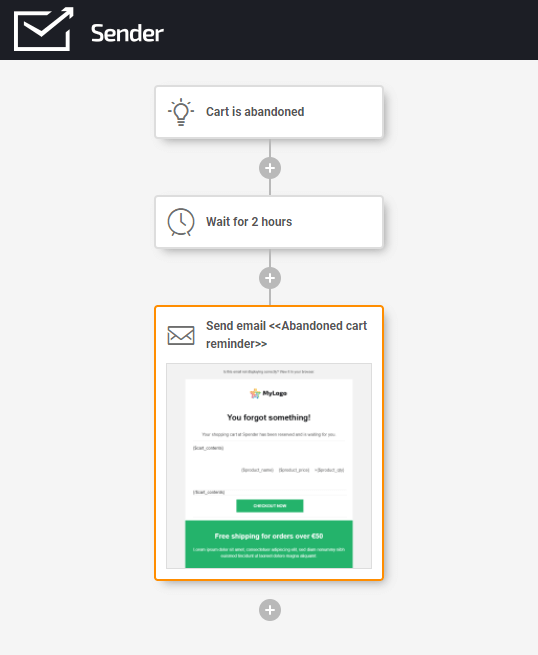
Abandoned cart emails are one of the most effective ways to recover lost revenue, consistently outperforming other automated campaigns in ecommerce. These cart abandonment revenue loss statistics highlight how much revenue brands can reclaim—and what performance benchmarks to expect from optimized recovery flows.
- Abandoned cart emails recover an average of 10.2% of lost sales, typically ranging between 8–15%.
- Multi-step abandoned cart email sequences significantly increase recovery rates.
- Automated cart recovery emails account for a major share of ecommerce automation revenue.
Abandoned Cart SMS Recovery Statistics
Abandoned cart SMS messages are one of the fastest and highest-converting recovery channels, reaching shoppers instantly when purchase intent is still high. These statistics show how SMS can outperform traditional channels and drive immediate revenue recovery.
- Sending SMS reminders shortly after cart abandonment can recover up to 45% of lost carts, significantly outperforming email, which typically recovers around 10–12%.
- SMS recovery campaigns typically see conversion rates between 15-20%.
- Effective SMS campaigns can recover 25–35% of abandoned carts, and some brands see as high as 45% recovery.
Exit-Intent & Retargeting Statistics
Exit-intent popups and retargeting campaigns help capture users right before they leave or bring them back after they’ve gone. These statistics show how these tactics recover otherwise lost revenue and reinforce abandoned cart recovery strategies.
- Retargeting is the #1 tactic used to reduce cart abandonment.
- 26% of abandoned cart shoppers return due to retargeting ads.
- Exit-intent popups used for cart abandonment can recover 10–15% of otherwise lost sales, making them an effective last-touch recovery tactic before users leave the site.
- Facebook dynamic product ads recover 10–25% of abandoned carts.
Push Notification Recovery Statistics
Push notifications provide a direct and immediate way to re-engage shoppers who leave without completing a purchase. These statistics highlight how timely, personalized messages can drive higher engagement and boost abandoned cart recovery rates.
- Exit-intent abandoned cart popups average 2.81%.
- Ecommerce brands using personalized push notifications have seen up to a 30% increase in abandoned cart recoveries.
- 10–15% of visitors who trigger an exit-intent pop-up can be convinced to complete their purchase.
*Sources:
- https://www.bigcommerce.co.uk/articles/ecommerce/abandoned-carts/
- https://baymard.com/lists/cart-abandonment-rate
- https://getsitecontrol.com/blog/shopping-cart-abandonment-statistics/
- https://www.klaviyo.com/marketing-resources/abandoned-cart-benchmarks
- https://financesonline.com/statistics-shopping-cart-abandonment-statistics/
- https://marketing.dynamicyield.com/benchmarks/cart-abandonment-rate
- https://www.klaviyo.com/blog/abandoned-cart-benchmarks
- https://www.statista.com/statistics/477804/online-shopping-cart-abandonment-rate-worldwide
- https://visionary-marketing.co.uk/blog/abandoned-cart-statistics-2026
- https://www.salecycle.com/blog/abandoned-basket-emails-uk-europe-guide
- https://www.attnagency.com/blog/sms-abandoned-cart-recovery
- https://www.slicktext.com/blog/2019/08/data-recover-abandoned-carts
- https://www.opensend.com/post/cart-abandonment-rate-ecommerce
- https://onesignal.com/blog/announcing-the-forrester-total-economic-impact-study-of-onesignal/
- https://wisepops.com/blog/cart-abandonment-popup
- https://twinr.dev/blogs/abandoned-cart-push-notifications/
- https://baymard.com/research/checkout-usability
- https://www.shopify.com/enterprise/blog/faster-checkout-process
- https://www.omnisend.com/blog/abandoned-cart-email/
- https://redstagfulfillment.com/percentage-of-online-shoppers-abandon-their-cart
- https://www.shopify.com/enterprise/blog/44272899-how-to-reduce-shopping-cart-abandonment-by-optimizing-the-checkout
- https://www.resultfirst.com/blog/ecommerce-seo/20-shopping-cart-abandonment-statistics-you-must-know