

Batch-and-blast is bleeding your program dry. Open rates are sliding, inbox placement is taking hits as ISPs tighten filters against generic mail, and the revenue you’re leaving on the table compounds with every send. The math gets ugly fast: a 0.5% drop in click-through across a 100,000-person list, sent weekly, is real money walking out the door before the end of the quarter.
Here’s the fix, and it’s not glamorous: email list segmentation is the highest-leverage change most email programs can make. The teams pulling away from the pack are the ones sending fewer emails to better-defined groups, and they’re winning on both revenue and deliverability while doing it.
This guide gets you there. You’ll get the strategic frame for why segmentation works, the four foundational data types every program needs, the advanced strategies that drive most of the revenue (lifecycle, RFM, engagement, VIP, firmographic), a practical process for collecting the right data and building your first segments, and the 2026-specific best practices shaped by Apple MPP, AI spam filtering, and the new economics of retention.
What is Email Segmentation?
Email marketing segmentation splits your subscriber list into smaller groups based on shared traits, then sends each group emails built specifically for them. That’s it. The complexity comes from deciding which traits matter and how granular to get, but the core idea is straightforward: stop sending the same email to everyone.
Email segmentation is the email-specific application of customer segmentation, the broader discipline of dividing a customer base into actionable groups. Customer segmentation can inform product development, paid media, retention strategy, and dozens of other functions. Email segmentation takes those same principles and applies them to your owned channel, where you have direct contact with named individuals and can act on segment differences in real time.
It’s also the first step in the STP marketing framework (Segmentation, Targeting, Positioning) that underpins most modern marketing strategy. STP works in sequence: you segment your audience into distinct groups, target the segments worth pursuing, then position your offer to match what each target segment actually wants. Skip segmentation and the rest collapses. You can’t target groups you haven’t defined, and you can’t position against needs you haven’t identified.
Done right, it turns generic blasts into targeted email marketing — campaigns built around who’s receiving them. A new subscriber who joined yesterday gets a different email than a customer who’s bought three times in the last quarter. Someone in Toronto sees different shipping copy than someone in Austin. A subscriber who’s opened your last six emails gets treated differently than one who’s gone dark for four months.
Without segmentation, none of this happens. You’re either sending one email to everyone (low effort, low return) or trying to write copy generic enough to work for everyone (which usually means it works for no one). Segmentation is the mechanism that makes specificity possible at scale.
The practical takeaway: if you can’t describe at least three distinct segments in your current list, you don’t have a segmentation strategy. You have a mailing list. Those are different things, and they produce different results.
Why Email Segmentation Matters in 2026
Segmented email campaigns consistently outperform non-segmented ones, often doubling click-through rates and producing a meaningful share of total email revenue. The broader pattern across email personalization statistics is consistent: relevance is now the single biggest driver of email performance.
But the case for segmentation in 2026 isn’t just about better numbers. Three structural shifts have made it operationally necessary, not optional.
Inbox providers have tightened sender requirements. Gmail and Yahoo began enforcing stricter sender requirements on February 1, 2024, and both now require proper authentication (SPF, DKIM, DMARC) and keep spam complaint rates below 0.3%, with 0.1% as the recommended working ceiling. Microsoft followed with similar rules for Outlook in 2025.
Major mailbox providers rely on authentication, complaints, and engagement-related reputation signals to filter unwanted mail, and the bar keeps rising. Low-engagement bulk sends increase the risk of spam filtering, regardless of whether your list opted in cleanly.
Segmented sends look fundamentally different to providers because they perform fundamentally differently. Higher clicks, lower complaints, more replies. That performance is what protects email deliverability and keeps you in the primary inbox.
Apple’s Mail Privacy Protection has broken open rates as a metric. Litmus data shows Apple Mail accounts for over 50% of all email opens, with figures often falling in the 40 to 60% range depending on your audience. MPP significantly inflates open rates by pre-fetching images regardless of whether the recipient actually opened the email, and it also makes open timing and geolocation data unreliable.
Retention is now a board-level conversation. With acquisition costs rising across many paid channels and venture funding tighter than it was three years ago, executive teams are scrutinizing customer lifetime value with new urgency.
Segmentation vs. Personalization
These two get conflated constantly, and the confusion costs you. They’re related, but they’re not the same thing, and treating them as interchangeable produces a messy strategy.
Here’s the clean distinction: segmentation groups people. Personalization tailors content within a group. Segmentation is the “who.” Personalization is the “what.”
When you segment, you’re drawing lines around your list based on shared attributes. All customers who bought in the last 30 days. All subscribers in the EU. All prospects who downloaded the pricing guide but haven’t booked a demo. These are segments. Each one is a defined group of people.
When you personalize, you’re varying the content each individual sees inside their segment. The product recommendation block pulls a different SKU based on their browsing history. The hero image swaps based on gender. The discount code changes based on loyalty tier. These are personalization layers. They operate at the individual level, not the group level.
The order matters. Segment first, then personalize inside each segment. Doing it the other way around (or skipping segmentation entirely and trying to personalize a generic blast) produces the worst of both worlds: you’re spending engineering effort on dynamic content for an audience that wasn’t worth defining in the first place.
Quick example. Two brands run a “VIP” campaign. Brand A blasts the entire list with “Hi [First Name], here’s 10% off.” That’s personalization without segmentation. Mildly creepy, barely effective. Brand B segments to customers who’ve spent over $500 in the last six months, then personalizes inside that segment with product recommendations based on past purchases. Same effort, dramatically different outcome.
Once your segments are in place, the next layer is email personalization — dynamic content, product recommendations, and behavioral triggers applied inside each segment.
The takeaway: segment to decide who gets what email. Personalize to decide what’s inside it. Both, in that order.
4 Core Types of Email Segmentation
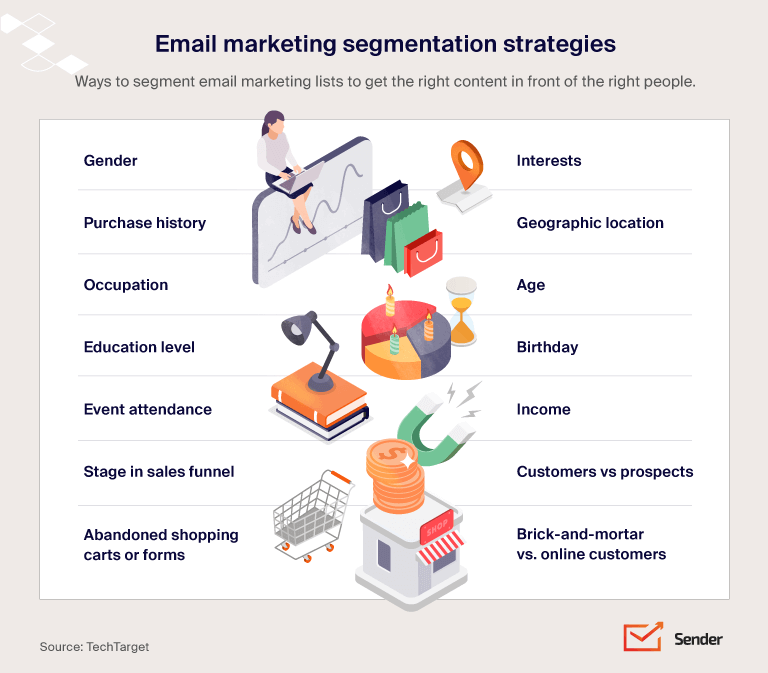
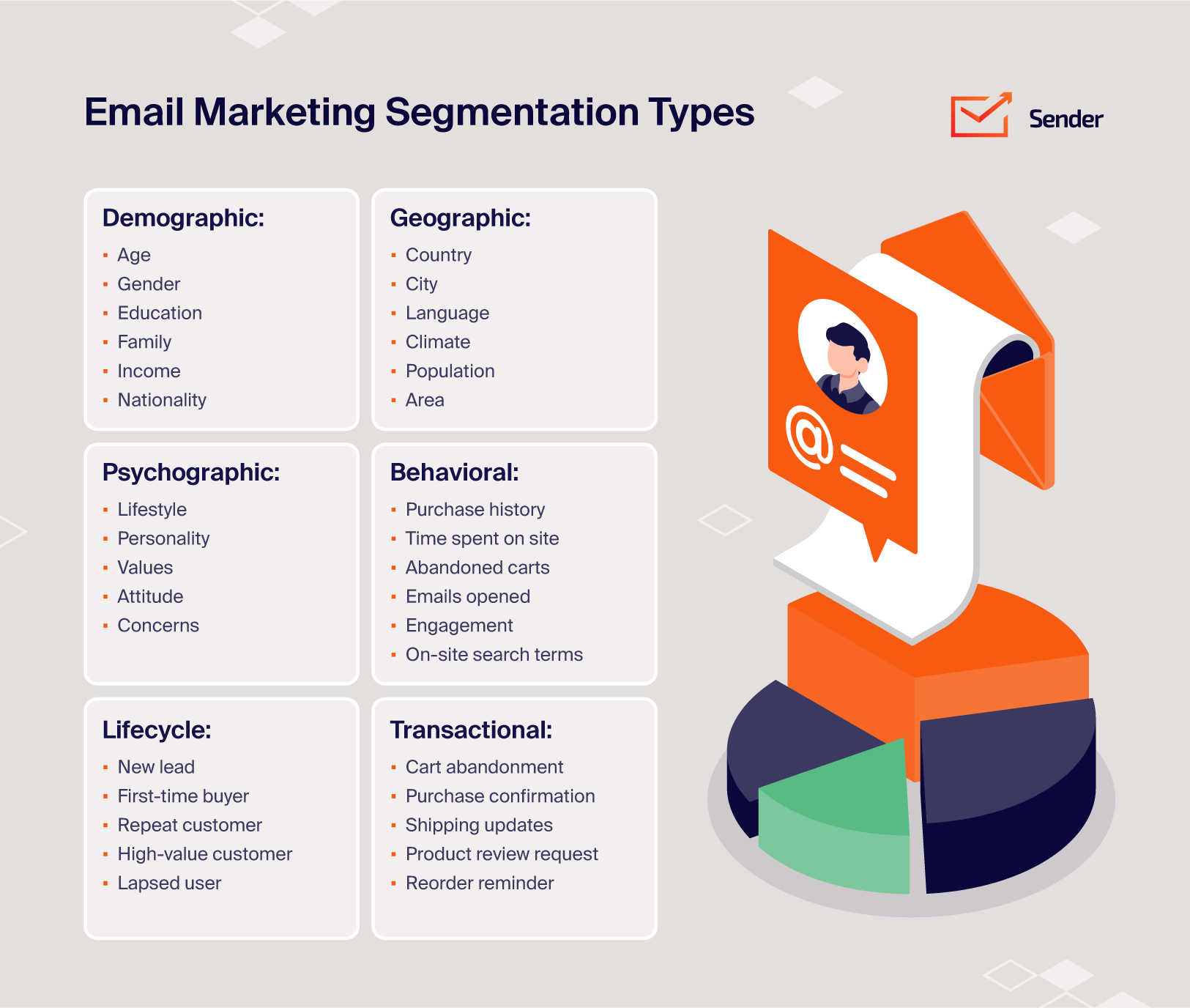
Every segmentation strategy, no matter how sophisticated, pulls from four foundational data categories: demographic, geographic, psychographic, and behavioral. These four endure because they map to the only questions that matter when you’re deciding what to send: who is this person, where are they, why do they care, and what have they actually done?
Get these right and the advanced strategies in the next section have something solid to build on. Skip them and you’re stacking complexity on a weak foundation.
Demographic Segmentation
Demographic segmentation groups subscribers by who they are on paper: age, gender, income, education, occupation, marital status, family size. It’s the oldest segmentation lens in marketing, and it remains useful because the data is easy to collect at signup, and most product catalogs map naturally onto demographic differences.
It’s also the lens most platforms support natively, which means you can act on demographic data without needing custom infrastructure or behavioral tracking pipelines.
The obvious applications are the ones that work. A skincare brand sends different routines to subscribers in their 20s versus their 50s because the product needs are genuinely different, not because the marketing team needed something to do.
A financial services company segments by income band because a $2 million wealth management offering and a $500 starter portfolio aren’t competing for the same customer. A children’s clothing retailer asks for the kid’s age at signup, and that single field powers years of relevant sends as the child grows.
Where demographic segmentation falls down is when teams treat it as a complete strategy rather than a starting layer. Two 40-year-old men with identical incomes and family situations can have wildly different purchase patterns, brand preferences, and price sensitivities. One is shopping for a hobby. The other is shopping for his kids. Demographics describe the surface. They don’t predict behavior on their own.
Collect demographic data lean. First name, age range, and one or two category-relevant fields at signup are plenty. Long forms kill conversion, and most demographic fields beyond the basics get used so rarely they’re not worth the friction. Ask for what you’ll actually use within the first 90 days, and not a question more.
The takeaway: demographics are useful as a layer, dangerous as a standalone strategy. Pair them with behavioral data, and they earn their keep.
Geographic Segmentation
Geographic segmentation splits your list by location: country, region, city, climate zone, time zone, and language. The data is some of the easiest to collect (IP address, shipping address, signup form, browser locale) and some of the most underused.
The obvious play is climate-based product promotion. A retailer selling outerwear shouldn’t push down jackets to subscribers in Phoenix in October. A skincare brand shouldn’t send “winter hydration” campaigns to subscribers in Sydney during their summer. Neither costs much to set up, and both prevent the kind of tone-deaf send that gets you unsubscribed.
The underused play is time-zone-aware send scheduling. Most platforms let you stagger sends by recipient time zone, but plenty of teams still blast at one global send time and call it done. An email landing at 11 PM local time gets glanced at, maybe, before bed, then buried under tomorrow’s morning sends. The same email landing at 9 AM local time gets actual attention.
Geographic segmentation also handles language at the field level. If you have subscribers in Quebec and Ontario, sending English-only campaigns to your Montreal list isn’t just suboptimal, it signals you don’t see them as worth the effort.
One thing to know: geographic data is most powerful when combined with other layers, not used alone. “Customers in Germany” is a starting point. “Customers in Germany who bought in the last 60 days and opened the last campaign” is a segment worth marketing to.
The takeaway: collect location data at signup, then actually use it for both content and timing. Most teams do one or the other.
Psychographic Segmentation
Psychographic segmentation groups people by lifestyle, values, interests, attitudes, and opinions. If demographics tell you who someone is, psychographics tell you why they buy.
Two 35-year-old women with identical incomes and zip codes can have completely different relationships with your brand. One cares about ethical sourcing, the other cares about price. Same demographic profile, different psychographic profile, different email needed.
This is where subscriber segmentation gets genuinely interesting, because psychographic data captures motivation rather than identity.
A B2C example: a clothing brand identifies a sustainability-conscious segment based on survey responses, browsing patterns on their “ethical sourcing” pages, and engagement with content about supply chain transparency. That segment gets emails leading with materials, factory partnerships, and longevity. The price-driven segment from the same list gets emails leading with sale pricing and bundle deals. Same products, different angles, both convert better than a generic blast.
A B2B example: two companies in the same industry, same revenue band, same employee count. One is innovation-first, always testing new tools, willing to be an early adopter. The other is stability-first, wants proven ROI, references from Fortune 500 customers, and a long implementation runway. Send them the same email and you’ll lose both. The innovation buyer wants beta features and a “be first” angle. The stability buyer wants case studies and uptime numbers.
Psychographic data is harder to collect than the other three categories. It usually comes from preference surveys, quiz funnels, social listening, content engagement patterns, and inferred behavior over time. Tools like Klaviyo and HubSpot can build psychographic-adjacent segments from on-site behavior, but the cleanest data comes from asking directly during signup or in post-purchase surveys.
The takeaway: if you only segment on demographics, you’re describing your audience. If you segment on psychographics, you’re understanding them. The emails read completely differently.
Behavioral Segmentation
Behavioral segmentation groups people by what they actually do: purchases, clicks, page visits, email opens, downloads, app sessions, cart abandonment, search queries, video views. Anything tracked, observed, and tied to a contact record counts as behavior.
This is the strongest predictor of near-term conversion you have. What people do beats what they say, every time. A subscriber who tells you in a survey they’re “very interested” in your enterprise tier but hasn’t visited the pricing page in six months is a worse lead than someone who’s visited that page three times this week and downloaded the comparison sheet. Self-reported intent decays fast. Behavior shows you what someone is doing right now.
Behavioral data is also the easiest to act on because the signals are unambiguous. Someone added items to cart and didn’t check out. Someone opened your last five emails. Someone clicked a link to a specific product category twice in a week. Each of these is a clear trigger for a specific email. You don’t have to interpret the data, you just have to respond to it.
AI is rapidly changing what’s possible here. In 2026, platforms like Klaviyo, Bloomreach, and HubSpot are using machine learning to surface intent patterns most marketers would never spot manually. Klaviyo’s predictive analytics, for example, generate predicted CLV, churn risk scores, and expected next-order dates using machine-learning models that retrain weekly.
Predictive segments now identify subscribers likely to churn in the next 30 days, customers likely to make a second purchase, and leads showing buying signals across multiple touchpoints. The marketer’s job has shifted from manually defining every behavioral rule to validating the patterns the system surfaces and deciding which ones deserve a campaign response.
Advanced Segmentation Strategies
This is where the four pillars get applied. The strategies below (lifecycle, RFM, engagement, repeat/VIP, firmographic) combine demographic, geographic, psychographic, and behavioral data into segments that map directly to revenue opportunities. They’re not new categories. They’re frameworks for putting the foundational data to work.
A word of caution before you dive in: most teams should pick two or three of these to start, not all five. Spreading thin across every advanced strategy at once usually means none of them get implemented well.
Lifecycle Stage Segmentation
Lifecycle email marketing groups subscribers by where they are in their relationship with you: new subscriber, first-time buyer, active customer, lapsed, churned, win-back. The stages map to a journey, and each stage needs different content because the person is in a different headspace.
A new subscriber needs education and trust. They don’t know your brand voice yet, haven’t seen your bestsellers, don’t know what makes you different. Hit them with onboarding content, brand story, and your strongest social proof.
An active customer needs product recommendations, loyalty perks, and reasons to buy again. A lapsed subscriber, someone who used to engage but has gone quiet for 60 to 90 days, needs re-engagement: a “we miss you” with a softer offer, or a preference reset to figure out what changed. A churned customer needs your best offer, the one you’d normally hold back, because the alternative is losing them entirely.
Lifecycle segmentation works best when paired with automation flows triggered by stage transitions. Manual lifecycle segmentation is technically possible but rarely sustainable. The transitions happen too fast, and missing them means sending the wrong stage’s email at exactly the wrong moment.
The takeaway: define your stages first, then build the flow that catches each transition.
RFM Analysis
RFM stands for Recency, Frequency, Monetary. It’s a scoring framework that ranks every customer on three dimensions: how recently they bought, how often they buy, and how much they spend. Each dimension gets a score, usually 1 to 5, and the combined score tells you which customers deserve which kind of attention.
The output is typically a grid that buckets customers into named segments. Champions score high on all three (recent, frequent, high spend). Loyal customers buy often but not always at the top tier. At-risk customers used to score high but haven’t purchased recently, which is your early warning system. Hibernating customers haven’t bought in a long time, spent little when they did, and probably aren’t coming back without a strong offer.
RFM is heavier than lifecycle segmentation. Lifecycle gives you stage tags (new, active, lapsed). RFM gives you composite scores that capture value alongside stage. The same “active customer” in lifecycle terms could be a champion or a low-frequency buyer in RFM terms, and those two need very different emails.
For the full scoring methodology and how to set up your own grid, see our complete guide to RFM analysis.
The takeaway: lifecycle tells you when to email, RFM tells you how hard to push.
Engagement-Level Segmentation
Engagement segmentation tiers your list by how recently and frequently subscribers interact with your emails: highly engaged (opening, clicking, converting in the last 30 days), passive (occasional opens, rare clicks), and dormant (no meaningful interaction in 90+ days).
This segment exists as much for suppression as for re-engagement. Sending to dormant addresses tanks your sender reputation, drags your engagement metrics down, and signals to ISPs that you’re emailing people who don’t want to hear from you. Pulling dormant subscribers out of your regular sends, then running a focused win-back sequence to that group, protects email deliverability for everyone else.
One 2026 wrinkle worth flagging: Apple’s Mail Privacy Protection has made open rate alone unreliable for tiering. Build your engagement tiers on click-throughs, replies, conversions, and site visits. Those signals require actual human action, which means they survive MPP and reflect real engagement.
The takeaway: tier by behavior that can’t be faked, then suppress aggressively.
Repeat Customers and VIPs
This strategy identifies your top-spending or most-loyal customers and segments them for differentiated treatment: early access to new products, exclusive offers, loyalty rewards, first crack at restocks, invite-only events. The goal is to make repeat purchase feel like membership, not transaction.
It earns its own segment because VIP audiences typically outperform general campaigns due to higher intent and existing loyalty. The audience already trusts you, and the offer feels earned rather than mass-distributed. A 15% discount sent to your full list is a markdown. The same 15% sent to your top 5% of customers, framed as a thank-you, is a perk. Same number, completely different psychological weight.
There’s overlap with RFM. The “champions” segment in an RFM grid usually maps directly to your VIPs. The difference is positioning: RFM is the scoring method that surfaces who they are, the VIP segment is the applied marketing strategy you build around them.
The deeper play here is building a full strategy around growing your repeat customer base. Segmentation is the entry point, not the destination.
The takeaway: identify your top 5 to 10% by spend, then treat them like it.
Firmographic Segmentation (B2B)
Firmographic segmentation is the B2B equivalent of demographic. Instead of grouping individuals by age and income, you group accounts by industry, company size, revenue band, tech stack, growth stage, and funding status.
It matters more than most B2B teams act like it does. Many B2B teams underutilize segmentation, which creates a real competitive advantage for the ones doing it well. A 50-person SaaS startup and a 5,000-person enterprise have nothing in common in how they buy, even if they’re in the same industry. Sending them the same email guarantees one of them tunes you out.
Firmographic alone is weak, though. Layer it with role/title and behavioral intent signals (page visits, content downloads, demo requests), and you get segments worth the effort.
The takeaway: account-level traits get you in the door. Person-level behavior closes the deal.
How to Collect Segmentation Data
Segmentation only works if the data underneath it is good. Segmenting bad data just creates smaller piles of bad data, and you’ll spend hours building flows that fire on garbage signals. So before you build a single segment, get the collection layer right.
Start with the strategy, not the tooling. Before you decide what data to collect, you need a clear view of your target market— the broad commercial landscape your business operates in. From there, narrow into your target audience — the specific people your messaging needs to reach, which is what your segments are built around.
Skip this step, and you’ll end up collecting fields nobody uses while missing the ones that actually drive segmentation decisions.
There are two types of data feeding your segments:
Explicit data is what subscribers tell you directly. Signup form fields, preference center selections, survey responses, quiz funnel answers, profile updates. The advantage: it’s accurate when given honestly. The catch: people only share what you make easy to share, and they lie or exaggerate when forms feel intrusive. Ask for what you’ll actually use.
Implicit data is what subscribers do. Purchase history, average order value, product categories browsed, pages visited, emails opened (with the MPP caveat from earlier), links clicked, time on site, cart additions, app sessions. The advantage: behavior doesn’t lie. The catch: you need the tracking infrastructure to capture and tie it back to a contact record.
Your concrete collection sources, ranked roughly by ease of setup:
- Signup forms (start minimal: email plus one segmentation field, like role for B2B or interest category for B2C)
- Preference centers where subscribers self-select content types and frequency
- Purchase data from your ecommerce or billing platform
- On-site behavior tracked through your ESP’s pixel or a CDP
- Email engagement metrics surfaced by your platform
- Post-purchase or quarterly surveys for psychographic data
- Enrichment tools (Clearbit, ZoomInfo, Apollo) for B2B firmographic gaps
A practical order of operations: get the explicit basics at signup, layer implicit behavior tracking immediately, run quarterly surveys for the psychographic data you can’t observe, and enrich gaps with third-party data only when the cost is justified by segment value.
The takeaway: collect what you’ll act on, ignore what you won’t, and audit the list every quarter to kill fields nobody uses.
Building Your First Segments: 5-Step Process
If you’ve never built segments before, or if your current ones haven’t been touched in a year, this is the process. Five steps, in order, no skipping.
Step 1: Audit what data you already have. Before you plan new collection, look at what’s sitting in your ESP right now. Most teams discover they have more usable data than they thought (purchase history, email engagement, signup source, location) and a lot of empty fields nobody’s filling. Map what’s actually populated against what you’d theoretically segment on. The gap is your collection roadmap. While you’re in there, flag any fields that are populated but unreliable (free-text inputs, abandoned form fields, data imported years ago from a different platform) so you don’t build segments on top of bad inputs.
Step 2: Define two or three segments tied to revenue. Not 15. Not “every possible permutation.” Two or three, each tied to a specific revenue outcome. Examples: new subscribers (goal: convert to first purchase), top 10% spenders (goal: repeat purchase frequency), lapsed customers 60+ days (goal: win-back). If you can’t name the revenue outcome, the segment isn’t worth building yet. Your segmentation criteria should be specific enough that any teammate could replicate the segment without asking you what you meant. Write the criteria down somewhere your team can find them later, because the person who built the segment won’t always be the person who has to explain it six months from now.
Step 3: Build the segments as dynamic, not static. In your platform, set up dynamic segments so subscribers move in and out automatically as they meet or stop meeting the criteria. Static lists go stale within weeks. Dynamic segments stay accurate as behavior changes, which is the whole point. If your platform doesn’t support dynamic segmentation natively, that’s a strong signal it’s time to upgrade or move.
Step 4: Build one campaign or flow per segment. A segment without a corresponding email is just a database query. Each segment should have at least one piece of content built specifically for it: a welcome flow for new subscribers, a VIP early-access campaign for top spenders, a win-back sequence for lapsed customers. Ship the content the same week you build the segment. Momentum matters here. Segments that sit unused for a month rarely get activated at all.
Step 5: Measure against your control. Run the segmented campaign against a holdout group from your full list, or compare performance to the equivalent un-segmented send from a previous period. Look at click-through rate, conversion rate, and revenue per recipient. If the segmented version doesn’t outperform, the segment definition or the content isn’t right. Adjust before scaling.
The takeaway: build narrow, ship fast, measure honestly. Three working segments beat 15 theoretical ones every quarter.
Email Segmentation Best Practices for 2026
Treat this section as a checklist. None of these are revolutionary on their own, but skip them and your email marketing strategy underperforms by a margin you’ll notice in the revenue line.
Clean your data before you segment. A meaningful share of emails never reach the inbox due to invalid, role-based, or stale addresses. Run your list through a validation tool (Kickbox, NeverBounce, ZeroBounce) before building segments. Otherwise, you’re segmenting people who aren’t even receiving your mail.
Use dynamic segments, not static lists. A dynamic segment updates automatically as subscribers meet or fail the criteria. A static list is frozen at the moment you export it. Static lists go stale within weeks: customers churn, behavior shifts, contacts unsubscribe. If your platform supports dynamic segmentation natively (Klaviyo, HubSpot, Customer.io, Braze all do), there’s no reason to be running static.
Don’t over-segment. Three to five core segments beat 15 micro-segments every time. Once a segment falls below a few thousand contacts, you lose statistical confidence in your tests, can’t run meaningful A/B comparisons, and end up making creative decisions on volumes too small to learn from. Granularity is only useful if you can act on it.
Measure CTOR over open rate. Apple Mail Privacy Protection significantly inflates open rates, which makes them unreliable for optimization. Click-to-open rate (clicks divided by unique opens) and click-through rate are far more reliable signals of segment performance. If you’re still reporting opens to your team, switch the dashboard.
Refresh firmographic and behavioral data quarterly. Companies pivot, employees change roles, customer behavior shifts seasonally. A “VIP” who hasn’t bought in eight months isn’t a VIP anymore. A B2B contact whose company doubled in size is a different segment now. Quarterly is the floor, monthly is better for fast-moving programs.
Use AI-powered segmentation for pattern detection humans miss. Klaviyo, Bloomreach, HubSpot, and Salesforce Marketing Cloud all ship predictive segments built on machine learning: likely-to-churn, likely-to-purchase-again, expected lifetime value tiers. They can surface patterns that are difficult to catch manually, often turning up subscriber groupings worth testing that you wouldn’t have built yourself. Validate the segments before you trust them with your top-of-funnel, but don’t ignore them.
The takeaway: segmentation is maintenance work, not a one-time build. Treat it like a flywheel, not a project.
Conclusion
Segmentation is the highest-leverage change most email programs can make. The teams hitting their revenue targets aren’t writing better subject lines or finding magic send times. They’re sending more relevant emails to better-defined groups, and they’re doing it consistently.
In 2026, this isn’t just a revenue lever. It’s a deliverability requirement. Mailbox providers reward positive engagement and penalize complaint-heavy, low-engagement sending. The brands that figure this out keep landing in the primary inbox. The ones that don’t end up in promotions, then spam, then ignored.
Your next step: pick two or three segments from this guide and ship a test campaign this week. Not next quarter. This week.