


Mailtrap does one thing well — catching outgoing emails in a sandbox during development. The friction starts when teams need more: CI assertions, production transactional sending, or simply a free Sandbox that doesn’t cap at 50 test emails per month.
I tested eight alternatives over three months on live accounts — same test domain, same Node.js test harness, evaluated against the workflow each tool is built for. Sandbox tools (Mailpit, MailHog, Mailosaur) were measured on capture reliability and API support for automated testing.
Transactional senders (Postmark, Mailgun, SendGrid, UniOne, Sender) were measured on inbox placement, webhook reliability, and bounce handling.
This guide covers what each tool actually does, where it falls short, and which side of Mailtrap’s split product line — Email Sandbox or Email API — it’s built to replace. If you’ve only used Mailtrap to inspect outgoing emails during development, you’re on the Sandbox side. If you’ve used Mailtrap to send production transactional email, you’re on the Email API side. The right alternative depends on which. Free open-source options live alongside paid services here because Mailtrap competes with both.
Mailtrap Alternatives Worth Your Attention: A Snapshot
- Local development default — Mailpit. Docker container running in under two minutes, no account, no rate limits, MailHog-compatible API for drop-in replacement. The default choice for anything that doesn’t leave your laptop.
- Legacy local testing, with caveats — MailHog. Still functional for basic SMTP capture, but the project has been quiet since 2020 and no longer ships meaningful updates. New projects should pick Mailpit; existing MailHog setups only need to migrate if they hit a bug.
- CI/CD email assertions — Mailosaur. Purpose-built for asserting on email content inside automated pipelines, with per-test inboxes and content-extraction APIs the marketing-focused tools don’t offer. Go straight to the API on day one of the 14-day trial.
- Hosted manual QA inspection — Mailtrap (kept). As an email sandbox tool, Mailtrap delivers clean inbox UI, spam analysis, and HTML rendering across clients. Still the right tool if your team uses Mailtrap for development inspection rather than CI assertions. Not every Mailtrap user has a reason to leave.
- Production transactional, deliverability-first — Postmark. As a transactional email service, Postmark delivered the strongest inbox placement we measured across three months of testing, separate Message Streams for transactional vs broadcast traffic, and the cleanest DNS-to-first-send setup path of any tool we tested.
- Transactional + marketing in one platform — Sender. Native transactional SMTP alongside marketing automation and custom events triggering, on a free tier of 15,000 emails/month. No credential juggling between two tools, no Zapier dependency for events sourced from your app.
- High-volume transactional at scale — Mailgun. Per-domain reputation controls and webhook infrastructure that hold up at any tier, with a permanent free tier of 100 emails/day and Basic plan from $15/month. Plan for ~25 minutes of setup — right tool if you have the ops bandwidth.
- Broadest integration ecosystem — SendGrid. Widest third-party integration coverage of any transactional service tested, with Twilio-backed phone-tree workflows on higher tiers. Reputation concerns at very high volume are real and worth checking before committing.
- Budget transactional with simple onboarding — UniOne. Per-email pricing lower than SendGrid or Mailgun at common volumes, with a setup flow simple enough for first-time SMTP integration. Smaller integration ecosystem and lighter analytics than the leaders.
Why Developers Keep Searching for Mailtrap Alternatives
Mailtrap works well for what it was originally built to do: act as a fake SMTP server that catches outgoing emails in a sandbox during development so they don’t reach real users. For that one job, it’s fast to set up and does what it promises. The friction starts when needs grow past that starting point — and the alternatives people reach for usually solve only one of the four issues below.
The free tier throttles in ways production never would. Mailtrap’s Sandbox caps you at 50 test emails per month on the free tier, and rate-limits sends in ways no real mail server does. A developer testing a bulk notification feature locally hits the ceiling on the first day of work and either upgrades or works around it — neither should happen during development. The cap also makes load testing impossible without juggling multiple sandbox inboxes, which defeats the purpose of having a single capture environment for the team to inspect.
The Sandbox and Email API products don’t feel integrated. Mailtrap has expanded into production sending, but Email Sandbox and Email API share a dashboard without feeling like one product. Teams report confusion about which context they’re operating in, and the upgrade path from Sandbox to Email API isn’t as clean as the end-to-end positioning suggests. The credentials, project structure, and analytics views differ enough between the two that switching contexts mid-debugging session adds friction rather than removing it — which is the opposite of what a unified platform should do.
The inbox API isn’t built for CI assertions. Mailtrap’s inbox exposes an API, but it isn’t designed around the test-assertion workflow. Writing a test that sends an email, retrieves it programmatically, and asserts on its subject line or a link inside it requires workarounds Mailosaur handles natively. For teams investing in automated testing, this gap compounds quickly — every flaky retry, every regex parse against raw HTML, and every polling loop waiting for a message to arrive becomes maintenance debt that lives in your CI pipeline indefinitely.
Per-client HTML rendering is paywalled. Checking how an email renders across Gmail, Outlook, and Apple Mail requires a paid plan. The free tier gives you HTML validation but not visual previews — which is what most developers actually want when debugging a template. Outlook’s quirks alone justify visual rendering checks, and gating that behind a paywall pushes teams toward dedicated rendering tools like Litmus or open-source options like Mailpit that surface compatibility warnings without an extra subscription.

even on the free plan.
How We Evaluated Mailtrap Alternatives
Each tool was tested on a live account over three months, run against the workflow it’s actually built for — automated email testing for the sandbox tools, transactional delivery for the production senders. Same test domain, same Node.js test harness across all eight platforms.
Features evaluated per tool:
- Setup time from account creation to first captured or delivered email
- SMTP and API integration with a real codebase
- For sandbox tools: capture reliability, inbox UI, API for CI assertions, HTML preview, free-tier rate limits
- For transactional tools: inbox placement, webhook reliability, bounce and complaint handling, suppression lists
- Documentation quality
- Support responsiveness on the entry-level paid plan
- Pricing model and free-tier scope
- Customer feedback on G2, GitHub issues, and Reddit
Deliverability testing: For transactional providers, we measured inbox placement using GlockApps and Mail-Tester across identical seed lists over four weeks. Results vary by domain warmup, sending frequency, and reputation history in ways that make cross-platform scores misleading on their own — observations are folded into each transactional tool’s qualitative review rather than published as standalone numbers.
User reviews: We pulled patterns from recent G2, Capterra, GitHub issues, and Reddit r/webdev and r/devops feedback, balancing positive and negative themes. Technical complaints (rate limits, API quirks, deliverability dips) were weighted above onboarding feedback for this audience.
What was not tested: Enterprise features (dedicated IPs, SSO, custom SLAs), high-volume sending above 100,000 emails per month, multi-region setups, and sub-account hierarchies. This review targets development teams and small-to-mid stacks.
Pricing methodology: All pricing is verified as of April 2026. Annual billing discounts are noted separately, prices shown in USD. Verify each platform’s pricing page directly before committing.
To learn more about our in-house testing methodology, head to this article, which breaks down the process we follow to deliver accurate, unbiased reviews.
Capterra, G2, Trustpilot, and Reddit to create an objective evaluation. Learn more about our review methodology
Mailtrap Competitors — A Quick Comparison Table
Eight Mailtrap competitors plus Mailtrap itself as a reference row, ordered by workflow — local testing, cloud QA, hybrid sandbox, then production sending. Pricing is for the entry tier; unit prices vary across platforms, so verify each page directly before committing.
| Platform | Tool type | Best for | Stands out for | Pricing |
| Mailtrap | Hybrid (testing + sending) | Developers doing manual sandbox QA | Clean inbox UI with spam analysis; HTML check on free tier | Sandbox free 50 emails/mo (paid from $14/mo annual); Email API free 4k emails/mo (paid from $15/mo) |
| Sender | Transactional + marketing | Teams managing both product and marketing email | One platform for both use cases; custom events trigger sends from your app without Zapier; most generous free tier tested | Free 15k emails/mo with transactional included (2.5k subscribers); paid from $7/month |
| Mailpit | Local testing | Solo devs on localhost | No account needed; running via Docker in under 2 min | Free (self-hosted) |
| MailHog | Local testing | Teams already running it | Familiar if you’re on it — but no longer maintained; migrate to Mailpit | Free (self-hosted) |
| Mailosaur | Cloud QA / CI testing | QA engineers automating email testing | Purpose-built assertion API; ~780ms average message retrieval in testing | 14-day trial; from $20/month billed annually |
| Postmark | Production sending | Teams launching transactional email | Strongest deliverability tested; message streams protect sender reputation | Free (100 emails/month); paid from $15/month (10k emails) |
| Mailgun | Production sending | High-volume transactional sending | Mature webhook infrastructure; competitive per-message pricing at scale | Free 100 emails/day; Basic from $15/mo (10k), Foundation from $35/mo (50k) |
| SendGrid | Production sending | Teams in the Twilio ecosystem | Capable API and template engine — but 1.1/5 Trustpilot score warrants caution | 60-day trial (100 emails/day); Essentials from $19.95/month |
| UniOne | Production sending | Startups sending under 100k emails/month on a budget | Per-email pricing below SendGrid and Mailgun at common volumes; lighter analytics layer | Free trial (6k emails/mo for 4 months); from $6/mo (10k emails) |
8 Best Mailtrap Alternatives I’ve Reviewed
Each tool below — covering the best email testing tools alongside the transactional senders that handle production delivery — was tested on a live account against the workflow it’s built for: capture reliability and CI assertion APIs for sandbox tools, inbox placement and webhook handling for transactional senders.
Sender — Transactional and Marketing Email in One Account
Sender combines transactional SMTP with marketing automation in one account, so product emails and newsletters share credentials and contact data. Webhook tooling is shallower than what dedicated transactional providers like Mailgun or Postmark offer.

Key Features
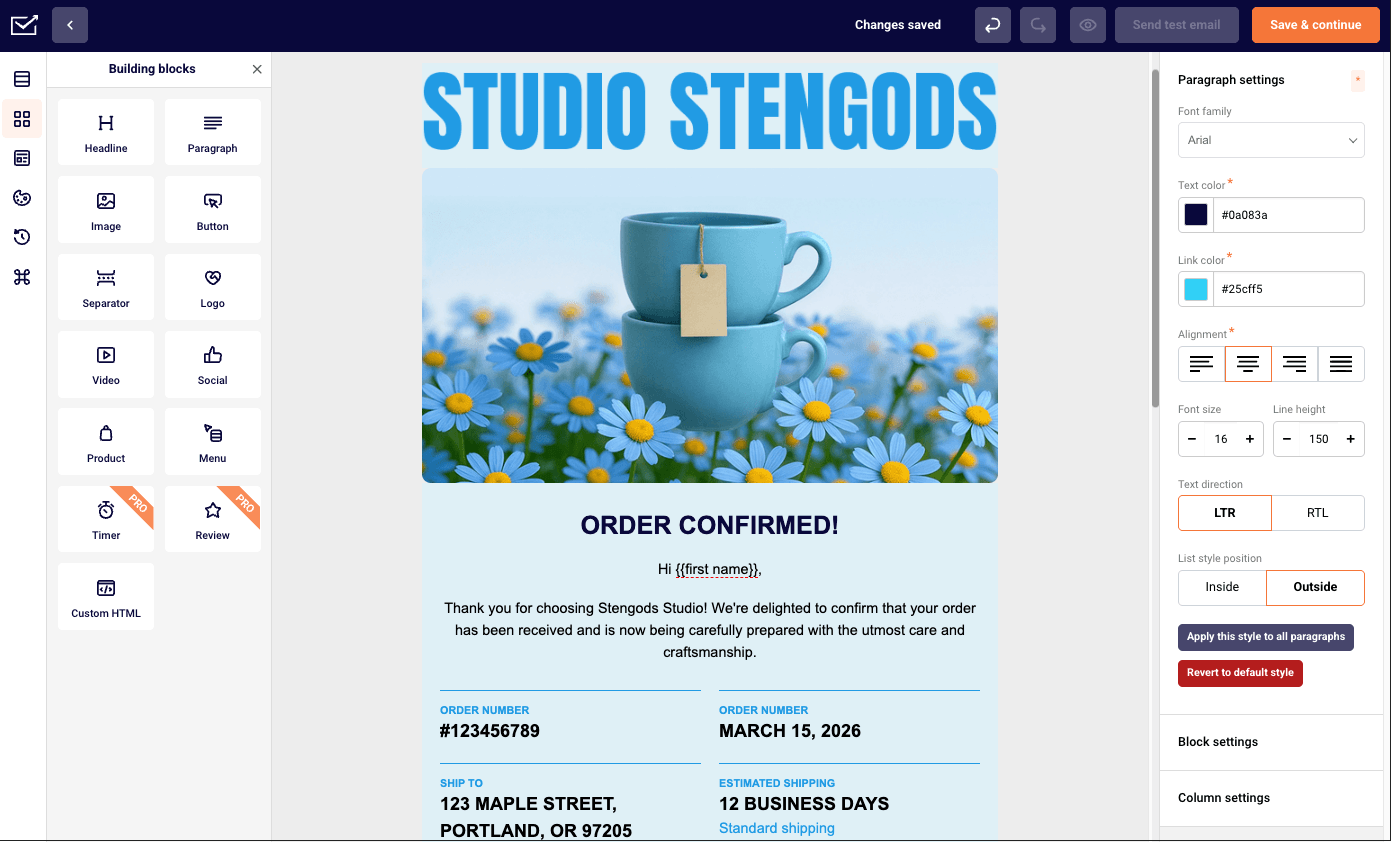
- Unified transactional + marketing dashboard. Both use cases live in one account — no separate credentials, bounce lists, or analytics tabs to manage between two tools.
- Custom events trigger transactional sends. Define events in your app code (signup_complete, purchase_made, password_reset) and fire transactional templates without Zapier or middleware. Tied to the marketing automation engine, so transactional and lifecycle emails share the same trigger language.
- SMTP relay + REST API on the free plan. Both delivery methods available without upgrading. API docs cover basics but lack depth on webhook configuration and event payload structure.
- Guided SPF/DKIM/DMARC setup. Email authentication configuration is a checklist inside the dashboard — one of the clearer implementations tested across the eight tools.
- 15,000-email free tier with transactional included. Most generous free tier in this comparison: 15,000 emails/month to 2,500 subscribers, with both transactional SMTP and marketing automation, segmentation, and templates included at no cost.
Pros & Cons
- Most generous free tier in this comparison
- Transactional + marketing on one set of credentials
- Custom events fire sends directly from app code, no middleware
- Guided auth setup reduces DNS and deliverability errors
- Dashboard noisy for pure transactional use — marketing UI fights for screen space
- Webhook and advanced API docs thinner than Postmark or Mailgun
- No self-hosting option
- Sender branding on free-plan emails
Pricing
Free email marketing for 15,000 emails/month (2,500 subscribers, transactional included). Paid plans from $7/month, with exact pricing varying by plan and billing cycle.
Best for: Early-stage startups or small teams running both a product and a mailing list who want to avoid managing two separate email platforms — not the right tool for teams whose sole need is high-volume transactional sending.
Mailgun — API-First Transactional Email Service
Mailgun is API-first transactional infrastructure for engineering teams sending at scale, with per-domain reputation isolation and granular webhook event tracking. Setup is the steepest tested — about 25 minutes from signup to a verified send.

Key Features
- Per-domain reputation management. Each sending domain gets its own reputation tracking and warmup curve, so transactional and marketing traffic don’t cross-contaminate. The dashboard exposes reputation metrics at a granularity Postmark and SendGrid don’t match.
- Webhook infrastructure with retry policies. Configurable per-event webhooks (delivered, opened, complained, failed) with automatic retry on 5xx responses. Setup is API-only with no UI wizard — adds about 25 minutes for first-time integration.
- EU and US sending regions. Choose the region your sending IPs originate from at account setup. Useful for GDPR-aware traffic and EU-resident recipient lists, where US-origin IPs sometimes trigger inbox-placement issues.
- Native inbox placement testing. Built-in seed list testing across Gmail, Outlook, Yahoo, and AOL on Foundation plan and above. The only platform in this comparison with native inbox-placement testing — the others require GlockApps or Mail-Tester separately.
- Email validation API. Real-time email address validation to filter typos and disposable addresses before they hit your suppression list. Pay-per-validation, billed on top of the sending plan.
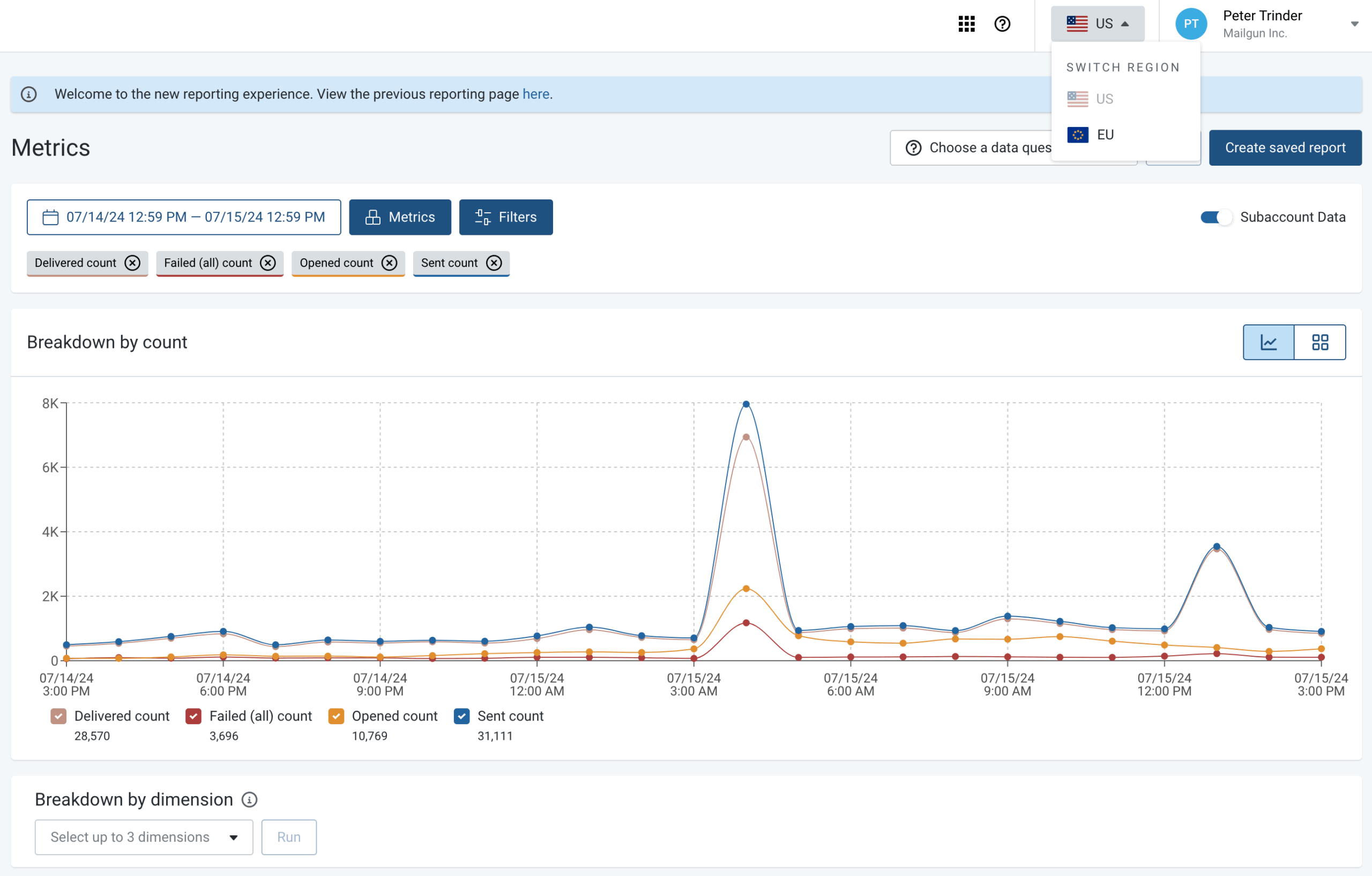
Pros & Cons
- Per-domain reputation isolation between transactional and marketing traffic
- Native inbox placement testing built in
- EU/US region choice for data residency requirements
- Detailed webhook event structure with retry guarantees
- Daily-cap free tier (100/day) burns quickly during batch sends or bursty workflows
- 25-minute setup from signup to verified send, the longest of the transactional tools tested
- Pricing jumps sharply between Foundation ($35/mo) and Growth ($90/mo)
- Documentation density assumes engineering experience — not friendly for first-time integrators
Pricing
Free 100 emails/day (permanent). Basic plan from $15/month for 10,000 emails; Foundation from $35/month for 50,000 emails.
Best for: Engineering teams with the ops bandwidth to manage per-domain reputation and webhook retry logic, sending tens of thousands of emails per month — not for solo developers or teams looking for a quick setup.
SendGrid — Scalable SMTP and API Email Delivery
SendGrid is Twilio’s transactional email arm, with the widest third-party integration ecosystem in this comparison and direct connection to Twilio SMS and voice. Shared-IP deliverability is the real friction — the 1.1/5 Trustpilot score reflects that pattern.

Key Features
- Twilio integration for multichannel workflows. Native connection to Twilio SMS, voice, and WhatsApp lets you build escalation patterns (email → SMS → call) inside one platform. Useful for transactional flows like password resets or 2FA when email delivery is delayed.
- Dynamic templates with Handlebars syntax. Server-side templating with substitution tags, conditional blocks, and loops. Templates render at send time, no client-side processing required from your app. Documentation and examples are stronger than Mailgun’s templating system.
- Event Webhook with 9 event types. Granular events (delivered, opened, clicked, bounced, dropped, deferred, processed, unsubscribed, spamreport) sent to a single endpoint. Easier to wire up than Mailgun’s per-event configuration, harder to scope precisely.
- 60-day free trial at 100 emails/day. Time-limited rather than a permanent free tier — useful for evaluation and proof-of-concept work, but you’ll need to move to a paid plan ($19.95/month Essentials minimum) for any sustained production use beyond the trial window.
- Marketing Campaigns add-on. Separate marketing tool bolted onto the transactional account, with contact lists and campaign builders. The UX gap between the transactional API and marketing UI is noticeable.

Pros & Cons
- Twilio ecosystem connection for multichannel transactional flows
- Strong templating documentation and examples
- 60-day free trial at 100 emails/day for evaluation
- 900+ third-party integrations, the widest in this comparison
- 1.1/5 Trustpilot score across 2,000+ recent reviews — pattern of deliverability complaints
- Shared IP pools on lower tiers expose you to other senders’ reputation
- Support on free and entry tiers is community-forum-based
- Pricing tiers escalate quickly above 100,000 emails/month
Pricing
Free trial: 100 emails/day for 60 days. Essentials plan from $19.95/month.
Best for: Teams already invested in the Twilio ecosystem who need email alongside SMS and voice workflows — not for teams optimizing primarily for inbox placement or deliverability reputation.
UniOne — Transactional Email Service for Startups
UniOne is a transactional email service built for startups wanting low per-email cost and simple SMTP setup without enterprise pricing pressure. Integration ecosystem and analytics are lighter than what Mailgun, SendGrid, or Postmark offer.

Key Features
- Pay-per-email pricing model. Pricing scales linearly with volume, no tier jumps or contact-count surcharges. Standard plan starts at $6/month for 10,000 emails. At 50,000 emails a month, UniOne charges $25, undercutting Mailgun’s Foundation tier ($35/month for the same volume).
- REST API and SMTP relay on entry tier. Both methods available from the lowest plan. API supports template variables, attachments, and scheduled sends. Documentation is sparser than Mailgun or Postmark but covers the core endpoints clearly.
- Built-in email validation on send. Invalid addresses flagged and suppressed automatically without consuming send credits. No separate validation API to bolt on, unlike Mailgun’s pay-per-validation model.
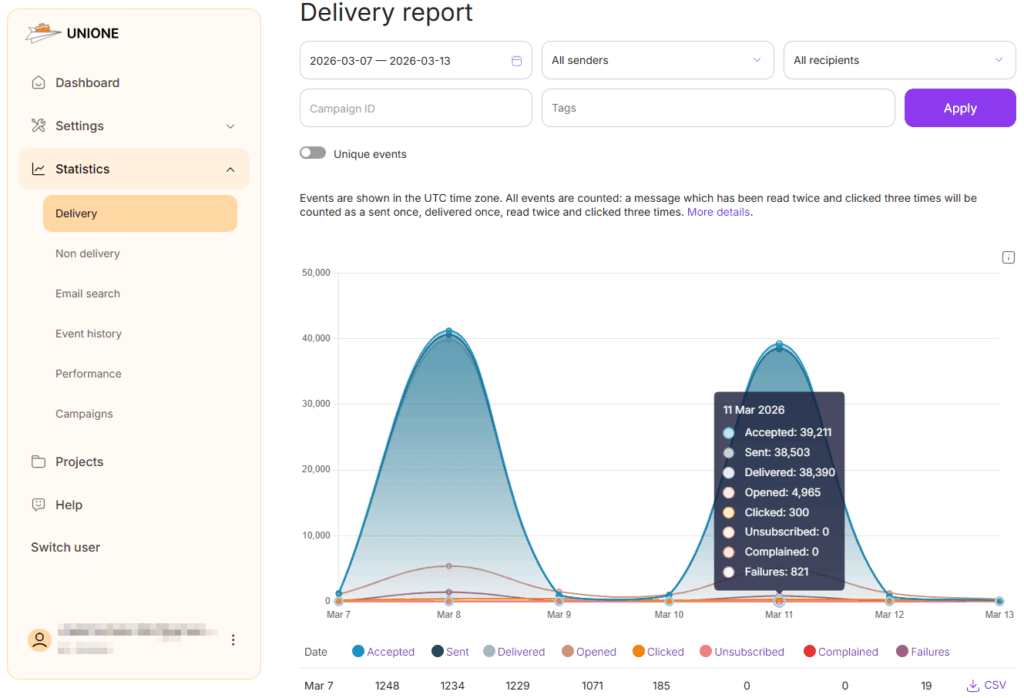
- Webhook events covering the full delivery and engagement lifecycle. Ten status types, more than SendGrid’s nine — enough to track everything from acceptance and delivery through opens, clicks, bounces, and spam complaints.
- Standalone analytics layer. Open rates, click rates, and bounce rates surfaced in the dashboard. No revenue attribution or cohort analysis — UniOne expects your application layer to handle those.
Pros & Cons
- Among the lowest per-email costs in this comparison at moderate volumes
- Built-in validation prevents wasted credits and bounces
- Linear pricing without tier jumps or surcharges
- Simple SMTP setup, well-suited to first-time transactional integrations
- Smaller integration ecosystem than SendGrid or Mailgun
- Analytics layer is lighter — no advanced segmentation or cohort views
- Documentation gaps on edge cases like rate limiting and suppression API
Pricing
Free trial: 6,000 emails/month for 4 months. Paid plans: Standard from $6/month for 10,000 emails.
Best for: Bootstrap startups and small teams sending 10,000–100,000 emails/month who want low per-email cost and simple SMTP integration — not for teams needing deep analytics or complex webhook routing.
Postmark — Transactional Email Built for Consistency
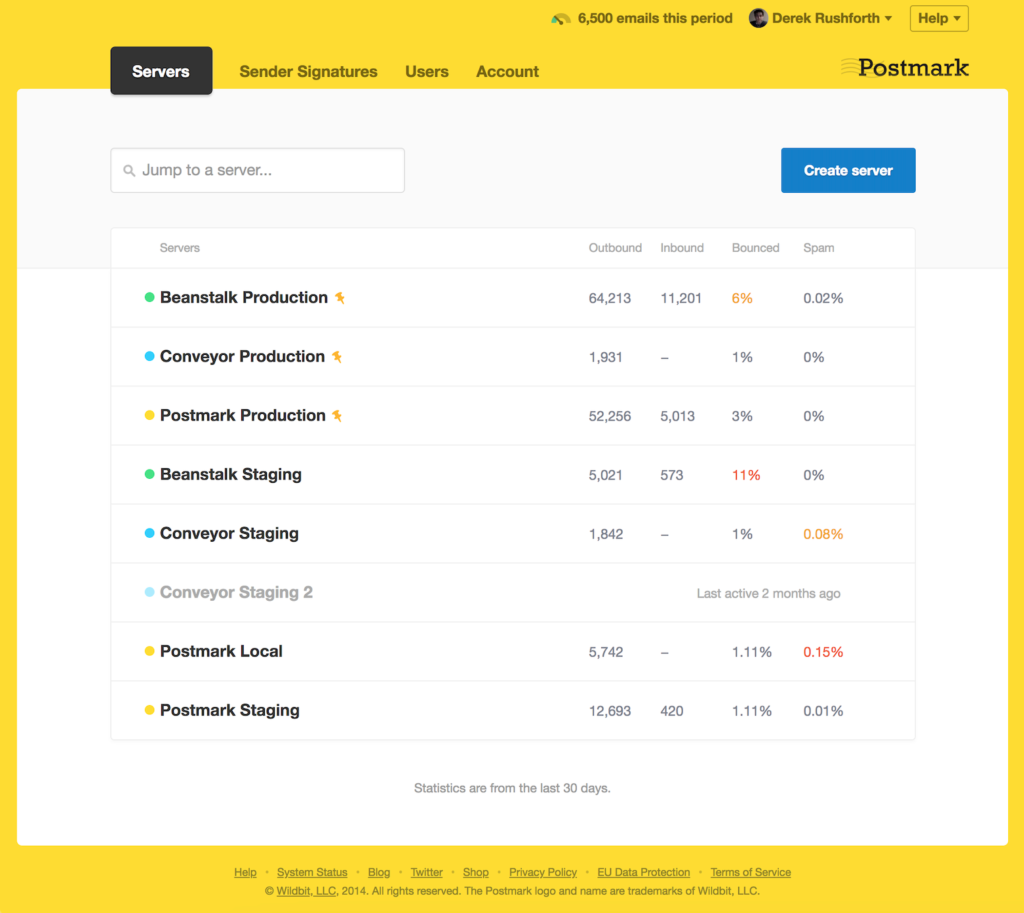
Postmark is a transactional-only service that has invested heavily in deliverability — Message Streams separate transactional from broadcast traffic, and inbox placement topped this comparison across three months of testing. The trade-off is scope: no marketing automation, no EU sending region.

Key Features
- Message Streams separate transactional from broadcast. Native separation of transactional and broadcast traffic at the account level, each with isolated IP reputation. Prevents marketing sends from damaging transactional deliverability — the most common cause of password-reset emails landing in spam.
- Strongest inbox placement we measured. Across three months of GlockApps testing on identical seed lists, Postmark achieved the highest inbox placement rate of any tool in this comparison, particularly to Gmail and Outlook. Margins narrowed at lower send volumes but held at scale.
- DNS-to-first-send under 10 minutes. Onboarding walks through SPF, DKIM, and Return-Path configuration with a verifier that confirms each record before letting you send. The cleanest setup path of any production sender tested.
- 45-day searchable message archive. Every send searchable with full content and event history for 45 days. Longer than Mailgun’s 5-day default and useful for debugging delivery issues retroactively.
- REST API with 12 event types. Granular event tracking (delivered, opened, clicked, bounced, complained, plus subcategories). Webhook payloads include the full Postmark message ID for correlation with internal logs.
Pros & Cons
- Best inbox placement in this comparison, measured over three months
- Message Streams isolate transactional from broadcast reputation
- Clearest authentication setup flow tested
- 45-day searchable message archive built in
- Pricing rises sharply above 1 million emails/month
- No EU sending region — US-only IP origins
- No native A/B testing on transactional templates
- Free tier capped at 100 emails/month, intended for evaluation only
Free up to 100 emails/month. Paid plans from $15/month for 10,000 emails.
Pricing
Best for: Product teams launching transactional email where deliverability of password resets, receipts, and account notifications matters more than send volume — not the cheapest option for high-volume marketing-style sends.
Mailosaur — Automated Email Testing for QA Teams
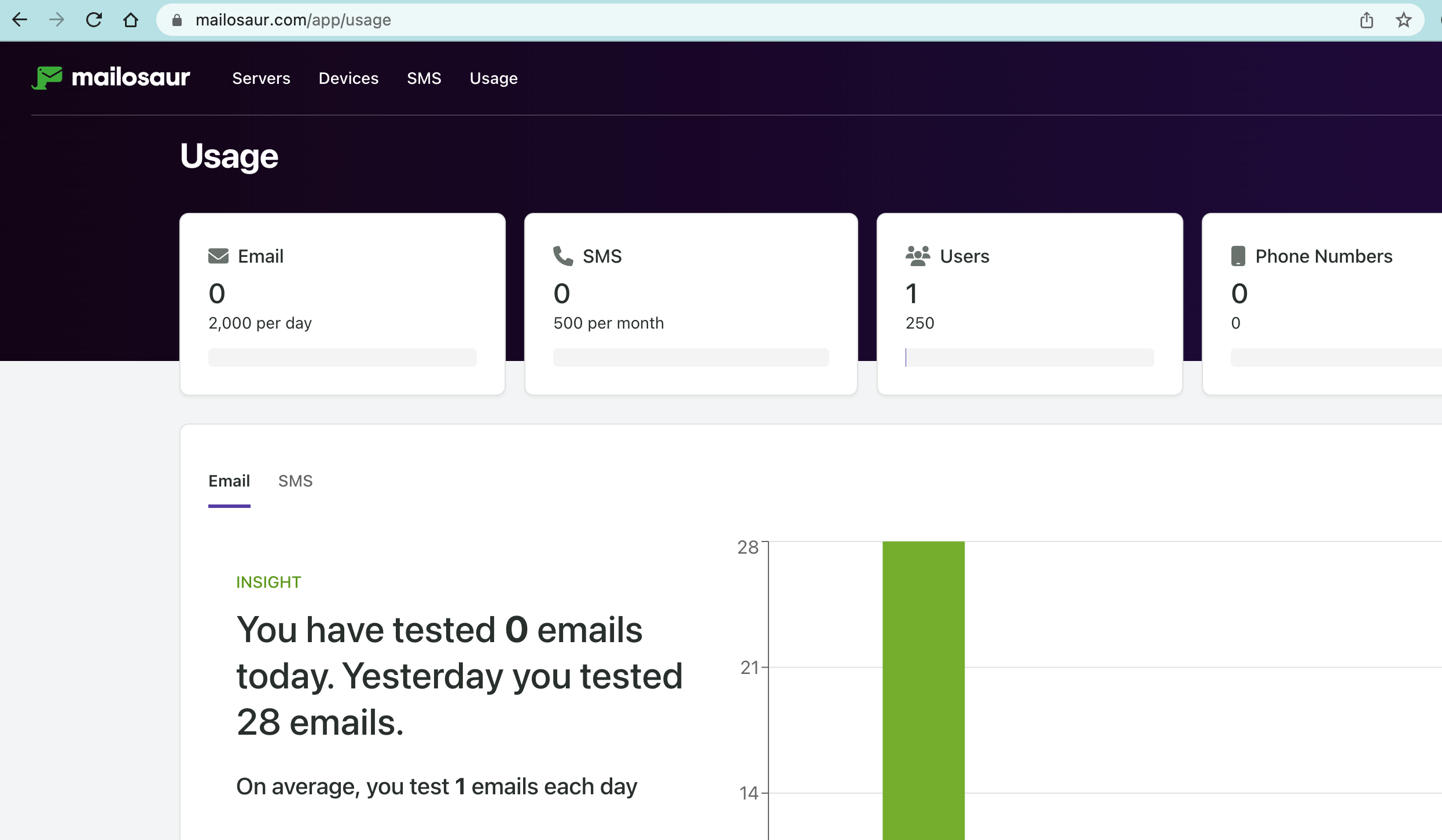
Mailosaur is cloud-hosted email testing built specifically for automated CI/CD pipelines — per-test inboxes, content extraction APIs, and SDKs for eight programming languages. Not designed for manual development inspection.

Key Features
- Per-test inbox provisioning. Each test run can spin up a fresh, isolated inbox by generating a unique address (e.g. anything@server-id.mailosaur.net). No inbox cleanup between tests; no shared-state risk in parallel CI runs.
- Content extraction API. Built-in helpers to extract verification codes, password reset links, OTP values, and tracked URL parameters from email bodies. Avoids regex-parsing email HTML in your test code — the most common source of fragile email tests.
- ~780ms average message retrieval in testing. From SMTP send to API-retrievable, Mailosaur delivered captured messages in roughly 780ms across our 100-message test batch. Mailtrap’s API returned comparable messages in 1.4–2.1 seconds.
- SMS and WhatsApp testing on higher tiers. Same assertion model extended to SMS verification codes and WhatsApp messages. Useful for testing multi-factor authentication flows that mix channels.
- Native SDKs for 8 languages. First-party libraries for Node, Python, Ruby, Java, C#, Go, PHP, and Swift. Documentation includes Cypress, Playwright, and Selenium examples for end-to-end testing frameworks.
Pros & Cons
- Built specifically for CI/CD email testing workflows
- Fast message retrieval suits parallel test suites
- Content-extraction helpers reduce test fragility
- SDKs and framework examples available out of the box
- 14-day trial only — no permanent free tier
- Pricing rises with parallel server count and message volume
- Limited HTML preview UI compared to Mailtrap or Mailpit
- Not designed for manual development inspection — sandbox tools fit that job better
Pricing
14-day free trial. Paid plans from $20/month billed annually.
Best for: QA engineers and platform teams running automated email assertions inside CI pipelines, especially for verification codes and password-reset flows — not for solo developers doing manual email inspection during local development.
Mailpit — Lightweight Self-Hosted Alternative
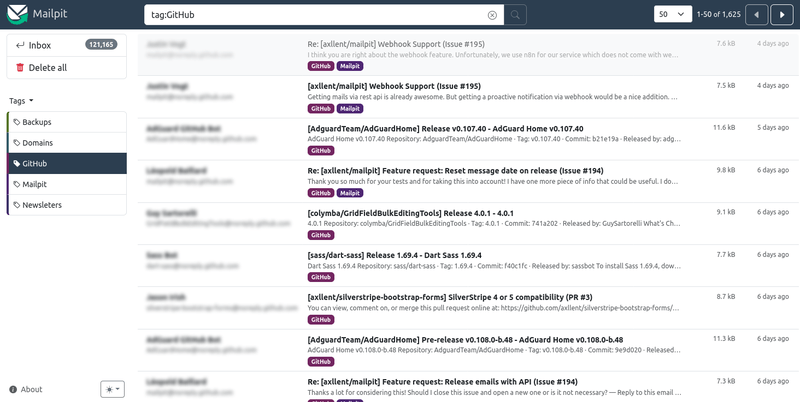
Mailpit is a self-hosted SMTP capture tool that runs as a single Docker container, designed as a modern replacement for the unmaintained MailHog. It captures outgoing email locally with a web UI and REST API for inspection — no cloud component, no account, no signup.
Key Features
- Docker container, no account needed. Run docker run -p 1025:1025 -p 8025:8025 axllent/mailpit and Mailpit is capturing SMTP traffic in under two minutes. No signup, no API key, no cloud component.
- MailHog-compatible API. As an SMTP testing tool, Mailpit is a drop-in replacement for projects already integrated with MailHog’s API endpoints. Migration from MailHog typically requires changing the image name in docker-compose and nothing else.
- HTML, plain-text, and raw source views. As an email preview tool, Mailpit lets you inspect every captured message in three formats. HTML preview renders inline with link-blocking enabled by default — useful for verifying templates without firing tracking pixels.
- Per-client CSS compatibility checker. Built-in CSS rule checker against an email-client compatibility database. Warns about properties Outlook 2016 strips, dark-mode rendering quirks, and mobile-client incompatibilities — without a Litmus or Email on Acid subscription.
- Optional persistent storage. SQLite-backed message storage for capturing messages across container restarts. Off by default (Mailpit assumes ephemeral usage); enable via the –db-file flag if you need persistence between sessions.
Pros & Cons
- Zero-config Docker setup, no account required
- Compatible with existing MailHog tooling
- CSS compatibility checker without a third-party subscription
- Active development with regular releases
- Self-hosted only, no cloud option
- No multi-user collaboration features
- API not designed for CI assertion workflows like Mailosaur’s
- No SMS or alternative channel testing
Pricing
Free, open source.
Best for: Solo developers and small teams running local SMTP capture during development on personal machines or shared dev containers — not for distributed QA teams needing shared cloud access or CI assertion APIs.
MailHog — Free Local Email Testing Alternative
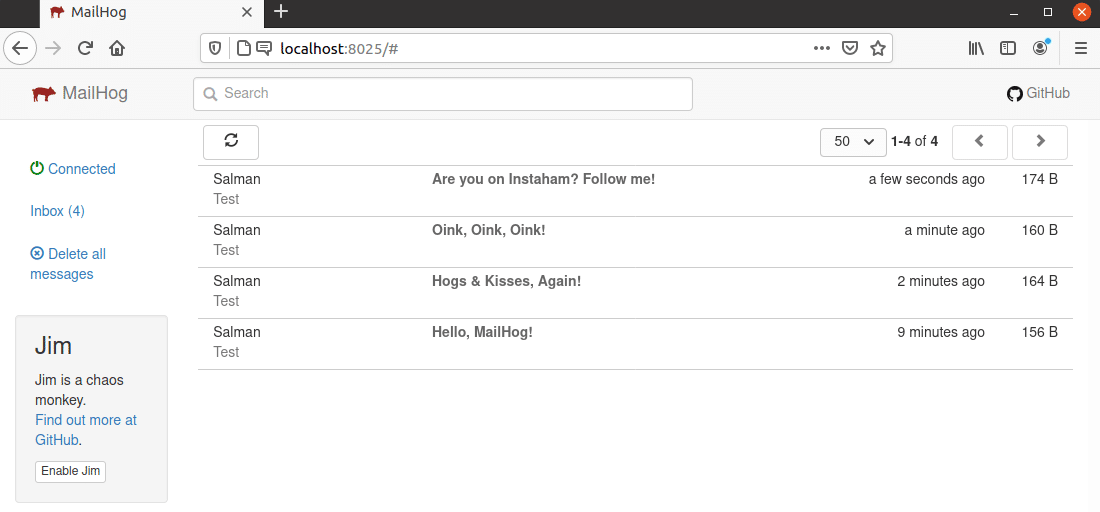
MailHog was the dominant local SMTP capture tool before development effectively stopped in 2020. It still works for basic capture and inbox preview, but the API is frozen and lacks the modern features Mailpit has added since.
Key Features
- SMTP capture with web UI. Catches outgoing SMTP traffic on a configurable port and exposes captured messages in a browser UI at port 8025. Same operational model as Mailpit, which it predates by several years.
- Simple HTTP API. RESTful endpoint for retrieving, deleting, and releasing captured messages. Mailpit replicates this API surface, which is why MailHog setups are portable to Mailpit with minimal changes.
- Multiple storage backends. In-memory (default), MongoDB, or Maildir storage. The MongoDB option supported larger development environments where capture volume could exceed memory limits, though Mailpit’s SQLite handles most cases.
- Static Go binary distribution. Single-executable distribution for Linux, macOS, and Windows. Under 10MB binary, no runtime dependencies — easy to drop into a CI runner or shared dev box.
- Project in maintenance mode since 2020. Last significant release was MailHog v1.0.1 in 2020. The repository sees occasional security fixes but no new features. New projects should pick Mailpit; existing MailHog deployments have no urgent reason to migrate.
Pros & Cons
- Static binary distribution with no runtime dependencies
- Familiar to teams already running it for years
- Lightweight and well-documented for its scope
- Multiple storage backends for varied development setups
- No active development — last meaningful release was 2020
- No CSS compatibility checker or modern email rendering features
- API surface frozen at 2020 capabilities
- New projects gain nothing from picking MailHog over Mailpit
Pricing
Free, open source.
Best for: Existing self-hosted email testing setups on MailHog where switching costs outweigh the benefit of newer features — not for new projects, which should choose Mailpit instead.
Migration Guide: Switching Away From Mailtrap
If you’ve decided to switch, here’s what the migration looks like — covering the three most common paths. The process is straightforward, but easy to do partially, which is where most deliverability problems come from.
SMTP Settings at a Glance
The four values that change when you switch are host, port, username, and password. Here’s what they look like across the most common migration paths:
| Setting | Mailtrap | Mailpit | Postmark | Mailgun |
| SMTP host | sandbox.smtp.mailtrap.io | localhost | smtp.postmarkapp.com | smtp.mailgun.org |
| Port | 2525 | 1025 | 587 | 587 |
| Username | Your Mailtrap user | None required | Your server token | postmaster@yourdomain |
| Password | Your Mailtrap pass | None required | Your server token | Your Mailgun SMTP password |
| Auth required | Yes | No | Yes | Yes |
Update these values in every environment — local, staging, and production. Leaving one environment pointing at Mailtrap is the most common migration mistake.
Migration Checklist
Follow these steps in order. Skipping step 3 is the most common cause of post-migration deliverability problems.
- Update SMTP settings in all environments using the table above.
- Rotate your API key on the new provider immediately after setup. Never use the default key created during signup in production.
- Verify SPF and DKIM DNS records for your sending domain before sending a single production email. Both Postmark and Mailgun have a DNS verification dashboard that confirms when records are live. Unverified sends will land in spam.
- Test in staging first. Send at least 10 emails covering your real templates — HTML, plain-text, and any with attachments — and confirm they arrive correctly before cutting over production.
- Update webhook endpoints if you used Mailtrap’s event logging for opens, clicks, or bounces. Postmark and Mailgun support webhooks too, but with different payload formats — check your handler code before go-live.
- Confirm your From address domain matches your verified sending domain. A mismatch between the two is a common post-migration deliverability issue that’s easy to miss in testing.
FAQs
Only if you already have it deployed and stable — for new projects, Mailpit is the better choice. MailHog stopped meaningful development in 2020 and now ships only occasional security patches, while Mailpit offers the same SMTP capture model with an API-compatible interface, active maintenance, and modern additions like a CSS compatibility checker and dark-mode preview.
Migration cost is minimal: change the image name in your docker-compose file and most existing tooling continues to work. Stick with MailHog only if your current setup is stable, your tooling depends on its exact API surface, and you have no specific reason to switch.
Not by default. Mailpit holds captured messages in memory, so a docker stop or container restart wipes everything. For persistence, pass the –db-file flag with a path mounted from your host (e.g. docker run -v ./mailpit:/data axllent/mailpit –db-file /data/mailpit.db). The SQLite file holds the full message body and metadata, so search, filtering, and the web UI all keep working after a restart.
Most local development workflows are cleaner without retained state, so only enable persistence if you have a specific reason to keep messages across sessions — debugging an intermittent template bug, for example.
Yes, if you stay focused on a single integration target. The trial includes one server with unlimited message capture, the full API surface, and SDK access — enough to build and validate a CI/CD pipeline against one workflow, such as signup-with-verification or password-reset assertions.
What it won’t cover is multiple parallel test environments (each consumes a separate server), high-volume regression suites, or webhook-driven inbound flows at production cadence. Plan to wire up one critical test path during the trial, prove it works in your pipeline, and commit to the paid tier ($20/month billed annually minimum) before expanding scope.
Yes — Mailpit and MailHog are both fully open source and free forever for local SMTP capture, replacing Mailtrap’s free Sandbox tier (capped at 50 test emails/month) with no quotas or signup.
For free transactional email on the production-sending side of Mailtrap, Sender offers 15,000 emails/month with transactional included, Postmark gives 100 emails/month, and Mailgun has a permanent free tier of 100 emails/day. Mailosaur and SendGrid offer time-limited trials only (14 days for Mailosaur; 60 days at 100 emails/day for SendGrid) rather than perpetual free tiers. For pure local development where nothing should leave your machine, Mailpit is the default starting point.
Mailpit, for almost every case. It runs entirely on localhost via a single Docker command, captures all SMTP traffic from your app, and exposes both a web UI and a REST API — none of which requires internet access.
MailHog works the same way and is a reasonable choice if it’s already in your stack, but it stopped active development in 2020 and lacks Mailpit’s CSS compatibility checker and dark-mode preview. Cloud-hosted options like Mailtrap and Mailosaur require network access to function, so they’re not viable for fully offline workflows or air-gapped development environments.