




SMS marketing has made a comeback.
Though many marketers sidelined SMS after the smartphone revolution, consistently high open rates have reignited widespread interest in the channel. SMS open rates average around 98%, and SMS marketing ROI statistics consistently show that few channels deliver comparable returns.
In this article, let’s explore some exciting statistics about SMS open rates, SMS marketing, and engagement rates. By the time you end up reading these numbers, you’ll realize how profitable running an SMS marketing campaign for your business is. So, let’s get started.
This article is part of our SMS marketing guide.
Top SMS Marketing Open Rates at a Glance
- SMS open rates are commonly cited at around 98%, making text one of the highest-visibility marketing channels, though this is best treated as an industry benchmark rather than a directly trackable metric;
- 82% of consumers check text notifications within five minutes, and 32% do so within 60 seconds;
- 81% of consumers have signed up to receive texts from a business or organization;
- 79% of consumers opted in to business texts in 2024, showing SMS subscription rates continue to stay high;
- 68% of U.S. consumers have spent $50+ after buying through text messaging, and 22% have spent up to $500;
- 58% of consumers say they are more likely to buy from a brand after subscribing to its text list;
- 86% of consumers made two or more purchases in the last year from a branded text, showing SMS can drive repeat buying, not just one-off clicks;
- Current 2026 timing data suggests SMS performs best on Monday–Tuesday, with the strongest overall send window at 4 p.m.–7 p.m.
What is SMS Open Rate?
SMS open rate is the percentage of recipients who open and read an SMS message out of the total number of recipients in an SMS campaign. For example, if you send an SMS to 100 prospects and 90 out of them open it, your open rate for SMS is 90%.
SMS open rate is an important metric for gauging the efficacy of an SMS marketing campaign. Compared to other forms of digital communication, like emails, SMS boasts staggeringly high open rates.
Why? Think about your relationship with your phone. An SMS is immediate, often alerting the user instantly. It’s personal, landing in the same inbox where messages from friends and family appear.
It also doesn’t require an internet connection, which is one reason SMS delivery rate statistics consistently outperform email — texts reach handsets far more reliably than messages that can be filtered into spam folders.
Want to start SMS marketing? Try Sender — it’s effortless, affordable, and effective.
What are Standard SMS Marketing Open Rates?
If you trust actual data before experimenting with any marketing channel, you’d love the following statistics about SMS open rates.
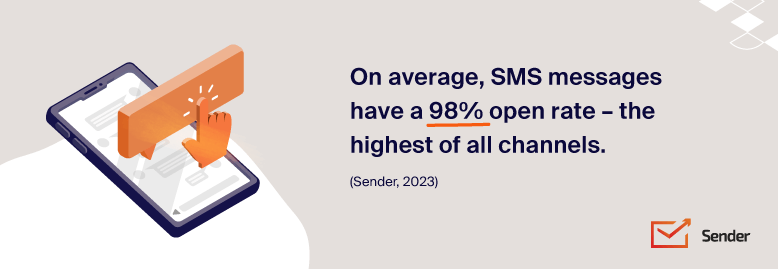
According to research, on average, SMS messages have a 98%* open rate. Compared to email, this is almost five times more. Here are some more SMS marketing statistics:
- 90%* of people open a text within three minutes;
- Most consumers now choose texting over email and phone calls for customer service issues, and 71%* want the ability to text a business back;
- One in three customers sends an SMS to a business but never receives a reply;
- 82%* of consumers check their text notifications within five minutes, and 32% check them within 60 seconds;
- 81%* of consumers ignore marketing messages that aren’t relevant to them.
SMS isn’t a medium that should be ignored, not after you’ve come across these compelling SMS open rate statistics.
SMS Open Rates vs. Engagement Rates
High open rates are promising — but you should always look beyond them. Before diving into the data, it’s worth understanding the difference between the two metrics.
SMS open rate is a straightforward metric that tells you how many recipients opened and read the SMS. It’s a preliminary benchmark showing whether your message is getting seen.
However, a high open rate doesn’t necessarily translate to action. It simply means the message was viewed. Some marketers also note a downside: because people check their phones frequently, SMS opt-out rate statistics tend to be more volatile than email unsubscribe rates — recipients are quick to disengage if messages feel irrelevant or too frequent.
Engagement rate goes further. It measures whether the recipient actually interacted with the content — clicking a link, replying to the message, or taking any other defined action. A higher engagement rate signals not just visibility, but that your message motivated recipients to act.
However, a high open rate doesn’t necessarily translate to action. It simply means the message was viewed. Additionally, some marketers say that open rates bring with them a certain negative. People check their phones often and unsubscribe more often when compared* to emails.
Thus, a better metric is engagement rate which measures customer engagement in a marketing campaign. It doesn’t just register the ‘viewing.’ Instead, it records if (and how) the recipient interacts with the SMS content.
This could involve clicking on a link in the message, replying to the SMS, or taking any defined action the sender desires the recipient to take. A higher engagement rate signifies not only visibility but the effective motivation of the recipients to act.
| SMS Open Rates | Engagement Rates | |
| Focus | Measures the percentage of recipients who open the SMS. | Measures the percentage of recipients interacting with the SMS content in some actionable way. |
| Depth of Interaction | Reflects passive consumption. Recipients just view the message. | Indicates active interaction. Records recipients who engage with the message, e.g., clicking a link or replying. |
| Impact | Shows the message’s visibility and initial reach. | Demonstrates the effectiveness and persuasive power of the message. |
| Dependency | Often higher since SMS is direct and personal. | It can vary greatly depending on the call-to-action and content quality. |
| Used For | Assessing initial interest and message penetration. | Evaluating the success of campaigns and understanding recipient behavior. |
Read vs. Open Rate
Just as there’s an evident difference between engagement and open rates, there’s a clear difference between open and read rates. This important distinction is essential due to SMS marketing campaigns registering the highest open rates.
SMS open rate indicates how many recipients opened the text message. It’s a preliminary metric signaling that the message grabbed enough attention to be opened.
SMS read rate goes a step further. It aims to quantify how many recipients not only opened the SMS but actually read its content — whether in full or substantially. Think of it as a bridge between open rate and engagement rate.
Though harder to measure accurately, SMS read rate statistics provide deeper insight into message effectiveness than open rates alone. A high read rate indicates that the content retained the recipient’s attention beyond a mere glance.
| SMS Open Rate | SMS Read Rate | |
| Focus | Measures the percentage of recipients who open the SMS. | Measures the percentage of recipients who read the content of the SMS. |
| Depth of Interaction | Indicates initial interest by simply opening the message. | Demonstrates a deeper level of engagement by consuming the content. |
| Impact | Highlights the message’s ability to grab attention initially. | This signifies the message’s ability to retain interest and engagement. |
| Dependency | Factors like sender identity and message preview can influence it. | Heavily reliant on the quality and relevance of the message content. |
| Used For | Evaluating the immediate impact and initial reach of the message. | Assessing the overall effectiveness and resonance of the message content. |
With these differences in mind, analyze your SMS marketing performance and experiment with your campaigns. Now, look at some actual SMS marketing and open rate statistics.
SMS Open Rates Statistics
Beyond open rates, SMS marketing conversion rate statistics reveal the channel’s true commercial impact. Here are key statistics that illustrate the scale of SMS marketing’s potential:
- SMS open rates hover between 95-99%, with an average of about 98%;
- 91%* of customers worldwide have signed up for SMS marketing campaigns (or are keen on signing up);
- 63% of customers engage with SMS programs at least twice a week;
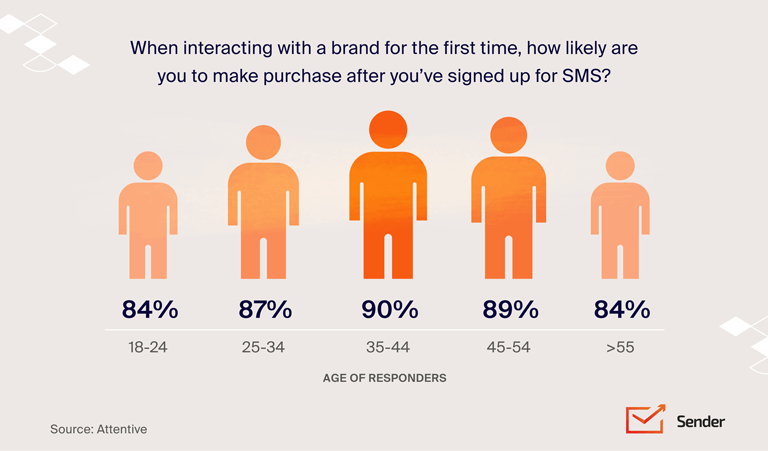
- Millennials are most likely to buy for the first time after subscribing to an SMS from a brand;
- 68% of consumers in the US have spent $50+ on buying an item through text messaging; 22% have splurged up to $500.
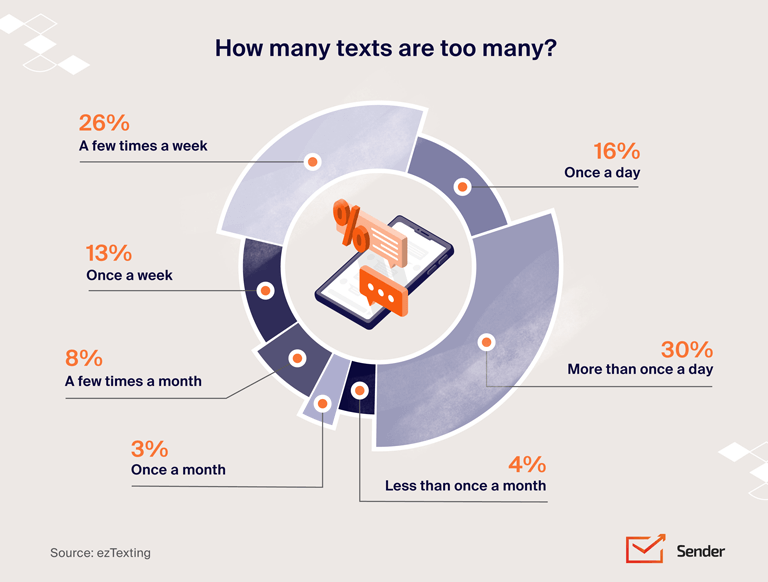
- 34% of people feel that 1 text message per week from businesses is enough;
- Consumers in the US who sign up for SMS campaigns are 87% more likely to make a purchase. In the UK, Australia, and Canada, the figures are 80%, 82%, and 78%, respectively;
- For marketers, SMS is one of the top three revenue-driving channels. In fact, for 22% of marketers, SMS drives over 20% of the total revenue for the brand;
- 64%* of customers feel curious when they receive a text from a brand, 27% feel happy, and 23% feel excited. 17% of people get anxious, and the other 15% feel annoyed when they receive a brand text on their mobile phone;
- Most customers prefer receiving text on weekdays between 9:00 am-5:00 pm;
- 30% of consumers are fine with receiving more than one text daily on their mobile phones from brands and businesses.
Now that you have seen the potential, let’s quickly explore the different statistics that will guide your SMS marketing strategy.
SMS Engagement Rates
SMS doesn’t just deliver high open rates — personalized, targeted messages also achieve strong click-through rates.
SMS response rate statistics further reinforce the channel’s strength: the average SMS CTR sits at 10.66%, and SMS campaigns are known to increase order volume by an average of 23.8%.
SMS Click-Through Rates
If you’re curious if SMS campaigns are for you, here’s the average CTR data* for different industries. This clickthrough data is recorded for a typical welcome message sent to subscribers who opted-in for SMS marketing.
- Retail SMS campaigns average a 7.62% CTR;
- Food & beverage SMS campaigns average a 5.88% CTR;
- Entertainment & media SMS campaigns average a 12.78% CTR.
The average CTR is much better than emails, which register an average clickthrough rate of 2.5%.
SMS Open Rates by Industry
Most SMS campaigns across industries report open rates between 95% and 99%, with a benchmark average of around 98%. Because texts are delivered directly to a user’s phone inbox and trigger immediate notifications, they achieve consistently high visibility regardless of sector.
Exact industry-level open rates are rarely published due to SMS tracking limitations, but research consistently shows that differences between industries are minimal compared to email marketing. Industries tend to vary more in click-through rates and conversions than in raw visibility.
Typical reported ranges include:
- Retail & Ecommerce: ~97–99%
- Food & Beverage: ~95–98%
- Health & Beauty: ~96–98%
- Travel & Hospitality: ~95–97%
- Financial Services: ~94–97%
- Healthcare: ~95–98%
- Media & Entertainment: ~96–99%
These figures highlight that SMS marketing performs consistently well across industries because texts are typically read shortly after delivery. For this reason, marketers usually focus more on click-through rates, responses, and conversions when comparing SMS campaign performance across sectors.
SMS Send Time Statistics
SMS marketing receives phenomenal responses from consumers. But when should you send your SMS campaigns?
Recently Attentive analyzed over 25 billion messages and shared very accurate recommendations on SMS send times:
- Best overall time: 4pm–7pm
- Best for engagement: 12pm–3pm
- Best days: Monday–Tuesday
Factors Influencing SMS Open Rates
There are many things that affect how many people open your SMS. The most important factors out of these include:
- Timing and frequency of messages. Sending messages at the right time boosts open rates. Check your analytics to find the best time when your audience engages. Avoid spamming and send at an optimal frequency without annoying;
- Personalization and relevance of content. Tailored messages resonate more with prospects. Use personalized content and relevant offers to grab attention and encourage engagement;
- Sender reputation and trust. A trusted sender name and a clean sending history make your messages more credible. This matters because 70% consumers have blocked a business number in the past, and in the U.S., messages sent from unregistered 10DLC numbers are fully blocked, which can severely hurt deliverability.
Key Takeaways: SMS Open Rates
Adding SMS marketing to your marketing mix is a sound decision. It can cover several important aspects of the business – from a supportive role for emails to delivering time-sensitive messages.
In short, SMS can cover deliver great results regardless of the approach taken; just keep in mind the following:
- Use SMS campaigns along with other marketing strategies to get the maximum benefits;
- Always test SMS open rates with a smaller sample audience group to plan for future SMS marketing campaigns;
- Follow up using SMS messages for abandoned carts and other email marketing campaigns to increase open rates;
- Write concise and compelling SMS copy if you want to get the benefits of high open rates of SMS campaigns.
Interested in more mind-blowing SMS marketing features? Check out the articles below:
- What is the SMS Character Limit? (Max. Text Message Length)
- 12 Best SMS Marketing Platforms Compared — 2026
*Sources
- https://www.pcmag.com/news/businesses-take-note-your-customers-prefer-texts/
- https://www.omnisend.com/blog/sms-marketing-statistics
- https://www.emarketer.com/content/brands-lean-mobile-sms-marketing-audience-attention-conversion
- https://www.klaviyo.com/wp-content/uploads/2024/06/global-sms-consumer-research-2024.pdf
- https://www.statista.com/topics/5983/mobile-marketing-worldwide/#topicOverview/
- https://www.attentive.com/2023-sms-marketing-benchmarks-report/
- https://www.eztexting.com/report/2022-state-of-texting-consumer-behavior-report/
- https://www.tatango.com/blog/average-sms-marketing-opt-in-rates/
- https://www.attentive.com/blog/best-time-to-send-sms-marketing/
- https://simpletexting.com/blog/2025-texting-and-sms-marketing-statistics/
- https://www.textmagic.com/blog/consumer-sms-survey/