

Let’s face it—email marketing campaigns aren’t going anywhere anytime soon. Despite all the buzz around new social platforms, email marketing continues to be the workhorse of the online marketing world.
I’ve been watching the trends for years, and the email marketing statistics don’t lie—email delivers results and effectiveness that other channels in your overall marketing strategy simply can’t match.
This article is part of our Email marketing guide.
Email Marketing ROI at a Glance
- 95% of marketers agree email marketing delivers an excellent ROI;
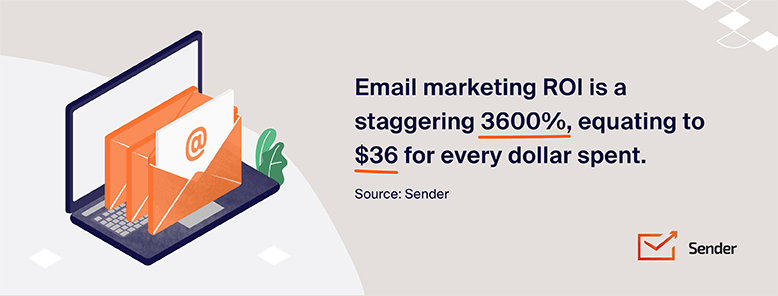
- Email marketing generates $36 for every $1 spent on average;
- Automated emails generate $2.87 per email vs $0.18 for standard campaigns;
- Average email conversion rate is 2.4%, higher than most marketing channels;
- Advanced segmentation and targeting can increase email ROI by up to 22%;
- Personalized emails can deliver up to 6× higher transaction rates;
- 21% of marketers still don’t measure email ROI at all.
What is Email Marketing ROI & Why Does It Matter?
Email marketing return on investment (ROI) is basically how much money you make compared to what you spend on your email marketing efforts. It’s not rocket science, but getting this essential metric right makes all the difference between wasting your marketing budget and seeing real growth in your email marketing revenue.
The basic formula for measuring email marketing return on investment looks like this:
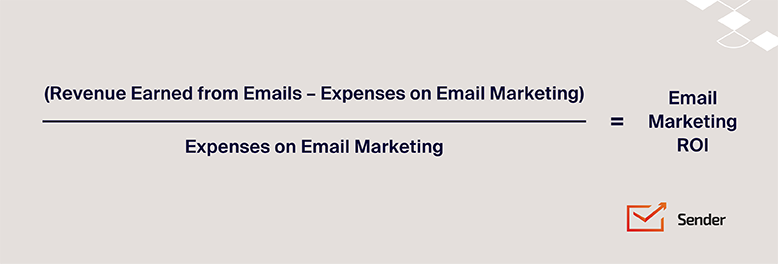
I’ll be honest: if you’re not tracking this number, you’re flying blind. Think about it: if you spent $500 on marketing emails that brought in $5,000, that’s a 900% email marketing return. You’d want to know that, right?
According to the 2025 State of Email, 21% of marketing leaders said they do not measure ROI at all, although that was down from 36% in 2023.
Litmus research shows that most email marketers who carefully track their ROI report significantly better results than those who don’t. Makes sense when you think about it – you can’t improve what you don’t measure. That’s why an email marketing ROI calculator has become an essential tool for many marketers worldwide.
Here’s why campaign ROI tracking isn’t optional anymore for a successful email strategy:
- It gives you ammunition when budget discussions come around (trust me, you’ll need it);
- You’ll know exactly which email marketing campaigns are worth repeating and which ones bombed;
- Year-over-year comparison helps prove you’re getting better at driving email engagement;
- It forces you to think about email as a revenue channel for specific actions, not just for sending emails.
According to industry research, 95% of marketers agree that email marketing has an excellent ROI, reinforcing why brands continue to invest in the channel.
What Is a Good Email Marketing ROI
You’ve probably seen that famous statistic floating around – $36 return for every dollar spent on email marketing. While it sounds amazing, it’s actually the average across various industries based on the email marketing statistics behind these benchmarks.
Your mileage will definitely vary depending on:
- Your company size (businesses with 500+ employees see about 41:1 ROI in their email marketing efforts);
- Team makeup (interestingly, teams of 3-5 people tend to see better results than larger teams);
- Industry (B2B tends to have longer sales cycles but higher average order values);
- Campaign types (email automation sequences consistently outperform one-off broadcasts – sometimes by 3x or more);
- Target audience engagement (campaigns to highly engaged email subscribers perform better)
- Mobile optimization (with so many email users checking messages on mobile devices, this is crucial).
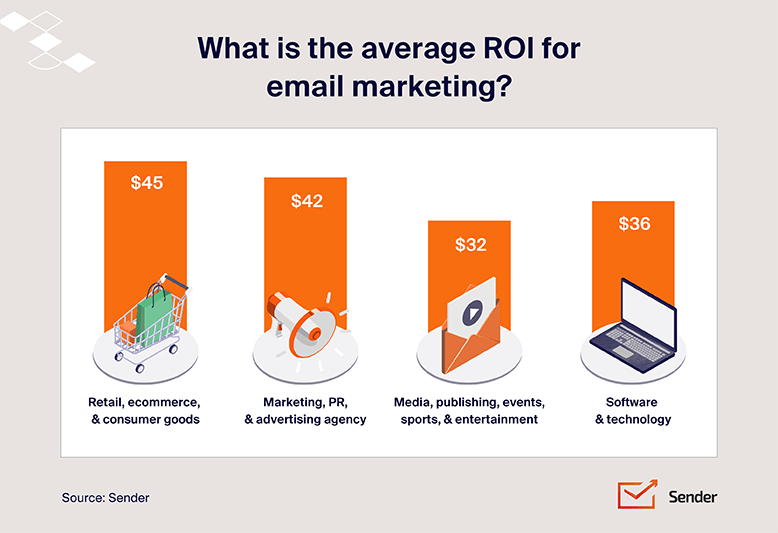
Email ROI Benchmarks by Industry
Email ROI varies significantly by industry, depending on factors like purchase frequency, customer lifecycle, and reliance on retention channels. The benchmarks below highlight how different sectors translate email marketing into revenue.
- Retail / ecommerce / consumer goods – 45:1
- Marketing / PR / advertising – 42:1
- Software / technology – 36:1
- Media / publishing / events / entertainment – 32:1
Email ROI vs. Other Marketing Channels
Email remains one of the most effective marketing channels for return on investment, combining relatively low distribution costs with strong revenue potential. Recent marketer data still places it among the top-performing channels, alongside website/blog/SEO and paid social.
- Email marketing: $36 per $1 spent
- SEO: 721%–748% ROI
- PPC / SEM: 24%–36% ROI
- Google Ads / paid search: $2 per $1 spent on average
- Social media: just over $2 per $1 spent ROI
If you’re just starting out, don’t get discouraged by these average email marketing ROI statistics. I’ve seen brands start with a modest 5:1 ROI and work their way up to 25:1 within a year of focused optimization of their email marketing strategy.
The key is progress, not perfection — and knowing which email marketing metrics and KPIs to pay close attention to so you can see whether you’re meeting return on investment benchmarks.
That said, here are the key figures you should understand:
Open Rates
Industry average is around 35.63%, according to 2025 benchmarks on email marketing statistics, but it varies widely by industry. What matters most is your trend over time and achieving higher open rates through optimization.
Pro tip: Apple’s Mail Privacy Protection has made open rates less reliable since 2021. Focus more on clicks and conversions if a large percentage of your email subscribers use Apple Mail on their mobile devices.
Click-Through Rates
This important metric shows how compelling your content and offers are in your marketing emails. The average is 2.17% according to industry benchmarks, but top performers often see double digits in email engagement.
Low opens + high clicks = your subject lines need work but your content is solid. High opens + low clicks = great subject lines but your content isn’t delivering specific actions.
Conversion Rate
This is the percentage of email recipients who take your desired action. It’s the most direct predictor of email marketing ROI and effectiveness.
According to FirstPageSage, the average email conversion rate is 2.4%, significantly higher than most other marketing channels, which explains why email remains central to most marketing strategies.
Revenue Per Email
Revenue per email (total email marketing revenue ÷ number of messages sent) helps you compare campaign performance at a glance and is useful for measuring email marketing ROI. Combined with email marketing revenue per subscriber tracking, there’s no better way to measure if you’re heading in the right direction.
Omnisend reported in 2026 that automated emails generated $2.87 in revenue per email in 2025, compared with $0.18 for scheduled marketing emails.
How to Calculate Your Email Marketing ROI (Step-by-Step)?
Let me walk you through how this works in practice:
Step 1: Get Clear on Your Goals
This seems obvious, but you’d be surprised how many email campaigns go out without a clear objective. Are you trying to:
- Drive immediate sales?
- Nurture leads who aren’t ready to buy?
- Increase repeat purchases from existing customers?
- Build awareness for a new product line?
Each of these goals requires different marketing ROI metrics and approaches for ROI calculation. Which brings us to the next step.
Step 2: Track All Your Costs (And I Mean ALL of Them)
This is where many email marketers cut corners, and it skews their ROI calculations. You need to account for total costs:
- Your ESP costs — whether it’s Mailchimp, Constant Contact, or an enterprise solution;
- Team time — including planning, writing, designing, testing and analyzing (be honest about how many hours at what hourly rate actually go into each campaign);
- Content costs — if you’re hiring freelancers or agencies for copy, dynamic content, or design;
- List building expenses — those lead magnets to generate leads and acquire new leads aren’t free;
- Any specialized tools you use just for email (like subject line testers, preview text optimizers, etc.).
Don’t forget to factor in your own time! I’ve talked to so many small business owners who don’t count the hours they spend on email marketing campaigns because “it’s just me doing it.” Your time has value — include it in your email marketing ROI calculator.
Many marketers still struggle to measure email ROI accurately. In 2025, 21% said they do not know how to measure ROI for their email program, which shows how easy it is to miss the full picture when calculating returns.
Step 3: Measure What Email Actually Brings In
This gets tricky because not all email revenue is immediately obvious – and that’s exactly why email marketing revenue tracking needs a structured approach. But YyYou should track the following, at least:
- Direct revenue (the easiest to measure – sales directly attributed to email clicks);
- Influenced revenue (harder to track but important – purchases that marketing emails played a role in);
- Lead generation value (if you know your ability to generate leads and convert them to customers);
- Customer retention impact (customer lifetime value email marketing is tricky to pin-point but that’s where you can keep track of customer retention levels).
A good analytics setup that leverages customer data makes this much easier. Organizations that use advanced segmentation and data-driven targeting report up to 22% higher email ROI compared to those using basic, non-targeted campaigns. This marketing channel ROI comparison is important to understand why segmentation is such a big component in driving the ROI.
I’ve found that most email platforms overstate email campaign revenue attribution for marketing emails, while general analytics platforms like Google Analytics often understate it. The truth is usually somewhere in between. The key is consistency in how ROI marketing is measured over time.
Step 4: Calculate Your Email Marketing ROI
Once you have your numbers:
- Add up all your costs for the period you’re measuring
- Calculate the total revenue generated
- Plug them into the ROI formula for marketing:
ROI = [(Revenue – Cost) ÷ Cost] × 100
So if you spent $1,000 total on email marketing last month and generated $10,000 in sales, your ROI would be 900%.
[(10,000 – 1,000) ÷ 1,000] × 100 = 900%
That means every dollar you invested brought back nine dollars in profit (plus the original dollar). Not too shabby!
Steps to Increase Email Marketing ROI
I’ve audited hundreds of email programs over the years, and certain strategies consistently deliver better results. Here’s what actually moves the needle:
1. Clean Your Email List Regularly
It may sound counterintuitive, but trimming your email list actually increases ROI.
Why? Because sending emails to inactive or invalid addresses hurts your deliverability, open rates, and sender reputation.
So, you should clean your email list at least once every 3–6 months. Particularly look for the following contacts and remove them:
- Contacts that haven’t opened anything in 90+ days;
- Hard bounces and invalid addresses;
- Unengaged freebie hunters who never converted.
This will not only increase your engagement rates over time but will boost your chances of building a solid community that appreciates your brand (and reciprocates your efforts).
Pro tip: Before removing inactive subscribers completely, send a re-engagement email campaign. If they still ghost you? Time to say goodbye. Remember, quality > quantity, always.
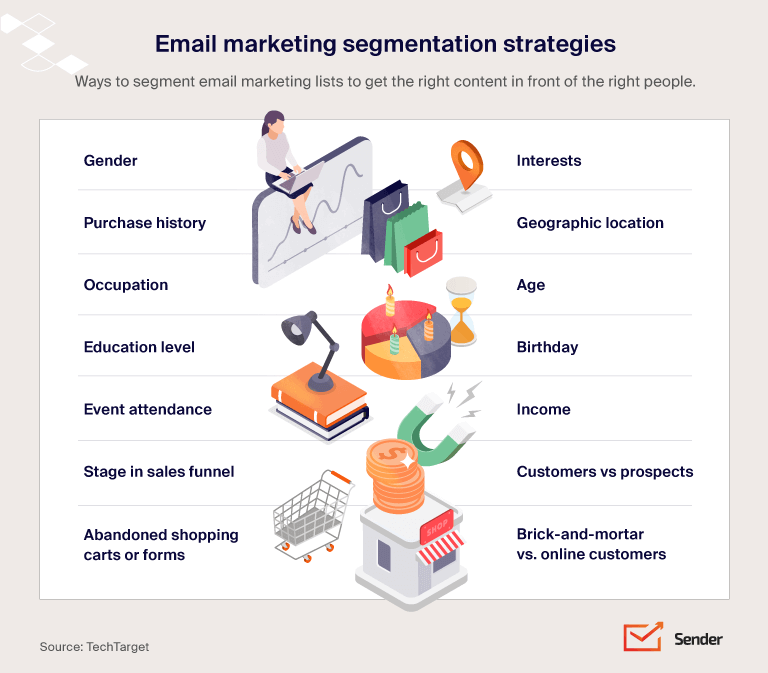
2. Get Serious About Segmentation
Mass emails to your entire list of email subscribers are rarely the best approach for your target audience. Epsilon study found that segmented email marketing campaigns drive 760% more email marketing revenue than one-size-fits-all blasts. That’s not a typo — 760%!
The simplest segments that deliver results for improving email marketing ROI are:
- Past purchases (what they’ve bought determines what they might buy next);
- Email engagement level (highly engaged subscribers vs. those who rarely open);
- Where they came from (different lead sources often have different buying behaviors);
- Geography (especially if you have location-specific offers or exclusive discounts);
- Device preferences (tailoring experiences for those who open primarily on mobile devices).
I worked with a retailer who segmented based on category affinity (which consumer goods your customers browse the most) using their customer data. Their conversion rates jumped by 34% almost overnight, dramatically boosting their email marketing return. The data was already there — they just needed to use it as part of their email strategy. Subscriber segmentation tied to ROI gains like this is built into most modern ESPs.
3. Use Personalized Emails
Personalized emails can deliver 6x higher transaction rates, and we’ve seen it firsthand. The more your emails feel like they were written for one person, the better your ROI gets. Personalization isn’t just nice to have anymore–it’s expected. Research shows that 64% of consumers expect personalized interactions and would turn elsewhere if companies can’t deliver that.
But nobody gets excited about an email that says, “Hi [FirstName], check out our new arrivals.”
Personalization goes beyond just using someone’s name. It’s about sending relevant, timely content based on behavior. Think of a skincare brand sending different follow-up emails based on a customer’s skin type (oily, dry, or combination).
True personalization isn’t just about names, it’s about relevance. Here’s what works:
- Recommend products based on past browsing or purchase behavior;
- Send birthday or anniversary surprises;
- Reconnect with “Hey, it’s been a while” messages for inactive users.
4. Time Your Emails for Maximum Impact
We’ve all been there—testing email sends at different times for the same audience and same content. Still, we get different results. Right?
If you’ve still not tried this tactic, we highly suggest you do because when you send your emails matters just as much as what’s inside them. And when you get your timing right, you don’t just show up, you show up at the perfect moment.
But don’t rely on guesswork — test different send times and days to find your sweet spot.
Here are the best times to send an email based on the latest data:
- Midweek works best for most businesses (Tuesday–Thursday);
- Avoid weekends unless you’re in ecommerce or entertainment;
- Send between 9 AM–12 PM for B2B, evenings for B2C sometimes work wonders;
- Always consider your audience’s time zone, not yours when scheduling emails.
The best approach, however, is to test continuously, learn, and adapt. What works for a SaaS startup might bomb for a fashion brand.
5. Automate the Customer Journey
One-off email marketing campaigns have their place, but email automation consistently delivers higher ROI. According to Omnisend, automated emails generated $2.87 in revenue per email in 2025, compared with $0.18 for regular campaigns, showing that automation can drive nearly 16 times more revenue per email.
Start with these high-impact automations for your email marketing strategy:
- Welcome series (Klaviyo’s research shows these convert 12.3 times better and drive higher open rates than standard campaigns);
- Abandoned cart recovery (these recover 10-15% of otherwise lost sales, per Barilliance);
- Post-purchase follow-ups (increase customer loyalty and repeat purchases by 31%, according to Klaviyo);
- Re-engagement campaigns for inactive subscribers (win-back campaigns that generate one response from previously lost customers).
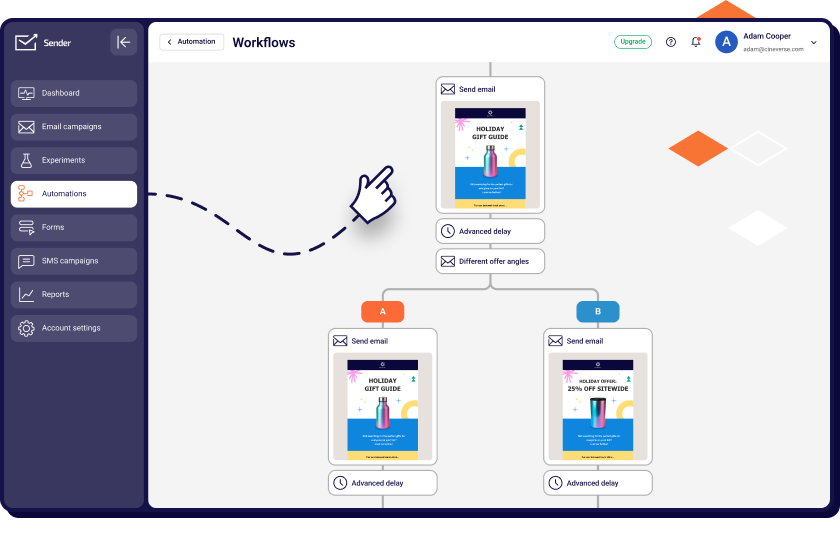
I’ve seen brands triple their email marketing revenue by simply implementing these four automation sequences. They take time to set up initially, but they’re basically money-printing machines once they’re running. Our walkthrough on building automated welcome and abandoned cart flows in Sender covers the setup. These specific actions that occur automatically based on customer behavior represent the pinnacle of effectiveness in modern email marketing efforts.
These flows used to require a developer; modern platforms with an automation builder with prebuilt workflow templates let any marketer ship them in an afternoon.
Sender’s intuitive automation builder and premade workflow templates make automating your campaigns easy as 1-2-3. The best part — it’s free!
6. Include Clear CTAs
Your email can be beautiful, persuasive, and well-written, but if the call-to-action isn’t clear, it won’t convert.
One of the biggest mistakes we see? Emails that try to do too much — “Read this, buy that, follow here, check this link too.” And the result? The reader does nothing.
Here’s the golden rule: One email. One goal. One CTA. Look at these examples:
- “Grab Your 20% Off”
- “Book Your Free Call”
- “Explore the Collection”
Use action words, make it stand out visually, and don’t bury it in a wall of text. Use white space. Repeat the CTA if needed, once above the fold, once at the end. The clearer the call, the better your results.
7. Test Everything (But Not All at Once)
A/B testing in email marketing sounds boring, but it’s the secret weapon of high-performing campaigns. Recent industry data shows that email marketers who consistently run A/B tests achieve an average ROI of 42:1, compared to 23:1 for those who don’t – an uplift of roughly 83% driven by optimizing subject lines, content, and send times.
Focus your testing on these high-impact elements to boost effectiveness:
- Subject lines and preview text (they determine whether emails get opened at all);
- CTA placement and wording (directly impacts conversion rates);
- Email send timing (can affect higher open rates by up to 20%);
- Content format (short vs. long, text vs. images, dynamic content vs. static);
- Mobile responsiveness (how your emails appear across different mobile devices).
The key is changing just one element at a time so you know exactly what caused the improvement in your email marketing stats. I’ve seen subject line testing alone improve open rates by 25-30% over time through consistent optimization. This kind of systematic approach is an important metric for any serious email strategy — and it sits inside the broader email marketing strategy your ROI sits inside.
Sources:
- https://dma.org.uk/research/marketer-email-tracker-2019
- https://www.getresponse.com/resources/reports/email-marketing-benchmarks
- https://www.barilliance.com/cart-abandonment-rate-statistics/
- https://mailchimp.com/resources/email-marketing-benchmarks/
- https://www.campaignmonitor.com/resources/guides/email-marketing-benchmarks/
- https://www.litmus.com/resources/state-of-email/
- https://www.statista.com/statistics/255080/number-of-e-mail-users-worldwide/
- https://www.barilliance.com/triggered-email-conversion-statistics/
- https://www.litmus.com/blog/infographic-the-roi-of-email-marketing
- https://www.mckinsey.com/capabilities/growth-marketing-and-sales/our-insights/the-value-ofgetting-personalization-right-or-wrong-is-multiplying
- https://www.litmus.com/blog/email-marketing-for-it-companies-and-saas
- https://www.litmus.com/state-of-email-reports
- https://firstpagesage.com/reports/digital-marketing-conversion-rate/
- https://mailchimp.com/marketing-glossary/email-marketing
- https://www.omnisend.com/blog/transactional-email
- https://www.twilio.com/en-us/blog/insights/cx/personalization-customer-journey-experience
- https://www.klaviyo.com/products/email-marketing/ecommerce
- https://www.mailerlite.com/blog/best-time-to-send-email