

Your email didn’t get ignored because it was bad. It got buried. Inboxes are now saturated to the point that, across Instantly’s 2026 benchmark of billions of cold email interactions, the average reply rate was 3.43%: roughly 97 of every 100 messages go unanswered.
A reminder email fixes that with three ingredients: one clear ask, a reference to the original message, and the right send time. This guide gives you copy-paste email templates for every common scenario, from an unpaid invoice to a Zoom meeting, plus the timing rules, subject lines, and reply-rate data behind them.
This article is part of our Marketing automation guide.
What is a Reminder Email?
A reminder email is sent to someone who ought to complete an action but hasn’t yet. It works as a nudge: a short message that jogs the recipient’s memory and asks for prompt action, resurfacing the original request and telling the recipient exactly what to do next.
Reminder emails generally fall into two types:
- Preventive reminders, sent before something happens: a webinar next week, an invoice due in seven days;
- Corrective reminders, sent after something failed to happen: a missed deadline, an unpaid invoice, or no response to your first email.
Both sit inside a larger automation lifecycle. The trigger email framework that explains where reminders fit alongside other automated emails maps them against welcomes, transactional notifications, and re-engagement sequences.
Anatomy of a Reminder Email (the 5 Parts)
Every well-crafted reminder email contains the same five parts. Miss one and the recipient has to work to figure out what you want, which is usually where the message dies.
- Subject line. Reference the original thread; replying with “Re:” preserved keeps your first message one scroll away, and a familiar thread holds the reader’s attention better than a clever new subject line;
- Preheader. The 40 to 90 characters shown after the subject in the inbox, and often the only body text visible on mobile devices. Put the deadline or the ask there (“Invoice #4211 due Friday”), not “View in browser”;
- Context line. One sentence stating what you sent, when, and why it matters now. Dates and reference numbers, not “my previous email”;
- Call to action (CTA). Exactly one, answerable in a single line or click; a reminder with two asks gets neither. Read the click-through rate against opens: opened but not clicked means the CTA is the problem, unopened means the timing is;
- Sign-off. At the very end, your name, company name, and contact information. If the recipient would rather call than type, let them.
When to Send a Reminder Email (Timing & Cadence)
Timing decides more than wording does; getting it right is half the battle. Timely reminders sent on day 2 read as attentive; the same message on day 14 reads as an afterthought. These cadences hold up across the datasets cited later:
- No-response follow-up: first reminder 2 to 3 business days after the original, second 5 to 7 days after that. Stop at three touches; unsubscribe and spam-complaint rates climb from the fourth follow-up;
- Appointments: 24 to 48 hours before the slot; earlier is forgotten again, later leaves no time to reschedule;
- Events and webinars: one week and 24 hours before, plus an optional 1-hour “starting soon” message for live sessions;
- Payments: 7 days before the due date, on it, and 3 days after; the full ladder is in the payment section below;
- Day and time: midweek mornings perform best. Instantly’s 2026 benchmark found Tuesday and Wednesday take the peak reply rates, with Wednesday highest.
Vary the intervals: a nudge every 72 hours at 9:00 sharp reads as automation. The spacing patterns in these drip campaign examples show how irregular, value-adding intervals keep a sequence feeling human.
Reminder Email Templates by Situation
The friendly reminder email examples below each follow the same format: best for, subject line, copy-paste email template, verdict, and timing.
- Follow-Up Reminder Email After No Response
- Payment & Overdue Invoice Reminder Email
- Appointment Reminder Email
- Meeting / Zoom Reminder Email
- Event & Webinar Reminder Email
- Survey Reminder Email
- Reminders by Relationship: Boss, Client, Professor, HR
- Deadline, Renewal & Document/Timesheet Reminders
- Cart Abandonment Reminder
Follow-Up Reminder Email After No Response
Best for: any first email that sank without a trace: a pitch, a proposal, a question to a colleague.
Subject line: Re: [Original subject], quick nudge
Hi [First Name],
I emailed you on [date] about [topic in five words]. Inboxes pile up fast, so I’m bumping this in case it got buried.
The short version: [one-sentence restatement of the ask]. A one-word reply (“yes,” “no,” or “later”) works fine.
Anything unclear, just ask.
Best, [Your Name]
Verdict: a follow-up reminder email after no response should restate the ask instead of pointing at the old email, lower the reply effort to a single word, and skip guilt language (“I still haven’t heard back”) that makes people defensive. It doubles as a friendly reminder email template; adjust the register per the relationship section below.
Timing: day 3 for the first nudge, day 8 to 10 for the second, spacing that maintains momentum without crowding the inbox. In a final reminder, close the loop: “If the timing’s wrong, tell me and I’ll stop here.” At volume, build the touches as an email sequence so each step cancels once someone replies.
Payment & Overdue Invoice Reminder Email
Best for: freelancers, agencies, and any business on net terms, where an overdue payment is usually forgetfulness, not refusal; run payment reminder emails as an escalation ladder, not one message.
Step 1 (7 days before due, courtesy):
Subject line: Invoice [Invoice Number] due [Due Date]
Hi [First Name], a quick reminder that invoice [Invoice Number] for [Amount] is due on [Due Date]. Payment link: [link]. Let me know if anything needs correcting.
Step 2 (due date):
Subject line: Invoice [Invoice Number] due today
Hi [First Name], invoice [Invoice Number] for [Amount] falls due today: [link]. If payment is on its way, please ignore this.
Step 3 (3 days overdue, firm but polite):
Subject line: Overdue: invoice [Invoice Number], [Amount]
Hi [First Name], invoice [Invoice Number] was due [Due Date] and remains unpaid. Could you confirm when to expect payment, or flag any issue? Payment link: [link].
Verdict: every step carries all the details inline (invoice number, amount, due date, payment link). Save formal consequences (late fees, collections) for a final notice around day 14; legal threats in a day-3 email burn the relationship over an accounting lag.
Timing: −7 / 0 / +3 days around the payment due date, then a final notice if needed; the ladder catches most missed payments before that point. Wording conventions for amounts, references, and attachments are covered in these invoice email approaches and templates.
Appointment Reminder Email
Best for: clinics, salons, consultants: anyone whose no-shows cost money.
Subject line: Reminder: your appointment with [Business Name], [Date] at [Time]
Hi [First Name],
A reminder from [Business Name] about your appointment on [Date] at [Time], at [Location / video link].
Need a different time? Use this reschedule link: [link]. Otherwise, no reply needed, we’ll see you then.
Regards, [Business Name]
Verdict: the reschedule link is the working part of this appointment reminder email. A self-serve link converts would-be no-shows into rebookings without a phone call, and “no reply needed” stops your inbox filling with “see you then” messages. Include anything the recipient must bring or prepare; preventing a wasted visit beats merely confirming it.
Timing: 24 to 48 hours before the appointment. For bookings made weeks out, add a second touch 7 days before. How reminders slot into the wider booking flow, confirmations included, is covered in these appointment email examples.
Meeting / Zoom Reminder Email
Best for: internal teams and external calls, especially an upcoming meeting that people treat as optional, recurring ones most of all.
Subject line: Reminder: [Meeting topic], [Day] at [Time] ([timezone])
Hi all,
Just a quick reminder about our meeting on [Date] at [Time] ([timezone]).
Join link: [Zoom/Meet link] Agenda: [two or three bullet items]
If you can’t attend, reply so we can adjust.
Thanks, [Your Name]
Verdict: a meeting reminder email earns its send by putting the join link at the top for easy access and stating the timezone explicitly. The agenda preview means the people involved arrive having thought about the items.
Timing: the afternoon before for internal meetings; for external calls, add a 1-hour-before reminder with nothing but the join link, the message people actually click.
Event & Webinar Reminder Email
Best for: webinars, launches, workshops, and ticketed events where registration for the upcoming event happens days ahead, sometimes weeks.
Subject line: [Event Name] is tomorrow. Here’s your link
Hi [First Name],
[Event Name] starts on [Date] at [Time] ([timezone]).
Your access link: [link] [Add to Calendar button]
We’ll cover [one-line value promise]. Can’t make it live? Register anyway and we’ll send the recording.
See you there, Team [Event Name]
Verdict: the Add to Calendar button, a one-click .ics or Google Calendar link, saves the date and time plus join link straight into the recipient’s calendar. It moves the event reminder job from your email to their calendar app. The recording line captures registrants who would otherwise ignore the message; deeper details belong on the event landing page, not in the email.
Timing: one week and 24 hours before, per the cadence section. The registration confirmation sets up the sequence; these confirmation email templates show how to structure that first touch so reminders land in an existing thread.
Survey Reminder Email
Best for: feedback requests after purchase, support interactions, or events.
Subject line: Only 4 minutes to improve [Product/Service]
Hi [First Name],
Our survey on [topic] closes on [Date], and your answer directly affects [specific decision, e.g., “which feature we build next quarter”].
It takes about 4 minutes: [Survey Link]
[Optional: everyone who completes it enters the draw for [incentive].]
Thank you, [Your Name]
Verdict: the completion time only works if it’s true; claiming “2 minutes” for a 10-minute survey teaches recipients to distrust every future message. Naming the decision their answer feeds outperforms generic “your feedback matters” copy.
Timing: 3 to 4 days after the invitation, one reminder only; a second nudge mostly harvests unsubscribes.
Reminders by Relationship: Boss, Client, Professor, HR
Best for: one-to-one professional reminders where tone outweighs the template. The structure stays the same; the register shifts, and sensitive topics like pay, grades, or hiring call for the formal end of it.
- Boss: assume they’re buried, make the action one click. Tone note: “here’s the decision I need,” never “just following up again”;
- Client: frame it around their deadline, not your queue. Tone note: “to keep [their launch] on schedule, I need X by Friday” reads as service;
- Professor: formal register, exact document names and dates, 5 to 7 days between touches. Tone note: name the specific commitment (“the dissertation review from March 3”);
- HR: logistics only, one or two lines: confirm time, format, and what you need, nothing else.
Timing: 3 business days for boss and client, 5 to 7 for a professor, 1 to 2 for HR logistics.
Deadline, Renewal & Document/Timesheet Reminders
Best for: recurring operational nudges: submissions, expiring documents, renewals, and the monthly timesheet chase.
Timesheet reminder email sample:
Subject line: Timesheets due Friday 5 PM (2 minutes now saves a chase later)
Hi team, timesheets for [period] are due [Date] at [Time]. Submit here: [link]. Anything blocking you, reply and we’ll sort it out.
Deadline reminders are time sensitive by definition, so put the date in the subject line and the consequence in the body (“submissions after Friday miss this payroll run”). Plain words convey urgency better than capital letters; when you need immediate action, state what happens without it.
Renewal reminders carry a compliance angle: for auto-renewing contracts, send notices 30, 7, and 1 day before renewal. Surprise renewals drive chargebacks and, in several US states, violate auto-renewal statutes; state the amount, date, and how to cancel.
Timing: deadline nudges at minus 3 days and the morning of; renewals at 30/7/1.
Cart Abandonment Reminder
Best for: e-commerce stores. 70.22% of online carts are abandoned per Baymard Institute’s 2026 meta-analysis of 50 studies, making the cart abandonment rate the largest recoverable leak in most stores’ funnels.
Subject line: You left something in your cart
Hi [First Name],
[Product Name] is still in your cart, saved and ready whenever you are.
[Product Image]
[Button: Complete Your Order]
Questions before you buy? Just reply, happy to help.
[Store Name]
Timing: The standard series is three emails: a message at 1 hour that reminds people what they left behind, with product images and a return-to-cart link, a nudge at 24 hours answering common objections (shipping cost, returns), and a final touch at 72 hours, where a discount is optional and worth testing rather than assuming.
Setup is platform-specific; for WooCommerce, this walkthrough of recovering WooCommerce abandoned carts covers tracking and trigger configuration end to end.
Gentle Reminder Email Subject Lines
It can be tricky to strike the right tone with reminder email subject lines. You want to be direct but not demanding. Here are a few ideas to gently remind someone about something:
- Friendly reminder: [Original subject]
- Checking in on [Topic]
- Quick follow-up on [Topic]
- Reminder: [Event] on [Date]
- Don’t forget: [Action item] due [Date]
- Re: [Original subject] – just a gentle nudge
- Touching base on [Topic]
- Any updates on this? [Original subject]
- Still time to [Action item] for [Event]
- Do you have any thoughts on our business proposal?
Reminder Email Reply Rate Data
The reminder that pays back the most is the first one you send.
Instantly’s 2026 Cold Email Benchmark Report, built on billions of email interactions, puts the average reply rate at 3.43%: the first email captures 58% of replies, follow-ups the remaining 42%.
Saleshandy’s analysis of 53 million emails (January to June 2026) found the first follow-up alone generated 26% of all positive replies.
Woodpecker’s 2026 report, from over 20 million platform emails, agrees: the first follow-up peaked at 8.4% against 3.43% for the initial email, and spam-complaint and unsubscribe risk roughly triples from the fourth follow-up.
Methodology note: these datasets measure cold and semi-cold outreach; reminders inside an existing relationship reply at higher rates, so treat the figures as a floor. Sources: Instantly Cold Email Benchmark Report 2026, Saleshandy cold email statistics, Woodpecker cold email statistics.
Best Practices & Etiquette
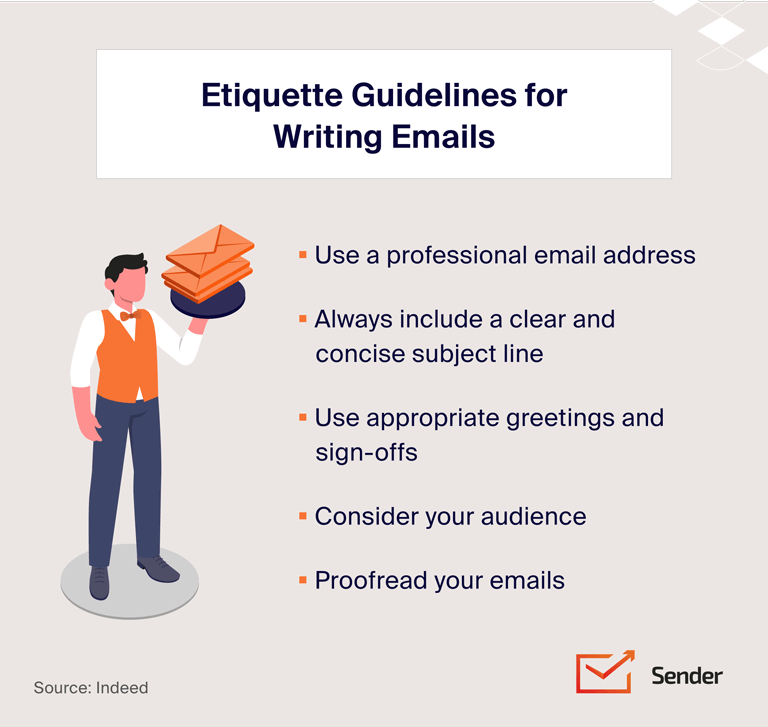
Sending a friendly reminder email doesn’t mean politeness goes out the window. A few practical tips when writing reminder emails:
- Polite tone. Even an urgent reminder should read as a polite message, understanding rather than demanding;
- One is enough (for now). One well-timed reminder usually suffices;
- Timing is everything. Send the first reminder at a context-appropriate time;
- Offer help. Offer a hand or ask if they have questions;
- Remain professional. Always use a professional sign-off, even if you have a friendly relationship.
Two things people still get wrong:
Watch the spam trigger words. Subject lines like “Final Notice: ACTION NEEDED!” borrow their urgency from spam, and filters have noticed. All-caps words and stacked exclamation marks raise the odds your gentle reminder lands in the spam folder instead of the inbox; “Reply needed by Friday” filters better and reads better.
Protect your sender reputation. Reminders blasted to people who ignore them drag down the engagement metrics on all your marketing emails, and mailbox providers use those metrics to place your next campaign. Suppress recipients who ignored the last two touches, keep your domain authenticated, and send in the recipient’s timezone; the mechanics are in this guide to scheduling a campaign.
When the reminder works, close the loop: these thank-you email templates for after the reminder gets results keep the relationship warm once the payment lands.
Reminder Email FAQs
Send the follow-up email in the same thread so your original message sits directly below, then restate the ask in one sentence instead of pointing at “my previous email.” Give the recipient a low-effort exit: “a one-word answer is fine.” A polite reminder email skips guilt phrasing like “I still haven’t heard from you.” A kind reminder assumes the silence was accidental: the message got buried under a busy schedule and a long to-do list, not rejected.
Most people are confused about when to send a reminder email. Generally, two to three days is a reasonable waiting time before sending one. This allows enough time for the recipient to respond to your first email, but it is not too long to completely forget about everything. The email marketing calendar that defines optimal send timing for reminders and every other email type breaks down the day-of-week, time-of-day, and seasonal cadence patterns that maximize response rates.
If your first follow-up wasn’t successful, there is no need to give up. Keep on creating reminders and get in touch with your required recipient more than once. It might take time for them to notice you.
For a one-off email reminder, tools built into your inbox do the job: Gmail’s snooze and nudge features resurface threads, Outlook’s follow-up flags set due dates, and services like FollowUpThen schedule a bump by BCC’ing a date-based address. For recurring reminders at any volume (appointments, payments, events), set up automated email reminders in an email marketing tool instead of calendar entries; this walkthrough of setting up automated reminder triggers covers trigger conditions, scheduling rules, and template setup.
Keep it to four sentences: what you sent and when, why it matters now, the one action you need, and an easy out. Open with a friendly greeting and the recipient’s name, reference concrete details (a date, an invoice number, a document title), and put the deadline in the subject line rather than urgency theatrics. The friendly tone comes from the structure, not the adjective: a short, effective message with a single clear ask feels considerate even without writing “gentle reminder” anywhere.
Five parts: a clear subject line that references the original thread, a preheader carrying the deadline or ask, one context sentence with specifics (dates, reference numbers, the recipient’s name where automation supports it), a single, clear call to action, and a sign-off with your contact information. For payment reminders, add the invoice number, amount, due date, and payment link in every message. For meetings and events, the join link and an Add to Calendar option belong above everything else.
Three touches total is the practical ceiling for multiple reminders in most situations: the original message plus two reminders. The data backs this up; the first follow-up email produces the largest lift in replies, returns diminish from the third, and spam-complaint and unsubscribe risk climbs sharply from the fourth. Exceptions run on fixed ladders: payments escalate at −7/0/+3 days around the due date, renewals at 30, 7, and 1 day out.
Key Takeaways
Reminder emails are a great way to engage your subscribers and nudge them to act. When planning to set up reminder emails, always remember the following tips and best practices:
- Keep your reminder messages and emails short and crisp;
- Create scroll-stopping reminder email subject lines that grab instant attention;
- Always keep your audience’s perspective in mind when you write a reminder email;
- Never be pushy or threatening in your reminder emails;
- Use a marketing automation solution to automate sending reminders to your customers.
Reminders are one piece of a larger system of triggers, sequences, and lifecycle messages; for how the pieces fit together, work through the full marketing automation guide.