


The best time to send emails in 2026 is Tuesday to Thursday, 9 AM to 11 AM in the recipient’s local time, if you want the email opened. If you want it clicked, MailerLite’s 2025 data points to 8 PM to 9 PM and Omnisend’s 2026 data points to 7 AM to 8 AM, so the click window depends on which of those audiences yours resembles.
This guide gives send times by day, hour, email type, industry and audience, using MailerLite (2.1 million campaigns, December 2024 to November 2025), Omnisend (about 26 billion emails), Mailchimp Send Time Optimization, HubSpot’s 2025 survey and Moosend, then a procedure for testing your own list. SMS timing and transactional infrastructure are out of scope.
This article is part of our Email marketing guide.
The Short Answer: Best Day and Time to Send Emails in 2026
The best day to send email for opens is Tuesday in Omnisend’s 2026 data (31.27% open rate) and Friday in MailerLite’s 2025 data (49.72%), and the gap between weekdays in both datasets is under two percentage points, so the hour and the goal matter more than the day.
Pick the row that matches what the email must do (get opened, clicked, or replied to) and who receives it. Every window is in the recipient’s local time, and every open rate figure is the platform’s own reported number, so figures from different platforms are not comparable.
| Goal and audience | Best day | Best window (recipient’s local time) | Source and data window | Caveat |
| Opens, general list | Tuesday to Thursday | 9 AM to 11 AM (Mailchimp’s system-wide peak is 10 AM) | Mailchimp STO insights (June 2025); MailerLite (Dec 2024 to Nov 2025); Omnisend (2026) | Opens are inflated by Apple Mail Privacy Protection |
| Clicks, general list | Tuesday or Friday | 8 PM to 9 PM (MailerLite) or 7 AM to 8 AM and 4 PM (Omnisend) | MailerLite (2025); Omnisend (2026) | The two datasets disagree; test both windows |
| Opens, B2B | Tuesday or Wednesday | 9 AM to 12 PM | HubSpot 2025 survey (47.9% of B2B marketers); Mailchimp STO insights | Survey of marketers, not send logs |
| Clicks and orders, B2C and ecommerce | Tuesday (clicks), Friday (orders) | Tuesday 4 PM (7.57% click rate); Friday 7 AM (0.138% conversion rate) | MailerLite ecommerce segment (2025); Omnisend (2026) | Ecommerce open peaks are scattered; judge by clicks and orders |
| Clicks, creators and newsletters | Monday or Tuesday | 8 PM to 9 PM (9.01% click rate at Monday 9 PM) | MailerLite creators segment (2025) | Single-platform segment |
| Replies, cold and sales | Tuesday to Thursday | 8 AM to 10 AM | Omnisend (2026); Moosend (8 AM to 9 AM open peak) | Reply rates are not tracked in campaign datasets; treat as practitioner consensus |
Why Send Time Changes the Result
Send time changes the result through inbox position. When messages arrive while the subscriber is already in the inbox they sit at the top of the list; a message that arrives overnight is buried under everything delivered after it. MailerLite reports that most opens for a campaign happen within an hour of arrival, which is why the send hour matters more than the send day, and why “the right time” means an hour, not a weekday.
Opens and clicks peak at different hours. In MailerLite’s 2025 data, opens peak between 8 AM and 11 AM on weekdays and clicks between 8 PM and 9 PM, so a 10 AM send maximises visibility and a 6 PM to 7 PM send maximises action. The click-to-open rate (CTOR), unique clicks divided by unique opens, separates “seen” from “acted on”: a high open rate with a low CTOR means the email was seen and deferred.
Open rates have been inflated since 20 September 2021, when Apple Mail Privacy Protection shipped with iOS 15. Apple’s proxy preloads tracking pixels for opted-in users, which registers an open whether or not the person reads the email, and Litmus measured Apple clients at roughly 46% of tracked opens in September 2025. That inflation is why MailerLite’s average open rates sit near 47% to 49% while Omnisend’s sit near 30%, and why the key metrics for send-time decisions are click rate (click-through rate) and CTOR, as set out in our breakdown of email marketing metrics and KPIs.
Best Day to Send Emails
Friday beats Monday for both opens and orders: MailerLite’s 2025 data gives Friday a 49.72% average open rate against Monday’s 49.44%, and Omnisend’s 2026 data gives Friday the week’s highest conversion rate (0.081%) against Monday’s 0.074%. Tuesday beats both for clicks (7.84% in MailerLite, 0.81% click-to-sent in Omnisend), which matches MailerLite’s reading that action-oriented emails perform best during the work week. For a single email blast to an unsegmented list, Tuesday to Thursday at mid-morning remains the safest default because the weekday spread is small.
The table shows each day’s peak hour in the MailerLite 2025 data (peak average open and click rates) and the Omnisend 2026 data (peak open, click-to-sent and conversion rates).
| Day | MailerLite peak opens | MailerLite peak clicks | Omnisend peak opens | Omnisend peak clicks | Omnisend peak conversions |
| Monday | 10 AM (49.4%) | 8 PM to 9 PM | 1 PM (32.68%) | 4 PM (0.89%) | 8 AM (0.114%) |
| Tuesday | 10 AM (48.7%) | 8 PM to 9 PM | 7 AM (33.41%) | 8 AM (0.94%) | 12 PM (0.131%) |
| Wednesday | 11 AM (48.5%) | 8 PM to 9 PM | 9 AM (32.12%) | 4 PM (1.08%) | 1 PM (0.085%) |
| Thursday | 9 AM (49.2%) | 8 AM | 2 PM (33.06%) | 8 AM (0.87%) | 10 AM (0.093%) |
| Friday | 6 PM (49.7%) | 6 PM (8.09%) | 9 AM (31.92%) | 4 PM (0.94%) | 7 AM (0.138%) |
| Saturday | 9 AM (48.9%) | 8 PM | 9 AM (33.19%) | 6 AM (0.78%) | 8 AM (0.074%) |
| Sunday | 9 AM (48.9%) | 8 PM | 11 AM (33.69%) | 7 AM (0.77%) | 12 PM (0.109%) |
Where the Studies Disagree
The four send-time studies used in this article (MailerLite, Omnisend, HubSpot, Moosend) disagree on the click window because they measure different populations. MailerLite’s dataset is 2,138,817 campaigns from US, UK, Australian and Canadian accounts, weighted toward creators and small businesses, and it puts clicks at 8 PM to 9 PM.
Omnisend’s dataset is roughly 26 billion emails from ecommerce stores, and its May 2026 update, the latest data in this set, puts clicks at 7 AM to 8 AM and 4 PM; Omnisend’s own 2025 edition had reported 8 PM as the top hour for opens, so one vendor’s answer moved between editions.
HubSpot’s 2025 figures come from a survey of about 150 marketers, not send logs. Moosend’s 10 billion-email analysis predates Apple Mail Privacy Protection. When sources conflict, use the one whose audience looks like yours, then run a send-time A/B test (step 2 of How to Find Your Best Send Time), since audience preferences measured on your own list override any benchmark.
Monday
The best time to send email on Monday is 10 AM local time for opens, where MailerLite’s 2025 data shows a 49.4% average open rate that holds until 1 PM. Omnisend’s 2026 data puts Monday conversions at 8 AM (0.114%) and clicks at 4 PM.
Tuesday
The best time to send email on Tuesday is 10 AM local time for opens (48.7% in MailerLite’s data) and 8 PM to 9 PM for clicks. Omnisend ranks Tuesday first for opens (31.27%) and click-to-sent (0.81%), with opens peaking at 7 AM and orders at 12 PM (0.131%). HubSpot’s 2025 survey names Tuesday the top engagement day for 27% of US marketers, ahead of Monday (19%).
Wednesday
The best time to send email on Wednesday is 11 AM local time for opens (48.5% in MailerLite’s data), an hour later than Monday and Tuesday. Omnisend’s 2026 data records Wednesday 4 PM as the highest click-to-sent hour of the week at 1.08%, with conversions peaking at 1 PM. MailerLite’s SMB segment shows early-morning Wednesday clicks, so SMB senders should test both ends of the day.
Thursday
The best time to send email on Thursday is 9 AM local time for opens (49.2% in MailerLite’s data), and Thursday is the one weekday where MailerLite’s clicks peak in the morning, at 8 AM. Thursday carries the highest campaign volume in MailerLite’s data because email marketers cluster on the same days, so inbox competition is heaviest; Moosend’s analysis still ranks it first for opens.
Friday
The best time to send email on Friday is 6 PM local time, the only slot in MailerLite’s 2025 data where the week’s top open rate (49.7%) and top click rate (8.09%) coincide, which MailerLite calls the week’s sweet spot. Omnisend’s data points the other way for revenue: Friday 7 AM carries the highest conversion rate in its dataset (0.138%).
Saturday
The best time to send email on Saturday is 9 AM local time for opens (48.9% in MailerLite’s data). In the weekday vs weekend comparison, Saturday is Omnisend’s weakest day for action, with the week’s lowest click-to-sent rate (0.68%) and conversion rate (0.058%). Send volume is also low, so a Saturday newsletter faces less inbox competition; MailerLite’s ecommerce segment records a 6.61% click rate at 4 PM.
Sunday
The best time to send email on Sunday is 9 AM local time in MailerLite’s data (48.9%, with opens above 48% from 6 AM to noon) and 11 AM in Omnisend’s (33.69%), followed by a 12 PM conversion peak (0.109%). Mailchimp’s Send Time Optimization system finds Sunday optimal for the fewest subscribers, so treat Sunday as a low-competition slot for newsletters rather than promotions.
Launch email campaigns with ease with Sender. Use features like drag-and-drop builder, automation, segmentation and more – completely free.
Best Time of Day to Send Emails
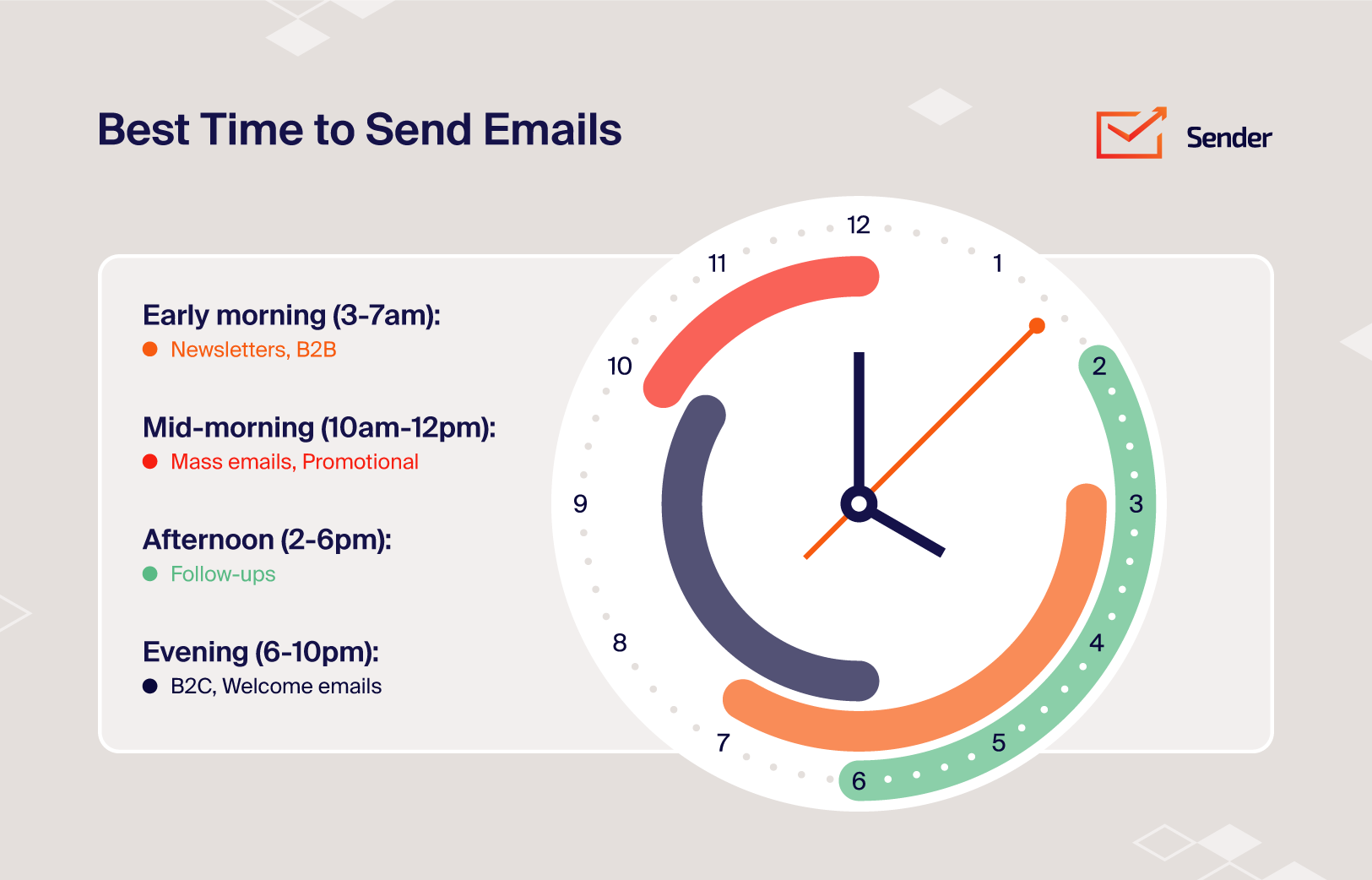
The best time of day to send email for visibility is the weekday morning, 8 AM to 11 AM in the recipient’s local time. Every large dataset lands there: MailerLite’s opens peak at 8 AM to 11 AM, Omnisend’s at 9 AM to 11 AM, Moosend’s at 8 AM to 9 AM, and Mailchimp’s Send Time Optimization system puts the system-wide peak at 10 AM. HubSpot’s 2025 survey adds 9 AM to 12 PM.
The best time of day for action varies depending on the dataset, and both datasets break with the traditional wisdom that a single 10 AM send serves every goal. MailerLite’s click rates peak at 8 PM to 9 PM on most weekdays. Omnisend’s click-to-sent rates peak at 7 AM to 8 AM and again at 4 PM, with conversions concentrated before noon, and its ecommerce audience has usually acted by 5 PM.
The practical rule before hitting send: schedule the window that matches the email’s goal, not the highest open rate. An email newsletter whose job is to be read goes out at 9 AM to 10 AM. A promotional email whose job is a click goes out at 6 PM to 7 PM for the evening click window or at 6 AM to 7 AM for the early one, and a send-time A/B test between those two settles which pattern your list follows. Morning vs evening sends is the first comparison worth running.
Worst Times to Send (and What “Too Early” Means)
The worst time to send email is between 6 PM and 5 AM in Moosend’s data, where open rates decline after 6 PM and are lowest overnight; Moosend found no significant difference between 6 AM and 7 PM. Mailchimp’s guidance is to avoid 3 AM to 4 AM in the recipient’s time zone. “Too early” therefore means before 6 AM local time: the email lands under the overnight backlog and is scrolled past during the morning clear-out. The exception is an audience that reads at the start of a shift, such as MailerLite’s institution segment (Friday 7 AM). MailerLite’s lowest weekday hour is Thursday 2 PM.
Best Time to Send Emails by Email Type
Email type sets the send time before the day does, because type decides what the email must achieve (a read, a click, an order, a reply) and whether timing is a clock time at all.
Campaigns and newsletters are scheduled to a clock. Welcome, abandoned cart and follow-up emails are triggered, so their timing is a delay measured from the subscriber’s action. Cold and sales emails are judged on replies, which neither the MailerLite nor the Omnisend dataset tracks. The five sections below give the window and source for each type.
Marketing Campaigns and Newsletters
The best time to send marketing emails depends on whether the campaign needs reading or clicking. For an email newsletter, Omnisend’s data favours Tuesday and Wednesday between 9 AM and 11 AM, and Mailchimp’s Send Time Optimization system converges on 10 AM local time.
For a promotional email, the best time to send an email campaign is the click window instead. MailerLite’s data puts clicks at 8 PM to 9 PM and its ecommerce segment’s peak at Tuesday 4 PM (7.57% click rate); Omnisend’s data puts conversions at Friday 7 AM (0.138%).
Mass sends to the full list get a second chance through auto-resend: a resend to non-openers 24 to 48 hours later with a changed subject line, which is the setting described in resending a campaign to non-openers. Leave the body unchanged so the two sends stay comparable, and exclude anyone who clicked rather than anyone who opened, since Apple Mail Privacy Protection turns non-readers into openers, and a resend doubles email frequency for that group, which is where email fatigue starts.
Key Takeaways:
- Best days: Tuesday and Wednesday for newsletters; Tuesday (clicks) or Friday (orders) for promotions;
- Best time: 9 AM to 11 AM local time for newsletters; 6 PM to 7 PM (MailerLite) or 6 AM to 7 AM (Omnisend) for promotional clicks;
- Auto-resend: to non-openers only, 24 to 48 hours later, changed subject line, same body.
B2B Emails
The best time to send B2B emails is Tuesday, Wednesday, or Thursday between 9 AM and 4 PM in the recipient’s local time, when professionals are actively working. B2B emails contain sales enablement or marketing material for business professionals, enterprises, and companies from other businesses.
Consider the recipient’s role and typical device usage when scheduling: executives may check email early, while operational staff engage more mid-morning.
Keep in mind that recipients are often located in multiple time zones. Use time-zone-based sending when possible, or stick to general optimal times for the most effective campaigns. Maintaining a strong sender reputation is critical for B2B emails to reach decision-makers’ inboxes.
Key Takeaways:
- Best days: Tuesday, Wednesday, Thursday;
- Best time: 9 AM to 4 PM local time.
B2C and Ecommerce Emails
The best time to send B2C emails is mid-morning (9 AM to 11 AM) or the post-work window of 5 PM to 8 PM in the recipient’s local time, Tuesday through Friday, with weekends worth testing for promotions. B2C emails are targeted directly at the end consumers to create awareness, increase sales revenue, or promote your products.
According to recent research, the B2C target audience often engages well during late afternoon and early evening hours (post-work, around 5 PM to 8 PM), as well as mid-morning windows. Many consumers check email during their leisure time after work.
Tips for timing B2C campaigns:
- Test different days of the week for variations in engagement rates.
- Segment your audience based on time zones for optimal delivery.
- Use marketing automation tools for scheduling and personalizing emails.
- Consider the nature of your business and subscriber interests when deciding send times.
Key Takeaways:
- Best days: Tuesday through Friday (test weekends for promotions);
- Best time: Mid-morning (9 AM to 11 AM) or late afternoon/early evening (5 PM to 8 PM);
Cold and Sales Emails
The best time to send cold emails is Tuesday to Thursday between 8 AM and 10 AM in the recipient’s local time, the window Omnisend’s 2026 research gives for cold outreach, with Thursday 8 AM to 10 AM as its best time to send sales email. The metric for cold and sales email is the reply rate, not the open rate; sequence tools report it and campaign datasets do not, so these windows rest on smaller samples.
The common failure is scheduling emails in your own time zone: an 8 AM send from New York reaches a San Francisco prospect at 5 AM. Cold outreach also runs from a separate sending domain, for the deliverability reasons covered in our cold email guide.
Key Takeaways:
- Best days: Tuesday, Wednesday, Thursday;
- Best time: 8 AM to 10 AM in the recipient’s local time (Thursday 8 AM to 10 AM for sales email);
- Metric: reply rate, not open rate.
Automated Emails: Welcome, Abandoned Cart, and Follow-Ups
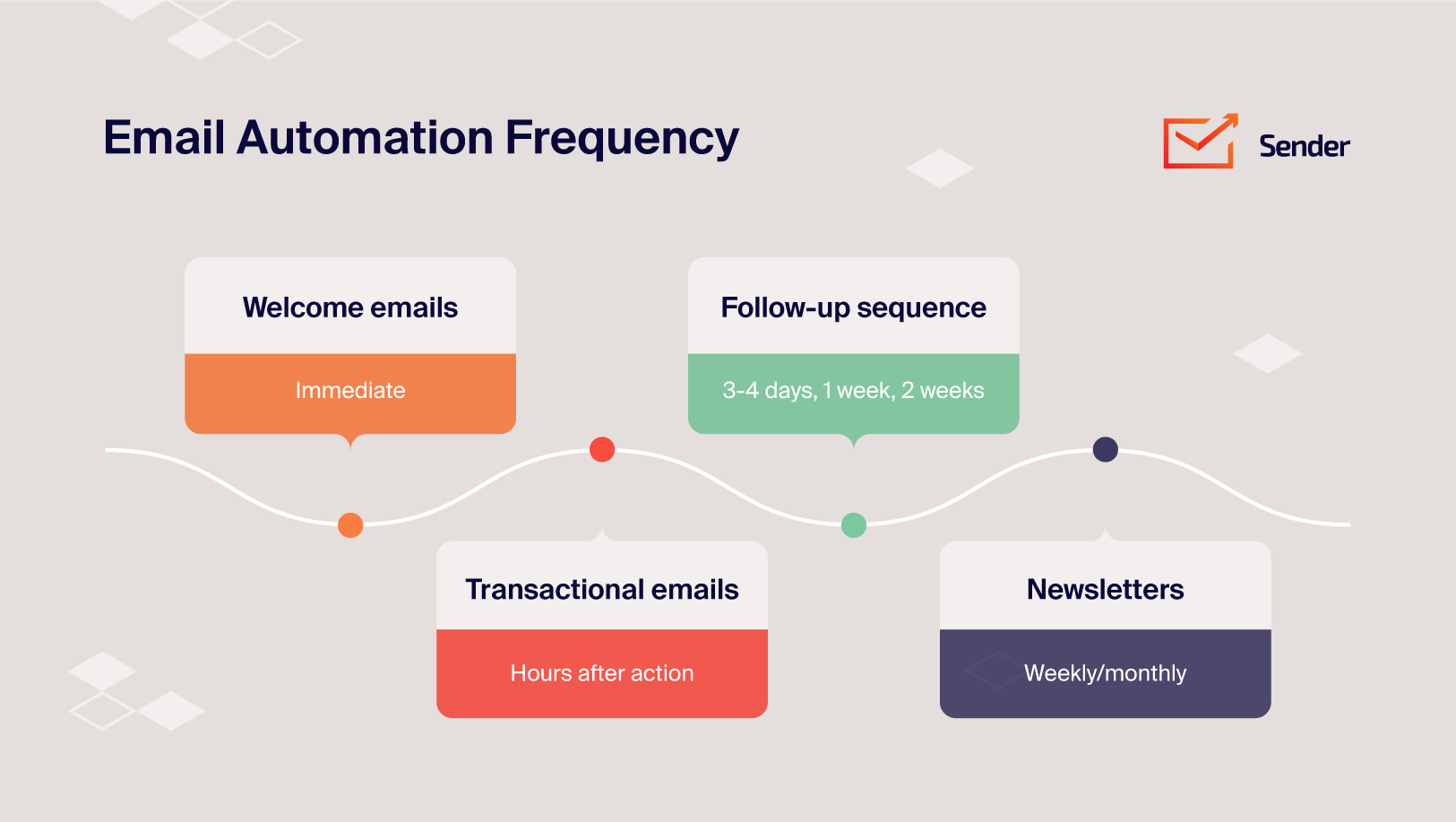
Automated emails are timed by a delay after the subscriber’s action, not by a clock, so the question is how many minutes, hours or days to wait. A welcome email sends within minutes of signup; a 15-minute batching delay in the automation is the usual reason a welcome email “arrives late” and the first setting to check when welcome-email clicks fall.
An abandoned cart email runs as a three-step sequence: the first email one hour after abandonment, the second 24 hours later, and the final email five to seven days later carrying the incentive. A follow-up email in a sequence waits three to four days after an unanswered message. These are practice, not measured optima, and the wait steps and time-window rules where the values are set are documented in delays and timing rules.
The failure mode is a delay that lands at a bad hour: a 24-hour wait after a 2 AM cart abandonment sends at 2 AM again. Use a “wait until” or delivery-window condition to hold the send to 9 AM to 8 PM where the workflow builder offers one, and check that each flow sits where the subscriber expects it in the email marketing customer journey.
Key Takeaways:
- Best days: none; timing is a delay after the subscriber’s action, not a clock time;
- Best time: welcome email within minutes of signup; abandoned cart emails at 1 hour, 24 hours and 5 to 7 days; follow-up email after 3 to 4 days;
- Delivery window: hold automated sends to 9 AM to 8 PM with a “wait until” condition.
How Audience and Industry Change the Answer
Audience behavior changes the answer more than the industry label does, because send-time peaks come from when your target customers are free to read, not from what they sell. MailerLite’s 2025 data splits its 2.1 million campaigns into four audience segments, and the click peaks range from 8 AM (institutions) to 9 PM (creators). Several factors move the window; the three below, industry, time zone and device, move it far enough to act on.
By Industry
MailerLite’s segment data (December 2024 to November 2025) gives windows for four different industries. Creators, whose personal content translates into higher engagement: clicks peak in the late evening, at Monday 9 PM (9.01%), Tuesday 9 PM (8.97%) and Sunday 8 PM (8.98%).
Entrepreneurs and SMBs: opens peak Thursday 9 AM (46.3%) while clicks land in early mornings and late nights, with Wednesday and Thursday early morning as the conversion window. Institutions (higher education, government, nonprofits): Friday 7 AM for opens (58.4%) and Friday 8 AM for clicks (12.26%), the highest click rate in the study. Ecommerce: Tuesday 4 PM for clicks (7.57%), Thursday 10 AM (6.74%) and Saturday 4 PM (6.61%), with opens scattered enough that MailerLite advises ignoring open peaks for this segment.
Mailchimp’s guidance from its Send Time Optimization system: retail and ecommerce, late morning to early afternoon, Thursday through Saturday; the best time to send B2B emails is Tuesday and Wednesday mornings; nonprofits, evenings and weekends when supporters have time, or the Tuesday to Thursday window as the compromise.
Time Zones and International Lists
Time-zone sending delivers the campaign at the same local hour in every zone, which fixes the problem that a 10 AM send from New York reaches a Los Angeles subscriber at 7 AM and a London subscriber at 3 PM. This feature reads one audience demographics field, time zone, or location from the customer data on each subscriber record, usually captured from the signup IP address or a country field.
Where the platform has no time-zone sending, segments built on subscriber country or region and scheduled separately produce the same result. For unsegmented US lists, the email scheduling compromise is 10 AM to 11 AM Eastern (7 AM to 8 AM Pacific). For lists spanning the US and Europe, one send cannot reach both morning windows; split the list.
Mobile vs. Desktop Readers
Mobile clients account for 41.6% of email opens in Litmus’s client-share data, webmail 40.6% and desktop clients 16.2%. Mobile readers open during commutes (6 AM to 9 AM) and evenings (6 PM to 10 PM) and defer longer actions; desktop readers open during business hours and complete forms and purchases at higher rates. If more than half of your opens are mobile, favour the 8 PM to 9 PM click window in MailerLite’s data and keep the email to one click target. If desktop dominates, the 9 AM to 11 AM window covers both opens and clicks.
When the Benchmarks Don’t Apply
Small lists (under about 1,000 recipients per test group): a send-time A/B test will not reach statistical significance. Use the mid-week morning default, Tuesday to Thursday at 9 AM to 10 AM local time, and revisit testing once the list passes 2,000 contacts.
Apple-Mail-heavy audiences (over 40% of opens from Apple clients): open rate is unreliable because Apple Mail Privacy Protection preloads the tracking pixel. Judge send-time tests by click rate and CTOR (click-to-open rate) only, the behavioral data that Apple’s proxy does not distort.
Triggered emails (welcome, abandoned cart, post-purchase): the send time is the delay after the action, not a clock time. Set the wait step and a delivery window, and leave day-of-week benchmarks aside.
Holidays and Black Friday: holiday promotions push campaign volume on Black Friday to several times a normal Friday, so subscribers’ inboxes are crowded in the mid-morning windows, and the best time to send Black Friday email moves earlier.
Omnisend’s Friday 7 AM conversion peak (0.138%), the hour with the most sales per email in its data, makes an early-morning send the defensible start, staggered by segment; our Black Friday marketing guide covers the full sequence.
Very large single sends (hundreds of thousands of recipients in one batch): ISP throttling applies. Gmail returns 421 4.7.28 deferrals when volume from a domain or IP jumps, so the tail of the send lands hours after the chosen window. Batch sending over one to three hours, or STO (the AI tools sold as Smart sending or Send Time Optimization, depending on the platform) keeps arrival inside the window; the bulk email guide covers volume limits by provider.
How to Find Your Best Send Time
Finding your own best send time takes five steps: establish a baseline from 3 to 6 months of campaign data, run send-time A/B tests, use send-time optimization (STO) where the platform offers it, verify the result across at least three sends, then retest seasonally.
1. Establish Your Baseline
Before running tests, establish your current performance:
- Review historical data: Analyze 3 to 6 months of campaigns to identify patterns in opens, clicks, and conversions by day and time.
- Segment your analysis: Break down performance by audience segment and email type. Promotional emails and newsletters often have different optimal times.
- Document current send times: Record when you’ve been sending so you can measure improvements against a clear baseline. The walkthrough on scheduling a campaign covers timezone settings and recurring schedule logic.
- Identify outliers: Note campaigns that performed unusually well or poorly and what time they were sent.
2. Run Send-Time A/B Tests
A/B testing in email marketing is the most reliable way to discover your best send times. The deeper guide covers how to design tests that actually produce conclusions:
- Test one variable: Change only the send time while keeping subject line, content, and audience identical.
- Start broad: Test morning vs. afternoon before fine-tuning to specific hours.
- Use sufficient sample sizes: Each test group needs at least 1,000 recipients for statistically significant results.
- Confirm patterns: Run the same comparison across 3 to 5 campaigns before drawing conclusions.
3. Use Send-Time Optimization (STO)
Send-time optimization automatically determines the best send time for each individual subscriber:
- How it works: The platform analyzes each subscriber’s historical engagement patterns and delivers emails at their predicted optimal time.
- Performance boost: STO often improves open and click rates by 10 to 25% compared to batch sending.
- Popular platforms: Klaviyo, Mailchimp, HubSpot, and Brevo all offer STO features.
- When to use it: Use STO for broad campaigns; use manual timing for time-sensitive announcements where everyone needs the email simultaneously.
4. Verify the Result
A send-time test has worked when it passes three checks:
- Pass criterion: the click rate or conversion rate difference between two send times of the same email holds across at least three sends to the same segment with the same content type.
- Noise threshold: with 1,000 recipients per test group and a 2% click rate, any single-send difference under about 1.2 percentage points is inside sampling noise, so one winning send proves nothing about future emails.
- If nothing moves after three rounds: email timing is not the constraint on email performance. Look at subject lines, list health (bounce and unsubscribe rates) and inbox placement instead, since a send that lands in spam has no send time at all.
5. Monitor and Retest Seasonally
Retest send times whenever audience habits shift, on this schedule:
- Review regularly: Check email metrics weekly or monthly and look for shifts in engagement patterns.
- Seasonal adjustments: Audience habits change with seasons, holidays, or industry cycles. Re-test during major transitions.
- Refine segments: As you learn more about your audience, create finer segments with tailored send times.
- Avoid over-optimizing: Small timing differences (9:00 vs. 9:15 AM) rarely produce meaningful results. Focus on broader patterns first.
Best Time to Send Emails FAQs
What Is the Most Professional Time to Send an Email?
The best time to send business email, and the most professional one, is 9 AM to 11 AM in the recipient’s local time on a Tuesday, Wednesday or Thursday, inside standard working hours. It is the window 47.9% of B2B marketers in HubSpot’s 2025 survey report as their peak. Avoid sends before 7 AM and after 6 PM.
Is It Better to Send an Email on Friday or Monday?
Friday, by a small margin, for opens and orders: MailerLite’s 2025 data gives Friday a 49.72% average open rate against Monday’s 49.44%, and Omnisend’s 2026 data gives Friday the week’s highest conversion rate (0.081%) against Monday’s 0.074%. Monday wins only for B2B lists that clear inboxes first thing. Tuesday beats both for clicks in both datasets.
What Time Is Too Early to Send an Email?
Before 6 AM in the recipient’s local time is too early for most lists. Moosend’s data shows open rates falling before 6 AM, and Mailchimp advises against 3 AM to 4 AM sends. The exception is an audience that reads at the start of a shift; MailerLite’s institution segment peaks at Friday 7 AM.
When Should You Send a Cold Email?
Send a cold email Tuesday to Thursday between 8 AM and 10 AM in the recipient’s local time, the window in Omnisend’s 2026 research; Moosend’s data shows opens highest at 8 AM to 9 AM. Measure replies, not opens. Test a 6 AM to 7 AM send only for executives who clear email before the working day starts.
Should I Use Send-Time Optimization (STO)?
Yes, for most campaigns. STO features in modern email platforms analyze individual subscriber behavior and deliver emails at predicted optimal times for each recipient. This typically improves engagement by 10 to 25% compared to sending to everyone simultaneously. Use manual timing only for time-sensitive announcements where everyone needs to receive the message within a specific window.
How Do I Handle Subscribers in Different Time Zones?
Segment your email list by geographic region and schedule sends based on local optimal times. Most email platforms offer automatic time-zone-based delivery. For unsegmented lists, late morning EST (10 to 11 AM) often works as a reasonable compromise for US audiences. For global lists, consider using STO or creating region-specific campaigns.
Next Steps
If you want the full program that send timing sits inside, read the complete email marketing guide, which covers list building, content, segmentation and deliverability.
If you want to test this on your own list, designing an email A/B test covers sample size, one-variable design and how to read the result.
If your list spans time zones, start with the customer segmentation guide to build the location segments that time-zone sending depends on.
Sources and Method Note
All send windows are stated in the recipient’s local time. Figures are quoted as each platform reports them; open rates from different platforms measure different populations under different tracking conditions and are not comparable with each other. Sources, with data windows:
- MailerLite, “The best time to send email newsletters in 2026,” published 16 December 2025: 2,138,817 campaigns sent from US, UK, Australian and Canadian accounts between December 2024 and November 2025. https://www.mailerlite.com/blog/best-time-to-send-email
- Omnisend, “The best time to send an email (2026 research),” updated 4 May 2026: approximately 26 billion emails. https://www.omnisend.com/blog/best-time-to-send-email/
- Mailchimp, “Insights from Mailchimp’s Send Time Optimization system,” June 2025. https://mailchimp.com/resources/insights-from-mailchimps-send-time-optimization-system/
- HubSpot, “The best time to send an email,” 2025 survey of 150+ marketing professionals. https://blog.hubspot.com/marketing/best-time-to-send-email
- Moosend, “The best time to send an email,” analysis of 10 billion emails (2021 dataset). https://moosend.com/blog/best-time-to-send-an-email/
- Litmus, “Email client market share,” September 2025 data. https://www.litmus.com/email-client-market-share
- Apple, Mail Privacy Protection release date: 20 September 2021 (iOS 15), as cited by MailerLite.