



An email marketing strategy is the plan that defines who you email, what you send, when and how often, and how you measure results against a business goal. The goal drives the strategy, and the strategy drives the individual tactics you run week to week.
This guide is written for SMBs and in-house marketers who already send email. It assumes you have an email service provider (ESP) and a list you collected yourself. It does not cover deliverability setup such as SPF, DKIM, and DMARC records, and it does not go deep on B2B or ecommerce specifics.
What is an Email Marketing Strategy?
An email marketing strategy is a documented email marketing plan covering audience, message, cadence and measurement for a defined period, usually a quarter or a year. It answers four questions: which segments receive email, what each segment receives, how often, and which number tells you whether it worked.
An email marketing strategy sits below your business goals and above your campaigns and automations. The business goal (“add $80,000 in Q4 revenue”) comes first. The strategy translates that goal into audience and cadence decisions. Campaigns and automations are the output.
Here is that chain with real numbers. A homewares store sets a Q4 email revenue goal of $80,000. Average order value is $65, so the store needs roughly 1,230 orders from email.
Working back from a 1.5% campaign conversion rate, the program needs about 82,000 sends across the quarter, split between a 12,000-contact engaged segment mailed weekly and three automated flows running continuously. Every one of those decisions traces back to the $80,000 figure.
The strategy is not the same as the channel itself. Email marketing describes the practice of sending commercial messages to a subscriber list. The strategy is the specific set of choices you make about how to run it.
Strategy vs. Tactics
Strategy is the set of decisions about audience, cadence, and success measures. Tactics are the individual actions that carry out those decisions, such as writing a subject line, adding a countdown timer, or testing a send time.
The strategy vs tactics distinction matters because tactics fail silently without a strategy behind them. A/B testing subject lines will lift open rates on a list that has no segmentation, but it will not lift revenue if you are mailing lapsed contacts who stopped buying eighteen months ago. The test succeeds, and the business result does not move.
A useful check: if you cannot say which goal a tactic serves, and which number would change if it worked, it is a tactic without a strategy attached. Most underperforming email programs are not short of tactics. They are running a lot of them without a decision layer above.
Why It Still Matters in 2026
Is email marketing still effective in 2026? Yes: email remains the digital marketing channel where you own the audience list, and the customer relationships attached to it, rather than renting them from a platform algorithm.
That is the structural reason strategy pays off: changes you make to segmentation or cadence compound across the same subscriber base, instead of resetting with every algorithm update.
The measurement picture has changed, though. Apple Mail Privacy Protection has made open rate unreliable as a primary metric, and mailbox providers now enforce complaint-rate thresholds that used to be advisory.
Programs built around opens and volume have lost ground, while those built around segmentation and revenue per send have not. Our roundup of where email is heading this year covers the shifts in more detail.
How to Create an Email Marketing Strategy in 5 Steps
Building an email marketing strategy takes five decisions, made in order: set one measurable goal, define your audience and segments, plan content and cadence by journey stage, automate the recurring moments, then choose KPIs and iterate.
Work through them in sequence. Each step narrows the options for the next one, so choosing segments before you have a goal usually produces segments you never mail. Expect the first pass to take a working session of two to three hours, not a week.
1. Set One Measurable Goal
Set a single measurable goal for the quarter, expressed as a number with a deadline. “Generate $40,000 in email-attributed revenue by 31 December” is a goal. “Grow the list” is not, because nothing tells you when you are done.
One goal, not four. Goals compete for the same sends: acquisition wants frequent broadcasts and aggressive signup prompts; retention wants lower frequency and tighter segmentation. Running both at once usually means neither target is hit.
The main types of email marketing strategies follow from which of three goal types you pick. Revenue goals suit businesses with a purchase event to track. Customer engagement goals suit newsletters where the click is the conversion.
Acquisition goals suit early-stage programs without enough subscribers to test reliably. Set the number from your own last-quarter baseline rather than an industry average, and our breakdown of email marketing returns explains how the calculation works.
2. Define Your Audience and Segments
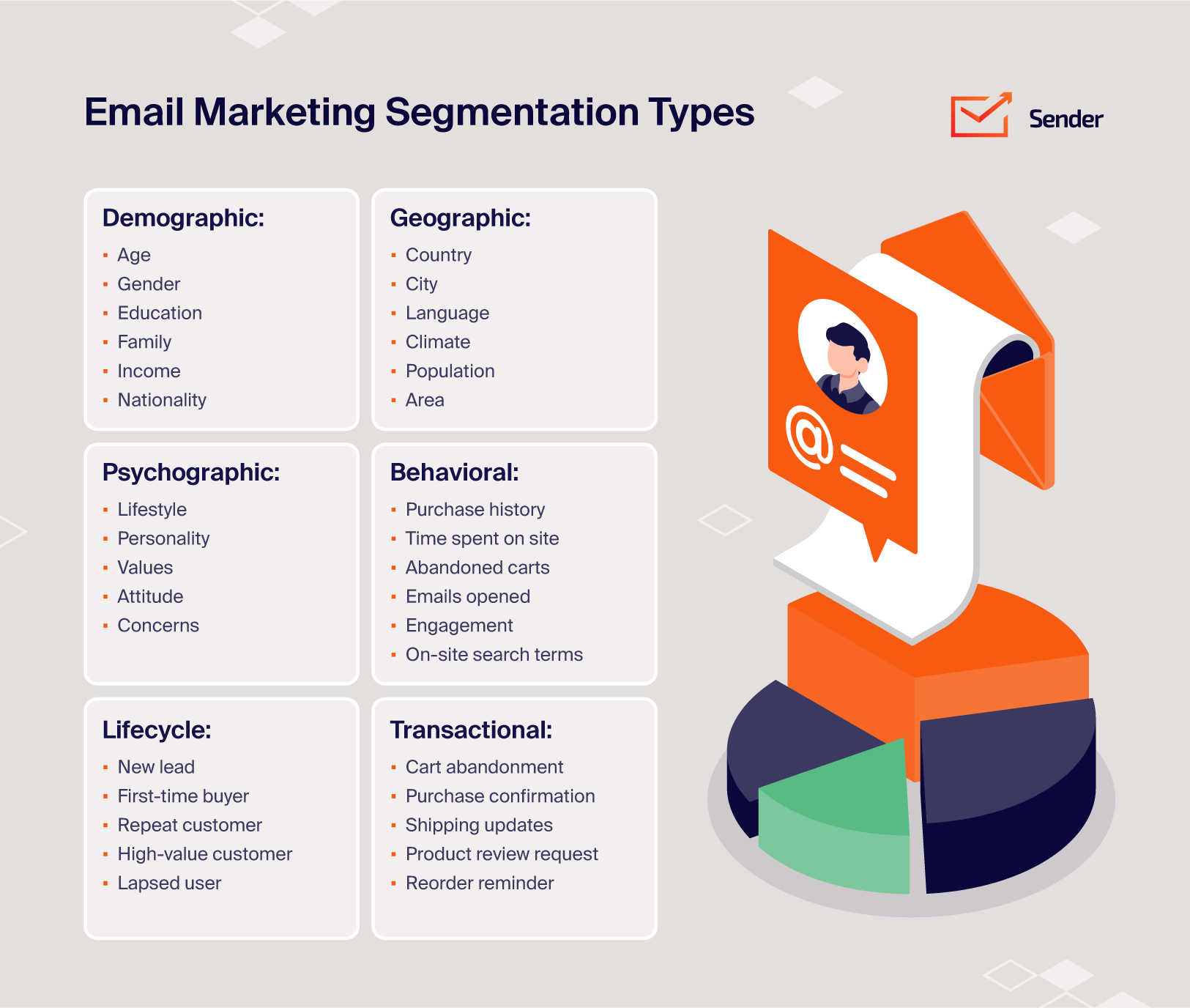
Audience definition means describing your target audience in concrete terms: naming the buyer personas on your list and splitting them into segments you will mail differently. A segment earns its place only if it changes what you send, when you send it, or both.
Start with three segments, not twelve. Audience segmentation on engagement alone is the simplest email segmentation strategy, and it gives most SMB lists a workable split: engaged (opened or clicked in the last 90 days), lapsing (90 to 180 days), and dormant (180 days or more).
That split usually produces the largest single gain available to a small program, because it stops you from mailing dormant contacts who drive complaints and bounces without buying.
Layer a second dimension once the first is running: customer lifecycle stage, purchase category, or which of your sign-up forms the contact came through.
Two failure modes are worth naming. The first is building segments from first-party data you do not actually collect, since a “high-value customer” segment is useless if order value never reaches your email marketing platform. The second is over-segmentation: a 4,000-contact list carved into segments of 80 produces no readable result, and a segment below roughly 1,000 contacts will not support a reliable A/B test.
Define segments by rules, not static lists, so membership updates as contacts qualify and disqualify. Dynamic segmentation recalculates on each send instead of needing a manual re-export.
3. Plan Content and Cadence by Journey Stage
Your content strategy and cadence planning decide what relevant content each segment receives at each point in the buying process, and how often. The output is a content calendar with a fixed send frequency per segment.
Creating relevant content starts with matching the right message to the stage. New subscribers are potential customers who need orientation: what you sell, what emails they will get, and one reason to buy now. Existing customers need product news, restocks, and offers.
Lapsing contacts need a reason to return that is not another discount, such as a preference update or a best-of roundup. This is easier once you have sketched the path subscribers take from signup to purchase.
Set cadence per segment and hold it. A workable starting point is weekly to engaged contacts, twice monthly to lapsing contacts, and one re-engagement campaign to dormant contacts before suppression. Frequency is the variable most likely to break email deliverability when it changes suddenly, so move it one send per month at a time and watch complaint rate.
Types of Email: Campaigns, Automations, Newsletters
Campaigns are one-off sends to a chosen segment at a chosen time, such as a Black Friday offer. Planning a single campaign starts with the segment, not the design.
Automations are triggered emails that fire on subscriber behavior or a date, such as a welcome series, and run without a scheduler.
Newsletters are recurring editorial sends on a fixed schedule to a broad segment. A one-off send to a large list is called a broadcast in some tools.
4. Automate the Moments That Matter
Email automation covers the moments that recur for every subscriber, so automating repetitive tasks stops eating your week: build the sequence once and it runs on trigger rather than on your calendar. Three flows cover most automated revenue for SMBs: welcome, cart abandonment, and win-back.
Define each flow by trigger, timing, and exit condition before writing a single email. A welcome series triggers on signup confirmation, sends three to four emails across seven days, and exits on purchase.
An abandoned cart email flow triggers on an add-to-cart with no checkout, sends at one hour and again at 24 hours, and exits on order placed. A win-back flow triggers at 90 days without engagement, sends two win-back emails a week apart, and exits to a suppression segment if neither is opened.
The common mistake is building flows without exit conditions. A subscriber who buys during a cart sequence and still gets the 24-hour reminder receives a message that contradicts what just happened, and that produces complaints rather than unsubscribes.
5. Choose KPIs, then Measure and Iterate
Choose one primary KPI that matches your goal, plus two or three secondary metrics that explain movement in it. The match matters more than the list: click rate for an engagement goal, revenue per email for a sales goal, and list-growth rate for an acquisition goal.
Treat open rate as directional only. Apple Mail Privacy Protection preloads images through Apple’s proxy servers, so a message registers as opened whether or not anyone read it. Litmus reports that more than half of tracked opens now come from Apple Mail with the feature active, which means open rate reflects your audience’s device mix as much as your subject line.
Performance tracking runs on a fixed review cadence, so set one and hold it. Review campaign numbers weekly, segment and flow performance monthly, and the strategy itself quarterly against the single measurable goal you set for the quarter. Weekly review catches deliverability problems early.
Quarterly review is where you change segments or cadence for future campaigns, because anything shorter does not give a flow enough volume to read. Definitions and formulas for each number sit in our reference on the metrics that matter in email.
Email Marketing Strategy Template
Use this template to document the strategy on one page. Fill every row before you build a single campaign, because a blank row is usually where the plan falls apart later.
Keep the filled template somewhere your team can see it, and update it at the quarterly review rather than continuously. Writing it down makes the decisions arguable: if someone proposes a send that does not map to a row, the template gives you the reason to say no.
| Element | What to decide | Example |
| Business goal | One number, one deadline | $40,000 email revenue by 31 December |
| Primary KPI | The metric tied to the goal | Revenue per email |
| Secondary metrics | Two or three explanatory numbers | Click rate, conversion rate, unsubscribe rate |
| Audience segments | Three to five, rule-based | Engaged 90d / Lapsing 90-180d / Dormant 180d+ |
| Content types | What each segment receives | Weekly offer, monthly roundup, re-engagement |
| Cadence | Sends per segment per month | 4 / 2 / 1 sequence |
| Automations | Trigger, timing, exit | Welcome, cart, win-back |
| Compliance | Consent record, unsubscribe, address | Double opt-in, one-click unsubscribe, footer address |
| Review cadence | When you look and what you change | Weekly campaigns, monthly flows, quarterly strategy |
Example: a Filled-in Strategy for a Small Online Store
This email marketing strategy example starts with a 9,000-contact homewares store that sets a Q4 goal of $40,000 in email revenue, with revenue per email as the primary KPI and a target of $0.22 per send.
Segments: 3,400 engaged contacts (opened or clicked within 90 days), 2,900 lapsing (90 to 180 days), and 2,700 dormant (180 days or more), excluded from campaigns entirely.
Cadence: four campaigns a month to engaged contacts, two to lapsing, and one four-email re-engagement sequence to dormant contacts in early October, after which non-responders are suppressed.
Flows: welcome series (four emails over seven days), cart abandonment (one hour and 24 hours), and post-purchase follow-ups (replenishment) at 45 days.
At $0.22 per send across 58,200 quarterly campaign sends, campaigns contribute roughly $12,800, so flows have to carry the remaining $27,200.
That gap is why the store builds flows before writing more campaigns, and it is worth checking the target against your email marketing cost, which our breakdown of what running an email campaign costs sets out by subscriber count.
10 Email Marketing Tactics That Put the Strategy to Work
The tactics below are the execution layer. Each one supports a decision from the five steps above, so run them in service of your goal rather than as a checklist. Several appear in most lists of email marketing best practices, but they only produce results when a segment and a KPI sit behind them.
1. Build a High-Quality Email List
Collect addresses only from people who opted in, and judge the list by how many of them engage rather than by how many there are. An engaged, permission-based email list is the foundation of any successful email marketing campaign.
See our full breakdown on how to build an email list in the long-form playbook. Instead of casting a wide net, focus on attracting the right email subscribers who are genuinely interested in your brand and more likely to become loyal customers.
Offer something in return for the address. Don’t just ask people to subscribe; give them a compelling reason to join your community.
A well-crafted offer can make all the difference, considering that the average popup conversion rate is 4.65%. That means you can engage almost 5% of your website traffic before it’s gone for good.
Three list-building methods worth using:
- Use lead magnets. Entice potential subscribers with valuable incentives like ebooks, checklists, or exclusive discounts in exchange for their email addresses. Promote these incentives in your blog posts and other marketing channels for better reach;
- Use double opt-in. Implement double opt-in to ensure email addresses are valid and subscribers are genuinely interested. This involves sending a confirmation email after filling in the signup form, asking users to verify their subscription;
- Never purchase an email list. Resist the temptation to take shortcuts. Purchased lists are often filled with inaccurate or inactive addresses, harming your sender reputation and deliverability. For a winning email marketing strategy, focus on organic list-building.
2. Write Subject Lines That Earn the Open
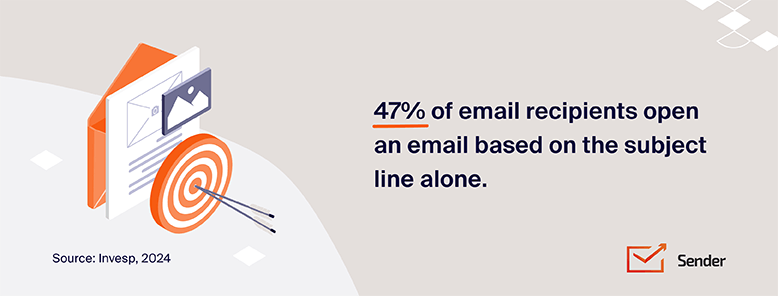
Front-load the value in the first 30 to 40 characters of email subject lines, because that is roughly what mobile inboxes display before truncating. EmailToolTester’s device testing found 33 characters visible across every major mobile client it tested, and 37 for preheader text.
Short is not automatically better. What matters is that the deciding words land before the cut: “Your order ships tomorrow, here is the tracking” survives truncation; a slow build-up does not. Test length rather than obeying a rule, since visible characters vary by client, orientation, and font size setting.
Three subject line techniques to apply:
- Keep the value early. Put the offer, deadline or benefit inside the first 30 to 40 characters, then use the preheader to extend the message, not repeat it.
- Use action-oriented language. Use verbs that prompt action: “Download Your Free Guide” instead of “A Free Guide is Available;”
- Create urgency or curiosity. Time-sensitive offers and open questions both raise opens, though urgency stops working if you use it every week;
3. Lead with Value and One Clear CTA
Give the reader the point of the email in the first two lines, then ask for one action. Emails with competing calls to action split attention across several links and reduce clicks on the one that matters to your goal.
One action per email means one primary button, repeated if the email is long, plus any navigational links kept visually secondary. If a campaign genuinely needs two actions, that is usually a signal it should be two emails to two segments.
Place the primary CTA above the fold, and write the button text as the action rather than the mechanism: “Get the size guide” instead of “Click here”. Test the copy and the color, since button text often moves click-through rates more than the surrounding paragraph does.
Strong email engagement usually comes from clarity of ask, not from adding visual elements.
4. Segment First, then Personalize
Segmentation decides who receives a message; personalization decides what it says to them, and targeted messaging needs both.
Segment first, because personalizing a message sent to the wrong audience only makes an irrelevant email more specific. A single undifferentiated send to the whole list, where every subscriber gets the same email, is what segmentation replaces.
With segments in place, three angles cover most of the personalized emails an SMB will send.
- Demographics (age, location, gender). Segment on attributes you actually collect, then adjust offers by age group or messaging, shipping and currency by location;
- Customer behavior (purchase history, website activity). Use the customer data you already hold to recommend products related to a previous order, or surface items viewed but not bought;
- Engagement level (active vs. inactive). Send re-engagement content to lapsing contacts, and early access or customer loyalty offers to active ones.
Personalization fails in two predictable ways. Merge tags without fallback values produce “Hi ,” in the inbox, which is most visible when you personalize subject lines, so set a default such as “there” on every dynamic content field.
And behavioral rules on stale data recommend products based on a two-year-old purchase, which reads worse than no personalization at all. Set a 180-day recency window.
5. A/B Test Your Emails
Test one variable at a time against a control, on a segment large enough to read, and change nothing else in that send. What works for one audience might fall flat for another, and consistent A/B testing is the only way to tell which is which.
Test everything from subject lines to send frequencies. By analyzing the results of your A/B testing email experiments, you gain insights into subscriber preferences, allowing you to refine your approach and send more effective email marketing campaigns.
The help guide on A/B testing campaigns walks through the setup.
Three elements worth A/B testing:
- Subject lines. Experiment with different subject line variations to see which ones generate the highest open rates. Test different wording, lengths, and personalization techniques;
- Email copy and visuals. Try different layouts, images, and calls to action to see what drives the most engagement;
- Send times and frequencies. Optimize your email strategy by testing different send times and frequencies. Determine when your audience is most receptive to your messages to maximize opens and clicks.
6. Automate Welcome, Cart and Win-back Flows
Automated flows earn a disproportionate share of email revenue because they fire on intent rather than on a schedule. Klaviyo’s 2026 Omnichannel Benchmark Report found that flows generated close to 41% of email revenue from 5.3% of sends.
Build these three first, with trigger and timing fixed before you write the copy:
- Welcome series. Triggered on subscription confirmation. Send three to four welcome emails across seven days: introduction on day zero, category orientation on day two, social proof on day four, a time-limited offer on day seven;
- Abandoned cart reminders. Triggered on add-to-cart without checkout. Send at one hour, while intent is live, and again at 24 hours. Exit on order placed so buyers never get the second message;
- Win-back campaigns. Triggered at 90 days without an open or click. Send two emails a week apart, then move non-responders to a suppression segment.
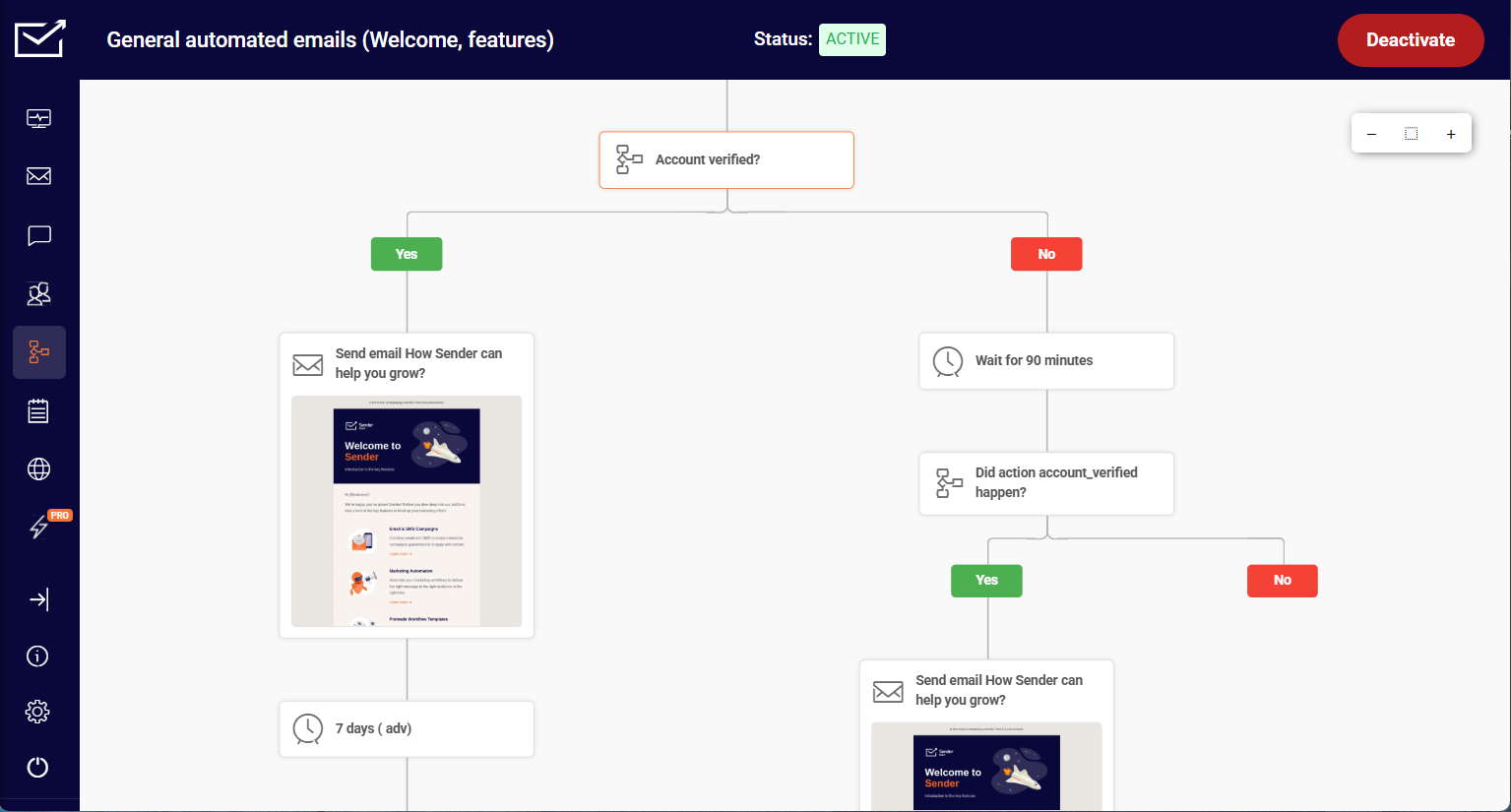
Marketing automation setup is a sequence of triggers, delays, and conditions, and a first flow usually takes under an hour in an automation builder for email workflows.
Instructions for the cart sequence are in the guide to creating an abandoned cart series.
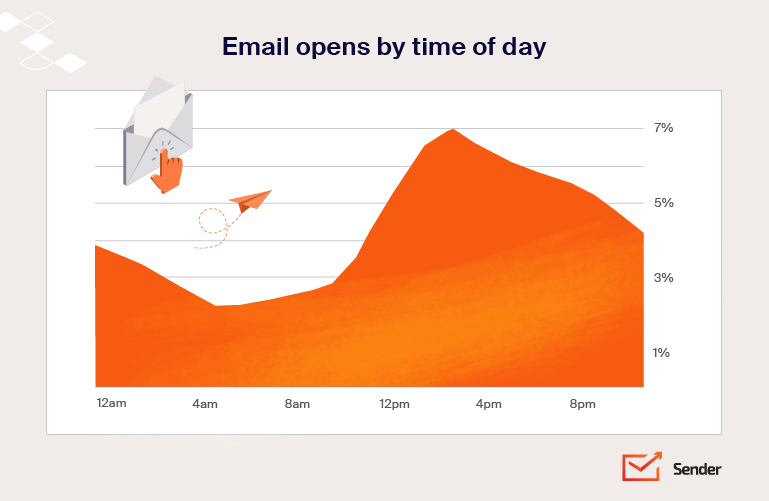
7. Find Your Own Best Send Time
Start with weekday mornings, then test your way off that default. Sends between roughly 9 a.m. and noon local time are a reasonable first position, but the “Tuesday and Wednesday, 10 a.m. to noon” rule is contradicted often enough across published datasets that it is not settled.
Test by segment, not across the entire list. B2B contacts, retail buyers and weekend browsers rarely share a peak, and an average across all three describes none of them.
Segment by time zone first. If your list spans several zones and your email service provider (ESP) sends at a fixed absolute time, a 10 a.m. send lands at 2 a.m. for part of the audience and distorts every result. Our data on when subscribers actually open is a hypothesis to test, not a schedule to copy.
8. Focus on Mobile Users
Mobile optimization starts with building every email for a phone screen, then checking how it renders on desktop. With 43.5% of all email opens happening on mobile devices, optimizing for mobile is crucial for any effective email marketing strategy.
One out of every three clicks in an email happens on a mobile device, and 60% of people check their emails first thing in the morning on their smartphones.
Three ways to optimize an email for mobile devices:
- Use responsive email templates. Ensure your emails look great on all devices by using mobile-friendly email templates that automatically adjust to different screen sizes;
- Keep content concise and scannable. Mobile users are often on the go, so keep your content concise and easy to digest. Use short paragraphs, bullet points, and clear headings;
- Use larger fonts and clickable buttons. Make it easy for mobile users to interact with your emails by using larger fonts and buttons that are easy to tap with a finger.
9. Track the Metrics Your Goal Depends On
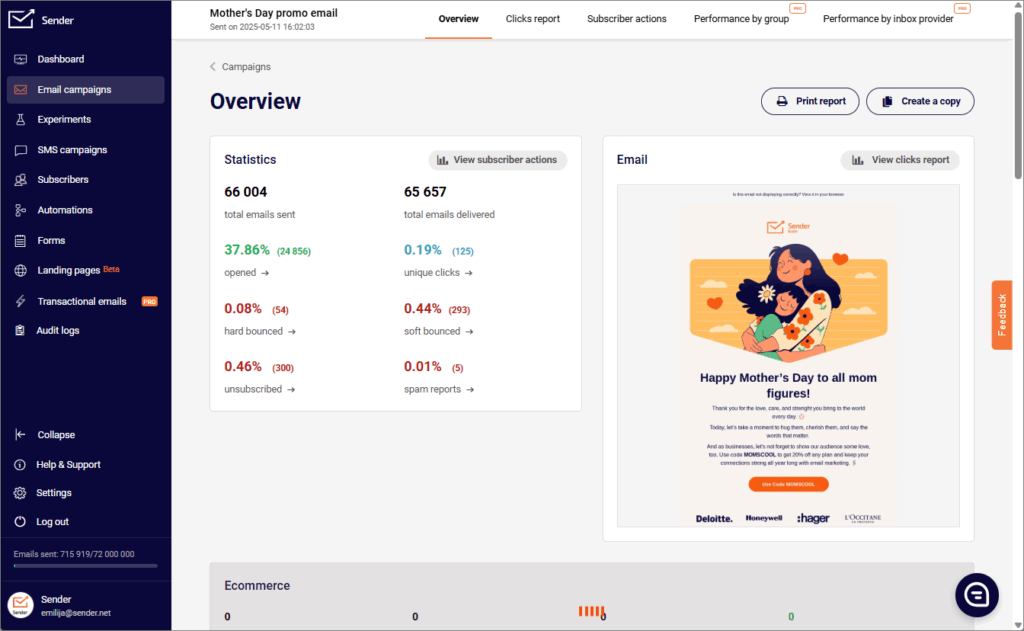
Monitor key metrics in a fixed set: the one your goal depends on, plus the two that explain it. A revenue goal needs revenue per email, supported by click-through rate and conversion rate. An engagement goal needs click rate as the headline number, supported by engagement metrics like click-to-open rate and unsubscribe rate.
Watch bounce rate and unsubscribe rate, whatever the goal, because both warn about list quality rather than measuring performance. A bounce rate above 2% on a list you built yourself points to an import or list hygiene problem, not a content problem.
Do not track metrics you will not act on. If a number would not change a decision at your next review, it belongs in the report, not the dashboard.
10. Stay Compliant and Protect Deliverability
Compliance and deliverability are separate requirements, and meeting one does not satisfy the other. CAN-SPAM sets the US legal floor, with penalties of up to $53,088 per violating email under the FTC’s inflation-adjusted maximum, effective January 2025 and current as of 2026. CASL in Canada and GDPR in the EU set their own consent rules for those audiences.
The threshold that matters operationally is the spam complaint rate. Google’s sender guidelines tell bulk senders to keep the user-reported spam rate below 0.10% and never let it reach 0.30%.
Above 0.30%, senders lose eligibility for Gmail’s mitigation process until the rate holds under that ceiling for seven days. Yahoo aligned in February 2024, Microsoft in May 2025.
Three requirements to build into every send:
- Include a working unsubscribe link. Promotional messages need a visible link plus the List-Unsubscribe and List-Unsubscribe-Post headers, with opt-outs honored within 10 business days;
- Use double opt-in where list quality matters more than list size. Confirming the address filters typos, bot signups, and addresses entered by someone other than the owner, which usually lowers bounces and spam complaints. It also reduces signup completion;
- Offer a preference center. Letting subscribers reduce frequency or choose topics gives them an alternative to opting out. The CAN-SPAM and GDPR compliance guide covers the setup.
FAQs
The most effective email marketing strategy is the one built backward from a single business goal, with segments that change what you send and a KPI that matches the goal.
Effectiveness depends on list size, purchase cycle, and margin, so no single set of email marketing best practices ranks first for everyone. In practice, segmenting by engagement and building the welcome, cart, and win-back flows produces the largest gain across most email marketing strategies.
The 3-3-3 rule is an attention heuristic: roughly three seconds to earn attention, thirty seconds to communicate value, three minutes to convert. In email, that maps to the subject line and preheader, then the opening and first CTA, then the landing page. It is a direct-response rule of thumb, not a measured standard, and competing versions exist.
The 5 Ts are a mnemonic for the elements of an email program, and two versions circulate. The more common one is Targeting, Timing, Testing, Tracking, and Technology, the last meaning the email marketing tools that carry the other four. A second version, used more in content-led programs, is Tease, Target, Teach, Test and Track. Neither comes from a standards body, so treat them as checklists rather than definitions.
The 80/20 rule has two meanings in email. As a content guideline, roughly 80% of sends should be valuable content that informs or entertains, and 20% should be promotional emails that sell directly. As an application of the Pareto principle, a small share of your list, often around 20%, generates most of your email revenue. The second version is the one worth measuring.
Most SMB programs land between weekly and twice monthly to engaged subscribers, with lower frequency to lapsing contacts. Set frequency by segment rather than for the whole list, and change it in increments of one send per month while watching complaint rate and unsubscribe rate. If complaints rise above 0.10%, reduce frequency before changing anything about the content.
Next Steps
Write the one-page strategy template before you write another campaign. Fill in the business goal, the segments, the cadence, and the primary KPI, and you have a strategy you can argue with.
Then build in this order: engagement segments, welcome flow, cart flow, campaign calendar. That sequence puts the highest-return work ahead of the highest-effort work, which matters when hours are limited.
If any part of the plan is unfamiliar, our full email marketing guide covers the fundamentals underneath it.
Before your first quarterly review, the advice we collected from working email marketers is worth an hour of reading for email marketing tips you can apply the same week.