



The most effective email marketing tips are to segment your audience, keep your list clean, write clear subject lines, and give every email one obvious action. Send messages when subscribers are likely to engage, automate behavior-based sequences, design for mobile, provide consistently useful content, and test individual elements to improve results over time.
Good email marketing is rarely about one clever trick. Results usually come from getting the fundamentals right: building a healthy list, sending relevant content, writing stronger subject lines and CTAs, using automation wisely, and tracking the metrics that show what is actually working.
The 15 tips below focus on the parts of email marketing that have the biggest impact on engagement, conversions, and long-term performance. They also cover where common advice can go wrong, so you can avoid over-segmenting, over-emailing, or optimizing vanity metrics while missing the bigger picture.
This article is part of our Email marketing guide.
Get the List Right First
Over the last few years, we tested, tweaked, and learned what works–and now, we’re sharing email marketing best practices that helped us in our efforts.
List quality sets the ceiling on everything else in email marketing. Two things determine it: email segmentation, so each message can be relevant to the group receiving it, and list hygiene, so you’re sending to addresses that still belong to interested people. Both come before any work on copy or timing.
1. Segment Before You Personalise
Personalisation only works when it reflects what subscribers actually care about. You wouldn’t speak to a teenager the same way you would to a CEO, and your emails shouldn’t treat every subscriber as if they have the same needs, interests, or reasons for buying.
A buyer persona can be a useful starting hypothesis, but build your segments from first-party data – what subscribers actually click, browse, buy, and tell you. Start by learning what different parts of your audience respond to:
- Review your existing data. Use website analytics, social media insights, purchase behavior, and past campaign performance to spot patterns;
- Track email engagement. Compare clicks, unsubscribes, and other engagement signals to see which topics and offers resonate;
- Ask subscribers directly. Surveys and polls can reveal needs, interests, and preferences that behavioral data may miss;
- Build useful segments. Group subscribers by demographics, interests, engagement, purchase history, or behavior, then tailor content to each group. That’s where personalization becomes useful: use dynamic content for larger content changes and merge tags for simple fields such as name or company.
Relevance also means balancing promotional emails with content people genuinely want to receive. Constant sales pitches can quickly wear subscribers down. Instead, mix offers with useful advice, practical solutions, insights, stories, case studies, or other content that educates, informs, or entertains.
Keep testing what resonates. Compare engagement across segments, formats, and topics, and use metrics such as click-through and unsubscribe rates to refine your approach. Make every version accessible too, including clear formatting and alt text for images.
Good personalisation starts with knowing who you’re talking to, then giving each audience segment a reason to keep listening.
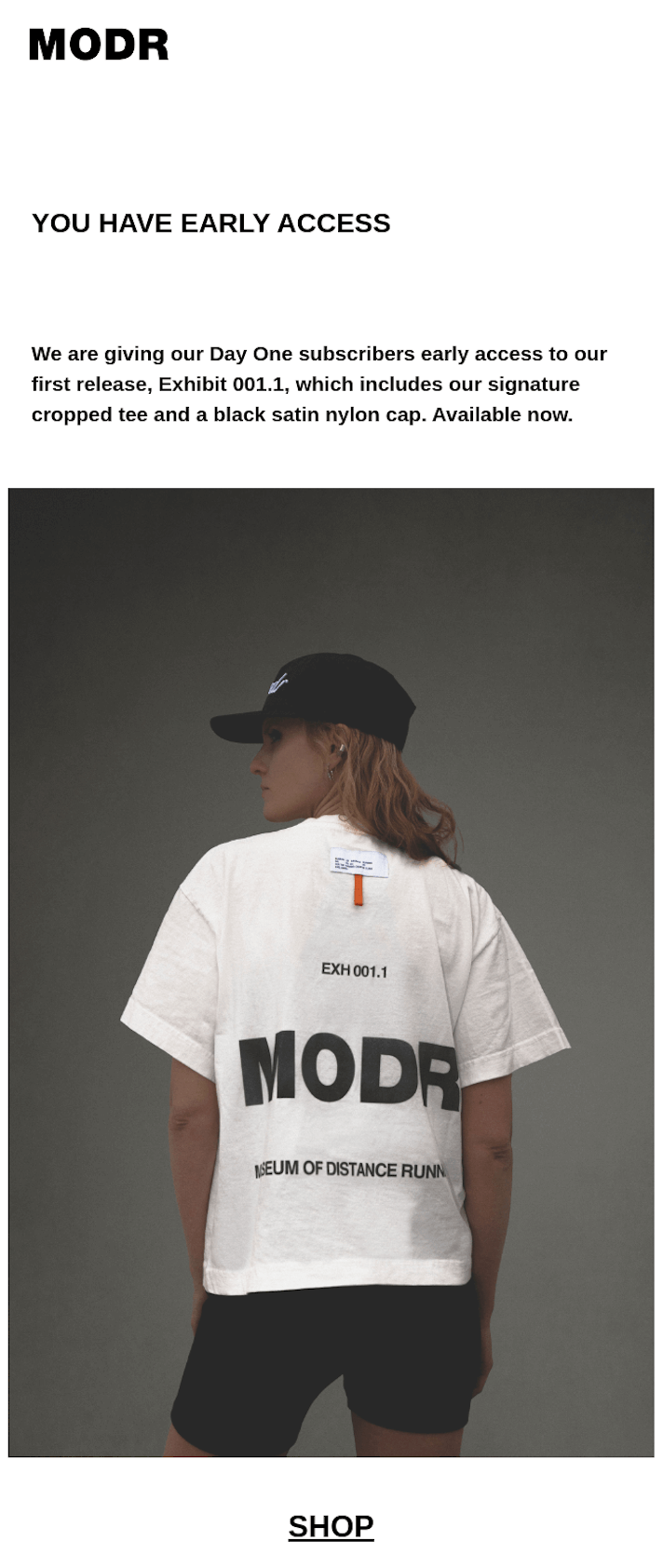
For example, realizing that their VIP customers (high or frequent spenders) deserve a little pampering, MODR sent an email inviting them to shop the new collection early.
2. Keep Your Subscriber List Healthy
A clean email list is vital for avoiding spam complaints and improving deliverability and engagement. Regularly remove inactive subscribers to keep your list optimized.
– Andrus Purde, Co-Founder of Outfunnel
Confirm every sign-up with double opt-in and an opt-in confirmation email, identify inactive subscribers from clicks, purchases and replies, run a re-engagement campaign or win-back email, then remove the people who don’t respond.
Here’s how you keep your email list healthy:
- Use double opt-in to confirm that people really want to subscribe and prevent those pesky fake sign-ups;
- Keep an eye on subscriber activity and identify inactive subscribers using a mix of signals, such as clicks, purchases, replies, and long-term engagement patterns;
- Send out some fun re-engagement campaigns to try and win back those inactive subscribers;
- Make it super easy for people to unsubscribe with a one-click unsubscribe option where supported. Keep opted-out addresses on a suppression list so they aren’t mailed again.
- GDPR and CAN-SPAM have different consent and unsubscribe requirements, so apply the rules that cover your audience.
Good list hygiene also supports deliverability, sender reputation, and inbox placement. For higher-volume programs, sending infrastructure matters too: a dedicated IP gives you more control than a shared IP, and a new sending IP may need a gradual IP warm-up to reduce sudden-volume problems such as ISP throttling.
Write Emails People Open and Act On
Four things decide whether an email is opened and acted on: a subject line that earns the open, a tone that fits the segment you’re writing to, one CTA that names the next step, and a visible human brand behind the sender name.
3. Write Subject Lines That Survive a Crowded Inbox
Treat your email subject line like the title of a book. You want to grab attention, but also make sure it aligns with the content.
– Beau Bawab, Director of Marketing at Beau B Content
Keep subject lines under 50 characters so they display in full on mobile – and pair it with preheader text that adds context instead of simply repeating it – then earn the open with urgency, exclusivity, or subscriber data.
Here are some more statistics that show why subject lines matter:
- Using machine learning for subject line optimization can increase open rates by 35%;
- 47% of email recipients open an email based on the subject line alone;
So, how do you make your subject lines better? Beyond the quick tips below, our deep dive on email subject line best practices covers the full framework:
- Keep your subject lines concise – aim for up to 50 characters to ensure they display correctly on various devices;
- Create a sense of urgency or exclusivity with words like “limited-time offer”, “exclusive access”, or “don’t miss out”;
- Use subscriber data to personalize your subject lines.
4. Match Tone to Who You Are Writing To
Match your tone to the segment you’re writing to: humour and memes for Gen Z, proof points and plain language for Gen X, data and time savings for B2B buyers.
How do different people respond to emotional triggers?
| Customer profile | What works? | Example |
| Gen Z (Ages 18–24) – Short, Punchy & Trend-Driven | Humor, memes, and conversational tone. | “This deal slaps. But only for 24 hours 👀” |
| Millennials (Ages 25–40) – Humor & Social Consciousness | Sarcasm, memes, relatability, and purpose-driven messaging. | “Saving the planet AND 20% on your next order? Yes, please!” |
| Gen X (Ages 41–55) – Reliability & Efficiency | Straightforward, results-driven language with proof points. | “No gimmicks. Just the tools you need–at 30% off.” |
| Baby Boomers (Ages 56+) – Nostalgia & Trust | Familiarity, storytelling, and exclusivity. | “The classic [product name], just like you remember–but better.” |
| Engaged Online Shoppers – FOMO & Urgency | Scarcity, exclusivity, and social proof. | “Only 3 left in stock–grab yours before they’re gone!” |
| B2B Decision Makers – Logic & Value | Data-driven reasoning, credibility, and time savings. | “Boost productivity by 45% with [solution]. Here’s how.” |
Email marketing content tips to create emotional angles:
- Match tone to audience expectations. Use humor, urgency, or storytelling based on who you’re talking to;
- Tap into pain points. Address real frustrations and offer relevant solutions that make their lives easier;
- Use an emotional hook in subject lines. Make them feel curious, excited, or urgent;
- Test emotional triggers. Run A/B tests to see what resonates most.
5. Give Every Email One Obvious Next Action
Think of your email’s call-to-action buttons as that little push they need to swing by your online store, check out a blog post, or grab a special deal. The CTA is the bridge between interest and action, telling your subscribers exactly what to do next – no wonder why 35% of marketing professionals worldwide say CTAs are the most effective interactive elements in emails.
Why does a strong CTA matter?
- Using a specific, clear CTA can increase conversion rates by 30+%;
- Adding urgency to CTAs, such as limited-time offers, can increase conversion rates by 332%*;
- Placing the CTA button at the end of the product landing page can increase conversions by 70%*.
Tips to create a high-converting CTA
| Tip | Details | Examples |
| Use action-driven language | Tell readers exactly what to do, instead of a generic ‘Learn More’. | ‘Grab Discount Now’‘Claim Your Free Trial’ ‘Start Now’ |
| Create urgency | Limited-time offers push people to act fast. | ‘Claim Before It’s Gone’‘Grab The Last Chance’ |
| Highlight the benefit | Why should they click? Show the value they’ll get. | ‘Get $50 Off’‘Unlock Success Secrets Now’ |
| Test different CTA styles | A/B test CTA placement, button color, wording, and urgency to see what works best for your audience. | ‘Check below’ |
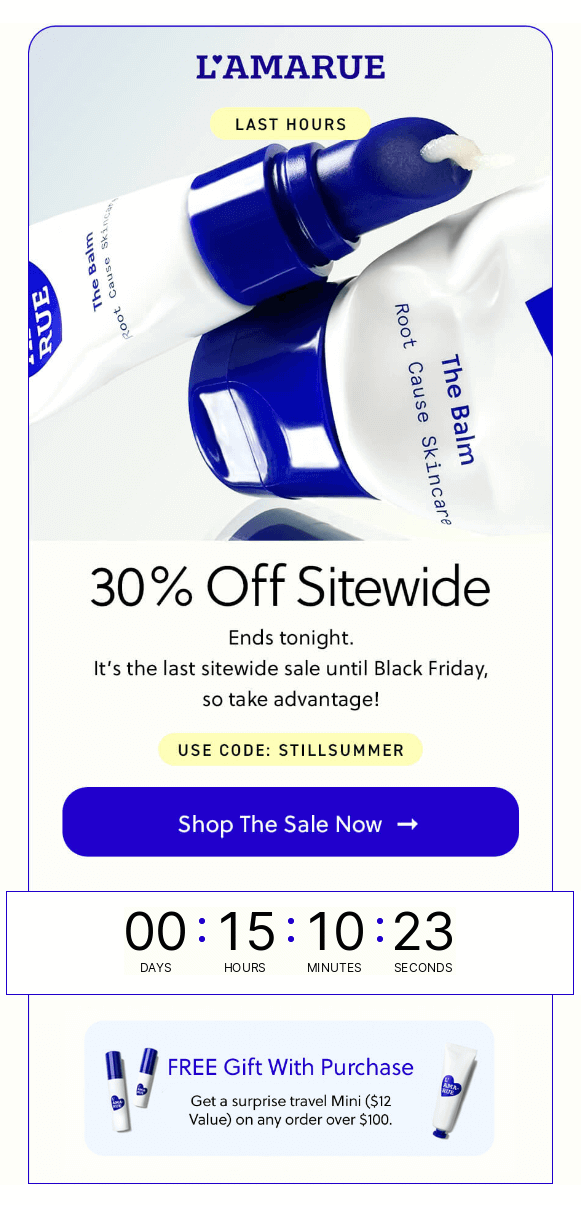
Need to see these tips in action? Here’s an example of a great CTA by L’amarue:
6. Show the Brand Behind the Emails
Reverse personalization means showing the people and process behind your brand – your team, values, milestones, and behind-the-scenes moments – instead of only tailoring copy to the reader.
People connect with people, not faceless corporations–so the more relatable and transparent your brand appears, the stronger your email engagement will be.
Why does reverse personalization work?
- 44% of consumers are uncomfortable with brands partnering with AI influencers;
- 63% of consumers say authentic marketing content matters more than highly polished production.
Reverse personalization works because it taps into emotional psychology. When you show your company’s values, team, or behind-the-scenes moments, subscribers feel like they’re part of the journey.
The psychology behind reverse personalization:
- The parasocial effect. When brands share personal stories, consumers who weren’t aware before, feel emotionally invested, like they’re part of an inside circle;
- The principle of reciprocity. When you reveal your personal side and ask something, people feel more connected and are more likely to return the favor by engaging;
- Transparency builds loyalty. Showing transparency builds brand loyalty. Customers prefer brands that feel real, approachable, and human.
Ideas for implementing reverse personalization
| Idea | Explanation | Example |
| Plan a “Here’s what we’ve been up to” email. | Share what’s happening inside your brand. Whether it’s a product update, a milestone, or a team highlight, giving subscribers a peek behind the curtain fosters trust and connection | “Big month at [Your Brand]! Here’s what we’re working on–plus a sneak peek at something exciting.” |
| Showcase customer stories & real experiences. | Instead of generic testimonials, highlight real customer journeys, team experiences, or personal anecdotes that connect on an emotional level | “Meet Alex, a longtime customer who just hit a major milestone using [Your Product].” |
| Use a friendly and conversational tone | Write like you would speak to a friend. Emails that sound genuine and casual feel more relatable and get better engagement | “Hey [Name], we’ve been working on something exciting–want a sneak peek?” |
Send at the Right Moment, at the Right Rate
Timing has two variables: when you send and how often. Hour of day works best when matched to what subscribers are doing – waking up, taking a break, winding down. Frequency has no universal answer; set it from engagement, unsubscribes, and the expectations you gave people at signup.
7. Time Sends Around How People Actually Use Their Day
Finding out the best time to send emails was a yearslong process for email marketers – and it still is. Send based on what subscribers are doing at that hour: light reads between 6 and 9 AM, promotions at lunch, high-consideration offers between 7 and 9 PM when people make personal decisions.
But the right timing isn’t just about data. Send time optimization can help match delivery to engagement patterns, while time zone delivery prevents a morning campaign from reaching subscribers at the wrong local hour. The goal is still to understand human behavior and daily routines.
Here’s why timing matters in email marketing:
Every email competes for attention in a crowded inbox.
People don’t engage with emails just because they see them–they engage when their mental state aligns with the message. Understanding behavioral patterns helps you send emails when people are most likely to act.
Timing strategies based on human behavior
| Timing | Psychological reasoning | Best for |
| Early Morning (6–9 AM) – Setting the Tone for the Day | People check their inbox first thing in the morning, often while still in bed. Emails that land here should be light, digestible, and informative. | Newsletters, daily roundups, inspirational content, or updates for the upcoming day. |
| Mid-Morning Focus Shift (10–11 AM) – Seeking distractions | After settling into work, people take mental breaks between tasks and check emails. This is a great engagement window as they’re looking for light reads and useful insights. | Productivity tools, educational emails, value-packed content, or exclusive data. |
| Lunchtime (12–1 PM) – Micro-break engagement | During lunch, people scroll their phones. They’re mentally disengaged from work but still active online. | Shopping promotions, flash sales, “bingeable” content, or social engagement emails. |
| Afternoon Slump (2–3 PM) – Brain is looking for a reset | Energy levels drop, and people take short breaks to recharge. This is a great time for entertainment, engaging content, or softer sales messages. | Video content, brand storytelling emails, blog promotions, or discount reminders. |
| Evening Wind-Down (7–9 PM) – Decision-making time | People relax after work and finally have time to think about personal decisions–whether that’s booking a trip, making a purchase, or signing up for something. | High-ticket offers, webinars, and purchase-driven emails with compelling CTAs. |
| Late-night browsing (10 PM–12 AM) – Impulse zone | Scrolling through smartphones at night is often impulsive, with people more likely to click but less likely to take major actions. | Exclusive offers, wishlist reminders, or pre-launch teasers. |
As you see, there are multiple opportunities during the day to engage your subscribers. Pair it up with industry data on the best times to send an email, and you’ll see better engagement in your campaigns.
8. How Often Should You Send Marketing Emails?
There is no single ideal email frequency for every business. A good starting point is to send consistently enough to stay familiar without overwhelming subscribers, then adjust the cadence based on engagement, content value, purchase cycle, and the expectations you set when people sign up.
Sending more often is not automatically better. If every message contains something useful, frequent emails can work well. But increasing volume without increasing relevance can lead to falling engagement, more unsubscribes, and subscribers tuning you out.
Use your own campaign data to find the right balance:
- Watch engagement trends. If clicks and conversions fall as send frequency rises, you may be over-emailing;
- Track unsubscribes and complaints. Sudden increases can signal that your cadence or content is becoming too aggressive;
- Segment by engagement. Active subscribers can often receive emails more frequently than people who rarely interact;
- Set expectations early. Tell subscribers what they will receive and how often when they join your list, and offer a preference centre so they can change topics or send frequency without unsubscribing entirely;
- Test frequency gradually. Increase or reduce sends for a segment and compare the results.
Let Automation Carry the Repeatable Work
Automation is worth building for anything that repeats for every subscriber. Three patterns cover most of it: scheduled sequences like welcome and post-purchase, behavioral triggers that fire on what someone actually did, and micro-commitments that ask for a click or a poll answer before a purchase.
9. Automate the Sequences That Run Themselves
Email automation is a powerful tool that allows businesses to communicate at scale, always responding with the right message at the right time, making sure it’s relevant to each recipient.
– Dave Hitchins, Senior Content Marketing Specialist at Infobip
For ecommerce email marketing, automate the sequences that repeat for every subscriber: a welcome series, abandoned cart reminders, and post-purchase follow-ups. Set the triggers once, then review timing and exclusions against results.
Here’s an example of an automated email by Cymbiotika:
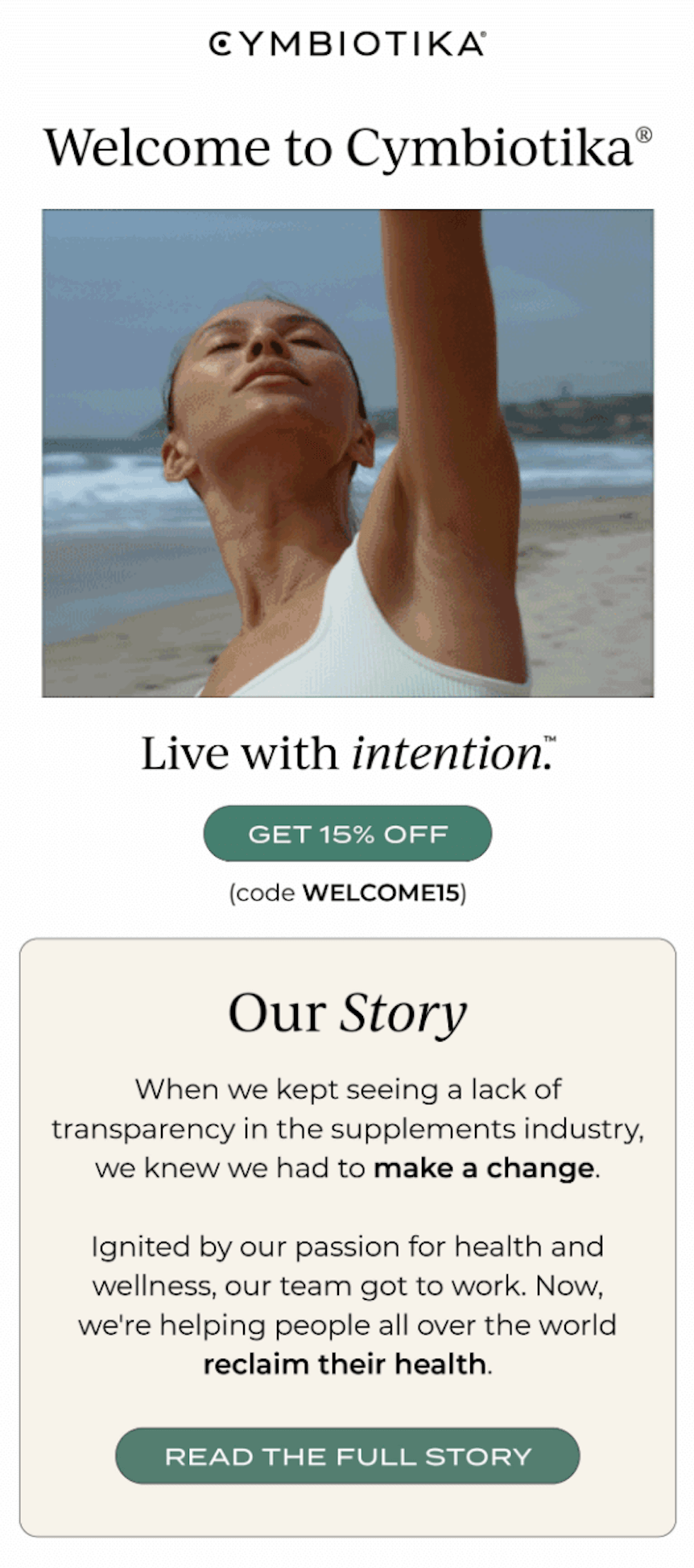
Cymbiotika’s email greets new subscribers with a warm welcome email containing a welcome coupon code and the brand’s story. This is a great way to introduce the brand and intrigue a new subscriber to buy something.
Why is email automation useful?
- Automated flows such as abandoned cart or post-purchase emails generate up to 30 times more revenue per recipient;
- Automated lead nurturing can improve lead conversion rates by 23 percentage points in shorter, less complex sales cycles.
Email automation works while you sleep, making sure no lead or customer slips through the cracks. Set it up using an automation-first email service provider once, regularly review and fine-tune triggers, timing, exclusions based on the results, and let it drive on autopilot.
Here are some marketing automation ideas to help you get started:
- Set up a welcome series. Greet new subscribers with a sequence of emails that introduce them to your brand and offer value;
- Use abandoned cart emails. Recover lost sales by reminding shoppers about items they left behind;
- Nurture leads with drip campaigns. Gradually educate and build trust with potential customers before pushing for a sale.
10. Trigger From What People Do, Not What You Planned
Behavioral triggers send emails based on what subscribers actually do, such as viewing a product, abandoning a cart, clicking a link, or completing a purchase. Instead of following a fixed schedule, these emails respond to specific actions, making the message more timely and relevant.
Automated campaigns based on behavioral triggers work really well to improve conversions. Here’s some proof:
- Automated emails saw 24% higher open rates and 6x higher click rates than manual campaigns;
- Abandoned cart emails had a 39.46% click-to-conversion rate in 2025, meaning nearly four in 10 people who clicked went on to purchase.
Here are some examples of behavioral campaigns that work:
- Browse abandonment. If someone repeatedly views a product but doesn’t add it to their cart, follow up with a relevant reminder rather than an abandoned cart email;
- Cart abandonment emails. If a subscriber adds something to their cart but doesn’t check out, follow up with a reminder or discount. Our help guide on abandoned cart automation walks through the setup. For example, ‘Still thinking about it? Grab 10% off before it’s gone!’;
- Engagement-based sequences. If a subscriber clicks on a link about email marketing templates, send a follow-up email with your top-performing templates or an exclusive guide. For example, “Loved our email template tips? Here’s a free email marketing guide with even more insider tricks!”;
- Post-purchase follow-ups. After a customer buys, send an email thanking them and suggesting complementary products or resources. A gratitude email that thanks and tells them how to get the most out of their product can be a great relationship starter.
11. Ask for Small Commitments Before Big Ones
Micro-commitments move subscribers toward conversion through small, low-friction actions. A click, poll response, quiz, or download gives people an easier first step than an immediate purchase and can make the next action feel more natural.
Micro-commitments work because they trigger the foot-in-the-door effect–a psychological principle where people are more likely to agree to a bigger request after saying “yes” to a smaller one.
The psychology behind micro-commitments:
- The commitment-consistency principle. Once people start taking small steps, they’re more likely to continue taking related actions;
- The sunk cost effect. Once people have invested time, effort, or resources into something, abandoning it can feel like wasting what they’ve already put in;
- Gradual escalation reduces resistance. Low-friction steps feel natural and don’t trigger decision fatigue.
How to use micro-commitments in email marketing?
- Start with curiosity-driven, low-commitment actions. Instead of asking for a purchase immediately, get subscribers to engage first;
- Use interactive elements to drive engagement. Polls, surveys, and quizzes make subscribers actively participate, increasing their investment;
- Progressively increase commitment over time. Follow up with a second email that builds on the previous engagement, leading toward a final purchase.
Design, Capture and Channel
Three things outside the copy decide how far an email gets: how it renders on a phone, how visitors are persuaded onto the list, and how email works alongside social, SMS, and your site. Most subscribers now read on mobile, so that constraint comes first.
12. Build for the Phone First
More people tend to open emails on their mobile devices rather than desktops. Emails that work well on mobile devices are more likely to engage recipients.
— Eunice Asuncion, Content Marketing Specialist at Web.com
Design every email for a phone screen first: responsive layout, subject lines under 50 characters, short paragraphs, and CTA buttons at least 44 pixels so they’re tappable without zooming.
Why does mobile optimization in emails matter?
If your emails aren’t easy to read on a mobile screen, you risk losing readers and clicks.
- 71.5% of consumers say a mobile phone is the device they use most often to check and read email;
- 69% of essential emails were opened on mobile devices;
Responsive design tips to create mobile-friendly emails:
- Use a responsive design. Your email should automatically adjust to different screen sizes;
- Keep subject lines short. Mobile screens cut off long subject lines. Stick to under 50 characters;
- Break up text. Huge paragraphs feel overwhelming on a small screen. Use short sentences, bullet points, and plenty of white space to improve readability;
- Make CTAs big and tappable. Buttons should be at least 44 pixels long so they’re easy to click without zooming in;
- Optimize images and loading speed. Compress images to prevent slow load times. A slow email means lost readers.
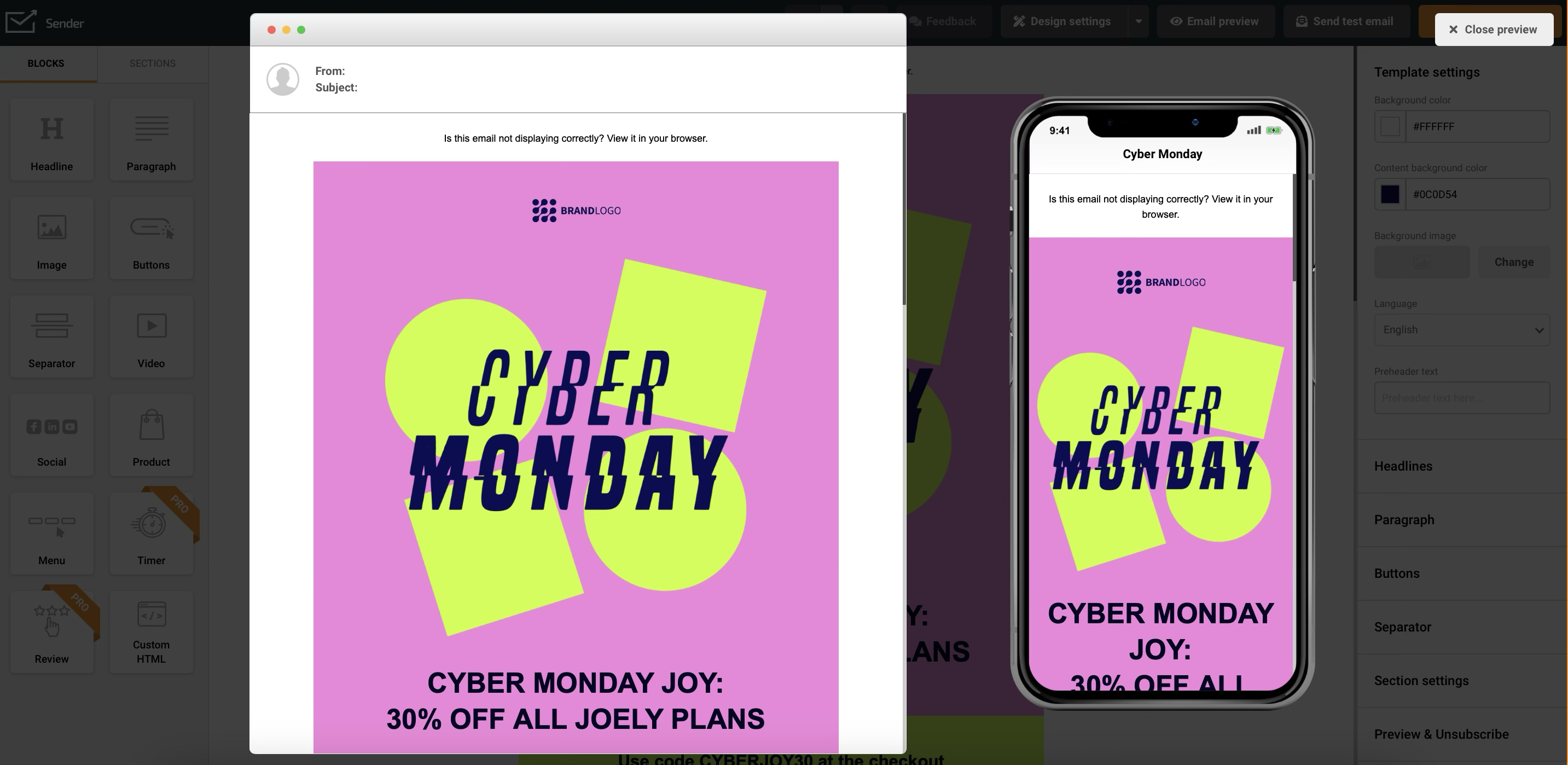
Grab Sender’s responsive email templates and create a beautiful emails in minutes that look sharp on any device.
13. Make Signing Up Worth Doing
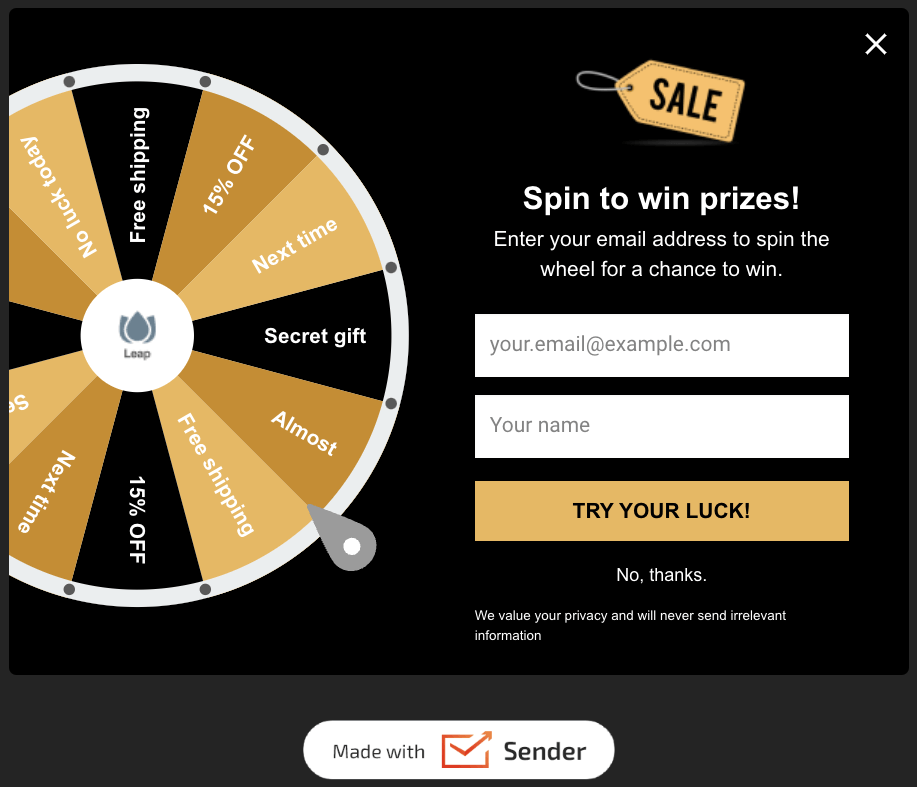
Gamified signup forms make joining an email list more interactive by adding elements such as spin-to-win offers, quizzes, scratch cards, or instant rewards. Interactive content is known to generate more engagement than static content (depending on industry and type of content), giving visitors a stronger reason to participate instead of ignoring a standard signup form.
Instead of a plain opt-in form, turn the signup process into an interactive experience. Think about adding a surprise incentive, like spinning the wheel for extra discounts, or a lead magnet, freebies, or an exclusive gift.
Here’s a great example from Sender:
The psychology behind gamification:
- Instant gratification. People love immediate rewards, making them more likely to sign up;
- Loss aversion. If they feel they might miss out on a great deal, they’re more likely to engage;
- Interactivity increases engagement. Games trigger curiosity and excitement, making users more interested.
Now that you know that adding an element of fun, excitement, and reward can boost your sign-up rate, here are some ideas:
- Scratch & reveal offers. Let users “scratch” a digital card to uncover their prize – a special discount, or a freebie;
- Personality quizzes for signup. Instead of a basic opt-in, guide users through a fun quiz that leads to a tailored offer;
- Countdown challenges. Create urgency by offering limited-time challenges that require email signup, like a limited-time, 48-hour VIP giveaway that requires them to sign up.
14. Run Email Alongside Your Other Channels
If social media is the cocktail party, then email marketing is the ‘meet up for coffee.’ The original 1-to-1 channel.
– Erik Harbison, Chief Marketing Officer at AWeber
Run email as one channel among several: promote your list on social, add sharing buttons to campaigns, run contests across both, and repurpose newsletter content into posts and blog articles.
To truly connect with your audience and drive the results you’re looking for in your marketing, you have to think multi-channel. Email platforms with omnichannel marketing automation built in let you orchestrate email and SMS from one place.
Take these ideas:
- Mention your email list on your social media channels and share an excerpt from the email, inviting followers to subscribe;
- Include social sharing buttons in your emails to let your subscribers grow your reach organically;
- Run omnichannel contests and giveaways. For example, promote your social media contest via email;
- Repurpose your email content across other channels. For instance, convert your newsletters into blog posts or social media status updates.
Know Whether Any of It Is Working
Email marketing only improves when you track the right metrics and KPIs. Open rate and click rate show whether people are engaging, while conversions, unsubscribes, complaints, revenue, and ROI reveal whether that engagement is actually producing business results. Benchmarks are useful for context, but your own historical performance is usually the better reference point for judging progress.
What Is a Good Open Rate for Email Marketing?
A good email open rate is generally around 28–35%, but benchmarks vary significantly by industry, audience, and email type. In 2025, the average open rate across industries was around 31%, so your own historical performance is often a more useful benchmark than a universal target.
For example, automated or highly targeted emails can perform very differently from broad promotional campaigns. Industry averages also range widely, which makes comparing a newsletter in one sector with a promotional campaign in another misleading.
There is another important limitation: open rates are no longer a precise measure of human engagement, and click-to-open rate inherits the same weakness because opens sit in its denominator. Apple’s Mail Privacy Protection can privately download email content in the background, preventing senders from reliably knowing whether someone actually opened a message. This can inflate reported opens, particularly for audiences with a large share of Apple Mail users.
Use open rate as a directional signal rather than your main success metric. Compare campaigns against your own past results, then look at clicks, conversions, unsubscribes, and revenue to understand whether subscribers are actually engaging.
What Is a Good Click Rate for Email Marketing?
A good email click-through rate is generally around 2–5%, depending on your industry, audience, and campaign type. Some research reports an average click rate of 2.62% across all users, while others also place a healthy range at roughly 2–5%.
Click rate measures the percentage of delivered emails that generate a click, making it a stronger engagement signal than opens alone. A subscriber who clicks has gone beyond seeing the message and taken an action on your content, offer, or CTA.
Still, broad benchmarks should only be a reference point. Performance varies substantially by industry: Mailchimp, for example, reports averages of 1.74% for ecommerce, 2.78% for business and finance, and 3.27% for nonprofits.
If your click rate is below your usual benchmark, look at:
- Content relevance. Does the email match what the segment actually wants?
- CTA clarity. Is the next action obvious and compelling?
- Email structure. Are important links easy to find and tap?
- Offer strength. Is there a worthwhile reason to click?
Use industry data for context, but compare campaigns primarily against your own historical click rates and downstream conversions.
15. Test One Thing at a Time, and Keep Testing
Testing helps avoid assumptions and provides data-backed insights. For instance, testing plain-text versions versus HTML emails can lead to surprising results that challenge initial instincts.
— Michael Alexis, CEO of Team Building
Never plan email marketing campaigns based on assumptions, but numbers. If you make decisions based on instinct rather than data, you’re leaving conversions on the table.
A/B testing in email marketing provides the insights needed to optimize and refine your strategies. And we’re not the only ones to say this. According to one study, brands that frequently A/B test their campaigns register up to 83% higher ROI than the ones that don’t.
Here are some elements of an email campaign to split test:
- Subject line testing. Try an urgency-based subject line vs. a question-based one (Example: “Last Chance: 24 Hours Left!” vs. “Are You Missing Out?”);
- Call-to-action (CTA) variations. Test a “Shop Now” button vs. a “Get Your Discount” button to see which drives more clicks;
- Plain text emails vs. HTML emails. Some audiences respond better to minimalist emails, while others prefer richly designed email templates.
The Mistakes That Cancel Out the Gains
Most email marketing advice works only when you apply it in the right context. Push any tactic too far, and the benefit can disappear.
- Segmentation and personalisation are usually better than a batch-and-blast approach, but they can become overcomplicated. You don’t need microsegmentation or dozens of tiny segments if you lack enough data to make them meaningfully different;
- Subject-line optimization cannot rescue a weak email. A strong subject line may earn the open, but misleading curiosity, excessive urgency, or clickbait can damage trust if the message does not deliver on the promise;
- One clear CTA does not mean every email needs to sell. Educational, onboarding, or relationship-building emails may be more effective when the next step is simply to read, reply, explore, or do nothing immediately;
- More automation is not always better. Automate repeatable journeys such as welcomes, abandoned carts, and post-purchase follow-ups, but review them regularly. Outdated triggers, overlapping workflows, or messages that ignore recent customer behavior can create a worse experience than a manual campaign;
- Behavioral triggers need enough context. A product view does not always signal purchase intent, and one missed email does not make someone inactive. Avoid treating every action as a reason to trigger another message;
- Frequency benchmarks are starting points, not rules. Some audiences welcome daily emails; others prefer monthly updates. Your engagement, unsubscribe, complaint, and conversion trends should determine whether to send more or less often;
- Open and click rates do not tell the whole story. Apple Mail Privacy Protection makes opens less reliable, while a strong click rate still means little if those clicks do not lead to conversions, revenue, or another meaningful outcome.
Finally, do not optimize individual campaigns while ignoring the wider relationship. A single high-performing send is useful, but sustainable email marketing comes from consistent value, lead nurturing, testing, and improving the program over time.
When individual tactics start competing with each other, return to the bigger email marketing playbook and judge them against the full customer journey.
Where to Go Next
The tips above can improve individual parts of your email program, but they work best when they sit inside a broader strategy. List growth, segmentation, content, automation, timing, testing, deliverability, and measurement all affect each other, so optimizing one area in isolation only gets you so far.
If you are building or reviewing your email program from the ground up, use our email marketing guide as the next step. It covers the core parts of email marketing in one place, from setting goals and growing your list to creating campaigns, automating customer journeys, measuring performance, and improving results over time.
Use this page when you need practical ways to improve specific campaigns. Use the broader guide when you need to step back, connect those tactics, and make sure your overall email marketing strategy is moving in the right direction.