



SMS marketing is permission-based text messaging sent to subscribers who have explicitly opted in to receive it. Before you send anything, three things need to be in place: express written consent from each recipient, a registered sender number, and a compliant number type for your volume and use case.
What is SMS Marketing?
SMS marketing is permission-based text messaging sent to subscribers who have explicitly opted in to receive it. That’s the entire definition, and every word in it matters. Strip out “permission-based” and you’ve described spam. Strip out “explicitly opted in” and you’ve described a TCPA lawsuit. SMS stands for short message service, the original carrier protocol built around a 160-character limit.
What makes the channel structurally distinct from email or social is a combination of three things:
- Inbox is personal. There’s no promotions tab and no algorithm deciding whether your message gets seen, since mobile phones keep messaging front and center.
- Consent is a hard legal requirement – one of SMS marketing best practices’ rules you don’t want to miss. You can’t buy an SMS list and start texting it the way some teams still buy email lists.
- Format is constrained. A standard SMS is 160 characters, and going over splits the message into multiple billable segments. MMS (multimedia messaging) allows images and longer content but costs more and isn’t always necessary. There’s no way to hide a weak offer behind a clever subject line and a long body.
SMS sits within mobile marketing, one of the categories inside digital marketing broadly, but it carries a stricter consent requirement than most.
The mechanics are straightforward. You sign up with an SMS marketing software like Klaviyo, Attentive, Postscript, or Sender to be able to send A2P messaging. The SMS marketing platform assigns you a sender number (or helps you register one). You collect opt-ins through forms, keywords, or checkout flows.
When you send a campaign, the platform routes your SMS marketing messages through the wireless carriers (Verizon, AT&T, T-Mobile in the US) to your subscribers’ phones.
The number type you send from matters more than most beginners realize. A 10DLC number (10-digit long code, the standard option for most US businesses) requires registration with carriers but offers a familiar local-number look. Toll-free numbers skip some registration friction but throttle throughput. Short codes (the five- or six-digit numbers you see big brands use) deliver high volume fast but cost thousands per month.
The takeaway: SMS isn’t email with a shorter copy. It’s a separate channel with its own rules, its own infrastructure, and its own compliance bar.
Is SMS Marketing Still Effective?
SMS earns close to full visibility for one structural reason: a text lands directly in a phone’s default messaging app the SMS inbox itself, not a folder competing with hundreds of other senders for attention.
Before the benchmarks and channel comparisons, the short version: SMS is the only major channel where you’ve already cleared three of the hardest hurdles in marketing before the message even sends.
SMS Marketing Benchmarks
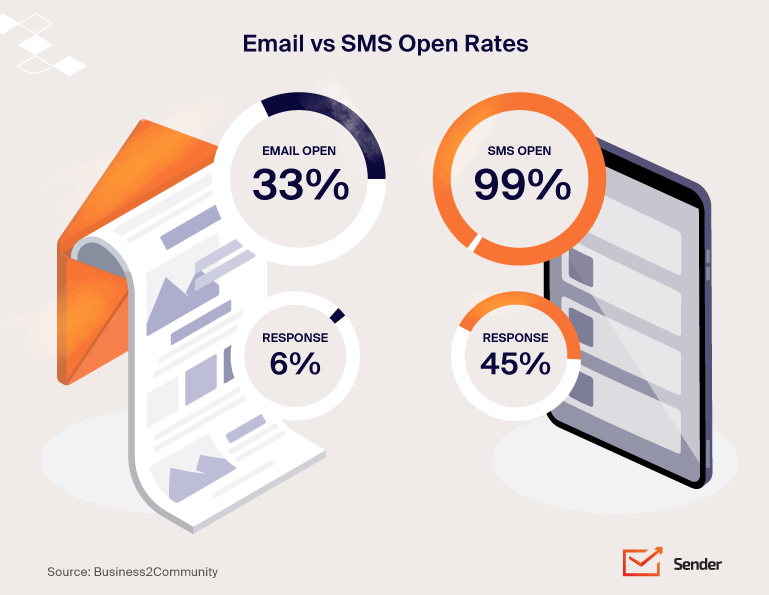
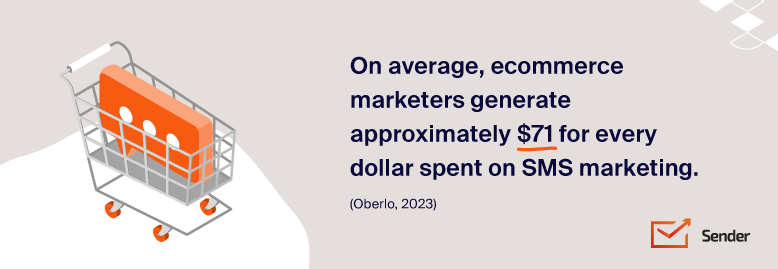
SMS open rates fall between 95% and 99% industry-wide, with a benchmark average around 98% (SimpleTexting, 2025 texting and SMS marketing statistics report), far above email’s 20-25% range. Reply rates average roughly 45%, multiple times higher than any other channel (SlickText, 2024). ROI estimates vary by source and program maturity but typically fall between $21 and $71 for every dollar spent.
Automated SMS earns roughly 5x more revenue per message than broadcast SMS, and converts at roughly 6.5x the rate (0.78% vs. 0.12%), according to Omnisend’s 2026 benchmark analysis of 246 million-plus campaign sends and 20 million-plus automation sends across 27,000-plus brands.
These are table-stakes benchmarks, not claims to defend. If your program isn’t hitting an open rate near 95%, that’s a deliverability or list-hygiene problem – not a creative one. SMS posts the highest open rates of any marketing channel – see our deep dive on SMS open rates for the latest benchmarks.
For broader performance data across CTR, ROI, and conversion, our roundup of SMS marketing statistics has the full set.
When SMS Beats Other Channels
SMS, email, and push aren’t really competing. They’re filling different gaps, and the orchestrated mix is what wins.
SMS scores on immediacy and time-sensitive sends. A flash sale ending in two hours, an appointment reminder, a delivery exception, a fraud alert, a back-in-stock notification on a high-demand product. Anything where read-within-minutes matters is an SMS use case.
Email marketing handles long-form content, nurture sequences, and anything that benefits from formatting, images, or detailed copy. Newsletters, educational sequences, multi-product catalogs, complex offers with terms and conditions. Email’s lower urgency and higher capacity are features, not weaknesses. They’re just different features than SMS offers.
Push notifications need an installed app and an engaged user, which limits the addressable audience to people who’ve already converted past your highest commitment threshold. When push works, it works well. But it doesn’t reach the 80% of your subscribers who have never installed your app.
The structural reason SMS holds up against either alternative: opted-in audience, personal inbox, near-instant read. None of the three is unique to SMS individually. The combination is.
In practice, don’t pick between channels. Pick what each channel does best and let SMS handle the time-sensitive moments the other channels can’t reach in time. Judged next to other marketing channels in isolation, SMS looks narrow. Judged as part of the mix, it fills the gap the rest can’t.
Types of SMS Messages You Can Send
There are four categories of SMS you can send: promotional, transactional, triggered/automated, and conversational/two-way. Most beginner programs lean heavily on promotional and ignore the other three, which is why churn is high, and ROI is lower than it should be. Sending relevant messages for the moment, not just frequent ones, is what keeps a list engaged instead of opting out. The four sections below cover what each type is, what consent it requires, and where it fits.
Promotional SMS
Promotional SMS messages drive a commercial action and are often sent as part of a broader SMS campaign, sometimes as bulk SMS marketing to a full list: sales, product launches, flash offers, restocks, members-only discounts. Anything where the goal is to move product or push traffic to a buying moment.
This is the type with the strictest consent bar. Promotional messages require express written consent from the recipient before you can send a single one, with all the disclosure elements that imply (sender identity, message frequency, data rates, opt-out instructions).
A clean format example:
Sender (Patagonia): Last chance – 20% off all jackets ends midnight tonight. Shop: pat.ag/sale Reply STOP to opt out.
Brand identifier, value, CTA, opt-out. That’s the structural minimum.
Transactional SMS
Transactional SMS messages are triggered by an action the customer themselves took. Order confirmations, shipping notifications, delivery alerts, two-factor authentication codes, password resets, account notifications, and appointment reminders for bookings the customer made.
The consent bar for transactional messages is lower because the customer initiated the transaction. Informational consent (typically baked into your terms of service or checkout flow) is enough. You don’t need a separate marketing opt-in to send someone the tracking number for the order they just placed.
A clean format example:
Sender (Warby Parker): Your order #4429 has shipped. Track: wp.com/t/4429 Expected delivery Thursday.
For a deeper look at how transactional alerts work in practice, see our guide to SMS notifications.
Triggered & Automated SMS
Triggered or automated SMS messages, the core of SMS marketing automation, are sent based on subscriber behavior rather than calendar or campaign timing. Cart abandonment, browse abandonment, post-purchase sequences, welcome series, win-back flows for lapsed customers, trial-expiry reminders, replenishment reminders for consumables.
This is where the revenue gap shows up. An automated SMS flow like this converts at roughly 6.5x the rate of broadcasts, per Omnisend’s 2026 benchmark data, because it hits subscribers at the moment of highest intent or relevance, rather than at a time the marketing calendar said to send.
For beginners, automation is the highest-leverage type to invest in early. A single well-built abandoned cart flow will outperform a year of broadcast experimentation, and once it’s set up it runs without further manual effort.
For extensive information on marketing automation read our marketing automation guide.
A clean format example:
Sender (Patagonia): You left your cart! Here’s 10% off if you finish checkout in the next hour: pat.ag/cart10 Reply STOP to opt out.
Two-Way SMS
Two-way SMS messages are sent where the brand expects, and routes, a reply. Customer support threads, single-question polls, NPS surveys, feedback prompts, and appointment confirmations that ask the customer to text YES or RESCHEDULE.
This is the most underused category relative to its engagement lift. Two-way messages signal that there’s an actual person on the other end, which raises trust and response rates. The catch is that replies need to be handled, which means staffing, SMS automation routing, or templated response logic.
The “conversational SMS” trend is the same idea pushed further: full back-and-forth threads that feel like texting a friend at the brand. It works when the staffing or AI is in place to support it, and it falls flat when replies sit unanswered for hours.
A clean format example:
Sender (Sweetgreen): Thanks for your order! Quick question – how was your bowl today? Reply 1 (great), 2 (okay), 3 (not great).
What are the Rules for SMS Marketing?
Last verified September 2026.
Compliance is the first thing beginners should master because the downside of getting it wrong is severe. TCPA penalties run between $500 and $1,500 per message, which means a single non-compliant broadcast to 10,000 subscribers can theoretically expose you to $15 million in damages.
The 2025-to-2026 regulatory landscape brought real change. In Insurance Marketing Coalition Ltd. v. FCC (11th Cir., 24 Jan 2025), the court vacated the FCC’s one-to-one consent rule, which would have required a separate opt-in for each individual marketer rather than one opt-in covering a list of affiliated sellers.
Virginia SB 1339 took effect 1 January 2026 and requires opt-outs to be honored for 10 years for solicitations to Virginia recipients specifically, not nationally, meaning suppression records for that audience need to be retained long-term. Even teams that were compliant in 2023 need to check whether their compliance policies reflect these changes.
SMS Marketing Laws (TCPA, GDPR)
The TCPA (Telephone Consumer Protection Act) is the primary US federal law governing text message marketing. It covers consent requirements, sender identification, opt-out handling, and quiet hours. Penalties run $500 per violation, tripled to $1,500 for willful violations, calculated per message.
GDPR governs SMS marketing in the EU. Consent must be freely given, specific, informed, and unambiguous. The right to withdraw consent must be as easy as the original opt-in. Implied consent doesn’t qualify, and pre-checked boxes don’t count.
A few other regimes you should know exist if you operate across borders. CAN-SPAM and CCPA (California Consumer Privacy Act), for instance, apply primarily to email but have some relevance to commercial messaging generally, and the National DNC Registry sits alongside TCPA as a separate consent check for voice and, in some interpretations, text.
CASL (Canada’s Anti-Spam Legislation) applies to SMS sent to Canadian recipients and is stricter than TCPA on consent specificity. The UK’s Data (Use and Access) Act received Royal Assent on 19 June 2025 and updated UK data rules post-Brexit, but it did not tighten SMS consent itself; PECR’s underlying consent requirements are unchanged. What the Act raised is the penalty exposure: PECR fines are now aligned with UK GDPR, up to £17.5 million or 4% of global annual turnover, whichever is higher.
SMS Opt-in & Consent
Express written consent for marketing SMS requires four disclosures at the point of opt-in (aligned with CTIA guidelines): who’s sending the messages (your brand name), what kind of messages (marketing, promotional, automated), the expected message frequency, and that message and data rates may apply. You also need a link to your terms and a link to your privacy policy.
A compliant opt-in disclosure looks something like this:
By submitting this form, you agree to receive recurring automated marketing messages (e.g., cart reminders) from [Brand] at the number provided. Consent is not a condition of purchase. Msg frequency varies. Msg & data rates may apply. Reply HELP for help, STOP to cancel. View [Terms] and [Privacy Policy].
The consent bar is different for transactional and informational messages. If a customer places an order, you don’t need separate marketing consent to text them the shipping update. The lower informational-consent bar applies.
Opt-out Rules & Sending Hours
Every promotional SMS must include opt-out instructions like “Reply STOP to unsubscribe.” Carriers automatically recognize the STOP keyword and related terms (UNSUBSCRIBE, QUIT, CANCEL, END) and may block messages before your system processes them.
Opt-outs must be honored in real time. As of 11 April 2025, FCC rules require processing an opt-out request within 10 business days at most, though immediate handling is best practice. A separate “revoke-all” provision (which lets one STOP reply cover every campaign type from a sender rather than just the one it was sent from) was waived to April 2026 and then delayed again on 6 January 2026 to 31 January 2027. Delayed list scrubbing exposes you to TCPA liability for any messages sent after a user opts out.
Quiet hours run from 8 PM to 9 AM in the recipient’s local time zone as the federal floor. Some states set a stricter window (Connecticut’s quiet hours run to 9 AM, for example), and quiet-hour litigation in this area is still unsettled, so check state-specific rules before relying on the federal window alone.
You must disclose message frequency at opt-in (“Msg frequency varies” is standard, but specificity is better).
A key 2026 consideration: Virginia’s SB 1339, effective 1 January 2026, requires opt-outs to be honored for 10 years for solicitations sent to Virginia recipients. That means retaining a suppression list and proof of compliance long-term for that audience. The requirement doesn’t extend to recipients outside Virginia.
10DLC Registration Explained
10DLC (10-digit long code) is the registration system US carriers require for application-to-person messaging on standard 10-digit phone numbers. Without registration, your traffic gets blocked, no questions asked. Carriers require this registration before you can send SMS messages at any real volume.
Registration involves submitting your business identity to The Campaign Registry and getting your A2P 10DLC sending campaigns approved. The operational pain point most teams hit: roughly 55% of registration rejections are paperwork issues.
Here are the alternatives if 10DLC doesn’t fit:
- Toll-free numbers offer lower throughput and setup for low-volume use;
- Short codes provide throughput but are expensive and slow to register.
How to Build Your SMS Subscriber List
List building is the operational version of consent, and where you place the opt-in form is as much a part of your SMS marketing strategy as anything you write in the message itself. Compliance tells you what’s legally required at opt-in. List building tells you where to put the form, what to offer, and how to confirm. The three sections below cover the highest-converting placements, the incentive types that actually move opt-in rates, and the choice between single and double opt-in.
SMS Opt-in Best Practices
Five placements worth knowing about, each with a different conversion ceiling and use case. Getting the placement right gets you targeted messages in front of the right audience without wasting incentive budget on window shoppers.
Pre/Post-purchase checkout is the highest-converting placement for most programs. Trust is highest after purchase, and a checkout opt-in is low friction since the phone number field sits right where the customer is already typing. Expect 30–50% opt-in rates post-purchase; optional pre-purchase fields usually convert lower, around 10–20%.
Website popups are the workhorse for top-of-funnel lead generation. With a moderate incentive, expect 3 to 8% of site visitors to opt in.
Dedicated landing pages built around a single offer convert higher when the traffic source is matched (paid social, influencer, partnership). Think 15 to 30% on warm traffic.
SMS keyword opt-ins (“Text JOIN to 12345”) work well for in-store and out-of-home placements where typing into a form isn’t easy. Conversion depends entirely on signal volume.
In-store/QR codes work best at checkout, packaging, or events. A QR code signup depends on foot traffic, offer clarity, and how easy the scan-to-signup flow feels.
Incentives That Work
Three incentive types move opt-in rates more than anything else:
- Percentage discounts are the workhorse. The 10-15% range is the sweet spot for most ecommerce programs. Below 10%, the lift is marginal. Above 15%, the opt-in rate climbs, but subscriber quality drops.
- Free gift with first order works when the gift has a clear perceived value (a known SKU, not a sample). It tends to attract higher-quality subscribers than discount codes because the customer still pays full price.
- Exclusive or early access to drops, sales, or new products converts well for brands with strong loyalty. It self-selects for fans rather than discount seekers, which is a feature, not a bug, and it tends to build customer loyalty over time.
Single vs. Double Opt-in
Single opt-in and double opt-in differ in when a subscriber is confirmed: single opt-in adds the subscriber to your list immediately on form submission, while double opt-in sends a confirmation text and requires a YES (or similar) reply before adding them.
The trade-off: SMS double opt-in confirmation rates typically run 50 to 80%, meaning the list shrinks by 20 to 50% compared to single opt-in (AudienceTap, 2026), but the subscribers who confirm are, by definition, more committed, which shows up as higher engagement and cleaner deliverability.
In some EU regions, double opt-in is effectively standard because of how strictly GDPR is interpreted on consent. In the US, single opt-in is the norm for most beginner programs and is fully TCPA-compliant on its own.
5 Elements Every Marketing SMS Needs
A good marketing SMS isn’t a short email. It’s a different format with five required elements: brand identification, value proposition, CTA, link (when applicable), and opt-out reminder. The two sections below cover the structural rule (the 160-character limit) and the writing craft (how to fit those five elements into that limit).
The 160-Character Rule
A standard SMS character limit is 160 characters in GSM-7 encoding (the default character set for SMS, covering basic Latin characters, numbers, and standard punctuation). Go over 160, and the message gets split into multiple message segments, each billed separately and sometimes delivered out of order or with delays.
Adding emojis, accented characters, or curly quotes drops you into UCS-2 encoding (the character set that supports a much wider range of symbols and non-Latin scripts, but at a cost), which cuts the per-segment limit to 70 characters. A message with one emoji in it suddenly costs you the same as a 70-character GSM-7 message, and a 161-character message with an emoji becomes a three-segment send instead of a one-segment one.
The sweet spot most data points to: 80 to 120 characters. Promotional broadcast click-through rates in this range track close to the roughly 12% campaign average reported in Omnisend’s 2026 benchmark data, ahead of both shorter messages (which feel curt) and longer ones (which feel like email).
The practical rule: write for one segment, in plain text, and only break the rule when you have a specific reason worth paying for.
How to Write a Marketing SMS
The five required elements, in the order they typically appear:
- Brand identification. Open with your brand name. Recipients don’t store business numbers in their contacts, so a message that starts with “Hi, our spring sale starts now” reads as spam. “Patagonia: spring sale starts now” reads as a brand they opted into.
- Value proposition. One clear benefit. Not three, not “lots of new arrivals plus 20% off plus free shipping over $50.” One.
- CTA. A single specific action. “Shop now” is generic. “Shop the sale” is better. “Browse new arrivals” is best when paired with a link to that exact page.
- Link. Use a shortened URL with a branded subdomain if possible (pat.ag/sale, not bit.ly/3xyz). Branded short links lift CTR because they signal the destination is legit.
- Opt-out reminder. “Reply STOP to opt out” or equivalent. Not optional.
A clean example annotated against the structure:
Patagonia: Last chance – 20% off all jackets ends tonight. Shop the sale: pat.ag/jackets Reply STOP to opt out.
Brand (Patagonia) + value (20% off, last chance) + CTA (Shop the sale) + link (pat.ag/jackets) + opt-out. 110 characters, fits in one GSM-7 segment.
A few writing notes:
Match your brand voice. Brevity isn’t an excuse for being generic. A brand that sounds warm in email should sound warm in SMS, just compressed.
Use urgency only when it’s real. “Last chance” works when the sale actually ends. “Don’t miss out!” on a promo with no end date reads as manipulation and trains subscribers to ignore you.
Personalized messages built on purchase history or browsing behavior consistently outperform generic broadcasts. Personalization beyond first name is where engagement compounds. “Jane, the running shoes you viewed are 15% off today” outperforms “Hi Jane, our shoe sale is on” by a wide margin. First name is table stakes. Behavioral references, tied to how you group and target subscribers, are the upgrade.
Templates by Use Case
Templates are starting points, not finished sends. They cover the structural skeleton (brand, offer, CTA, opt-out) and need to be customized for your voice, audience, and trigger context. A welcome message SMS template that sounds right for a luxury skincare brand will sound wrong for a meal-kit subscription, even though both have the same structural elements.
The most useful template categories to have on hand:
- Welcome (sent immediately after opt-in)
- Promotional broadcast (flash sale, seasonal launch)
- Abandoned cart (the highest-ROI automation in most programs)
- Win-back campaign (for subscribers who’ve gone quiet for 60+ days)
Each of these works as a base you customize, not as a script you copy verbatim.
SMS Marketing Examples & Campaign Ideas
Once you can write a single SMS, the question becomes which messages to send first. The five campaign types below are the highest-leverage starting points for beginner programs: cart recovery, payment lifecycle, order updates, customer service, and surveys.
Abandoned Cart Recovery
A cart recovery SMS is a triggered message sent 30 to 60 minutes after a shopper leaves items in their cart without checking out. It’s the single highest-ROI automation in SMS, with reported recovery rates of 20 to 30% when paired with a parallel email flow.
In ecommerce SMS marketing specifically, cart recovery works best as a second channel alongside an email recovery flow, not as a replacement for it.
The abandoned cart SMS flow structure is simple:
- First message at 30 to 60 minutes: helpful reminder, no pressure, single direct CTA back to the cart
- Second message at 24 hours (optional): an incentive nudge, typically a small discount or free shipping, for shoppers who didn’t return.
A clean example:
Patagonia: Forgot something? Your jacket is still in your cart. Finish checkout: pat.ag/cart Reply STOP to opt out.
Payment Reminders & Confirmations
The payment lifecycle has two paired SMS plays. Payment reminder SMS messages, for instance, are pre-due-date nudges. They work for subscriptions, invoices, BNPL installment plans, utility bills, anything with a recurring or scheduled payment.
Meanwhile, successful payment SMS messages are post-transaction receipts. They confirm the charge went through, name the amount, and reduce the “did this go through?” follow-ups that clog support queues. Confirmations also build trust by making the transaction feel finished.
A reminder example:
Acme Wireless: Your $84.99 bill is due in 3 days on Nov 15. Pay or set up autopay: acme.co/bill
A confirmation example:
Acme Wireless: Payment of $84.99 received. Thanks! Confirmation #44291. View receipt: acme.co/r/44291
Order, Shipping & Delivery Updates
Order, shipping, and delivery updates are the highest-engagement messages in any SMS program. Open rates approach 100% because customers are actively waiting for them. They also reduce support load by answering “where’s my order?” before it gets asked.
The standard sequence covers four events: order confirmation (immediately after purchase), shipped (when the carrier scans the label), out for delivery (morning of), and delivered (with a tracking link or photo).
Each message should include the order number, a tracking link, and the expected next event.
A clean example:
Warby Parker: Your order #4429 is out for delivery today. Track: wp.com/t/4429
Customer Service & Support
SMS isn’t just marketing. It’s a service channel. Use it for ticket acknowledgments, status updates, post-resolution follow-ups, and proactive alerts (delivery issues, outages, billing).
While this overlaps with two-way SMS, it requires different operations. You must handle replies through routing logic, templates, or a staffed inbox. Without a clear plan for who answers, service SMS can create more complaints instead of reducing support load. Handled well, this turns support into a channel that strengthens the customer experience instead of adding another queue to babysit.
For ready-to-use copy across common service scenarios, see our library of SMS templates for customer service.
A clean format example:
Acme Wireless: Your support ticket #8821 has been resolved. Reply if you need anything else.
Surveys & Feedback Requests
SMS surveys are brief: typically one question (NPS, CSAT) or a short 2–3 question micro-survey. Response rates run 40 to 50%, well above email or in-app survey channels, due to low friction and opted-in audiences (Zonka Feedback, 2026 benchmark data). Best timing: 3–7 days post-purchase or immediately after support resolution. Small incentives can boost survey SMS response rates, but aren’t required.
A clean example:
Sweetgreen: How was your order today, on a scale of 1-5? Reply with a number, or share more: sg.co/feedback
Setting Up Your First SMS Campaign
You now know the channel, the rules, the message types, the writing structure, and the use cases. This section sequences all of it into a launch plan.
6 Steps to Launch Your First Campaign
Step 1: Pick a platform and register your sender number. For US programs, complete 10DLC registration (1–2 weeks). Ensure accurate business details – EIN/website mismatches often cause rejections.
Step 2: Set up opt-in collection in one or two high-traffic spots, typically checkout and a website pop-up. Avoid overcomplicating early. Include required disclosures.
Step 3: Build a welcome automation: one immediate message confirming signup, setting expectations, and including an opt-out reminder. Add any promised incentive. Don’t delay the send.
Step 4: Write your first broadcast (80 – 120 characters). Lead with your brand, use a single CTA, and include opt-out language. Target a specific audience tied to an offer – avoid generic blasts or multiple CTAs.
Step 5: Test before scaling. Send to ~10% of your list (ideally your most engaged users). Monitor delivery, clicks, and opt-outs over 24 hours. Don’t skip this step.
Step 6: Review results. If delivery is under 95% or opt-outs exceed 3%, fix issues before continuing. If metrics look healthy, send to the remaining audience.
Common Beginner Mistakes
Skipping 10DLC registration. All traffic gets blocked. Fix: register before you launch, even if it adds a week to your timeline.
Over-sending in week one. Aggressive frequency spikes drive opt-out rates past 3% fast. Fix: cap the first 30 days at 4-6 messages per subscriber.
No brand identifiers. Recipients flag anonymous texts as spam. Fix: start every message with your brand name.
Treating SMS like email. Long copy and multiple CTAs tank engagement. Fix: use one CTA and keep text under 160 characters.
Ignoring real-time opt-outs. Messages sent after a STOP request are TCPA violations. Fix: use a platform that automates opt-outs and audits them monthly.
Measuring SMS Performance
The earlier benchmarks section covered the channel’s industry-wide proof points. This section covers the metrics you track on your own SMS marketing program. The two sections below walk through the core KPIs every program should monitor and the click-through rate benchmarks worth measuring against.
Core KPIs to Track
Five SMS KPIs matter for a beginner program, ordered the way they appear in the funnel.
Delivery rate. The percentage of sent messages that were successfully delivered to a handset. A healthy program runs 95%+. Anything below 95% means you have either a list-quality problem (invalid numbers) or carrier filtering (your sending number is being flagged and blocked by the carrier).
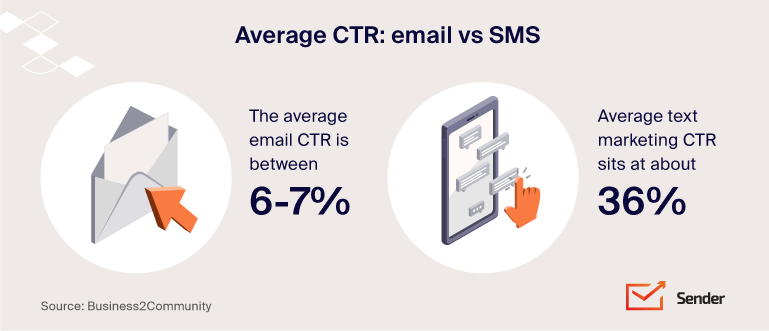
Click-through rate (CTR). The percentage of delivered messages that produced a link click, the main engagement signal for SMS since there’s no open-rate equivalent.
Conversion rate. The percentage of delivered messages that produced a downstream action you care about (purchase, signup, redemption).
Opt-out rate. The percentage of recipients who unsubscribe after a given send. Under 3% per send is healthy. Between 3% and 5% is a yellow flag. Above 5% is a problem with either the message, the targeting, or the frequency.
List growth rate. The percentage increase in SMS subscribers over a given period. Healthy subscriber list growth means your opt-in placements, incentives, and traffic sources are working; flat or negative growth usually means opt-outs are outpacing new signups.
Click-Through Rate Benchmarks
SMS click-through rate is the percentage of delivered messages that produced a click on the included link. It’s the most direct engagement signal you have, and unlike email open rate, it’s not distorted by privacy features or pre-fetching.
The typical ranges, per Omnisend’s 2026 benchmark analysis of 246 million-plus SMS campaign sends and 20 million-plus automation sends:
- Promotional broadcasts: roughly 12% on average, ranging from single digits in slower months to the low 20s during BFCM and December
- Triggered automations (cart recovery, win-back, browse abandonment): roughly 20%, consistent with the same dataset’s 20.34% average automation CTR
- Welcome messages: 14.7% when sent immediately after opt-in (depending on industry)
Four factors move CTR more than anything else:
- Message length
- CTA specificity
- List segmentation
- Send type.
Track CTR by send type, not as a single program-wide number. A 12% CTR is average for a broadcast and concerning for a cart recovery flow. Different audience segments respond to different message types, which is part of why send type moves the number so much.
Choosing Tools & Estimating Costs
You know what to do. Now you need to know what it costs and who to do it with. Costs and tooling here look different from email marketing, where sending itself is close to free at scale and the spend sits mostly in the platform fee. The three sections below cover what to look for in a platform, how SMS pricing actually breaks down, and when outsourcing to an agency makes sense.
What to Look for in an SMS Platform
SMS is one of several communication channels a platform needs to support well, not a feature bolted onto email as an afterthought. The non-negotiables for a beginner SMS marketing platform:
- Built-in 10DLC registration support (guided setup, not carrier handoff);
- Opt-in form and keyword tools (avoid rebuilding capture infrastructure);
- Automation builder for triggered flows (cart recovery, welcome, post-purchase);
- Two-way inbox for replies;
- Documented SMS deliverability and message throughput (real numbers, not claims);
- Native integration with your ecommerce or CRM stack (Shopify, BigCommerce, HubSpot, Salesforce).
AI features only matter if they improve metrics – validate with case studies or A/B testing.
SMS Marketing Pricing
Costs for SMS marketing campaigns break down into three layers: platform fees, carrier pass-through fees, and registration costs. Cost per message in the US typically runs $0.0075 to $0.05, depending on volume tier, number type, and platform. Higher-volume programs negotiate down. Toll-free and short-code sends usually cost more per message than 10DLC. On top of the platform’s per-message rate, carriers apply their own pass-through fees, typically $0.003 to $0.005 per message, which is why a quoted per-message price rarely matches the final invoice line for line.
Monthly SMS marketing pricing ranges from $20 to $500+, scaling with subscriber count and feature tier, which is why SMS marketing for small business usually starts at the bottom of that range. Some platforms (Klaviyo, Postscript) bundle SMS into broader marketing platform pricing, others (SimpleTexting, EZ Texting) sell SMS as a standalone product.
10DLC registration costs are roughly $50 one-time per brand registration, plus $2 to $10 per month per campaign use case. Toll-free verification has its own fee structure. Short codes run $1,000+ per month plus setup.
SMS Marketing Agencies
Hiring an SMS marketing agency makes sense in three situations:
- When in-house teams don’t have copywriting bandwidth, and the program is large enough to justify outsourced creative for ongoing marketing campaigns;
- When the program needs to scale past 50,000 subscribers fast, and the operational lift is more than the team can absorb;
- When ecommerce integrations get complex (Shopify Plus with multiple stores, headless commerce setups, custom CDPs).
Your Next Step
Where you go from here depends on where you are today:
Haven’t sent your first text yet? Start with 6 Steps to Launch Your First Campaign above, and register your 10DLC number before you build anything else. It’s the longest lead time in the whole process.
Already sending broadcasts, ready to add automation? Read our guide to triggered SMS and build an abandoned cart flow first; it’s the single highest-ROI automation covered in this guide.
Trying to fix underperformance or compliance gaps? Work through the opt-out and sending-hours rules above first.
From there, check your program against the Core KPIs to Track to isolate whether the problem is deliverability, targeting, or frequency.