


Lead gen is harder than it was three years ago, and not by a small margin. CPLs keep rising in major paid channels and many industries, with Google Ads CPL alone climbing from $66.69 in 2024 to $70.11 in 2025. Buyers have downloaded enough thin ebooks to spot a bait-and-switch from the homepage. Privacy rules tightened, third-party tracking is more fragmented and less reliable across browsers, and the AI tools that were supposed to fix everything have flooded inboxes to the point that response rates are sliding for the people doing it badly.
The teams winning right now aren’t running more tactics. They’re running better systems built for business growth, not vanity metrics. They’ve connected the pieces other teams treat as separate problems: the magnet that earns the opt-in, the form that captures it, the model that scores it, the sequence that warms it, the metrics that tell them what’s working.
That’s what this guide is. A practical playbook for building lead generation that compounds in 2026, not a checklist of plays you’ll abandon in a quarter.
What Is Lead Generation?
Lead generation is the work of turning strangers into people who’ve handed over their contact details and given you permission to follow up. That’s it. Strip away the jargon and you’re left with a simple exchange: you offer something useful, they give you an email address or phone number, and now you have a pipeline instead of a wishlist.
Online lead generation today runs across multiple channels (your site, social media platforms, email, paid ads, search), and how lead generation works in practice depends on which of those channels your potential customers actually use. The reason lead generation is important to most businesses is simple: without a steady flow of new leads moving through your sales funnel, revenue depends entirely on referrals and luck.
The distinction between three groups matters here, and most teams blur them.
A visitor is anyone who lands on your site, your social profile, your storefront. They might be researching, comparing, or clicking by accident. You don’t know who they are and you can’t reach them after they leave.
A prospective customer is one step closer. Before someone becomes a lead, they’re a prospective customer, a person who fits your ICP (Ideal Customer Profile) but hasn’t yet shared contact info. You might know they exist (a LinkedIn profile, a company on your target list), but you don’t have permission to email them or a reason to expect a reply.
A lead has crossed the line. They’ve filled out a form, downloaded a guide, booked a demo, or replied to a cold email saying “tell me more.” You have their details and, more importantly, implicit consent to keep the conversation going.
Why does any of this matter more in 2026 than it did five years ago? Acquisition costs keep climbing, third-party tracking has fragmented across browsers, and AI tools are reshuffling who actually qualifies as a buyer. Getting lead gen right is no longer optional table stakes. It’s the difference between a business that compounds and one that runs on fumes.
Types of Leads Explained
Not all leads are equal, and treating them like they are is how sales teams burn hours chasing ghosts. There are two ways to sort them, and you need both.
Lens one: where they sit in the sales funnel.
A cold lead has shown the faintest spark of interest, maybe downloaded a free template six months ago and gone quiet since. They know you exist. That’s about it.
A warm lead is engaged. They opened your last three emails, clicked through to a pricing page, attended a webinar. They’re paying attention but haven’t raised their hand.
A hot lead is ready. They booked a demo, requested a quote, replied to your sequence asking how soon you can start. The buying intent is unmistakable.
Lens two: how they got qualified.
A Marketing Qualified Lead (MQL) matches your ICP and has engaged with marketing content in a way that suggests buying interest. Think: a director of marketing at a 200-person SaaS company who downloaded your benchmarks report and signed up for the newsletter.
A Sales Qualified Lead (SQL) has been vetted by a human (or a sharp scoring model) and confirmed as ready for a sales conversation. Budget, authority, need, timing, the basics check out.
A Product Qualified Lead (PQL) has used your product, usually through a free trial or freemium plan, and hit a usage threshold that signals they’d pay for more. A Slack workspace that crosses 50 active users is the textbook example.
You’ll also see service qualified leads in agencies and professional services, contacts who’ve explicitly asked to talk to a human about a paid engagement.
Sorting leads by stage is only half the job. Grading them by lead quality is what keeps your sales team focused on deals that actually close. A pipeline of 500 cold MQLs looks impressive on a dashboard and produces almost nothing in revenue. Twenty warm SQLs will outperform it every quarter. Volume is vanity. Quality pays the bills.
The Lead Generation Process
The lead generation process runs on five connected stages, and each one hands something specific to the next. Break a handoff and the whole thing leaks.
1. Attract. Pull the right people into your orbit through content, ads, SEO, partnerships, events, organic social. Search engine optimization, social media marketing, and paid acquisition all do the same job at this stage: get the right traffic in front of the right offer. The output is traffic that roughly matches your target audience. Generic traffic doesn’t count. You want the marketing director reading your funnel post, not a student writing a paper.
2. Capture. Once someone engages with your offer, the next job is to capture the lead, collect enough contact info to start a relationship without killing conversion with a 12-field form. Email is usually enough. Sometimes a name and company. The output: a contact record with consent attached. This is the moment a visitor becomes a lead, and the data you collect here shapes everything downstream.
3. Qualify. Now you sort. Does this lead fit your ICP? Are they a decision-maker or an intern doing research? Are they buying this quarter or just curious? Qualification can run automatically through scoring models, manually through SDR review, or both. The output: a graded lead with a clear next action: nurture them, route them to sales, or politely deprioritize.
4. Nurture. Most qualified leads aren’t ready to buy on day one. Nurturing keeps you in their field of vision with content that matches where they are in the buyer’s journey, drip emails, retargeting, the occasional human check-in. The output: leads who move from passive interest to active intent, ready to talk to sales.
5. Convert. The final handoff. Sales takes the warmed-up lead, runs the deal, and turns potential leads into paying customers (or learns why it didn’t close, which feeds back into qualification). The output: a customer, plus the data you need to refine every stage above.
Here’s the uncomfortable part. Most pipelines don’t fail because one stage is broken. They fail because the seams between stages are loose. Marketing and sales teams celebrate an MQL, sales ignores it for a week, the lead goes cold, and everyone blames the other team. The rest of this guide is mostly about tightening those seams.
Lead Generation Strategies That Work in 2026
Strategy is a portfolio decision, not a tactic hunt. The teams winning right now aren’t the ones chasing whichever channel went viral on LinkedIn last week. They’re running two or three channels deeply, with clear handoffs between them, and ignoring the rest.
A successful lead generation strategy starts by mapping where your buyers actually spend time, what your team can execute well, and how patient your runway is. Effective lead gen strategies in B2B lead generation almost always span multiple channels (content, email, paid, outbound) rather than betting everything on one.
For a full breakdown of plays by channel, budget, and funnel stage, see our guide to lead generation strategies.
Inbound vs. Outbound vs. Hybrid
Inbound marketing pulls buyers to you through content, SEO, and organic presence. HubSpot built a billion-dollar company on it. Slow to start, compounds for years.
Outbound lead generation pushes you to buyers through cold email, LinkedIn outreach, and direct outreach by phone. Gong’s early growth was textbook outbound. Fast, targeted, expensive per touch.
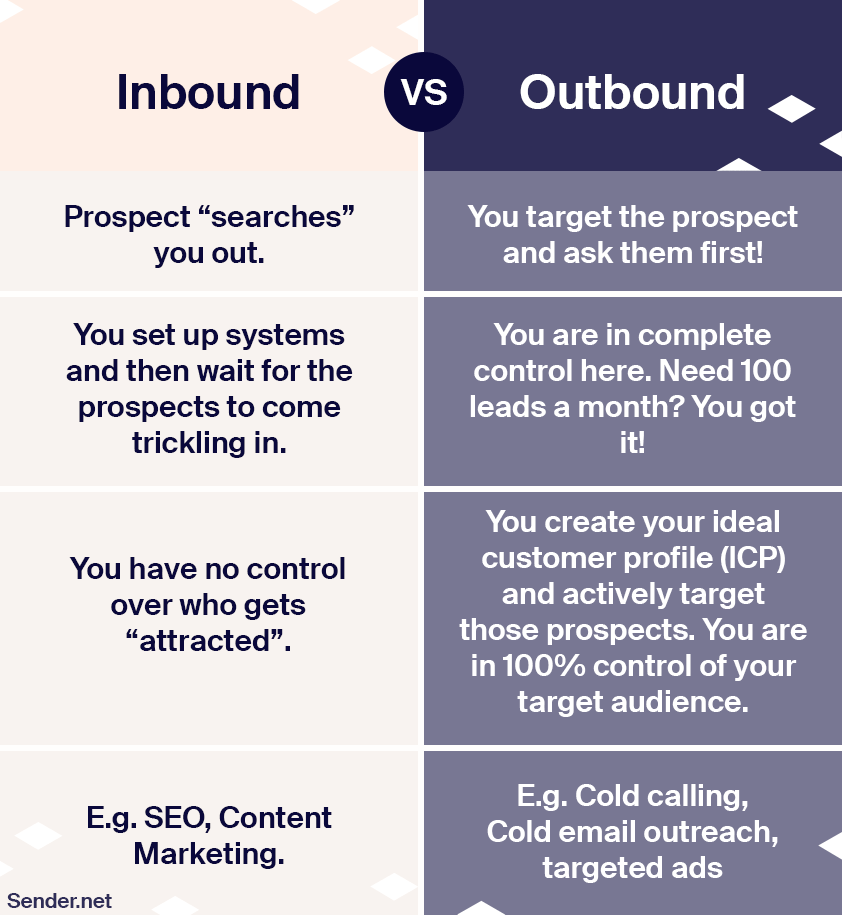
Hybrid runs both, with one feeding the other. Most mature programs end up here: inbound builds the brand and demand generation, outbound closes the gaps in the pipeline.
The decision rule: if you need pipeline this quarter, start outbound. If you’re playing the long game and have 9-12 months of patience, start inbound. If you have both budget and time, run hybrid from day one.
AI-Powered Lead Generation
The shift in 2026 isn’t subtle. We’ve moved from AI-assisted lead gen, where humans stay in the loop on every email and every list, to AI-agentic, where systems handle research, outreach, and follow-up on their own and only flag humans when something interesting happens.
Where AI clearly wins right now: ICP refinement (cluster your best customers and find lookalikes in minutes), intent signal detection (job changes, funding rounds, tech stack shifts), personalization at scale (custom first lines for 500 prospects without a sweatshop), and speed-to-lead (replying in under 60 seconds, every time). Done well, AI helps you generate high-quality leads instead of just more of them.
The failure mode is predictable. Teams crank up volume, skip qualification, and torch their domain reputation in a week. AI multiplies whatever process you give it, including the broken parts.
We’ve covered the full stack, tools, prompts, and workflows in our deep dive on AI lead generation.
Email Lead Generation
Email is the channel that connects capture to conversion, and unlike your social following or your ad accounts, it’s the one asset you actually own. Algorithms can’t deplatform a list you’ve built.
The core plays haven’t changed much, just gotten sharper. List-building offers (lead magnets, gated tools, newsletter incentives) get people on the list. A welcome sequence introduces you, sets expectations, and identifies who’s worth pursuing. Segmentation splits your list by behavior and intent so the marketing director and the curious freelancer don’t get the same email. Behavior-triggered sends (cart abandonment, demo no-shows, content re-engagement) catch people at the moment of highest intent. Email marketing, used this way, is one of the most reliable lead generation methods on a per-dollar basis.
Cost-per-qualified-lead on email marketing still beats paid in most categories in 2026, mostly because paid acquisition costs keep climbing while a clean list keeps performing.
The full playbook, from list-building to deliverability, lives in our guide to email lead generation.
Industry Spotlight: Real Estate
Strategy shifts hard by vertical, and real estate is a clean example. National SEO is mostly a waste of budget for an agent in Austin. Local SEO isn’t. The plays that move the needle: ranking for neighborhood-specific searches (“Tarrytown homes for sale,” “Mueller condos under 600k”), publishing relevant content tied to local market reports, optimizing the Google Business Profile with recent photos and reviews, and answering inquiry forms in under five minutes.
Speed-to-lead in real estate is brutal. The often-cited finding is that leads contacted within 5 minutes are roughly 9x more likely to convert than those contacted after 30 minutes, and while the original research is older, recent operators continue to validate the pattern.
The framework holds. The channels change. For a channel-by-channel playbook, see our lead generation ideas for real estate.
Lead Magnets: Your Capture Hook
A lead magnet is the value exchange that turns anonymous traffic into contact records. Someone gives you their email; you give them something worth more than the email. If that math doesn’t work, your form sits there collecting dust.
The formats that still earn opt-ins in 2026 are the ones that solve a small, specific problem fast and speak to real pain points:
- Checklists work because they compress expertise into something scannable.
- Templates work because they remove the blank-page tax (think: a cold email template pack, a campaign brief, a pricing model in Google Sheets).
- Calculators and interactive tools have quietly become the highest-converting format in B2B because they produce a personalized output, ROI estimate, salary benchmark, sizing recommendation, that the reader can actually use.
- Mini-courses delivered over email work for considered purchases where trust takes a few touches to build.
- Gated reports still pull, but only when they contain valuable insights from original data, not a rehash of the same five stats everyone else cites.
What’s losing ground:
- The generic 40-page ebook on “everything you need to know about X.”
- The thin five-page PDF that’s clearly a blog post in a different costume.
- The “ultimate guide” that’s neither ultimate nor a guide.
Buyers have downloaded enough of these to recognize the pattern, and they’ve stopped trading their email for content they could have skimmed in a Google search.
Three tests every magnet has to pass before you ship it:
- Specific to one pain. “Marketing tips for small business” fails. “The 12-email welcome sequence for Shopify stores under $1M” passes. The narrower, the better.
- Delivers valuable content in under five minutes. If someone has to block off an afternoon to get the payoff, they’ll save it for later and never open it. Under five minutes from download to “huh, that was useful” is the bar.
- Aligned with what you actually sell. A magnet that attracts the wrong audience produces a list that won’t convert. If you sell enterprise CRM software, a free Instagram caption template will fill your list with people who’ll never buy.
Match the magnet to the funnel stage. Top-of-funnel magnets are quick wins for cold audiences (checklists, calculators). Mid-funnel magnets help comparison shoppers decide (buyer’s guides, vendor scorecards). Bottom-of-funnel magnets are decision tools (free trials, audits, sample reports). Mismatch the stage and conversion rates collapse.
For a full breakdown of formats, examples, and creation workflows, see our guide to building a lead magnet that converts.
Lead Capture Mechanisms
Capture mechanisms are the on-page surfaces that turn magnet interest into contact records. Three matter most: dedicated pages, popups, and lead capture forms embedded across your site. Most teams treat these as a pick-one decision and pick wrong. You need all three working together. The page closes deliberate visitors, the popup catches the ones about to leave, and forms scattered across the site capture the ones who weren’t looking but ended up interested anyway.
Landing Pages and Squeeze Pages
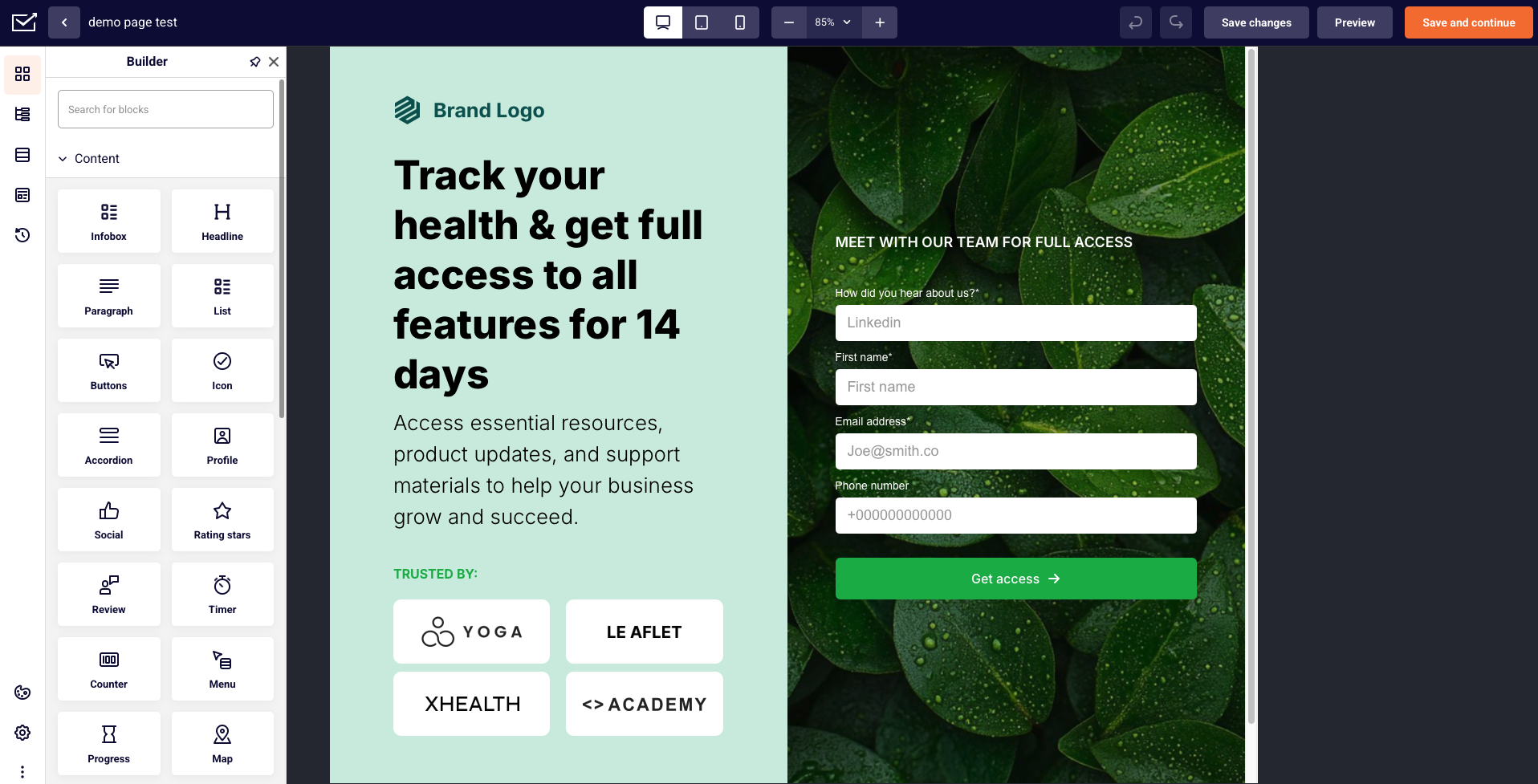
A landing page has one focused goal and multiple sections to support it: hero, benefits, social proof, FAQ, CTA. A squeeze page is the stripped-down cousin of a landing page, one offer, one form, zero distractions. No nav, no footer links, no “learn more about us.” Squeeze pages convert harder for cold paid traffic. Landing pages do better for warm traffic that wants to research before opting in.
The fundamentals that move conversion:
- Headline clarity. The reader should know what they’re getting in under three seconds. “Get the 12-email welcome sequence template” beats “Unlock your email marketing potential” every time.
- Offer above the fold. If they have to scroll to see what they’re signing up for, you’ve already lost half of them.
- Social proof near the CTA. Logos, testimonials, download counts. The closer to the button, the better.
- One CTA, repeated. Don’t make people choose between three buttons. Make the same ask three times down the page.
- Mobile load speed. Aim for 0-2 seconds. Conversions drop sharply as load time rises, and the gap between fast and average pages widens every year.
What’s “good”? Average landing pages often convert around 4-5%, while top performers exceed 10-11%. If you’re wondering what to aim for, our roundup of landing page statistics has current benchmarks by industry.
Popups That Convert
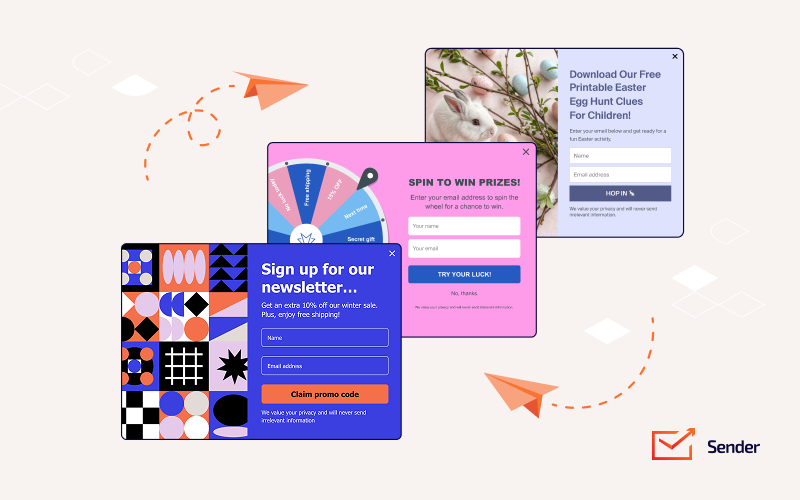
Popups are a high-intent capture surface when you trigger them right and a conversion killer when you don’t. The difference comes down to timing.
Triggered correctly (exit intent, scroll past 50%, time-on-page over 30 seconds), a popup catches someone at a moment of decision: leaving, finishing an article, lingering on a product page. Triggered badly (immediate, full-screen, no visible dismiss), it earns nothing but a back button.
The main types worth knowing:
- Newsletter optins for content sites and blogs.
- Exit-intent popups that fire when the cursor heads for the close button. Lower-pressure, higher-converting than entry popups.
- Gamified popups like spin-the-wheel offers, which work well for ecommerce because the mechanic raises the perceived value of whatever’s behind the spin.
- Announcement bars for promotions and product launches that need attention without blocking the page.
Two rules separate the 8%+ converting popups from the ones people screenshot for hate-tweets: relevance to the page content (don’t pitch a B2B template on a recipe blog) and a dismiss option that actually works on first click.
For design inspiration, we’ve pulled together newsletter popup examples from brands doing it right. For ecommerce specifically, a spin-the-wheel popup often outperforms standard optins because the game mechanic raises the perceived value of the discount.
Signup Forms and Email Capture
A signup form is your most common lead gen form, and it’s where the trade-off between list size and list quality plays out in real time. Three variables govern conversion:
- Field count. Fewer fields means higher submit rate, lower lead quality. Email-only forms convert hottest but produce a list that needs heavy enrichment later. Five-field forms produce sales-ready leads at a fraction of the volume. Pick based on what your sales reps can handle.
- Placement. Inline forms inside content convert best for engaged readers. Sidebar forms catch the skimmers. Footer forms pick up the determined. Modal forms fire on intent. Use multiple placements; don’t bet on one.
- Incentive clarity. Generic newsletter forms (“Subscribe to our newsletter”) usually underperform specific, outcome-driven offers. “Get the weekly teardown of one viral landing page, with annotations” converts harder because the reader knows exactly what hits their inbox.
Stop thinking about email capture as a single form. Think of it as a system: multiple touchpoints across the site, each catching a different audience segment, all feeding cleanly into your ESP with proper tagging so you know where every contact came from.
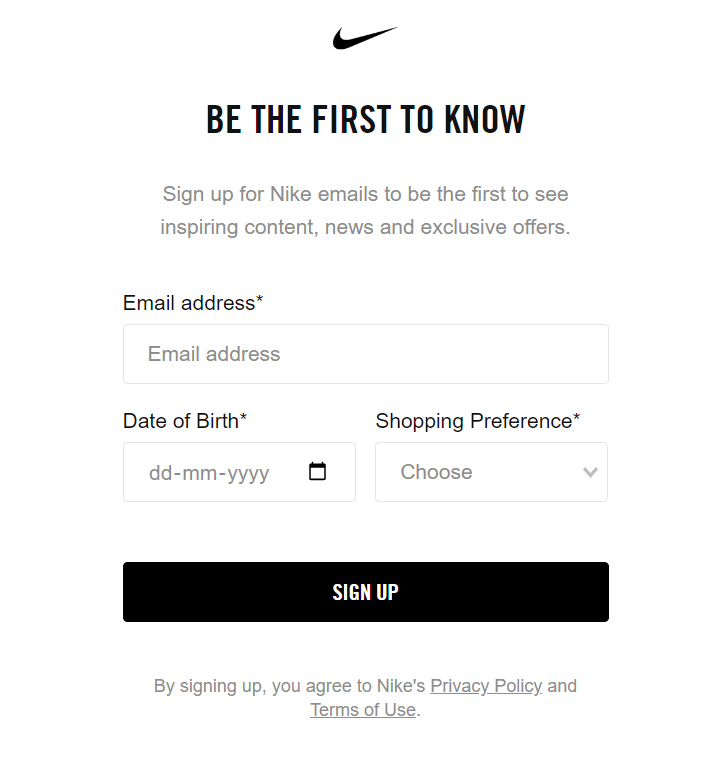
For the strategic view on how to build a capture system across your site, see our guide to email capture. If you want design patterns specifically, our roundup of high-converting email newsletter signup forms shows what’s working in 2026.
For the incentive side, what to offer and how to phrase it, our guide to email subscription best practices covers the mechanics that drive submit rates.
Choosing Your Lead Generation Tools
Tool selection is a category problem, not a shopping list. You need one capable tool per job: one for lead gen software, one for forms, one for popups. Not ten overlapping ones bleeding budget and confusing your data. Most small teams over-buy and under-integrate, ending up with five tools that each do 60% of what they need and none of which talk to each other.
A handful of teams skip the build and outsource everything to a lead generation company; that works for outbound at scale but rarely solves the inbound side. The three categories below cover what most businesses actually need to build their own lead generation engine.
Lead Generation Software
“Lead gen software” gets used as a catch-all, which makes it useless as a category. Here’s the cleaner line: lead gen software is the layer that captures, qualifies, and routes leads. It’s not your CRM (that’s where deals live after sales takes over), not your ESP (that’s where you send the emails), and not your analytics tool (that tells you what happened, not who did it).
Four criteria matter when you evaluate options:
- Integration depth. Native connectors to your CRM, ESP, and ad platforms. Zapier-only integrations are a yellow flag for anything you’ll run at volume.
- Compliance posture. GDPR and CCPA support out of the box, plus consent management you don’t have to bolt on later.
- Pricing model. Per-contact pricing punishes growth. Flat or tiered usage pricing scales better.
- AI and automation. Lead scoring, intent detection, and routing logic built in, not duct-taped via third-party tools.
Small teams should pick one tool that captures and scores well. Enterprise teams need depth on routing, attribution, and compliance, and should expect to pay for it.
For a category-by-category breakdown with current pricing and use-case fit, see our roundup of the best lead generation software.
Form Builders and WordPress Plugins
Form builders split into two camps, and you probably need one from each.
General form builders are standalone SaaS tools that work across platforms. You build a form once and embed it on a landing page, a Webflow site, a Shopify store, wherever.
WordPress-native plugins live inside your WordPress install, render fast, and integrate with the rest of your WP stack (membership plugins, ecommerce, custom post types).
The selection criteria are similar across both:
- Conditional logic. Show field B only if the answer to field A is X. Critical for qualification forms.
- Spam handling. Honeypots, reCAPTCHA, behavioral filtering. Without it, your sales team chases bots.
- ESP integrations. Native sync to your email tool, with proper tagging so you know which form produced which contact.
- Mobile rendering. Over half of submissions happen on mobile. Forms that break on small screens kill conversion silently.
- Conversion analytics. Submission rates, field-level drop-off, A/B test support.
Most businesses need one general builder for landing pages and one WordPress plugin for site-wide forms, not both doing everything.
If you’re evaluating across platforms, our comparison of the best form builders ranks the top options by use case. WordPress users have tighter native choices, see our picks for the best form builder for WordPress, and for the most common job specifically, the best contact form for WordPress.
Popup and Optin Tools
Popup tools are a separate buy from form builders, even though every form builder claims popup features. The difference shows up in trigger logic (exit intent, scroll depth, cart value), analytics (impression-to-conversion ratios, dismiss tracking), and pricing (usually per-impression rather than per-contact).
Two buying paths:
- WordPress-native popup plugins are lighter, cheaper, and integrate with your existing WP install. Good fit if you’re WP-only and your traffic is under a few hundred thousand visits a month.
- Standalone email collection platforms offer stronger targeting (geolocation, referrer, behavior) and work across any CMS. Worth the extra cost if you run multiple sites or need precise audience segmentation.
The one integration check that matters: does it sync cleanly to your ESP, with tagging that survives the handoff? If contacts land in your email tool without source data attached, you’ve lost the most useful piece of information about them.
For WordPress sites specifically, our picks for the best WordPress popup plugin cover both free and premium options.
If you’re on a different CMS or need cross-platform capability, see our deep dive on how an email collector works end-to-end.
Lead Scoring and Qualification
A lead scoring system is the bridge between marketing capture and sales action. It’s a numerical setup that ranks leads by likelihood to convert, so your sales team spends time on the deals that actually close instead of working a list alphabetically and hoping. Without it, every lead looks equal in the CRM. They aren’t.
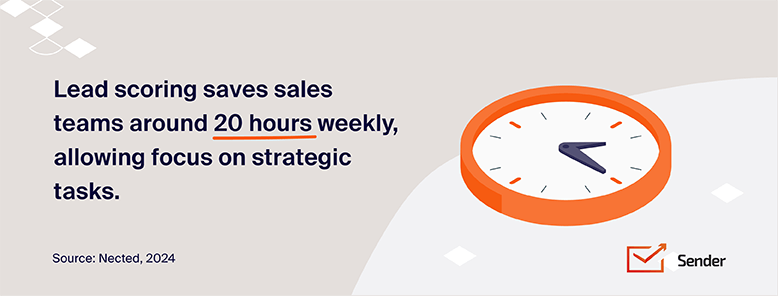
Two input types feed a scoring model.
Explicit criteria are the things leads tell you directly through form fields, enrichment data, or sales conversations. Job title, company size, industry, budget range, geography. A VP at a 500-person SaaS company gets more points than a freelancer browsing for ideas. These criteria answer “is this person a fit?”
Implicit criteria are behavioral. Pages visited, emails opened, content downloaded, demo requested, pricing page bounced from twice in a week. These answer “is this person interested right now?” A perfect-fit prospect who hasn’t opened an email in three months is colder than an imperfect fit who just spent 20 minutes on your case studies.
A simple model looks like this:
- Visited pricing page: +15 points
- Opened last 3 emails: +10 points
- Downloaded a bottom-funnel asset (buyer’s guide, ROI calculator): +20 points
- Job title matches ICP (Director and up): +25 points
- Company size in target range: +15 points
- Used a free email domain (gmail, yahoo): -10 points
- No engagement in 30 days: -15 points
Set a threshold, say 75 points, where a lead becomes an SQL and gets routed to sales. Anything below stays in nurture until it crosses the line or goes stale.
Here’s the part most teams skip. Scoring models drift. Your ICP shifts as you move upmarket. New content changes which behaviors signal real intent. The actions that predicted closed-won deals last year stop predicting them this year. Pull your closed-won and closed-lost data quarterly, see which signals actually correlated with revenue, and adjust the weights. A model you set and forget will quietly stop working in about six months.
For a step-by-step walkthrough of building a model, including point values, thresholds, and common mistakes, see our guide to lead scoring.
Lead Nurturing: Turning Leads Into Customers
Nurturing is the work that happens between capture and conversion, and most leads aren’t ready to buy when they first show up. They show up curious, distracted, comparing options, waiting for budget, or just learning the category.
Here’s why nurturing is the highest-leverage fix for most marketing teams: capture problems are visible. You see the form submission count every Monday. Nurture problems hide. They show up as a slow drift in the conversion rate from MQL to SQL, a number nobody on your team is looking at closely enough to act on. Teams pour budget into more capture, hit the same conversion wall, and never investigate the middle of the funnel where the actual leak lives.
A nurture program does four jobs. It educates leads about the problem and your approach. It builds trust through consistent value, social proof, and useful content that doesn’t pitch on every send. It surfaces buying signals so you know who’s warming up and who’s drifting away. And it hands leads off cleanly to sales at the right moment, with context attached.
The three subsections below cover how to build the sequence, what software runs it, and the data that justifies the work. We start with sequence design, because the first principle of nurturing is also the easiest to break: the gap between capture and first touch is where most pipelines bleed value.
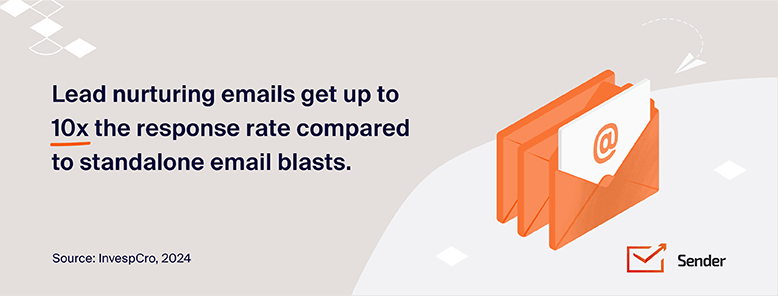
Building a Nurture Sequence
A nurture sequence has four parts.
Trigger: what puts a lead into the sequence. A form submission, a specific download, a behavioral threshold like three pricing page visits in a week. Different triggers should fire different sequences. A whitepaper downloader and a demo no-show are not the same person.
Cadence: how often you send. The first email fires within minutes (more on that below). The next two or three land within the first week. After that, weekly or biweekly until the lead converts, exits, or hits a stop point.
Content mix: roughly 70% educational, 20% social proof, 10% offer. Sequences that pitch every email train people to ignore them. The goal is to engage leads and engage prospects with content that actually maps to where they are in the customer journey, not blast them with promos.
Exit condition: what removes a lead from the sequence. Purchase, unsubscribe, sales handoff, or hitting a stale-lead threshold (no opens for 60+ days).
Segmentation turns generic nurtures into relevant ones. Split by lead source, behavior, and funnel stage. The freelancer who downloaded a checklist and the VP who requested a demo should not be on the same drip.
Speed-to-lead is the rule that overrides everything else. The first follow-up fires within minutes, not hours. Response rates collapse with every passing hour after capture.
For a deeper walkthrough on sequence architecture, see our guide to lead nurturing.
Nurturing Software and Automation
Nurture automation isn’t the same thing as a basic email tool with a scheduled send. The features that actually separate them: behavioral triggers (fire a sequence when someone visits the pricing page twice), multi-step workflows with branching logic (if they open email 2, send path A; if they don’t, send path B), CRM sync that updates lead records in real time, and reporting that breaks performance down by segment, not just by send.
Selection criteria that matter:
- Visual workflow editor. If you can’t map the sequence on screen, you can’t debug it.
- Integration depth. Native sync with your CRM and forms. Webhook-only integrations break at scale.
- Reporting granularity. Per-step open rates, drop-off points, conversion attribution.
- Cost at your list size. Per-contact pricing gets brutal past 10,000 contacts.
Most small teams don’t need enterprise marketing automation. A capable ESP with built-in automation handles 90% of the job at a fraction of the cost. For a category comparison with pricing and use-case fit, see our roundup of the best lead nurturing software.
What the Data Says
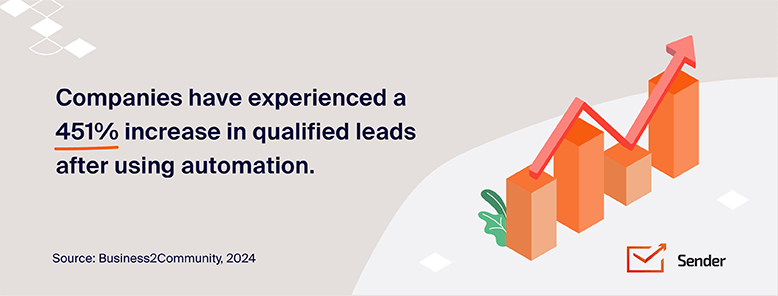
A few numbers worth keeping in your head, with the caveat that the most-cited nurture stats trace back to older Annuitas, Forrester, and DemandGen research that recent posts keep recycling. Treat them as legacy benchmarks, not 2026 measurements:
- Nurtured leads have historically produced around 47% larger purchases than non-nurtured ones in B2B studies.
- Companies that excel at lead nurturing have generated 50% more sales-ready leads at 33% lower cost per lead in widely-cited Forrester data.
- Segmentation and personalization generally outperform generic broadcasts on open rates, click rates, and conversion, even though the exact multiplier varies by source.
These aren’t rounding errors. Even the conservative read is the difference between a pipeline that compounds and one that needs constant top-of-funnel feeding to stay alive.
For the full set of current benchmarks by industry and channel, see our roundup of lead nurturing statistics.
Lead Generation Metrics and Benchmarks
Track four metric categories. Anything else is noise.
Volume metrics count what’s coming in: leads per channel, form submission rate per landing page, organic traffic to capture pages, paid traffic conversion rate. These tell you whether the top of the funnel is working and whether your overall marketing efforts are pulling weight.
Quality metrics count what’s worth keeping: MQL-to-SQL conversion rate, lead-to-opportunity rate, lead-to-customer rate. A team generating 1,000 leads a month with a 2% close rate is doing worse than one generating 200 leads with a 15% close rate, even though the first dashboard looks prettier.
Cost metrics count what it takes to get there: cost per lead (CPL), cost per qualified lead, customer acquisition cost (CAC), and the LTV-to-CAC ratio that tells you whether the math works long-term.
Velocity metrics count the time it takes: speed-to-lead (capture to first touch), time-to-qualify (capture to SQL), sales cycle length. Slow velocity quietly tanks pipelines that look healthy on volume.
One trap to avoid: last-click attribution underreports nurture and content. A reader who converts from a retargeting ad likely touched five or more assets first. If you credit only the last click, you’ll cut the channels that actually built the trust and double down on the ones that just collected the signature. Lead generation results should be measured across the full path, not the last touch.
Rough benchmarks for sanity-checking: B2B CPL commonly ranges from tens of dollars to several hundred, depending on industry and channel, with Google Ads averaging around $70. MQL-to-SQL often lands around 13-21% in broad B2B benchmarks, and lead-to-customer rates typically sit in the low single digits.
For current benchmark ranges by industry, channel, and company size, see our roundup of lead generation statistics.
Conclusion
Lead generation isn’t a stack of tactics. It’s a connected marketing strategy: a magnet that earns the opt-in, a capture surface that collects it, qualification that ranks it, nurture that warms it, and measurement that tells you what’s actually working. Pull on any one piece in isolation and the others quietly fall out of sync. That’s effective lead generation in a single sentence.
If you’re trying to figure out where to put your next hour of work, the answer is almost never “more traffic.” The highest-leverage fix usually sits in the middle of the funnel: tightening speed-to-lead so your first touch lands in minutes instead of days, and rebuilding the nurture sequence that’s been running on autopilot since 2023. Most teams are sitting on a real lift hidden in the gap between capture and conversion. They just haven’t looked.
A few directions worth going deeper on, depending on where your gaps are:
- If your capture rate is the problem, revisit your lead magnet against the three tests in this guide, then audit your forms for fields you don’t actually need. Solid lead generation best practices start with attracting leads who actually fit, not just more leads.
- If your conversion rate is the problem, the issue is usually nurture timing or segmentation, not subject lines. Match content to the customer journey and watch what happens when you start generating leads that actually move.
- If your cost per lead is climbing, your channel mix probably needs rebalancing. Lean harder on owned channels (email, search engine optimization, social media channels you control) and pull back on rented ones. Social media posts on LinkedIn and Reddit, used to attract leads through expertise rather than pitch, often outperform paid ads on a per-dollar basis once you’ve built an audience.
If you’re running WordPress and want to go beyond contact forms, into surveys, payment forms, and advanced optin logic, our roundup of WordPress form plugins covers the full ecosystem.
Build the system. Measure the seams. Fix what leaks. Done well, that’s what eventually leads a curious visitor to become a paying customer, and what keeps your lead generation efforts compounding instead of resetting every quarter.